






NextFin News -- Late one night in June 2026, a partner at a USD-denominated fund reposted the news on WeChat Moments about Qianxun Intelligence’s A+ round—raising 1.5 billion yuan—and commented in just a few words: “Can’t afford to play.”
He deleted the post soon after. But those three words were enough to capture how the rules of the embodied intelligence race changed in the first half of 2026.
According to domestic investment and financing data for embodied intelligence and robotics in the first half of 2026 (source: ITjuzi), there were 288 funding events involving 226 companies and 274 investment institutions, with disclosed financing exceeding 46 billion yuan.
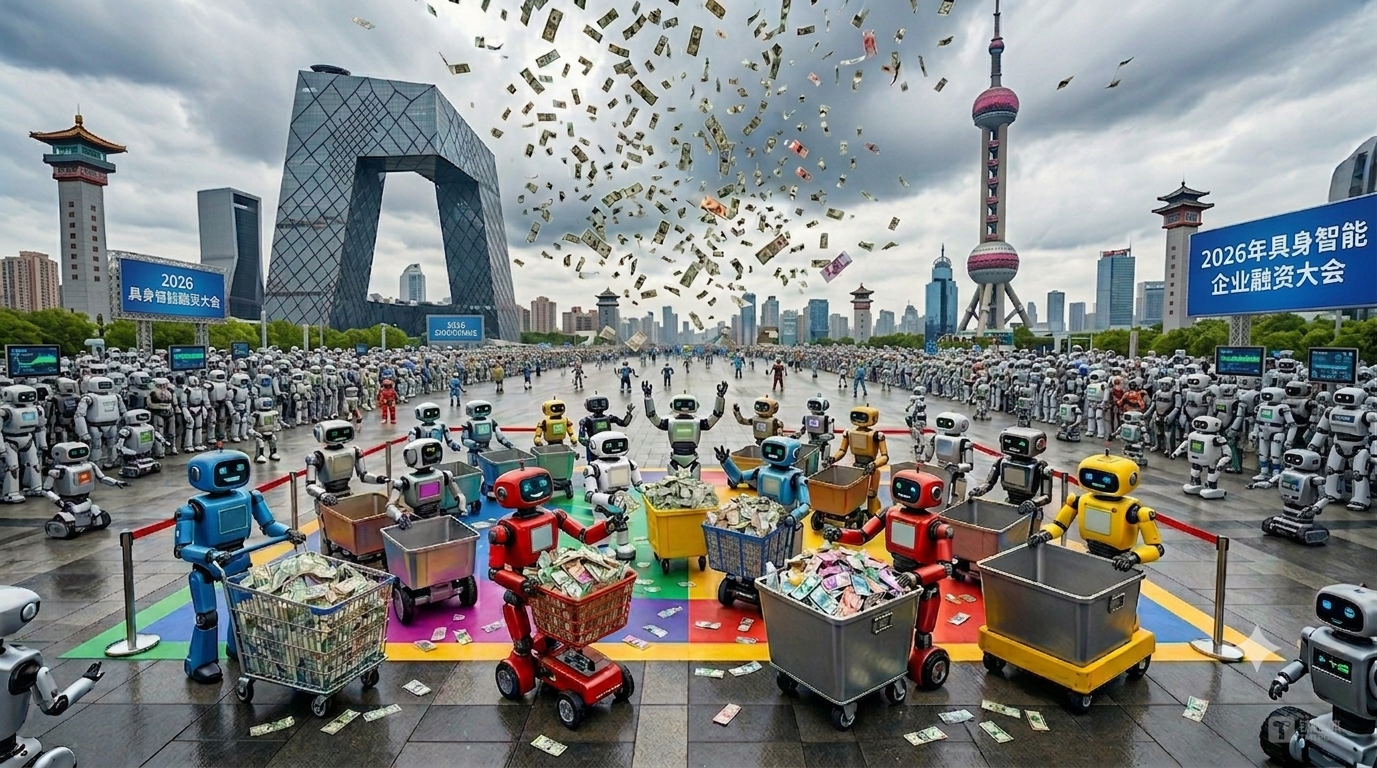
Yet the way that 46 billion yuan was distributed was extremely imbalanced: among the top 10 companies by funds raised, the top five took about 17 billion yuan, the next five got about 7.2 billion yuan, and the remaining 200-plus companies split roughly 12.4 billion yuan.
Qianxun Intelligence was one of the brightest stars in this capital feast: three rounds in four months, 4.5 billion yuan in total. In other words, one leading company’s half-year haul equaled roughly one-third of what 200 companies raised combined.
The money didn’t disappear—it just flowed to a small minority.
And the people deciding where it went were no longer traditional financially driven VCs, but rather industrial capital/Big Tech-backed investors and local state capital/government guidance funds. They were placing bets using completely different logic: some wanted ecosystem lock-in, some wanted local tax revenue and on-the-ground implementation, and some wanted greater leverage in the supply chain.
This retrospective tries to answer five questions: Where did all the money go? Who is putting up the money? What is most valuable? Where is the most aggressive? Do grassroots founders still have a chance to break in?
Where Did all the Money Go?
If you drew the first-half 2026 funding landscape as a pyramid, you’d see an extremely imbalanced structure: 70% of the capital (about 33 billion yuan) flowed into the top 20 companies.
The five companies at the very top of the pyramid—Qianxun Intelligence, Xiwang Sunrise, Xinghaitu, Zibianliang Robotics, and Jiji Vision—raised a combined roughly RMB 17.1 billion, swallowing up 37% of all funding in the sector.
The 15 companies in the middle of the pyramid were just as sharply split. The five ranked 6–10 (Galaxy General Robotics, Lingxin Qiaoshou, Xingdong Era, Pudu Robotics, and Stardust Intelligence) secured RMB 7.2 billion, while the ten companies ranked 11–20 raised a combined roughly RMB 7.9 billion.
This means that even if you’ve already made it into the Top 10, unless you’re in the Top 5, the resources you can access are still only a fraction of what the apex players get. The Matthew effect in the embodied intelligence track is becoming more pronounced—and accelerating.
The 200+ companies at the base of the pyramid split the remaining RMB 12.4 billion, averaging only tens of millions per company.
Meanwhile, 49 companies completed two or more funding rounds within six months. Among them, Landian Touch Control and Juwei Technology each closed four rounds, while nine companies—including Shihang Intelligence and Guanglian Xinke—completed three rounds.
This pace of fundraising is extremely rare in traditional hardware entrepreneurship. No hard-tech company can, on a monthly basis, complete a fundamental rebuild of its underlying foundation-model architecture or achieve a substantive breakthrough in mass-production lines for hardware.
A finance-focused VC partner, speaking on condition of anonymity, said: “This isn’t the speed of technological iteration—it’s the speed at which capital moats are being built. Top-tier firms are using money to buy time outright, cutting off the possibility for mid-tier companies to catch up during technology gaps.”
Who’s Putting Up the Money?
Traditional financial VCs are still very active: GL Ventures made 13 investments, Sequoia China made 10, InnoAngel Fund made 10, and Huakong Fund made 8.
But when you look specifically at large financings of RMB 1 billion or more, the names that show up most frequently on the investor list are a different group altogether: Baidu, ByteDance, Xiaomi, Meituan, SAIC, Inovance, Beijing E-Town State-owned Capital, Hangzhou Capital, and Changzhou High-Tech Investment. Together, their participation as co-investors or lead investors already accounted for more than 40%.
The roles have flipped: capital from industrial giants and local state-owned capital/government guidance funds are becoming the primary sources of funding, while traditional financial VCs that survive purely on management fees are gradually being reduced to co-investors or follow-on investors.
A VC partner told TMTPost Venture Capitalist: “Once a company enters the growth stage where it needs hundreds of millions in funding, the ones who take over are often capital from major industrial players and local state-owned/government guidance funds.”
Internet giants: betting on the next-generation gateway
Zhifang’s Series B raised RMB 1 billion, and the Beijing Humanoid Robot Innovation Center’s Series A raised RMB 700 million—Baidu was involved in both.
Baidu’s investment logic is straightforward: by tightly integrating its ERNIE foundation-model capabilities with the target company’s hardware, it aims to close the loop of the AI ecosystem from the virtual world to the physical world. For Baidu, embodied intelligence is the only vehicle for AGI to enter the physical world—this is not merely a financial investment, but a strategic “chokepoint defense” in the AI era.
Meituan and Didi followed on in two consecutive rounds in Digua Robot. One does food delivery and the other does mobility—they’re not investing in robots, but in the future capacity network. When autonomous delivery moves from the lab to the street, whoever controls the robot endpoints controls pricing power for the last mile.
Industrial capital isn’t simply chasing financial returns; through business tie-ins plus strategic capital positioning, it effectively hardwires embodied-intelligence targets into its own ecosystem chain.
Vertical manufacturing leaders: locking in supply-chain leverage
Manufacturing leaders are placing concentrated bets to secure priority procurement rights for future core components of embodied intelligence (such as precision reducers, servo drives, and dexterous hands).
Industrial automation giant Inovance (Inovance Industrial Investment) swept across the space in the first half of the year, taking stakes in Variable Robot, Daimeng Robot, and Chengtian Technology in quick succession.
SAIC Motor has shown up on the investor lists of multiple projects, including Galaxy General Robots, Independent Variable Robotics, Xuanji Power, and Nuoshi Robotics. A carmaker invested in at least four embodied-intelligence companies within six months. This wasn’t a scattered bet—it was buying insurance for its own supply chain. On the car production lines of the future, humanoid robots may end up cheaper than human workers.
In addition, the top tier of the industry—represented by AgiBot—began to show the hallmarks of ecosystem investors in the first half of the year, investing in or incubating companies such as Fullive.AI, Zhishen Technology, and Zhiding Robotics, and carrying out vertical supply-chain and scenario integration within the track.
Local state capital / government-guided funds: trading capital for on-the-ground deployment
Data shows that in heavyweight deals worth several hundred million yuan or more, the participation rate of state-backed investment institutions reached as high as 42%.
In February 2026, the Beijing Humanoid Robot Innovation Center completed a Series A funding round of RMB 700 million. The investor roster was almost entirely taken up by the full slate of Beijing-local state capital and urban investment platforms, including Yizhuang State Investment, Beijing Industry Investment, Shunxi Fund, Guoke Venture Capital, Beijing Embodied Era, and Beijing Embodied Future.
The core purpose of this capital-intensive backstop was to ensure that the innovation center’s key operating entity, intellectual property, and the future national-level laboratory would all take substantive root in Beijing’s Yizhuang. The center is not only expected to do R&D; it also carries administrative “performance-bet” targets tied to investment attraction for Beijing. Leveraging its technological pull, it is expected to incubate, attract, or funnel upstream and downstream industrial-chain companies into Yizhuang, forming an industry cluster.
Suzhou Industrial Park demonstrated another route. In March 2026, Elite Robots completed a D+ round of RMB 600 million, with a post-money valuation of RMB 6 billion. This round was jointly led by Suzhou’s most core local state capital platforms—Oriza Holdings and Yuanfeng Capital—together with Fortune Capital. Suzhou state capital put up several hundred million yuan as a sizable late-stage backstop, aiming for the dual returns of tax-revenue reinvestment and production-line localization.
Cross-regional competition for capital was even more complex. When Guangdong-based Zhifang completed its A+ round in January, the investor list included Changzhou High-Tech Investment, CRRC Capital, and Chengdu Tianfu Investment, with a post-money valuation of RMB 3 billion. Then, in February, it completed a Series B round of RMB 1 billion, with its valuation surging to RMB 10 billion, as CRRC Capital continued to double down.
Although Zhifang is registered in Guangdong and its core team is based there, once it took state capital from Changzhou and Chengdu, it had to set up a second headquarters locally, a Southwest R&D center, or a Yangtze River Delta manufacturing base. In return, local governments would commit to opening up their heavy-industry scenarios as the first testing ground and order outlet for Zhifang’s robots—for example, CRRC rail transit equipment manufacturing lines and Changzhou new-energy vehicle assembly plants.
This closed loop—using capital to secure deployment, and deployment to convert into orders—is becoming the standard playbook for local state-owned investors when attracting business.
Which Part of the Industrial Chain is Most Valuable?
By reclassifying the 226 funded companies along the industrial chain, you can see how capital is being allocated across different segments.
169 full-system companies took RMB 33.2 billion, 30 components companies took RMB 9.6 billion, and 12 downstream application companies received only RMB 1.9 billion.
Full systems are capital’s main battlefield. The underlying logic behind investors’ preference is straightforward: the ultimate value of embodied intelligence still lies in real-world physical deployment, and full-system companies complete the “perception–decision–execution” closed loop.
Components are the “picks-and-shovels” segment with the highest average deal size. Those 30 components companies collectively leveraged about RMB 9.6 billion in funding—an average of RMB 320 million per company—making this the segment with the highest average funding per company across the value chain. From an investment standpoint, core components are a classic picks-and-shovels business. No matter which full-system company ultimately wins, it will still depend on key parts such as dexterous hands, sensors, and joint modules.
Downstream applications are the most grounded in real demand—but also the most cash-starved: only 12 companies, with total funding of about RMB 1.94 billion, accounting for 4.2%. Although niches such as surgical robots, agricultural robots, exoskeletons, and cleaning robots have clear use cases, their market ceilings are relatively limited, making it hard to attract large-scale capital.
That said, this also means the segment likely has the least valuation froth and the greatest certainty around commercialization.
Which Region is the Most Aggressive?
Beijing led by a wide margin with 81 financing deals and RMB 18.85 billion raised, accounting for 40.7% of the country’s total financing amount. Leading companies such as Qianxun Intelligence, Xinghaitu, and Galaxy General Robotics are all clustered in Beijing. Most fundraising there tilts toward “the brain” and the main body, which is closely tied to Beijing’s comprehensive advantages in AI talent, research institutions (Tsinghua University, Peking University, the Chinese Academy of Sciences, etc.), and industrial policy.
Guangdong ranked second with 71 financing deals. Leveraging its hardware supply-chain strengths, a large share of its fundraising entities skewed toward hardware actuators, dexterous hands, high power-density joints, and high-performance complete humanoid robot systems.
Jiangsu–Zhejiang–Shanghai totaled 117 deals (Zhejiang 45, Shanghai 38, Jiangsu 34). This region leaned more toward scenario definition, with many funded companies concentrated in vertical niches such as industrial spray painting, home companionship, and cleaning services. Examples include Zhiyuan’s cleaning-service robot Zhidng (which completed a Series A of several hundred million RMB), as well as vertical scenarios like physical therapy and home services.
The pattern of “Beijing produces the brain/body, Guangdong produces components, and Jiangsu–Zhejiang–Shanghai runs scenarios” initially took shape in the first half of 2026.
Do Grassroots Entrants Still Have a Chance?
To answer that question, we first need to see where the money in early-stage fundraising actually went.
In the first half of 2026, there were 73 seed and angel rounds in total, with combined funding of less than RMB 1.3 billion—just 3% of the entire track.
Looking through the amounts, we found another story: the early-stage teams that were able to raise money were, without exception, made up of core executives from top tech giants and leading academic authorities. For example, Ma Xiaojian, founder of Delta Intelligence, earned his bachelor’s degree from Tsinghua University’s Department of Computer Science and his PhD from UCLA, and previously worked at Google Robotics and NVIDIA Research. He completed an angel round of nearly RMB 100 million in April 2026.
Zhu Senhua, founder of Junao Panshi, previously served as Director of Huawei Cloud’s AI Algorithm Innovation Lab and led Huawei’s projects related to the embodied-intelligence “brain.” He completed an angel round of over RMB 100 million in May 2026.
A partner at a top-tier VC explained the logic this way: “The early-stage technical risk in embodied intelligence is simply too high. With a grassroots team, no matter how impressive the demo is, you can’t tell whether they’ll be able to solve accuracy, cost, and reliability issues once they reach mass production. If someone comes out of Google Robotics, at least you know they’ve been through a complete industrial-grade engineering process at a big company.”
The definition of “grassroots” also needs to be unpacked.
If you’re a pure entrepreneur with no big-tech background, no academic title, and no supply-chain resources, the data from the first half of 2026 suggested the odds were extremely slim. If you’re a team with real technical depth but lacking brand endorsement, the answer was a bit more optimistic—but the path was still extremely narrow.
An entrepreneur who left an autonomous driving company said: “Our way out may not be building a full humanoid robot, but making a specific component in a niche. For example, we developed a low-cost six-axis force/torque sensor. Robot OEMs aren’t willing to build a tiny component like that in-house, so that’s where our opportunity is.”
This edge-innovation strategy was one of the few viable routes for grassroots teams in the first half of 2026. Even so, the challenges they faced remained enormous: OEMs could decide at any time to develop it in-house, or eliminate potential competitors through investment or M&A.
Meanwhile, leading projects in the growth stage were pulling in money at high frequency.
After Zhifang completed its Series A+ round in January, it quickly closed a RMB 1 billion Series B round in February led by a consortium including Baidu, Guotai Haitong, and CRRC Capital, pushing its post-money valuation past the RMB 10 billion threshold in one jump.
In February, the Beijing Humanoid Robot Innovation Center secured RMB 700 million in Series A funding, backed by a heavyweight lineup of Beijing state-owned capital players such as Yizhuang State Investment and BGII, along with strategic shareholders including Baidu.
Diguo Robot completed two consecutive Series B+ rounds in March and April (RMB 150 million in one round and RMB 120 million in the other), with existing shareholders such as Hillhouse, 5Y Capital, Temasek, and Meituan Longzhu continuing to follow on at high participation rates.
Capital is “voting with its feet,” channeling limited chips toward seed players that have already pulled ahead into a clear tier.
Five Guesses for 2H 2026
The roughly RMB 46 billion of hot money in the first half of 2026 completed the first round of land-grabbing and forced maturation in the embodied intelligence track.
After capital became extremely concentrated in a handful of key nodes, the investor base underwent a complete reshuffle, and an uneven, cutthroat internal “involution” took hold across different parts of the supply chain, the competitive landscape for the second half was no longer capable of returning to square one.
Hypothesis 1: The life-or-death line for mid-tier companies.
The top 20 companies have taken roughly 70% of the sector’s funding, leaving limited capital for the remaining 200-plus firms. This “Matthew effect” is likely to intensify further in the second half of 2026. For small and mid-sized companies that have yet to secure large financing rounds, the funding window is narrowing—and failing to reach a Series B could become a harsh reality that forces them out.
Hypothesis 2: A shift from a “fundraising race” to “product commercialization.”
After many growth-stage companies secured funding, the second half of 2026 will be a critical window for product delivery and commercialization validation. Humanoid robots still face a huge technical gulf between “being able to walk” and “being able to do real work.” Whoever is first to achieve scalable commercial deployment across scenarios such as manufacturing, logistics, and the home—turning products into orders, and orders into sustainable cash flow—will take the initiative in the next funding round.
Hypothesis 3: “Shoring up weak links” in components and chips.
After the full-robot track absorbed capital at a saturation level, the supply chain’s “barrel effect” is starting to show. Without precise, long-life actuators and low-power edge compute, even the most powerful general-purpose “brain” is nothing more than a castle in the air.
In the second half of 2026, market-driven capital and strategic industry capital will accelerate their shift toward the supply chain’s weakest links. Dexterous hands, high-performance six-axis force sensors, integrated joint modules, and dedicated SoC chips purpose-built for on-device multimodal inference—these “picks-and-shovels” segments will see their valuation premiums rise further.
Hypothesis 4: Local state-owned capital/industrial capital will hold the floor.
The entry of industry giants such as Baidu, ByteDance, Xiaomi, and SAIC is reshaping the competitive rules in embodied intelligence. Startups must compete not only on technology, but also on ecosystem integration—whether they can plug into the giants’ supply chains, channels, and application scenarios will become the key to differentiated competition.
Hypothesis 5: Policy dividends are a double-edged sword.
Participation by national “big funds” and local state-owned capital has already exceeded 40%. For early-stage companies, this is far from a simple celebration of capital tailwinds. How to enjoy the “sweetness” of policy funding while meeting stringent tax rebate-and-reinvestment requirements—and still preserving the strategic flexibility to move supply chains across regions—is increasingly becoming a thorny, must-answer dilemma.
The story of embodied intelligence is only just beginning.
The next chapter of this story may no longer be about who raised the most money, but about who is still at the table. (Author | Guo Hongyun)