


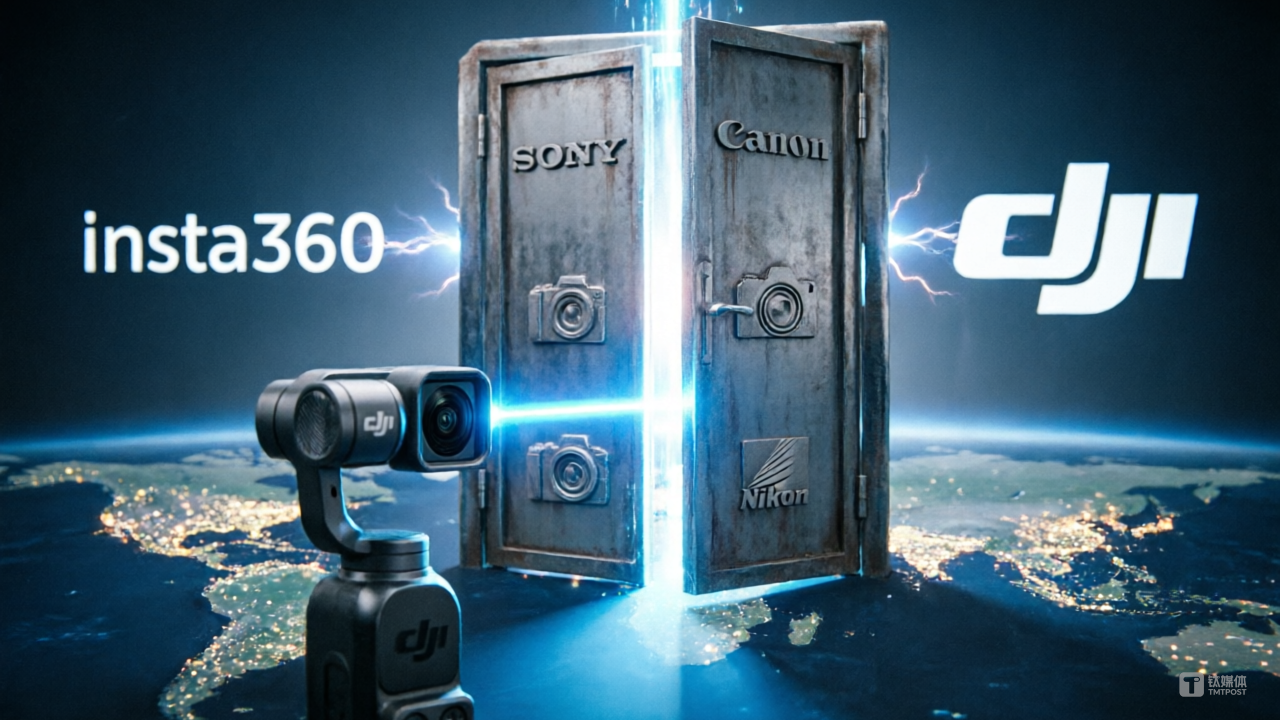
NextFin News -- On the evening of June 10, Insta360 officially launched the Luna Ultra, a handheld gimbal camera developed over six years.
That same day, DJI filed a patent infringement lawsuit against Insta360 in the U.S. District Court for the Eastern District of Texas, alleging that Insta360’s Luna Ultra was suspected of infringing two DJI-held design patents and four invention patents. DJI demanded that Insta360 disgorge infringing profits, pay damages, pay enhanced damages for willful infringement (triple damages), and sought a permanent injunction.
Two days later, Insta360 quickly counter-sued DJI in the United States for infringement of five patents, covering core technologies such as gimbal stabilization algorithms and panoramic video stabilization. At the same time, Insta360 filed related requests with the China National Intellectual Property Administration to invalidate corresponding patent family members.
This shows that as Chinese tech hardware brands expand overseas, competition has moved beyond price wars and has been elevated into battles over product technology and patents.
Both Insta360 and DJI are benchmark examples of Chinese consumer hardware brands that broke into global markets by entering through highly vertical niches and riding blockbuster products. Insta360 started with panoramic cameras and fended off GoPro; DJI, for its part, precisely filled the gap in the consumer drone market. After fully penetrating their respective vertical domains, each then moved into the other’s core stronghold—panoramic cameras and drones.
This product rivalry and patent war, sparked in the drone arena and now spilling into gimbal cameras, appears on the surface to be a back-and-forth contest between two Chinese overseas players in key markets. But looking past the surface-level patent lists, the real key to winning in the future for both companies is not each other’s market share.
The shared question they truly need to answer is: how to leap from vertical niches worth tens of billions to a global imaging market approaching one hundred billion dollars.
The Horizontal Leap of Chinese Brands
The rise of Insta360 and DJI on the global stage follows a classic playbook for Chinese smart hardware going overseas: find a narrow vertical niche and break through worldwide with an uncompromising product.
Insta360 has taken a 66% global share in panoramic cameras, pushing former king GoPro into a slide in revenue from $1.161 billion in 2021 to $652 million in 2025—nearly halving it. DJI has gone even further in consumer drones, shaping the world’s perception of what a “Chinese drone” is. Both are undisputed kings in their respective verticals.
But the ceiling for vertical niches is plainly visible. According to Frost & Sullivan data, the global panoramic camera market was only RMB 5.03 billion in 2023 and was projected to grow to RMB 7.85 billion by 2027. Growth in the consumer drone market has also been slowing.
Once a company’s share has already hit the ceiling, the only way to grow is through a horizontal leap—jumping from a “small pond” into the “open sea.” That “sea” is the global digital imaging device market.
Statistics from Global Market Insights show that the global digital camera market was worth US$24.4 billion in 2025, and it was expected to reach US$24.8 billion in 2026—equivalent to more than RMB 160 billion.
This hundred-billion-RMB market had long been monopolized by Japanese companies (Sony, Canon, Nikon, Fujifilm). For decades, almost no new entrant was able to shake their foundations—until DJI’s Pocket 3 arrived.
According to 2024 data from CIPA (the Camera & Imaging Products Association of Japan), sales of entry-level compact cameras priced under US$500 were nearly wiped out. The force that eliminated them wasn’t smartphones—it was gimbal cameras.
Starting in 2023, DJI’s Pocket 3 held the No. 1 spot in Japan’s camcorder (DV) category for 29 consecutive months. DJI’s share of Japan’s video camera market then surged to a staggering 72.5% in April 2026, achieving a substantive capture of market share on the home turf of Sony, Canon, and other brands.
These numbers reveal one fact: gimbal cameras have long since outgrown being a minor spillover from the action-camera market; they are the best point of entry for penetrating the entire Japanese ecosystem of mirrorless cameras and compact cameras.
The logic of this “penetration” becomes even clearer when you compare five categories of imaging creation tools. Handheld gimbal cameras have found the optimal balance in the “portability + image quality + stabilization” triangle: compared with mirrorless cameras, their built-in mechanical stabilization and AI tracking make creation far more lightweight; compared with smartphones, they pair a larger sensor with a physical gimbal, delivering image quality and stability that far surpass phones; and compared with action cameras, they meet the image-quality demands of professional-grade vlogging.
This comparison chart clearly highlights the “strategic positioning” value of handheld gimbal cameras: they carve out an entirely new “middle ground”—more portable than mirrorless cameras, more capable than smartphones, and better suited to everyday creation than action cameras. And that middle ground is precisely the most vulnerable link in the century-long dominance of Japanese brands.
Pocket and Luna Pry Open the Iron Gate of Japanese Imaging
If DJI’s Pocket 3 won its ticket in with “ultimate functionality,” Insta360’s Luna Ultra is trying to seize this blue-ocean market with an “ultimate experience.”
Insta360’s pricing strategy is itself a statement. The Luna Ultra is priced at US$769.99 in the U.S., and starts at RMB 3,999 for its initial release in China—noticeably higher than the DJI Pocket 3’s US$419 price point, and overlapping with the price range of Sony’s ZV-E10 II (body-only at around US$1,000).
That pricing comes down to this: Insta360 maxed out pro-level hardware specs to compete in the consumer market—putting a professional-grade solution into ordinary consumers’ hands.
For example, the Luna Ultra is the first portable gimbal camera to adopt a dual-camera setup of a 1-inch main camera plus a 1/1.3-inch telephoto secondary camera. Paired with 6x optical lossless zoom, it addresses a frequent pain point in vlogging—switching between wide environmental shots and tight subject close-ups—delivering image quality that single-camera gimbal units simply can’t match. At the same time, the double safety net of a three-axis mechanical gimbal plus electronic stabilization gives the Luna Ultra far better stability in motion than Japanese mirrorless cameras that rely on electronic stabilization alone.
But Insta360’s real differentiation isn’t just about piling on specs—it’s about weaving those otherwise cold technical parameters into an experience designed around video creators.
First is the modular, remote interaction design. The Luna Ultra comes with a detachable 2.4-inch screen, with a built-in microphone in the screen itself. This means creators don’t have to keep walking back to the camera to adjust framing, nor worry about audio getting muddy once they move farther away. With the screen detached, the camera body can be mounted anywhere, while users hold the screen at a distance to control settings and record.
This kind of scenario gives creators far more freedom of movement while shooting, breaking away from the kind of experience common with Japanese camera brands, where multiple people are often needed to complete moving shots or to coordinate filming from a distance.
Second is the synchronization between the user’s line of sight and the lens. By wearing the ear-hook accessory, Luna Ultra’s gimbal-mounted camera can follow the user’s head movements in real time, achieving “wherever your eyes go, that’s where the camera shoots.” Traditional mirrorless cameras are constrained by their physical form factor (a handheld body plus a viewfinder), and simply can’t deliver a hands-free, immersive shooting experience. The head-tracking capability precisely matches creators’ rigid, experience-driven needs.
Beyond hardware, the depth of its software ecosystem and AI algorithms also forms Insta360’s differentiated barrier. Take Deep Track 5.0 on the Luna Ultra as an example: through motion prediction, occlusion recovery, and single-/multi-subject tracking, the algorithm keeps the subject in the optimal position within the frame, lowering the threshold for composition. Combined with the AI editing and social-sharing features in the Insta360 App, it creates a software ecosystem distinct from the “optics-first, intelligence-light” path taken by Japanese imaging brands.
Insta360 uses top-tier specs to ensure baseline image quality that doesn’t lose to mirrorless cameras; it uses experience-driven innovations to fix pain points in the creation workflow; and it builds a software moat through deeper AI algorithms. Together, the three layers uncover new scenario ecosystems that traditional imaging brands never covered.
The cost of this leap is also enormous. Insta360 spent six years developing the Luna Ultra. While foundational capabilities from the panoramic-camera era—such as image stitching, AI visual tracking, and FlowState stabilization—could be carried over and reused, greatly lowering the barrier compared with starting from scratch, the entry ticket was still expensive.
In 2025, Insta360’s revenue hit a record RMB 9.741 billion (up 74.76% year on year), but net profit attributable to shareholders fell 6.62% year on year to RMB 929 million. By Q1 2026, behind revenue of RMB 2.481 billion (up 83.11% year on year), net profit was down to just RMB 84.62 million.
So where did the profit go? R&D. In 2025, Insta360’s R&D spending reached RMB 1.530 billion, surging 96.95% year on year—more than the total of the previous three years combined; in Q1 2026, R&D spending was RMB 465 million, up another 100.59% year on year.
As Insta360 founder Liu Jingkang put it, this is “trading short-term profit pressure for long-term technology barriers.” In the gimbal-camera arena, where optics, mechanical stabilization, and AI algorithms intersect across disciplines, that level of R&D investment is, to some extent, also about building a real moat—one that can keep smartphone makers from easily replicating it in the future through supply-chain integration.
U.S. Patent Warfare
The U.S. accounts for roughly 30% of the global digital photography market, and penetration of high-end creator gear is extremely high. North America contributed substantially to DJI Pocket 3’s sales surpassing 10 million units, and Insta360 also stated in its 2025 H1 financial report that the U.S. was its largest single-country market.
Whoever wins the U.S. wins a place in creators’ minds worldwide.
However, DJI is currently facing policy headwinds in the U.S. In December 2025, the U.S. FCC placed DJI on a “covered list,” meaning its new products (including the Pocket 4, which was already released in China) could not obtain certification for U.S. sales, making it difficult to enter American distribution channels.
Insta360, which was not affected, has seen a precious “vacuum period” open up in the U.S. market. But that window won’t be handed over for free. DJI’s lawsuit against Insta360 in the Eastern District of Texas is precisely an attempt to use a patent fight to keep Insta360 outside the door of this critical market.
The Eastern District of Texas is known for its short trial cycles, high win rates for patent holders, and large damages awards. By accusing Insta360 of willful infringement and seeking a permanent injunction, DJI is essentially using the U.S. judicial system to raise the cost of Insta360’s entry into the U.S. market—if its own products can’t get in, it will still try to block its rival.
The reason the U.S. market has become the flashpoint where both sides are going all-in is that it’s the high ground for a step-change—and the ticket into a smart imaging market worth hundreds of billions.
Still, in the view of “Outbound Reference,” within the competitive landscape of gimbal cameras, the tussle between Chinese brands is only part of the story. The deeper contest is a systematic challenge by China’s new generation of imaging hardware against traditional Japanese camera brands.
Data from Sigmaintell Consulting shows global gimbal camera shipments are expected to surge from 1.2 million units in 2023 to 14.8 million units in 2026. Even if DJI and Insta360 split the market 50–50, that would only mark the beginning of a category worth tens of billions. What they face together is a vast global imaging-equipment market.
When domestic smartphone makers enter the field with supply-chain advantages, the real concern isn’t losing share—it’s how to avoid letting low-price tactics cheapen and commoditize a high-barrier market.
DJI and Insta360’s patent battle is, in fact, a coming-of-age rite for China’s smart imaging brands going global: learning to protect themselves under international rules, and learning to compete within them.
DJI has shown with the Pocket 3 that gimbal cameras can replace compact point-and-shoots, while Insta360 has demonstrated with the Luna Ultra that a differentiated experience can open up new use cases. Their rivalry right now is a close-quarters clash in a patent war, but the longer-term picture is by no means a zero-sum game.
What we can see is that this competition signals that Chinese tech brands’ push overseas has moved beyond low-end “price wars,” and has been elevated into higher-dimensional “product-and-technology battles” and “patent wars.”
The real opponent may not be each other, but rather the Japanese giants with a century of brand heritage who are now being forced to transform. Whoever secures the ticket—both in products and patents—will gain the initiative in the much larger imaging market worth hundreds of billions. The globalization of a new generation of Chinese smart imaging hardware is only just beginning. (Reporting by Wang Lu, Editing by Luo Wenqin)