


惯性聚合 高效追踪和阅读你感兴趣的博客、新闻、科技资讯
阅读原文 在惯性聚合中打开

推荐订阅源

T
Tenable Blog
Engineering at Meta
Engineering at Meta
The Register - Security
N
Netflix TechBlog - Medium
D
Docker
Vercel News
Vercel News
云风的 BLOG
云风的 BLOG
月光博客
月光博客
钛媒体:引领未来商业与生活新知
钛媒体:引领未来商业与生活新知
freeCodeCamp Programming Tutorials: Python, JavaScript, Git & More
D
DataBreaches.Net
IT之家
IT之家
V
V2EX
人人都是产品经理
人人都是产品经理
F
Fortinet All Blogs
J
Java Code Geeks
酷 壳 – CoolShell
酷 壳 – CoolShell
博客园 - 叶小钗
OSCHINA 社区最新新闻
OSCHINA 社区最新新闻
雷峰网
雷峰网
博客园 - Franky
Hugging Face - Blog
Hugging Face - Blog
有赞技术团队
有赞技术团队
aimingoo的专栏
aimingoo的专栏
MongoDB | Blog
MongoDB | Blog
P
Privacy International News Feed
F
Full Disclosure
P
Proofpoint News Feed
B
Blog RSS Feed
T
Tor Project blog
T
The Blog of Author Tim Ferriss
B
Blog
Webroot Blog
Webroot Blog
腾讯CDC
T
Troy Hunt's Blog
T
Tailwind CSS Blog
H
Heimdal Security Blog
AWS News Blog
AWS News Blog
G
Google Developers Blog
Spread Privacy
Spread Privacy
NISL@THU
NISL@THU
A
About on SuperTechFans
SecWiki News
SecWiki News
CTFtime.org: upcoming CTF events
Cyber Security Advisories - MS-ISAC
I
InfoQ
M
MIT News - Artificial intelligence
大猫的无限游戏
大猫的无限游戏
美团技术团队
L
LangChain Blog

Analytics Vidhya

Handling Imbalanced Classification: What Works Better Than SMOTE GPT-5.6 Is Here: Sol, Terra, and Luna Loop Engineering for AI Agents: How /loop is Changing AI Workflows DeepSeek DSpark: The Speculative Decoding Trick Behind 400% Faster LLM OKF: Redefining Knowledge Bases for AI Agents Modern VLMs Explained: How GPT-4o, Gemini, Claude Vision, and Qwen-VL Work YOLO26 Tutorial: Object Detection, Pose Estimation & More Large Action Models (LAMs) vs Agentic LLMs: What's the Real Difference? Claude Sonnet 5: The Fable 5 at Home The Best $20 AI Plan: ChatGPT Plus vs Claude Pro vs Gemini Pro GraphRAG vs Vector RAG: Which Retrieval Method is Best? Using AI When You Don’t Trust AI The Self-Improving Loop in AI Agents: Architecture, Benefits, and How it Outperforms Traditional Agent Workflows Harness-1: The 20B Retrieval Subagent That Beats GPT-5.4 at Search Sakana Fugu: Multi-Agent System as a Model Claude's Hidden Art Skill: Making Illustrations With Code System Design for ML Interviews: 10 Real Problems Walked Through Most People Use ChatGPT Wrong: 10 Features and Tips That Changed How I Work OpenAI Just Launched 3 Free AI Courses with Certificates Autoregressive Models: Predicting the Future Using the Past Gemini Omni: AI Video Generation Inside Gemini DiffusionGemma: Google’s Diffusion-Based Open Model for Faster Text Generation Top 10 AI Engineering Tools Everyone is Using in 2026 Prophet vs NeuralProphet vs TimeGPT vs Chronos: A Practical Comparison Build an Emergency Helpline Voice Agent with LangChain Choosing the Right Vector Database for RAG and AI Applications Google Gemma 4 12B: Architecture, Benchmarks, Access, and Hands-on Guide for Developers How to Choose the Right AI Model for Your Needs Agent Observability with LangSmith, Langfuse, and Arize: A Hands-On Comparison How to Use Claude Managed Agents? Google AI Studio vs Gemini App: What’s the Difference? AI Workflows for Sales Teams: Prospect Research, Lead Qualification, and CRM Updates on Autopilot Using LangGraph 25 Most Influential AI Pioneers to Meet at DataHack Summit 2026 Claude Opus 4.8: A Smarter Model in the Right Direction PySpark Optimization: 12 Proven Techniques to Speed Up Your Spark Jobs 10 Everyday Tasks You Can Automate with AI Today (With n8n Templates) Google Antigravity 2.0: The Full Developer Guide (I/O 2026) Build a Claude Cowork-Like Browser Agent Using Playwright MCP and Claude Desktop Pandas vs Polars vs DuckDB: Which Library Should You Choose? Qwen3.7-Max: Alibaba’s New Agent-First LLM for Coding, Reasoning, and Long-Horizon AI Workflows The Biggest Announcements from Google I/O 2026 Top 9 AI Events and Conferences in 2026 that you Must Attend Gemini 3.5 Flash: Frontier Intelligence with Speed Kimi WebBridge: Hands-on Guide to Kimi’s Browser Extension for AI Agents 40 Advanced SQL Window Functions Every Data Scientist Must Know(with examples) Top 10 AI Research Papers of 2025 6 Steps to Crack GenAI Case Study Interviews (With Real Examples) OpenAI Omni Moderation: How to Filter Text & Images for Free DataHack Summit 2026: You Just Cannot Skip This AI Event of the Year OpenAI’s New API Voice Models Will Change the Way You Use AI Hermes Agent Guide: What is it and How to Use it? Top 10 LLM Research Papers of 2026 Agent Memory Patterns in Cognitive Science and AI Systems 10 AI Agents Every AI Engineer Must Build (with GitHub Samples) 23 Tips for Smart Claude Code Token Saving and Workflow Optimization Feature Engineering with LLMs: Techniques & Python Examples ChatGPT is Now Inside Excel and Google Sheets: Here is How to Use it Gemini API File Search: The Easy Way to Build RAG Top 10 Open-Source Libraries to Fine-Tune LLMs Locally ML Intern in Practice: From Prompt to a Shipped Hugging Face Model 15+ Solved Agentic AI Projects with Github Links How People are Figuring Out Life With Claude MemPalace Explained: Building Long-Term Memory for AI Agents Beyond RAG Grok Voice Think Fast 1.0: Build Voice AI Agents That Actually Think Compressing LSTM Models for Retail Edge Deployment: A Practical Comparison MCP vs Agent Skills: Different Altogether GPT 5.5 vs Opus 4.7: Which is the Best AI Model Today? What is Agentic AI? Claude Code vs Codex: A Detailed Terminal Agent Comparison Google Deep Research Max: Build Autonomous AI Research Agents in Minutes Meta Muse Spark Review: Is It Worth the Hype? ChatGPT Images 2.0 vs Nano Banana 2: Which is Better? Cursor V3 Explained: The AI Coding Agent That’s Replacing Traditional IDEs in 2026 DeepSeek-V4: The Most Powerful Open-Source Model Ever Is GPT Image 2 the Best Image Generation Model? Token Economics: Why AI is Getting “Cheaper” From Idea to Output: Claude Does the Design Work Opus 4.7 vs Opus 4.6: Should You Switch? Build Human-Like AI Voice App with Gemini 3.1 Flash TTS How to Structure a Claude Code Project that Thinks Like an Engineer Gemma 4 Tool Calling Explained: Build AI Agents with Function Calling (Step-by-Step Guide) Anthropic Launches Claude Opus 4.7 For “Most Difficult Tasks” Top 28 Claude Shortcuts that will 10X your Speed GPT-5.4-Cyber: Why OpenAI is Keeping its Most Powerful Model Under Lock and Key Google AI Studio Guide: Every Feature Explained Mastering Deep Agents: Context Engineering that Actually Works 21 Computer Vision Projects from Beginner to Advanced (2026 Guide) Excel 101: Excel Agent Mode Explained MiniMax M2.7 Goes Open-Weight to Let You Run Agents Locally Top 10 Gemma 4 Projects That Will Blow Your Mind GLM-5.1: Architecture, Benchmarks, Capabilities & How to Use It Understanding BERTopic: From Raw Text to Interpretable Topics From Karpathy’s LLM Wiki to Graphify: AI Memory Layers are Here 10 Most Important AI Concepts Explained Simply Project Glasswing is World’s Most Powerful AI in Action How to Run Gemma 4 on Your Phone Without Internet: A Hands-On Guide Running Claude Code for Free with Gemma 4 and Ollama LLM Wiki Revolution: How Andrej Karpathy’s Idea is Changing AI Rethinking Enterprise Search: How Cortex Search Turns Data into Business Impact Google’s Gemma 4: Is it the Best Open-Source Model of 2026?
I Tested Claude Fable 5: Can Anthropic’s Newest AI Deliver on the Hype?
Riya Bansal · 2026-06-10 · via Analytics Vidhya

Claude Mythos Preview, the AI model that sparked global concern earlier this year, has now evolved into two new offerings: Claude Fable 5 and Claude Mythos 5. Derived from the highly restricted Mythos Preview, these models bring Anthropic’s most advanced AI capabilities to a broader audience.

Anthropic is making bold claims, with Fable 5 reportedly setting new performance standards across a wide range of benchmarks. In this article, we take a closer look at what these Mythos-class models offer, how they differ, and who can access them.

Table of contents

  • What is Claude Fable 5?
  • Claude Fable 5 and Mythos 5: Key Features
  • Claude Fable 5 and Mythos 5: Benchmark Performance
  • How to Access Claude 5 and Mythos 5?
  • Let’s Try Claude Fable 5
    • Task 1: Recreating the Netflix Interface from a Screenshot
    • Task 2: Turning a Hand-Drawn Dashboard Sketch into a Modern Analytics Application
  • Conclusion
  • Frequently Asked Questions

What is Claude Fable 5?

According to Anthropic, Fable 5 outperforms previous Claude models across software engineering, knowledge work, vision, scientific research, and long-running tasks. More notably, Anthropic claims that Fable 5’s advantage grows as tasks become more complex and require sustained reasoning over longer periods.

In practice, this means Fable 5 is designed for workflows that involve multiple steps, large amounts of information, and extended context. Examples include codebase-wide migrations, financial analysis, complex document review, scientific research, screenshot-to-app generation, and other long-context problem-solving tasks.

Rather than optimizing for short interactions alone, Fable 5 is built to maintain performance and coherence throughout lengthy, demanding workflows.

I Tested Claude Fable 5: Can Anthropic's Newest AI Deliver on the Hype?

Claude Fable 5 and Mythos 5: Key Features

The biggest upgrade with Claude Fable 5 and Claude Mythos 5 is their ability to handle longer, more complex tasks. Anthropic says the models perform strongly across coding, knowledge work, vision, memory, and scientific research. In testing, Fable 5 handled large coding projects, analyzed financial documents, interpreted charts, and rebuilt applications from screenshots.

A key differentiator is autonomy. The models can stay focused across lengthy workflows, retain context more effectively, and solve multi-step problems with less guidance. Mythos 5 extends these capabilities to trusted users in areas such as cybersecurity, drug discovery, molecular biology, and genomics research.

Key capabilities include:

  • Advanced coding: Supports complex software engineering and long-horizon development tasks.
  • Stronger knowledge work: Excels at document analysis, financial reasoning, and problem-solving.
  • Improved vision: Understands screenshots, charts, scientific figures, and UI layouts.
  • Long-context memory: Maintains context across large inputs and extended workflows.
  • Scientific research support: Assists with biology, genomics, and drug discovery in trusted-access environments.
  • Built-in safeguards: Applies additional protections for sensitive domains such as cybersecurity, biology, chemistry, and model distillation.

Claude Fable 5 and Mythos 5: Benchmark Performance

Anthropic’s benchmark results show Claude Fable 5 and Mythos 5 leading across many of the areas that matter most for practical AI applications, including agentic coding, knowledge work, reasoning, tool use, cybersecurity, biology, and health.

The broader takeaway is that these models appear strongest on complex, multi-step tasks that require sustained reasoning, extensive context, and effective tool usage.

How to Access Claude 5 and Mythos 5?

Getting started with Claude Fable 5 is simple. Options include:

  • Claude API: Access immediately via the model string claude-fable-5. Also available on consumption-based Enterprise plans.
  • Claude apps: Included at no extra cost in Pro, Max, Team, and seat-based Enterprise plans through June 22, 2026. Access rolls out in stages.
  • Cloud platforms: Available on AWS, Google Cloud, and Microsoft Foundry, alongside Claude Code and the Claude Platform.

Pricing: $10 per million input tokens, $50 per million output tokens. Prompt caching provides a 90% discount on input tokens.

Note: Fable 5 includes safeguards for cybersecurity and biology. Flagged queries are routed to Opus 4.8 without incurring Fable charges, making this mostly transparent for users.

Let’s Try Claude Fable 5

Benchmarks are useful, but developers care more about whether a model speeds up real-world development. I tested Fable 5 on two tasks to assess its comprehension of visual input, production-ready code generation, and ability to work from existing designs.

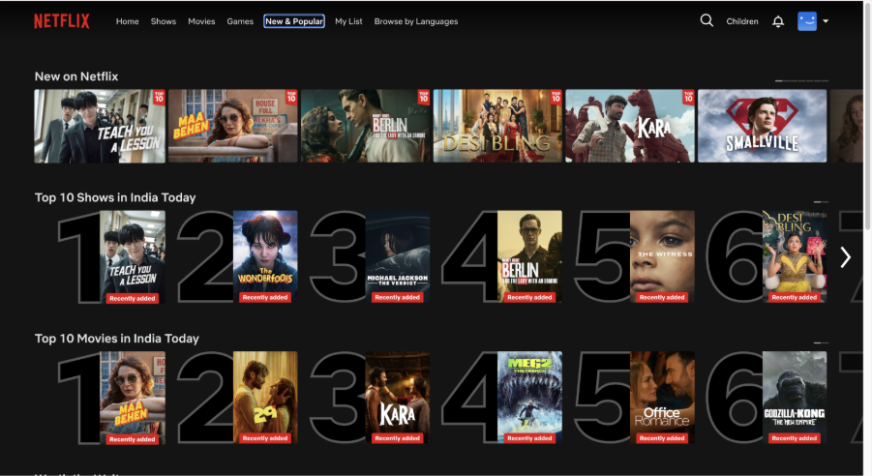
Task 1: Recreating the Netflix Interface from a Screenshot

Objective: Evaluate Fable 5’s visual understanding and frontend capabilities.

Input: A single screenshot of Netflix’s “New & Popular” page, containing:
Recreating the Netflix Interface from a Screenshot | Claude Fable 5
  • Complex navigation bar
  • Horizontally scrolling content carousels
  • Rank labels on content cards
  • Multiple content sections with differing layouts
  • Dark theme styling
  • Badges, labels, and overlays

Prompt:

Recreate this as a working HTML/CSS page. Make it pixel accurate. No frameworks, just clean HTML and CSS. Ensure responsive behavior for desktop and mobile. 

Output:

Evaluation Criteria:

  • Layout accuracy
  • Navigation bar structure
  • Netflix-style content rows
  • Responsiveness
  • Code quality

My Review:

Fable 5 did a great job of identifying all the important UI components as well as creating an actual functioning web page that resembles what you would find on the Netflix website. It recognized that the major components of the web page are composed of three main parts: a fixed navigation area followed by multiple vertical cards (i.e., content) laid out in a horizontal fashion. 

An area I was especially impressed with is how well it recognised patterns that repeat. For example, instead of treating each movie card (title card) that was rendered on the page as an individual piece of content, Fable 5 used the same constructs for each card, and of course, retained styling across all cards on the page. 

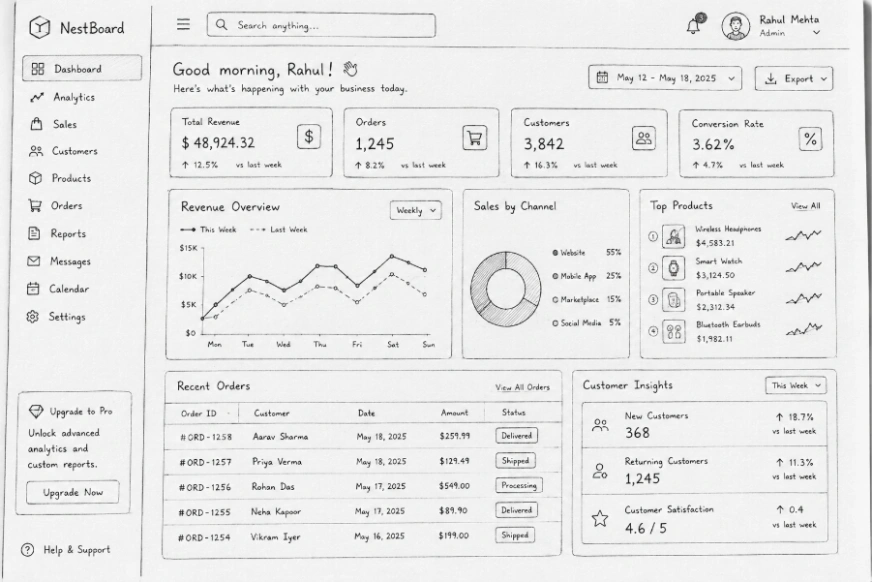
Task 2: Turning a Hand-Drawn Dashboard Sketch into a Modern Analytics Application

Objective: Simulate a real-world product workflow, turning rough sketches into a polished application.

Input: Hand-drawn dashboard wireframe with:
Task 2:  Turning a Hand-Drawn Dashboard Sketch into a Modern Analytics Application
  • Layout instructions
  • Charts and KPI cards
  • Tables and navigation elements
  • Dashboard widgets

Prompt:

Convert this hand-drawn dashboard into a modern SaaS analytics application. Use React, Tailwind CSS, and responsive design principles. Create polished charts, modern card layouts, subtle animations, proper spacing, and professional typography. Fill in any missing design details while preserving the structure of the sketch.

Output:

Evaluation Criteria:

  • Understanding of hand-drawn layout
  • Visual hierarchy comprehension
  • Filling in missing design elements
  • Component quality
  • Responsiveness
  • Overall visual presentation

My Review:

Fable 5 interpreted intent rather than copying pixels. It generated cohesive layouts with:

  • Sidebar navigation
  • KPI analytics cards
  • Data visualization areas
  • Administrative controls
  • Tables
  • Customer intelligence widgets

The model filled missing colors, typography, spacing, and interactivity intelligently. A few design choices leaned toward extra styling that might need refinement for production, but the app was usable and visually consistent.

Conclusion

The most notable aspect of this release isn’t just the performance or new capabilities—it’s how access is managed.

Rather than releasing its most powerful models to everyone, Anthropic is drawing a clear line between broadly available AI and restricted frontier AI. Fable 5 brings much of the Mythos-class intelligence to developers, enterprises, and Claude users, while Mythos 5 remains limited to trusted partners and researchers in sensitive domains.

This approach signals a shift in how advanced AI may be deployed in the future: not only based on capability, but also on risk and responsible access. For users, Fable 5 delivers stronger coding, reasoning, vision, and research support. For Anthropic, Mythos 5 tests whether frontier AI can be expanded safely without exposing the riskiest capabilities to the public.

Frequently Asked Questions

Q1. What is the difference between Claude Fable 5 and Claude Mythos 5?

A. Claude Fable 5 is the broadly available version of Anthropic’s Mythos-class AI, designed for developers, enterprises, and Claude users. Claude Mythos 5 is a more restricted model available only to trusted partners and researchers working in sensitive areas such as cybersecurity and biology.

Q2. How can I access Claude Fable 5?

A. Claude Fable 5 is available through the Claude API using the model string claude-fable-5, on Claude Pro, Max, Team, and Enterprise plans, and through cloud platforms such as AWS, Google Cloud, and Microsoft Foundry.

Q3. What are the key improvements in Claude Fable 5?

A. Claude Fable 5 is designed to handle longer and more complex tasks than previous Claude models. It offers stronger coding capabilities, improved reasoning, better visual understanding, enhanced long-context memory, and more reliable performance across multi-step workflows.

Q4. How much does Claude Fable 5 cost?

A. Claude Fable 5 costs $10 per million input tokens and $50 per million output tokens. Anthropic also offers prompt caching, which can reduce input token costs by up to 90% for eligible requests.

Data Science Trainee at Analytics Vidhya
I am currently working as a Data Science Trainee at Analytics Vidhya, where I focus on building data-driven solutions and applying AI/ML techniques to solve real-world business problems. My work allows me to explore advanced analytics, machine learning, and AI applications that empower organizations to make smarter, evidence-based decisions.
With a strong foundation in computer science, software development, and data analytics, I am passionate about leveraging AI to create impactful, scalable solutions that bridge the gap between technology and business.
📩 You can also reach out to me at [email protected]