




惯性聚合 高效追踪和阅读你感兴趣的博客、新闻、科技资讯
阅读原文 在惯性聚合中打开

推荐订阅源

F
Full Disclosure
奇客Solidot–传递最新科技情报
奇客Solidot–传递最新科技情报
Last Week in AI
Last Week in AI
The GitHub Blog
The GitHub Blog
WordPress大学
WordPress大学
博客园 - 三生石上(FineUI控件)
D
Docker
K
Kaspersky official blog
Latest news
Latest news
P
Privacy International News Feed
雷峰网
雷峰网
S
Security Affairs
博客园 - 司徒正美
博客园 - Franky
C
CERT Recently Published Vulnerability Notes
Cisco Talos Blog
Cisco Talos Blog
AWS News Blog
AWS News Blog
C
Check Point Blog
T
Tailwind CSS Blog
T
Tenable Blog
Cyber Security Advisories - MS-ISAC
T
Threat Research - Cisco Blogs
The Last Watchdog
The Last Watchdog
Google Online Security Blog
L
Lohrmann on Cybersecurity
Exploit-DB.com RSS Feed
B
Blog
The Hacker News
The Hacker News
V
V2EX
L
LINUX DO - 最新话题
云风的 BLOG
云风的 BLOG
Engineering at Meta
Engineering at Meta
GbyAI
GbyAI
W
WeLiveSecurity
Know Your Adversary
Know Your Adversary
P
Proofpoint News Feed
cs.AI updates on arXiv.org
Microsoft Security Blog
S
Securelist
V2EX - 技术
V2EX - 技术
博客园 - 叶小钗
The Cloudflare Blog
小众软件
小众软件
Recent Announcements
Microsoft Azure Blog
L
LangChain Blog
酷 壳 – CoolShell
酷 壳 – CoolShell
Hacker News: Ask HN
Hacker News: Ask HN
cs.CV updates on arXiv.org
The Register - Security

Analytics Vidhya

Handling Imbalanced Classification: What Works Better Than SMOTE GPT-5.6 Is Here: Sol, Terra, and Luna Loop Engineering for AI Agents: How /loop is Changing AI Workflows DeepSeek DSpark: The Speculative Decoding Trick Behind 400% Faster LLM OKF: Redefining Knowledge Bases for AI Agents Modern VLMs Explained: How GPT-4o, Gemini, Claude Vision, and Qwen-VL Work YOLO26 Tutorial: Object Detection, Pose Estimation & More Claude Sonnet 5: The Fable 5 at Home The Best $20 AI Plan: ChatGPT Plus vs Claude Pro vs Gemini Pro GraphRAG vs Vector RAG: Which Retrieval Method is Best? Using AI When You Don’t Trust AI The Self-Improving Loop in AI Agents: Architecture, Benefits, and How it Outperforms Traditional Agent Workflows Harness-1: The 20B Retrieval Subagent That Beats GPT-5.4 at Search Sakana Fugu: Multi-Agent System as a Model Claude's Hidden Art Skill: Making Illustrations With Code System Design for ML Interviews: 10 Real Problems Walked Through Most People Use ChatGPT Wrong: 10 Features and Tips That Changed How I Work OpenAI Just Launched 3 Free AI Courses with Certificates Autoregressive Models: Predicting the Future Using the Past Gemini Omni: AI Video Generation Inside Gemini DiffusionGemma: Google’s Diffusion-Based Open Model for Faster Text Generation Top 10 AI Engineering Tools Everyone is Using in 2026 I Tested Claude Fable 5: Can Anthropic’s Newest AI Deliver on the Hype? Prophet vs NeuralProphet vs TimeGPT vs Chronos: A Practical Comparison Build an Emergency Helpline Voice Agent with LangChain Choosing the Right Vector Database for RAG and AI Applications Google Gemma 4 12B: Architecture, Benchmarks, Access, and Hands-on Guide for Developers How to Choose the Right AI Model for Your Needs Agent Observability with LangSmith, Langfuse, and Arize: A Hands-On Comparison How to Use Claude Managed Agents? Google AI Studio vs Gemini App: What’s the Difference? AI Workflows for Sales Teams: Prospect Research, Lead Qualification, and CRM Updates on Autopilot Using LangGraph 25 Most Influential AI Pioneers to Meet at DataHack Summit 2026 Claude Opus 4.8: A Smarter Model in the Right Direction PySpark Optimization: 12 Proven Techniques to Speed Up Your Spark Jobs 10 Everyday Tasks You Can Automate with AI Today (With n8n Templates) Google Antigravity 2.0: The Full Developer Guide (I/O 2026) Build a Claude Cowork-Like Browser Agent Using Playwright MCP and Claude Desktop Pandas vs Polars vs DuckDB: Which Library Should You Choose? Qwen3.7-Max: Alibaba’s New Agent-First LLM for Coding, Reasoning, and Long-Horizon AI Workflows The Biggest Announcements from Google I/O 2026 Top 9 AI Events and Conferences in 2026 that you Must Attend Gemini 3.5 Flash: Frontier Intelligence with Speed Kimi WebBridge: Hands-on Guide to Kimi’s Browser Extension for AI Agents 40 Advanced SQL Window Functions Every Data Scientist Must Know(with examples) Top 10 AI Research Papers of 2025 6 Steps to Crack GenAI Case Study Interviews (With Real Examples) OpenAI Omni Moderation: How to Filter Text & Images for Free DataHack Summit 2026: You Just Cannot Skip This AI Event of the Year OpenAI’s New API Voice Models Will Change the Way You Use AI Hermes Agent Guide: What is it and How to Use it? Top 10 LLM Research Papers of 2026 Agent Memory Patterns in Cognitive Science and AI Systems 10 AI Agents Every AI Engineer Must Build (with GitHub Samples) 23 Tips for Smart Claude Code Token Saving and Workflow Optimization Feature Engineering with LLMs: Techniques & Python Examples ChatGPT is Now Inside Excel and Google Sheets: Here is How to Use it Gemini API File Search: The Easy Way to Build RAG Top 10 Open-Source Libraries to Fine-Tune LLMs Locally ML Intern in Practice: From Prompt to a Shipped Hugging Face Model 15+ Solved Agentic AI Projects with Github Links How People are Figuring Out Life With Claude MemPalace Explained: Building Long-Term Memory for AI Agents Beyond RAG Grok Voice Think Fast 1.0: Build Voice AI Agents That Actually Think Compressing LSTM Models for Retail Edge Deployment: A Practical Comparison MCP vs Agent Skills: Different Altogether GPT 5.5 vs Opus 4.7: Which is the Best AI Model Today? What is Agentic AI? Claude Code vs Codex: A Detailed Terminal Agent Comparison Google Deep Research Max: Build Autonomous AI Research Agents in Minutes Meta Muse Spark Review: Is It Worth the Hype? ChatGPT Images 2.0 vs Nano Banana 2: Which is Better? Cursor V3 Explained: The AI Coding Agent That’s Replacing Traditional IDEs in 2026 DeepSeek-V4: The Most Powerful Open-Source Model Ever Is GPT Image 2 the Best Image Generation Model? Token Economics: Why AI is Getting “Cheaper” From Idea to Output: Claude Does the Design Work Opus 4.7 vs Opus 4.6: Should You Switch? Build Human-Like AI Voice App with Gemini 3.1 Flash TTS How to Structure a Claude Code Project that Thinks Like an Engineer Gemma 4 Tool Calling Explained: Build AI Agents with Function Calling (Step-by-Step Guide) Anthropic Launches Claude Opus 4.7 For “Most Difficult Tasks” Top 28 Claude Shortcuts that will 10X your Speed GPT-5.4-Cyber: Why OpenAI is Keeping its Most Powerful Model Under Lock and Key Google AI Studio Guide: Every Feature Explained Mastering Deep Agents: Context Engineering that Actually Works 21 Computer Vision Projects from Beginner to Advanced (2026 Guide) Excel 101: Excel Agent Mode Explained MiniMax M2.7 Goes Open-Weight to Let You Run Agents Locally Top 10 Gemma 4 Projects That Will Blow Your Mind GLM-5.1: Architecture, Benchmarks, Capabilities & How to Use It Understanding BERTopic: From Raw Text to Interpretable Topics From Karpathy’s LLM Wiki to Graphify: AI Memory Layers are Here 10 Most Important AI Concepts Explained Simply Project Glasswing is World’s Most Powerful AI in Action How to Run Gemma 4 on Your Phone Without Internet: A Hands-On Guide Running Claude Code for Free with Gemma 4 and Ollama LLM Wiki Revolution: How Andrej Karpathy’s Idea is Changing AI Rethinking Enterprise Search: How Cortex Search Turns Data into Business Impact Google’s Gemma 4: Is it the Best Open-Source Model of 2026?
Large Action Models (LAMs) vs Agentic LLMs: What's the Real Difference?
Sree Vamsi · 2026-07-04 · via Analytics Vidhya

You tell your AI “Polish my email and send it.”

  1. A chatbot hands you a paragraph on how that’s done. 
  2. An agentic LLM opens your inbox and tries. Sometimes it works. Sometimes it clicks the wrong button three times. 
  3. A Large Action Model just does it, confirms, and moves on. 

Same sentence, three outcomes. The gap between Large Action Models (LAMs) and agentic LLMs is one of the most practically important distinctions in AI today, and also one of the least clearly explained.

In this article, we cut through the confusion through a simple breakdown of how each system is built, and a clear guide on when to use which.

Table of contents

  • What is an Agentic LLM?
  • What is a Large Action Model?
  • Aren’t They the Same Thing?
  • Side-by-Side Comparison
  • Which One Should You Use?
  • Frequently Asked Questions

What is an Agentic LLM?

An LLM like ChatGPT, Claude, or Gemini is fundamentally a word predictor. It reads context and produces the most useful next token. Its power comes from doing that at a massive scale.

An agentic LLM is the same model placed inside a reasoning loop with tools. It reads a goal, chooses a tool, reads the result, and decides what to do next until the task is complete or something fails. This loop is often called ReAct: reason, act, observe.
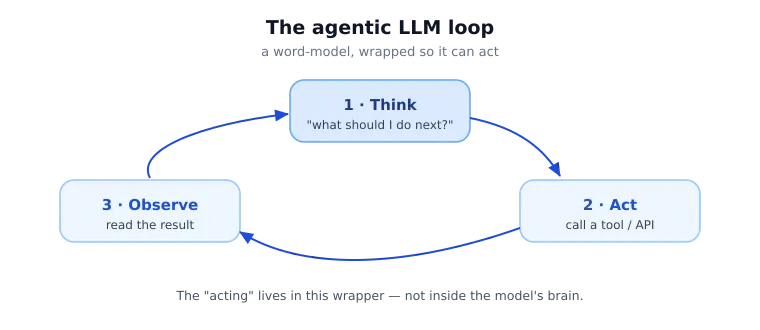
Th Agentic LLM Loop

The critical thing to understand is that the model itself hasn’t changed. Strip away the loop, tool definitions, prompts, and orchestration code, and you’re back to a chatbot. The action-taking ability lives in the scaffolding.

That makes the repurposing powerful: the same model can write copy, debug code, or call an API without retraining. But reliability suffers. It can choose the wrong tool, invent parameters, or get stuck in loops. In production, these failures aren’t edge cases. They’re the 2 AM incidents.

Take away the loop and the tools, and an agentic LLM goes right back to being a chatbot. The “doing” lives in the wrapper, not the model.

What is a Large Action Model?

A LAM approaches the problem differently. Rather than taking a language model and coaxing action-taking out of it, you train a model where producing correct, executable actions is the primary objective from day one.
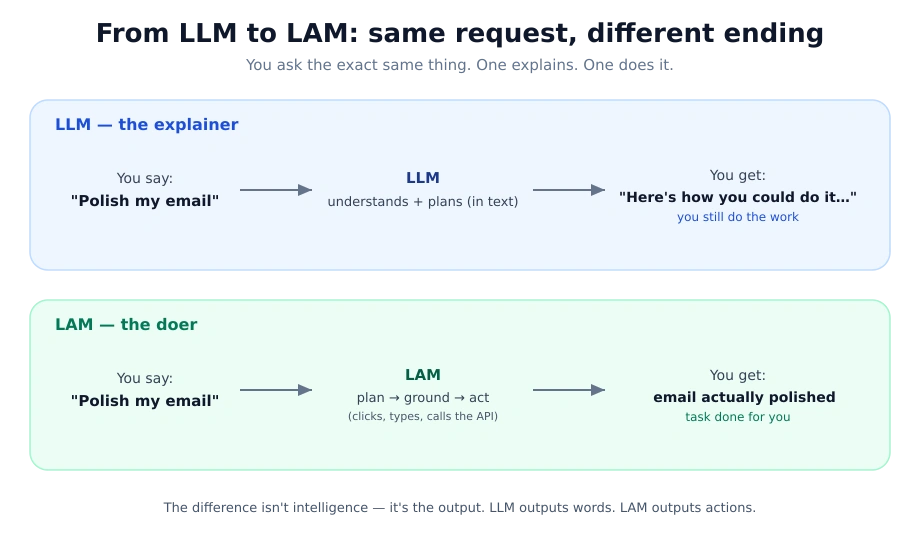
From LLM to LAM: Same request different ending

The training data is different. A standard LLM is trained on web-scale text. A LAM is trained on action trajectories: clicks, API calls, UI interactions, and multi-step task completions. Salesforce’s AgentOhana pipeline was built to unify this kind of action data into one training format. The model learns what a good action sequence looks like, not just a good sentence.

The architecture follows the same goal. Most LAMs use a perceive, plan, act, learn cycle: read the environment, break down the goal, take an action, and update the plan. It resembles the agentic LLM loop, but the behavior is trained into the model rather than bolted on through orchestration code.
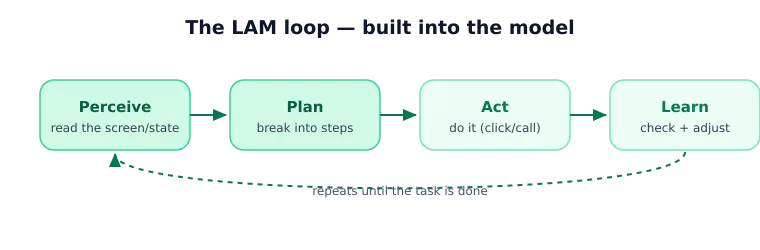
The LAM Loop
The perceive, plan, act, learn cycle described in LAM research 

Specialization produces surprising efficiency. Salesforce’s xLAM-1B, a 1-billion-parameter model nicknamed the “Tiny Giant,” outperforms GPT-3.5 on function-calling benchmarks while being roughly 175 times smaller. When the training objective matches the deployment task, you don’t need scale to win.

Aren’t They the Same Thing?

It’s a fair question, and the line genuinely blurs at the edges. An agentic LLM with heavy function-calling fine-tuning can look a lot like a LAM. Some products use “LAM” as a marketing term for what is plainly a wrapped GPT with a few tool definitions.
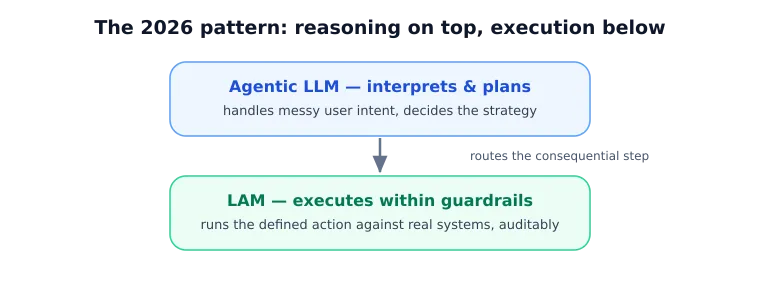
Agentic LLM on top LAM below it

The meaningful distinction sits in where the action capability originates:

Agentic LLM Large Action Model
Action capability source Borrowed from the scaffolding Trained into the model
Remove the wrapper Get a chatbot Still an action model
The point Flexibility Reliability on defined tasks

The strongest production systems in 2026 won’t choose between the two. They’ll use an agentic LLM for reasoning and open-ended interpretation, then route high-stakes actions like payments, data changes, or API calls through a guarded LAM.

Side-by-Side Comparison

Dimension Agentic LLM Large Action Model
Core output Text (actions extracted from it) Structured actions, natively
Where action capability lives The orchestration wrapper The model weights
Training data Web-scale text Action trajectories + text
Typical model size Large generalist (70B to 1T+) Often small and specialized (1B to 70B)
Strength Flexibility, reasoning, open tasks Reliability on bounded action tasks
Common failure mode Wrong tool, hallucinated args, infinite loop Breaks outside defined action space
Real examples GPT-4o + LangGraph, Claude + CrewAI Salesforce xLAM, Rabbit R1, Adept ACT-1

Which One Should You Use?

The practical question is whether the action space is open or closed. If the system’s actions are bounded and known in advance, such as fixed APIs, UI workflows, or business processes, a LAM-style model is usually more reliable, faster, and cheaper per operation.

If the task is open-ended, or needs rich language understanding inside the loop, an agentic LLM gives you more flexibility.

Reach for an Agentic LLM when:

  • the task is open-ended or poorly defined
  • tool definitions change frequently
  • you need strong reasoning alongside action
  • you’re prototyping and want iteration speed

Reach for a LAM when:

  • the action space is fixed and well-defined
  • a wrong action has real consequences
  • latency, cost, or on-device deployment matter
  • you need predictable, auditable execution

Frequently Asked Questions

Q1. Is a LAM just a fine-tuned LLM?

A. No. A LAM is trained primarily for action generation using trajectory data, with different data formats, objectives, and optimization targets.

Q2. Can I build a working agent without a LAM?

A. Yes. Most production agents use general LLMs with orchestration. LAMs help when reliability, cost, latency, or constrained deployment becomes a problem.

Q3. Are LAMs always smaller than LLMs?

A. No. Some small LAMs outperform larger LLMs on action tasks, but LAMs can also be large, like xLAM-70B.

Q4. Which should a team new to agents start with?

A. Start with an agentic LLM. The tooling is mature, iteration is faster, and the same agent-building patterns still apply later.

Q5. Do LAMs make agentic LLMs obsolete?

A. No. Strong production systems often use both: LAMs for reliable bounded execution and agentic LLMs for broader reasoning.

Hi , I am Sree Vamsi a passionate Data Science enthusiast currently working at Analytics Vidhya. My journey into data science began with a curiosity for uncovering insights from complex data and has evolved into building end-to-end Generative AI applications, RAG pipelines, agentic AI workflows, and multi-agent systems that solve real-world business problems.