


惯性聚合 高效追踪和阅读你感兴趣的博客、新闻、科技资讯
阅读原文 在惯性聚合中打开

推荐订阅源

WordPress大学
WordPress大学
The Register - Security
Hugging Face - Blog
Hugging Face - Blog
博客园 - 聂微东
GbyAI
GbyAI
Recent Commits to openclaw:main
博客园_首页
D
Docker
S
Security @ Cisco Blogs
K
Kaspersky official blog
爱范儿
爱范儿
Simon Willison's Weblog
TaoSecurity Blog
TaoSecurity Blog
V
V2EX
C
CXSECURITY Database RSS Feed - CXSecurity.com
T
Troy Hunt's Blog
Cloudbric
Cloudbric
博客园 - 三生石上(FineUI控件)
Cyber Security Advisories - MS-ISAC
The Hacker News
The Hacker News
美团技术团队
S
SegmentFault 最新的问题
L
Lohrmann on Cybersecurity
cs.AI updates on arXiv.org
宝玉的分享
宝玉的分享
The Last Watchdog
The Last Watchdog
Y
Y Combinator Blog
M
MIT News - Artificial intelligence
钛媒体:引领未来商业与生活新知
钛媒体:引领未来商业与生活新知
奇客Solidot–传递最新科技情报
奇客Solidot–传递最新科技情报
CTFtime.org: upcoming CTF events
Martin Fowler
Martin Fowler
Google Online Security Blog
K
KPMG report finds enterprise disconnect between AI and its ROI | CIO
C
Cybersecurity and Infrastructure Security Agency CISA
T
Tor Project blog
Vercel News
Vercel News
The Cloudflare Blog
G
Google Developers Blog
T
Threat Research - Cisco Blogs
AI
AI
Stack Overflow Blog
Stack Overflow Blog
I
InfoQ
Scott Helme
Scott Helme
S
Schneier on Security
大猫的无限游戏
大猫的无限游戏
The GitHub Blog
The GitHub Blog
S
Securelist
IT之家
IT之家
Microsoft Azure Blog

Analytics Vidhya

Handling Imbalanced Classification: What Works Better Than SMOTE GPT-5.6 Is Here: Sol, Terra, and Luna Loop Engineering for AI Agents: How /loop is Changing AI Workflows DeepSeek DSpark: The Speculative Decoding Trick Behind 400% Faster LLM OKF: Redefining Knowledge Bases for AI Agents Modern VLMs Explained: How GPT-4o, Gemini, Claude Vision, and Qwen-VL Work YOLO26 Tutorial: Object Detection, Pose Estimation & More Large Action Models (LAMs) vs Agentic LLMs: What's the Real Difference? Claude Sonnet 5: The Fable 5 at Home The Best $20 AI Plan: ChatGPT Plus vs Claude Pro vs Gemini Pro GraphRAG vs Vector RAG: Which Retrieval Method is Best? Using AI When You Don’t Trust AI The Self-Improving Loop in AI Agents: Architecture, Benefits, and How it Outperforms Traditional Agent Workflows Harness-1: The 20B Retrieval Subagent That Beats GPT-5.4 at Search Sakana Fugu: Multi-Agent System as a Model Claude's Hidden Art Skill: Making Illustrations With Code System Design for ML Interviews: 10 Real Problems Walked Through Most People Use ChatGPT Wrong: 10 Features and Tips That Changed How I Work OpenAI Just Launched 3 Free AI Courses with Certificates Gemini Omni: AI Video Generation Inside Gemini DiffusionGemma: Google’s Diffusion-Based Open Model for Faster Text Generation Top 10 AI Engineering Tools Everyone is Using in 2026 I Tested Claude Fable 5: Can Anthropic’s Newest AI Deliver on the Hype? Prophet vs NeuralProphet vs TimeGPT vs Chronos: A Practical Comparison Build an Emergency Helpline Voice Agent with LangChain Choosing the Right Vector Database for RAG and AI Applications Google Gemma 4 12B: Architecture, Benchmarks, Access, and Hands-on Guide for Developers How to Choose the Right AI Model for Your Needs Agent Observability with LangSmith, Langfuse, and Arize: A Hands-On Comparison How to Use Claude Managed Agents? Google AI Studio vs Gemini App: What’s the Difference? AI Workflows for Sales Teams: Prospect Research, Lead Qualification, and CRM Updates on Autopilot Using LangGraph 25 Most Influential AI Pioneers to Meet at DataHack Summit 2026 Claude Opus 4.8: A Smarter Model in the Right Direction PySpark Optimization: 12 Proven Techniques to Speed Up Your Spark Jobs 10 Everyday Tasks You Can Automate with AI Today (With n8n Templates) Google Antigravity 2.0: The Full Developer Guide (I/O 2026) Build a Claude Cowork-Like Browser Agent Using Playwright MCP and Claude Desktop Pandas vs Polars vs DuckDB: Which Library Should You Choose? Qwen3.7-Max: Alibaba’s New Agent-First LLM for Coding, Reasoning, and Long-Horizon AI Workflows The Biggest Announcements from Google I/O 2026 Top 9 AI Events and Conferences in 2026 that you Must Attend Gemini 3.5 Flash: Frontier Intelligence with Speed Kimi WebBridge: Hands-on Guide to Kimi’s Browser Extension for AI Agents 40 Advanced SQL Window Functions Every Data Scientist Must Know(with examples) Top 10 AI Research Papers of 2025 6 Steps to Crack GenAI Case Study Interviews (With Real Examples) OpenAI Omni Moderation: How to Filter Text & Images for Free DataHack Summit 2026: You Just Cannot Skip This AI Event of the Year OpenAI’s New API Voice Models Will Change the Way You Use AI Hermes Agent Guide: What is it and How to Use it? Top 10 LLM Research Papers of 2026 Agent Memory Patterns in Cognitive Science and AI Systems 10 AI Agents Every AI Engineer Must Build (with GitHub Samples) 23 Tips for Smart Claude Code Token Saving and Workflow Optimization Feature Engineering with LLMs: Techniques & Python Examples ChatGPT is Now Inside Excel and Google Sheets: Here is How to Use it Gemini API File Search: The Easy Way to Build RAG Top 10 Open-Source Libraries to Fine-Tune LLMs Locally ML Intern in Practice: From Prompt to a Shipped Hugging Face Model 15+ Solved Agentic AI Projects with Github Links How People are Figuring Out Life With Claude MemPalace Explained: Building Long-Term Memory for AI Agents Beyond RAG Grok Voice Think Fast 1.0: Build Voice AI Agents That Actually Think Compressing LSTM Models for Retail Edge Deployment: A Practical Comparison MCP vs Agent Skills: Different Altogether GPT 5.5 vs Opus 4.7: Which is the Best AI Model Today? What is Agentic AI? Claude Code vs Codex: A Detailed Terminal Agent Comparison Google Deep Research Max: Build Autonomous AI Research Agents in Minutes Meta Muse Spark Review: Is It Worth the Hype? ChatGPT Images 2.0 vs Nano Banana 2: Which is Better? Cursor V3 Explained: The AI Coding Agent That’s Replacing Traditional IDEs in 2026 DeepSeek-V4: The Most Powerful Open-Source Model Ever Is GPT Image 2 the Best Image Generation Model? Token Economics: Why AI is Getting “Cheaper” From Idea to Output: Claude Does the Design Work Opus 4.7 vs Opus 4.6: Should You Switch? Build Human-Like AI Voice App with Gemini 3.1 Flash TTS How to Structure a Claude Code Project that Thinks Like an Engineer Gemma 4 Tool Calling Explained: Build AI Agents with Function Calling (Step-by-Step Guide) Anthropic Launches Claude Opus 4.7 For “Most Difficult Tasks” Top 28 Claude Shortcuts that will 10X your Speed GPT-5.4-Cyber: Why OpenAI is Keeping its Most Powerful Model Under Lock and Key Google AI Studio Guide: Every Feature Explained Mastering Deep Agents: Context Engineering that Actually Works 21 Computer Vision Projects from Beginner to Advanced (2026 Guide) Excel 101: Excel Agent Mode Explained MiniMax M2.7 Goes Open-Weight to Let You Run Agents Locally Top 10 Gemma 4 Projects That Will Blow Your Mind GLM-5.1: Architecture, Benchmarks, Capabilities & How to Use It Understanding BERTopic: From Raw Text to Interpretable Topics From Karpathy’s LLM Wiki to Graphify: AI Memory Layers are Here 10 Most Important AI Concepts Explained Simply Project Glasswing is World’s Most Powerful AI in Action How to Run Gemma 4 on Your Phone Without Internet: A Hands-On Guide Running Claude Code for Free with Gemma 4 and Ollama LLM Wiki Revolution: How Andrej Karpathy’s Idea is Changing AI Rethinking Enterprise Search: How Cortex Search Turns Data into Business Impact Google’s Gemma 4: Is it the Best Open-Source Model of 2026?
Autoregressive Models: Predicting the Future Using the Past
Vasu Deo Sankrityayan · 2026-06-16 · via Analytics Vidhya

Autoregressive models are one of the most important ideas in time series forecasting and sequence modeling. The name may sound technical at first, but the concept is surprisingly intuitive.

An autoregressive model predicts the next value by looking at previous values.

That is the core idea.

For example, tomorrow’s temperature may depend on the temperatures from the last few days. Next month’s sales may depend on sales from previous months. The next word in a sentence may depend on the words that came before it — the main idea powering LLMs.

In all these cases, the model is using the past to predict what comes next.

Table of contents

  • What Does Autoregressive Mean?
  • The Basic Autoregressive Model
    • The General Autoregressive Model
  • A Simple Example
  • Why Are Autoregressive Models Useful?
  • Where Are Autoregressive Models Used?
  • Autoregressive Models in Language Modeling
  • Autoregressive vs Non-Autoregressive Models
  • Limitations of Autoregressive Models
  • Conclusion

What Does Autoregressive Mean?

The word autoregressive has two parts.

Auto means self.
Regressive means predicting a variable using other variables.

So, autoregressive means predicting a variable using its own previous values.

In simple terms:

An autoregressive model predicts the current or next value based on past values of the same variable.

Suppose we are forecasting daily website traffic. If traffic has been increasing steadily over the past few days, an autoregressive model can use that pattern to estimate tomorrow’s traffic.

For example:

Monday: 1000 visits
Tuesday: 1100 visits
Wednesday: 1200 visits
Thursday: ?

The model may predict around 1300 visits for Thursday because the recent pattern suggests an increase of about 100 visits per day.

Of course, real-world data is rarely this clean. There may be weekends, campaigns, holidays, outages, or random noise. But the basic idea remains the same: the past contains useful information about the future.

The Basic Autoregressive Model

A simple autoregressive model can be written as:

xₜ = c + φ₁xₜ₋₁ + εₜ

This is called an AR(1) model.

Click here to see the breakdown of the formula
  • xₜ is the value we want to predict at time t.
  • xₜ₋₁ is the previous value.
  • c is a constant.
  • φ₁ is a coefficient that tells us how strongly the previous value affects the current value.
  • εₜ is the error term, or random noise.

The model says that the current value is a combination of:

  • a constant,
  • the previous value,
  • and some random error.

So, an AR(1) model predicts the current value using only one past observation.

The General Autoregressive Model

If we use more than one previous value, we get a more general model:

xₜ = c + φ₁xₜ₋₁ + φ₂xₜ₋₂ + … + φₚxₜ₋ₚ + εₜ

This is called an AR(p) model.

Here, p tells us how many past values the model uses.

Examples:

  • AR(1) uses one previous value.
  • AR(2) uses two previous values.
  • AR(5) uses five previous values.

So, if we say a model is AR(3), it means the model predicts the current value using the last three observations.

A Simple Example

Imagine you are trying to predict the demand for a product.

The sales for the past five days were:
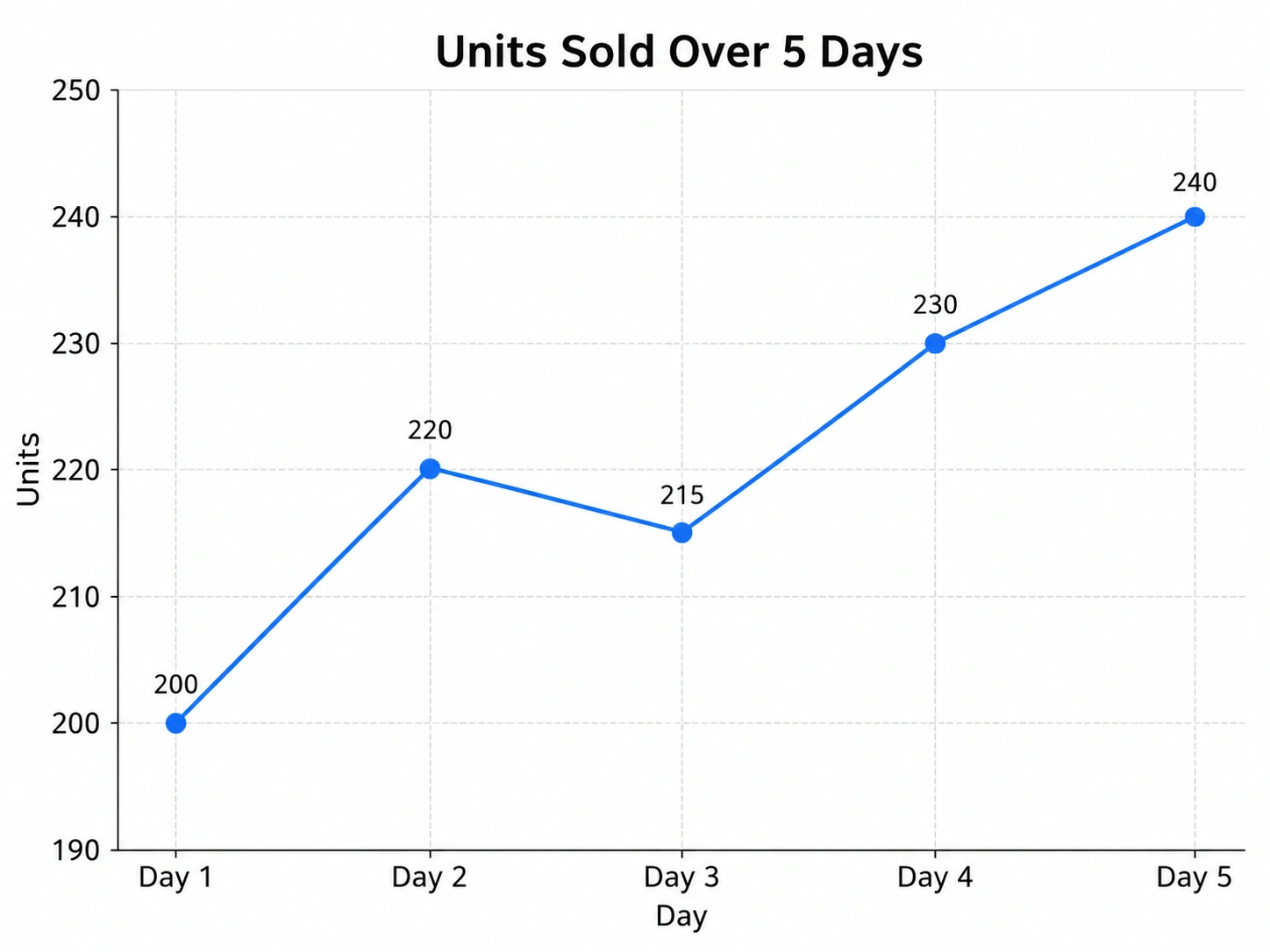
Autoregressive AI Model making predictions

An autoregressive model looks at these past sales values and tries to learn the relationship between them.

It may learn that sales today are strongly related to sales yesterday. It may also find that sales from two or three days ago still carry some useful signal.

Once the model learns this relationship, it can forecast Day 6.

This is useful because many real-world patterns have memory. Sales, stock prices, temperature, electricity usage, website traffic, and customer demand often depend on what happened recently.

Why Are Autoregressive Models Useful?

Autoregressive models are useful because they are simple, interpretable, and powerful for many forecasting problems.

They work especially well when recent history is a good predictor of the near future.

For example, if electricity consumption has been high for the past few hours, it may remain high in the next hour. If a stock has shown a certain pattern recently, traders may try to use that information for short-term forecasting. If a website has high traffic today, it may continue to have high traffic tomorrow.

Another advantage is explicability.

In many machine learning models, it can be hard to understand exactly why the model made a prediction. But autoregressive models are easier to explain because the prediction is directly tied to previous values.

We can look at the coefficients and understand how much each past value contributes to the prediction.

Where Are Autoregressive Models Used?

Autoregressive models are widely used in time series analysis.

Some common applications include:

  • Sales forecasting
  • Demand prediction
  • Stock price analysis
  • Weather forecasting
  • Economic forecasting

But autoregressive modeling is not limited to traditional time series.

It is also a key idea behind language models.

Autoregressive Models in Language Modeling

In natural language processing, autoregressive models generate text one token at a time.

A token can be a word, part of a word, or even a character, depending on the model. This is the central concept powering Large Language Models.
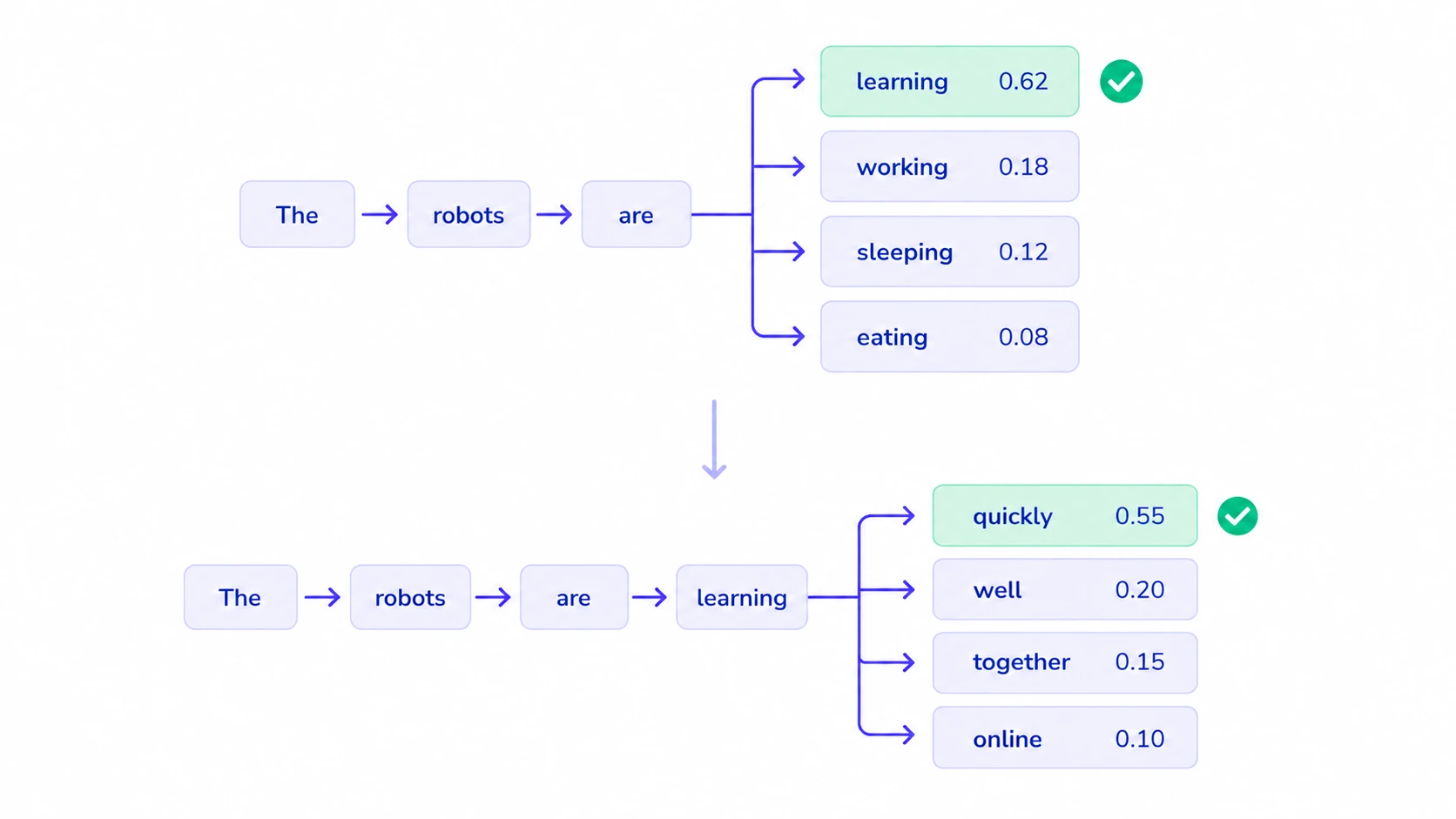
Text prediction by Autoregressive Models

For example, consider this sentence:

The cat sat on the

An autoregressive language model predicts the next token based on the previous tokens.

It may predict:

mat

Then the sentence becomes:

The cat sat on the mat

Now the model uses the updated sentence to predict the next token. This continues one step at a time.

The probability of a sentence can be written as:

P(w₁, w₂, w₃, …, wₙ) = P(w₁) × P(w₂ | w₁) × P(w₃ | w₁, w₂) × … × P(wₙ | w₁, …, wₙ₋₁)

This means each word is predicted based on the words before it.

The model does not generate the whole sentence at once. It builds the sentence step by step (sequentially), using previous tokens as context.

Autoregressive vs Non-Autoregressive Models

The difference between Autoregressive and Non-Autoregressive models are:

Point Autoregressive Models Non-Autoregressive Models
Generation One output at a time Multiple outputs at once
Dependency Depends on previous outputs Less dependent on previous outputs
Speed Slower Faster
Strength Captures sequence well Better for parallel generation
Example Predicts words token by token Generates several tokens together

Limitations of Autoregressive Models

Here are the limitations of Autoregressive Models:

  • Autoregressive models rely heavily on past values, so they may struggle when unexpected events occur.
  • A sudden sales jump due to a viral campaign may not be captured unless external variables are included.
  • A drop in demand caused by supply issues may not be understood from past demand values alone.
  • Traditional autoregressive models are mostly linear and assume the current value is a linear combination of past values.
  • Many real-world patterns are more complex, so advanced models like VAR, LSTMs, Transformers, and other deep learning models can be useful.

Conclusion

Autoregressive models remain one of the clearest ways to understand forecasting and sequence modeling. By learning from past values, they offer a simple yet powerful framework for predicting what comes next, whether in sales, sensor data, or language.

While they may miss sudden shocks, nonlinear behavior, or outside influences, their value as a starting point is undeniable. For anyone exploring time series or generative AI, they provide a strong foundation to build on.

TLDR: Autoregressive models use the past to predict the future.

I specialize in reviewing and refining AI-driven research, technical documentation, and content related to emerging AI technologies. My experience spans AI model training, data analysis, and information retrieval, allowing me to craft content that is both technically accurate and accessible.