




April has been a busy month in the world of AI. Two major AI models, hailing from the biggest AI companies of today, saw their debuts simultaneously. Anthropic was the first to drop Opus 4.7, and close to follow on its heels was OpenAI, which came out with its GPT-5.5. Though the leading models from their respective houses, both were launched to differing reactions from their users. Regardless, they claim to be the best AI brains of today, and that is exactly what we will put to the test here.
In this article, we shall compare the GPT 5.5 with Claude’s new Opus 4.7. We shall test both the models on their abilities across use-cases, to find the best fit for different types of workflows people usually rely on AI for. So without any further ado, let’s dive right in.
Let us begin with a brief introduction of both models for those unaware.
As mentioned, GPT-5.5 is OpenAI’s latest model, positioned as its smartest and most intuitive model yet. But beyond the usual launch adjectives, the real shift seems to be in how it handles work. This model is specifically designed to understand intent, plan the next steps, use tools when needed, and complete tasks with less hand-holding from the user.
That makes GPT-5.5 especially relevant for real-world workflows like research, coding, writing, analysis, and productivity tasks. You do not need to prompt it perfectly every time. It is better at picking up what you actually want and moving the task forward. So the promise here is simple: not just better answers, but better execution.
You can read more about GPT-5.5 here.
Claude Opus 4.7 is Anthropic’s latest frontier model, and unlike a minor upgrade, it appears to be built for heavier, more complex work. In its launch brief, Anthropic specifically positions the model for “most difficult tasks” so as to reduce the need for supervision. The biggest focus is on advanced software engineering, long-running tasks, and professional workflows where the model needs to follow instructions carefully and stay consistent.
Anthropic also claims major improvements in vision, real-world task handling, and memory. Opus 4.7 can apparently process higher-resolution images, making it useful for dense screenshots, diagrams, and document-heavy tasks. It is also said to perform better in areas like finance, legal, and knowledge work, while its improved memory helps across long, multi-session projects.
You can read more about the Claude Opus 4.7 here.
To give you a context of their prowess, here are the benchmark results of both.
With a look at their benchmark performances, let us try to understand what both models excel at.
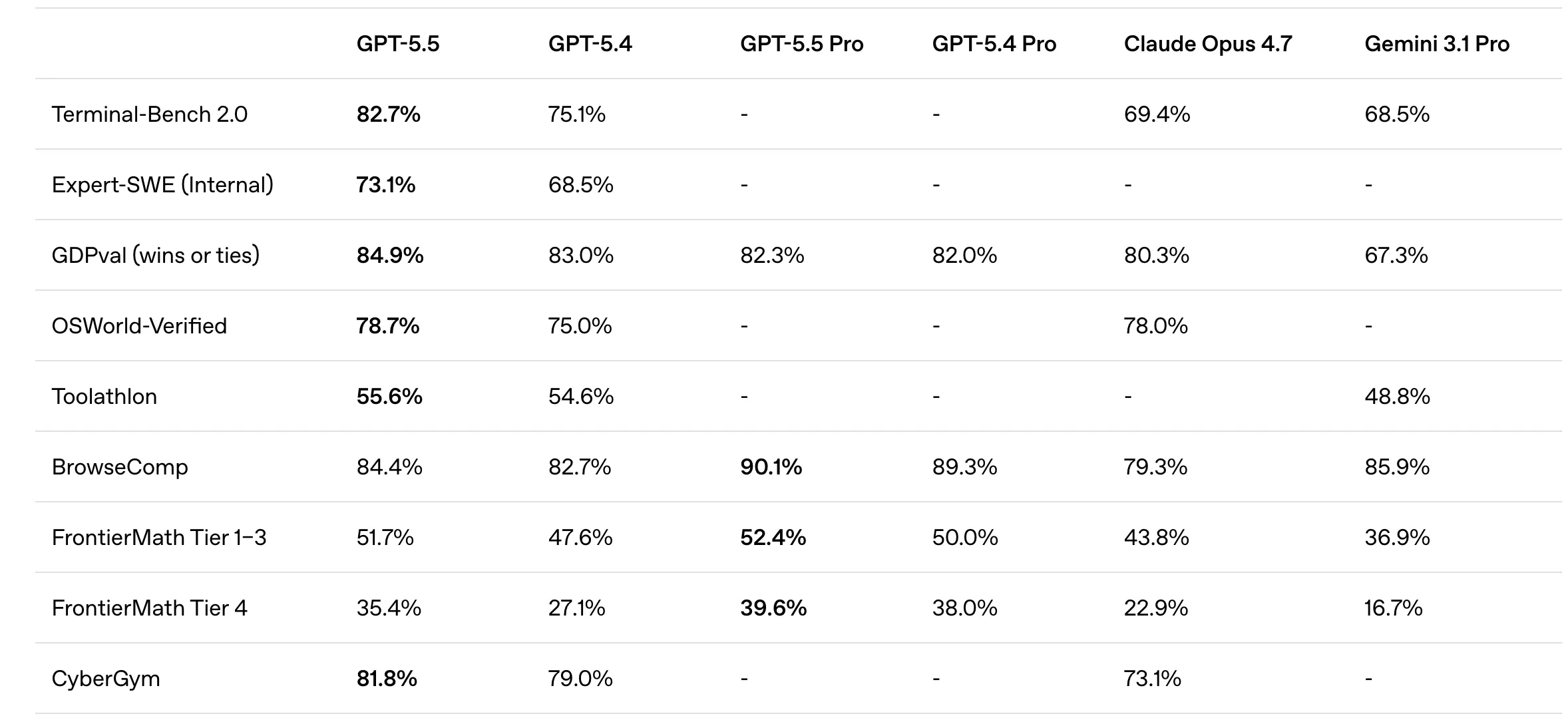
GPT-5.5 performs strongly across benchmarks that test real-world agentic work. It scores 82.7% on Terminal-Bench 2.0, 73.1% on Expert-SWE, 84.9% on GDPval, 78.7% on OSWorld-Verified, 55.6% on Toolathlon, and 81.8% on CyberGym. Its reasoning scores are strong too, with 51.7% on FrontierMath Tier 1–3 and 35.4% on FrontierMath Tier 4, while GPT-5.5 Pro goes even higher on harder maths and browser-based tasks. So the larger picture is clear: GPT-5.5 is built not just for better answers, but for coding, tool use, browser work, maths, and task execution.
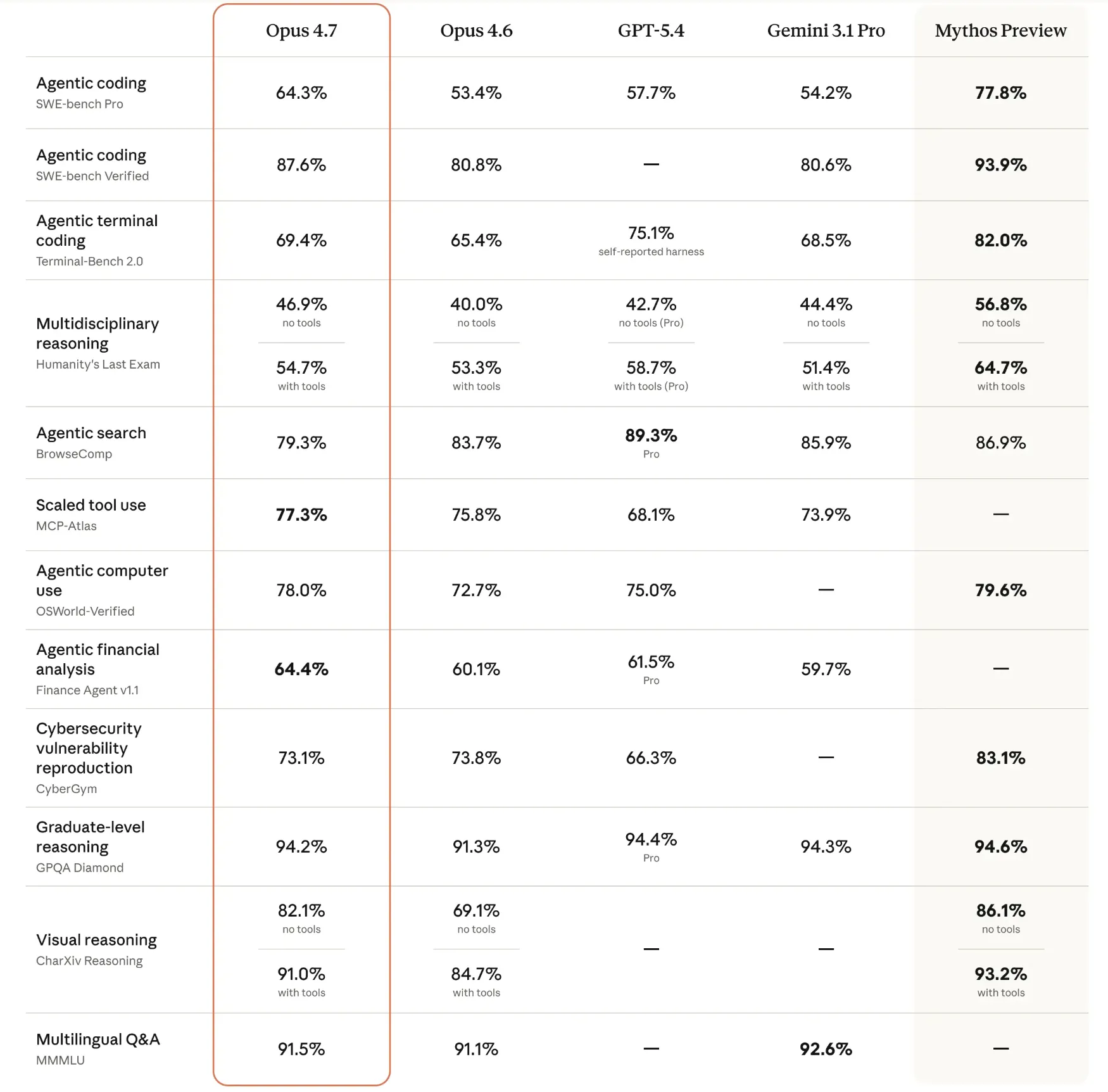
Claude Opus 4.7 also performs well across serious work benchmarks, especially in coding and reasoning-heavy evaluations. It scores 64.3% on SWE-bench Pro and 87.6% on SWE-bench Verified, showing strong software engineering ability. It also scores 69.4% on Terminal-Bench 2.0, 94.2% on GPQA Diamond, 91.5% on MMMU, and up to 91.0% on CharXiv visual reasoning with tools. These numbers suggest that Opus 4.7 is not just a conversational model either. It is a strong all-rounder for code, vision, search, research-style tasks, and professional workflows.
Looking at both models together, GPT-5.5 seems to have the edge in broader agentic execution, especially where browser use, tool workflows, terminal tasks, maths, and autonomous work matter. Opus 4.7, meanwhile, looks especially strong in software engineering, visual reasoning, and knowledge-heavy tasks. So the difference is not simply “which model is smarter”. GPT-5.5 appears better suited for end-to-end task execution, while Claude Opus 4.7 looks like a highly reliable work partner for coding, reasoning, and document-heavy professional tasks.
Based on this, let us evaluate the models in real-world tests to find out the better model overall.
Prompt:
A startup has ₹50 lakh in funding, 8 months of runway, and 3 possible revenue streams: SaaS subscriptions, enterprise consulting, and paid workshops. Build a 6-month priority plan and explain the trade-offs.
GPT 5.5 Output:
Opus 4.7 Output:
Observation:
Ok, so, having gone through the extensive answers, I’ve observed that the crux of both outputs is just about the same. Both models suggest SaaS subscriptions as a long-term goal, and enterprise sales to be instant money. They then proceed to give a month-wise distribution of all 3 sales channels in the best way that they can think of, which is, again, pretty much the same.
Honestly, I love the elaborate breakdown and understanding of things. Though if it were up to me, I might go a different route than they suggest (always enterprise-first). Nonetheless, if I were to compare the answers of both, the one by GPT 5.5 is way more elaborate and nuanced than what Opus 4.7 has come up with.
The instantly visible improvement is that GPT 5.5 has given a month-wise breakdown for the entire duration, complete with lists of Focus and Tasks for the month. It then proceeds to list the pros and cons of each of the 3 ways in the trade-offs section. While Opus 4.7 also shares information on the same, it simply does not hit the level of explanation that GPT 5.5 shows here.
Prompt:
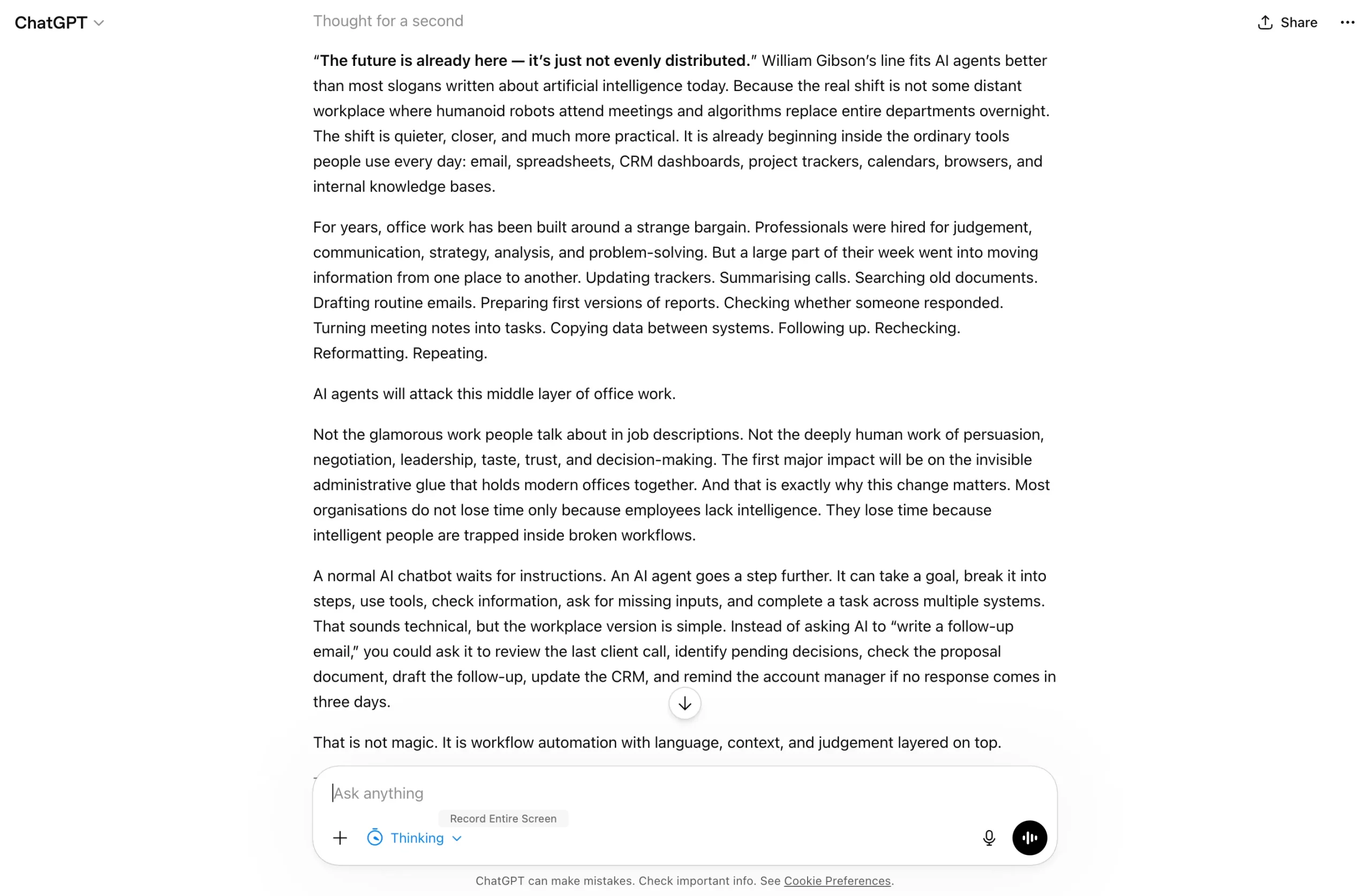
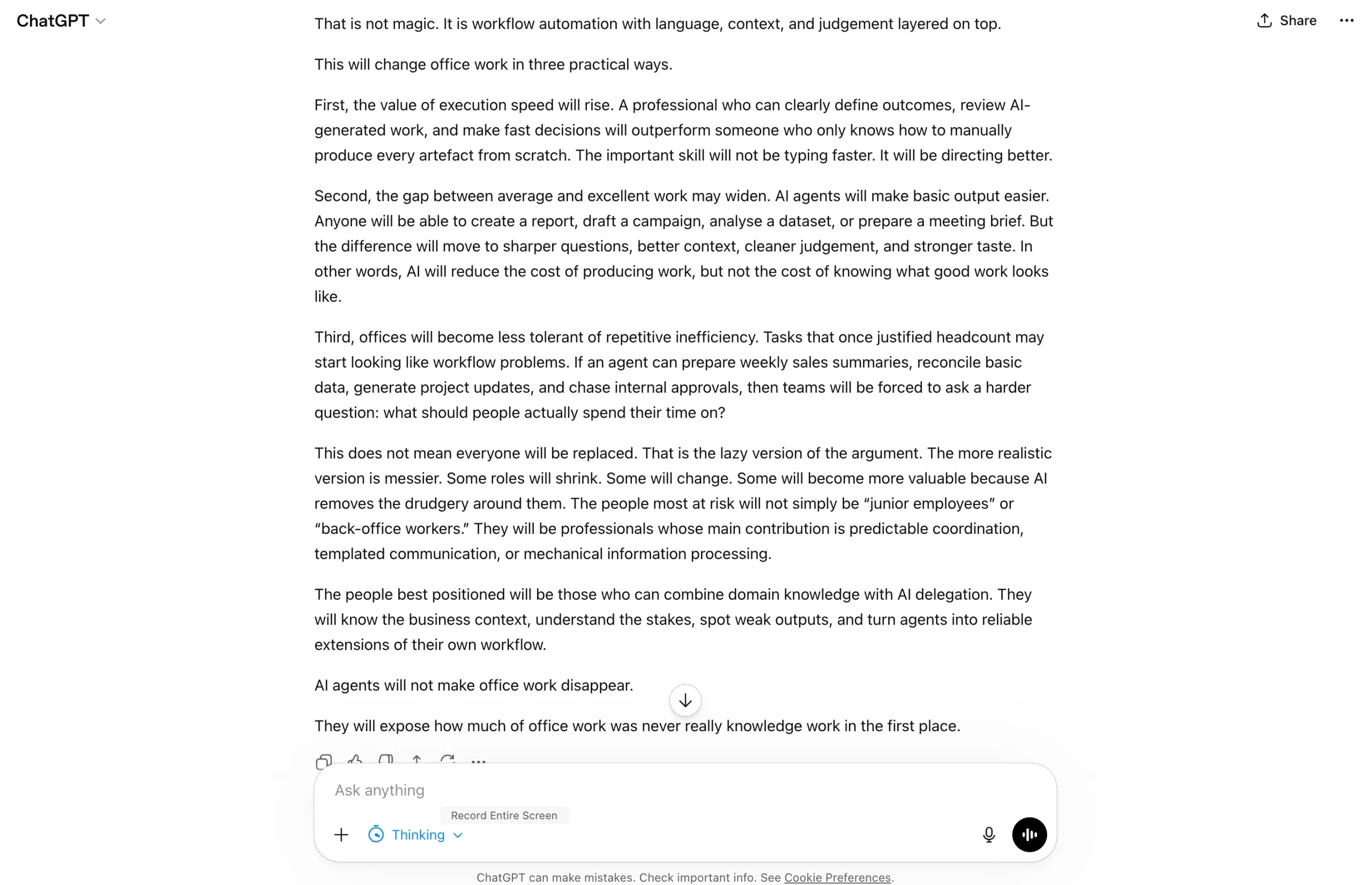
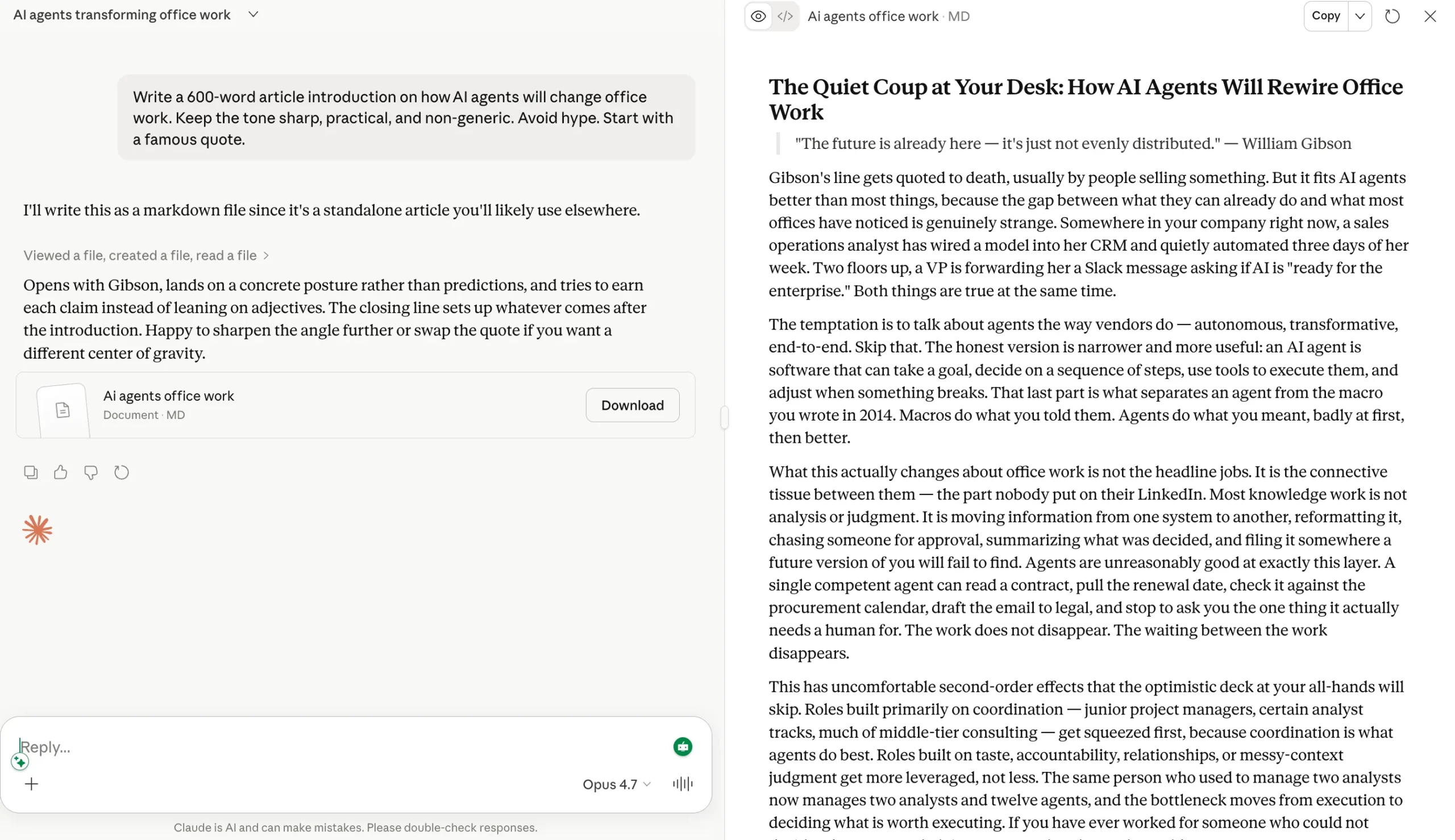
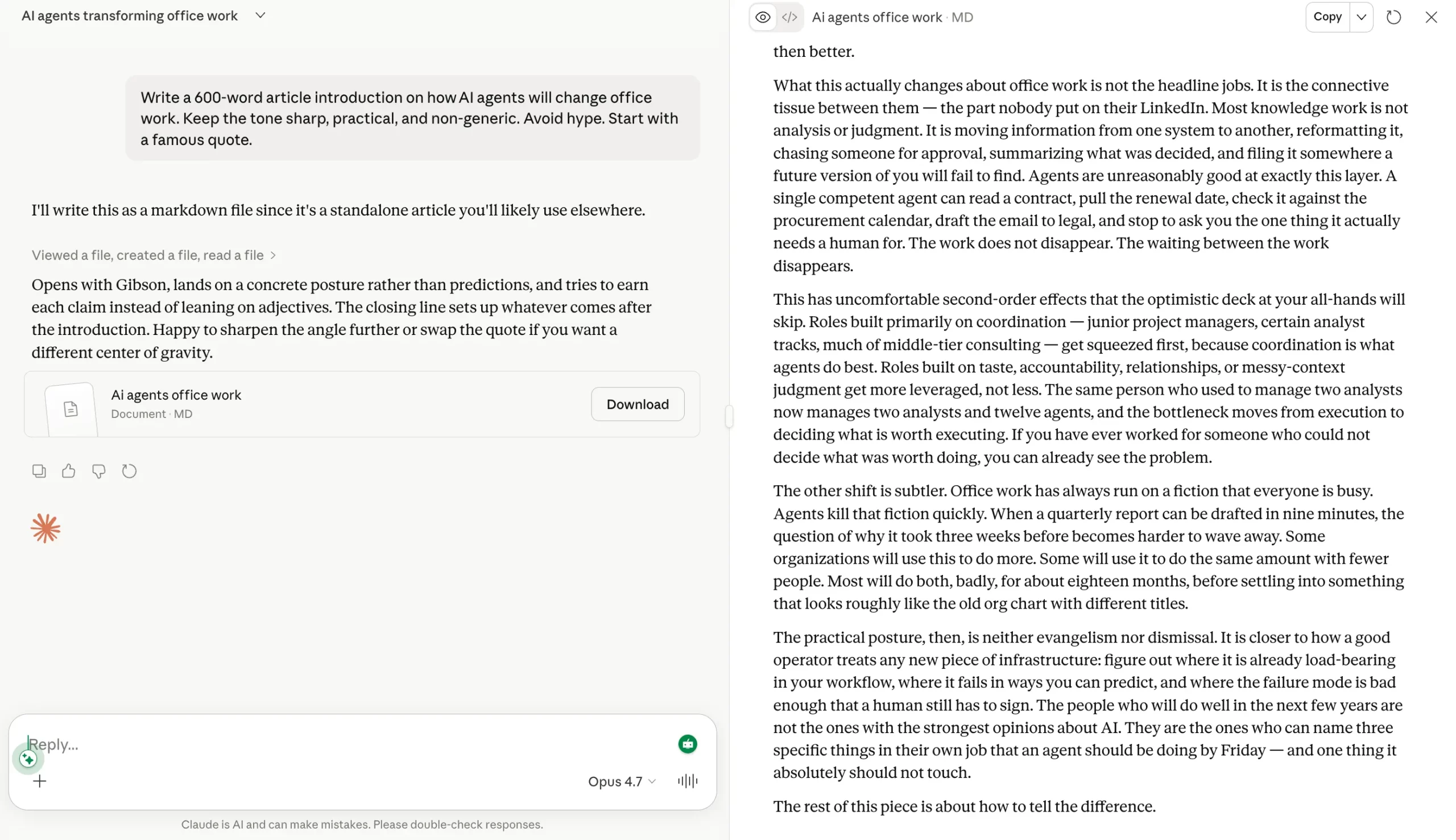
Write a 600-word article introduction on how AI agents will change office work. Keep the tone sharp, practical, and non-generic. Avoid hype. Start with a famous quote.
GPT 5.5 Output:
Opus 4.7 Output:
Observation:
What a coincidence we see here! Both models share the exact same quote by William Gibson to begin with. Goes on to show just how AI is trained across material.
As for the better writing prowess, Opus 4.7 clearly stands apart with its quirky write-up that resembles way more of a human than what the GPT 5.5 came up with. And as a writer who was using ChatGPT for all the writing help till now, I ask – why? Why was I not using Claude before?
Prompt:
Build a simple Python script that takes a CSV of customer complaints, classifies them into categories, counts frequency, and exports a summary report.
GPT 5:5 Output:
Opus 4.7 Output:
Observation:
Both models were able to churn up a working code for the problem at hand, complete with sample complaints and proper instructions to run the code. Yet, the output by Claude Opus 4.7 feels way more nuanced than what GPT 5.5 has given out. One look at the complaint identifiers used in both shows that the Opus 4.7 has taken into consideration a much larger variety of text that may correspond to complaints.
In addition, the Opus 4.7 output also contains more parse arguments so that we can use the input/ output files directly through the terminal, without making any changes in the code. The GPT 5.5 output completely misses that and has used pd.csv as a static.
Interestingly, Opus 4.7 was also ahead with its error handling, specifying a proper error instead of the typical code-written errors. e.g. we can see a ValueError within the code, which will appear whenever the user inputs the wrong data type.
Prompt:
Create a research plan to compare India’s EV two-wheeler market with China’s. Include sources to check, data points needed, and possible analysis angles.
GPT 5.5 Output:
Opus 4.7 Output:
Observation:
Both models have come up with a pretty extensive list of points to be noted for the research. I see that they have also followed all the instructions perfectly and responded with all the data points we asked for. Yet, I somehow lean towards the output by GPT-5.5, mostly because of its reasoning that accompanies each of the points in the form of “why it matters”, which gives a little context to the entire list, instead of it being just a list of points.
Prompt:
| Month | Revenue | CAC | Churn Rate | Conversion Rate |
|---|---|---|---|---|
| January | ₹8,00,000 | ₹2,400 | 4.2% | 3.8% |
| February | ₹9,20,000 | ₹2,650 | 4.5% | 3.6% |
| March | ₹10,10,000 | ₹2,900 | 5.1% | 3.4% |
| April | ₹10,80,000 | ₹3,300 | 5.8% | 3.1% |
| May | ₹11,20,000 | ₹3,850 | 6.4% | 2.9% |
| June | ₹11,60,000 | ₹4,300 | 7.2% | 2.6% |
Here is a table of monthly revenue, CAC, churn, and conversion rate. Analyse the business health, identify risks, and suggest next actions.
GPT 5.5 Output:
Opus 4.7 Output:
Observation:
Once again, both models do the job perfectly but differently, each in their own style. And once again, I like the style of GPT-5.5 way more in presenting the information in the way that it does. A clear example can be seen right in the beginning. While Opus 4.7 takes you through a journey within the output, GPT-5.5 tells you right away that the CAC is increasing way faster than revenue. Since this is one of the first things even a human will notice by looking at the table, I believe that is a job better done than any AI output.
Prompt:
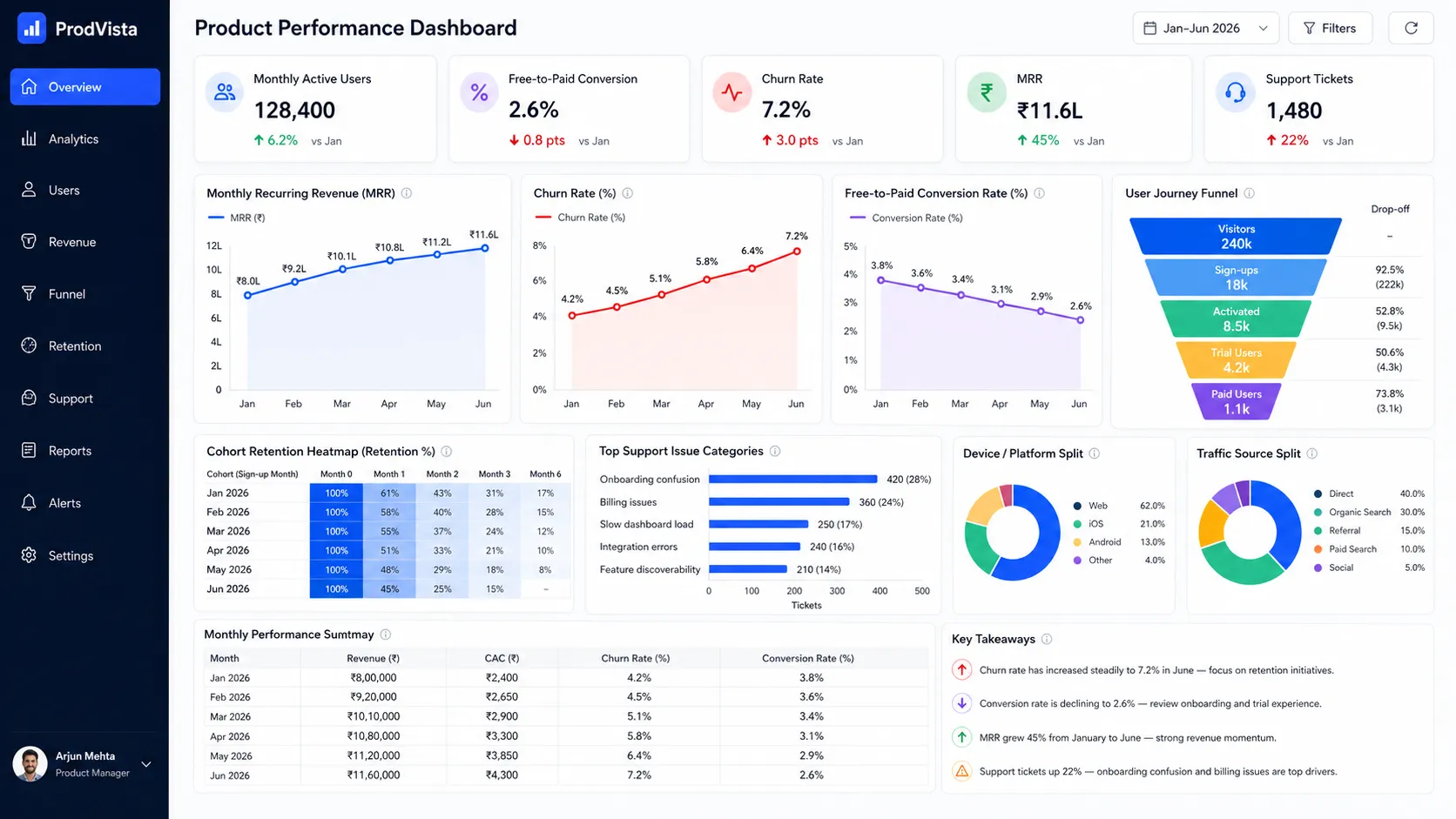
Analyse this product dashboard screenshot. Identify the main trends, possible problems, and what action the team should take next.
GPT 5.5 Output:
Opus 4.7 Output:
Observation:
Both models present a great output here, complete with the next steps to be performed as a solution. Once more, GPT-5.5 simply takes the additional brownie points thanks to its presentation, which is complete with tables, lists, and direct, easy-to-follow pointers for instant understanding.
Prompt:
I want to launch a niche AI newsletter in 30 days. Create a complete execution plan with daily tasks, tools required, content workflow, and monetisation path.
GPT 5:5 Output:
Opus 4.7 Output:
Observation:
Outputs from both GPT-5.5 and Opus 4.7 are just about similar, mentioning a detailed, day-wise breakup of what is to be done and how. Both have listed important tools that are sure to help along the process. I especially liked the phase-wise break-ups in each case, steadily building towards monetisation. One thing that stood out was that while Opus 4.7 lists day 1 for brainstorming around ideas, GPT-5.5 helped a bit more by actually presenting a variety of ideas right from the start, most of which sound extremely valid and useful. So that’s a big jump, right from the start. Other than that, you can follow either output for a successful, niche AI newsletter.
Also read: Top 20 AI Tools for Work: 10X Your Output
I will be lying if I said I prefer any one of these models over the other. In the GPT-5.5 vs Opus 4.7 battle, the only certainty is that the models will help you far more with your everyday work than AI ever did in the history of humankind. Their outputs, across all use cases, are a glaring testimony of how far AI has come.
As for which one is better, our tests conducted above suggest that both models have their own areas of expertise. While Claude Opus 4.7 is way better in coding and writing, GPT-5.5 takes the lead in most of the reasoning tasks and everyday workflows. Also, I personally prefer it over Claude for some simple and subtle reasons – it is more upfront and direct with the core query, its outputs are way more presentable and easier to understand, and best of all, it actually feels like a human counterpart, as this is exactly how natural conversations flow. You ask, and the person in front of you answers, specific to the query. A human does not give you an elaborate explanation of things just because.
And that is, or rather it should be, the end-goal with AI. A truly smart AI would understand exactly what the user wants from their query, and then respond appropriately. If it gives you an answer from the cumulative knowledge of the topic and you have to hunt for the solution within it, it beats the purpose of having an AI in the first place.
As for which one to use when, here is my final recommendation:
| Test Category | Better Performing Model |
|---|---|
| Reasoning Tasks | GPT-5.5 |
| Creative Writing | Opus 4.7 |
| Coding | Opus 4.7 |
| Research | GPT-5.5 (slightly better) |
| Data Analysis | GPT-5.5 / Opus 4.7 |
| Vision | GPT-5.5 / Opus 4.7 |
| Agentic Tasks | GPT-5.5 |
| Overall | GPT-5.5 is way more direct, presentable and easier to understand |
Which one do you prefer using? Let me know in the comments!
Technical content strategist and communicator with a decade of experience in content creation and distribution across national media, Government of India, and private platforms
此内容由惯性聚合(RSS阅读器)自动聚合整理,仅供阅读参考。 原文来自 — 版权归原作者所有。