惯性聚合 高效追踪和阅读你感兴趣的博客、新闻、科技资讯
阅读原文 在惯性聚合中打开

推荐订阅源

P
Palo Alto Networks Blog
A
Arctic Wolf
T
Tor Project blog
V2EX - 技术
V2EX - 技术
T
Troy Hunt's Blog
cs.CL updates on arXiv.org
C
CXSECURITY Database RSS Feed - CXSecurity.com
Scott Helme
Scott Helme
Cyberwarzone
Cyberwarzone
NISL@THU
NISL@THU
C
Cyber Attacks, Cyber Crime and Cyber Security
Project Zero
Project Zero
Know Your Adversary
Know Your Adversary
Attack and Defense Labs
WordPress大学
WordPress大学
Recorded Future
Recorded Future
C
Cybersecurity and Infrastructure Security Agency CISA
Recent Commits to openclaw:main
小众软件
小众软件
T
Threatpost
Threat Intelligence Blog | Flashpoint
Hugging Face - Blog
Hugging Face - Blog
博客园 - 聂微东
S
SegmentFault 最新的问题
C
CERT Recently Published Vulnerability Notes
Google Online Security Blog
L
Lohrmann on Cybersecurity
V
Vulnerabilities – Threatpost
Spread Privacy
Spread Privacy
爱范儿
爱范儿
V
V2EX
腾讯CDC
T
The Exploit Database - CXSecurity.com
Apple Machine Learning Research
The Cloudflare Blog
罗磊的独立博客
月光博客
月光博客
博客园 - 司徒正美
阮一峰的网络日志
阮一峰的网络日志
T
Tailwind CSS Blog
云风的 BLOG
云风的 BLOG
Vercel News
Vercel News
T
Threat Research - Cisco Blogs
MongoDB | Blog
MongoDB | Blog
M
MIT News - Artificial intelligence
Cyber Security Advisories - MS-ISAC
T
Tenable Blog
Simon Willison's Weblog
G
GRAHAM CLULEY
美团技术团队

Analytics Vidhya

Handling Imbalanced Classification: What Works Better Than SMOTE GPT-5.6 Is Here: Sol, Terra, and Luna Loop Engineering for AI Agents: How /loop is Changing AI Workflows DeepSeek DSpark: The Speculative Decoding Trick Behind 400% Faster LLM OKF: Redefining Knowledge Bases for AI Agents Modern VLMs Explained: How GPT-4o, Gemini, Claude Vision, and Qwen-VL Work YOLO26 Tutorial: Object Detection, Pose Estimation & More Large Action Models (LAMs) vs Agentic LLMs: What's the Real Difference? Claude Sonnet 5: The Fable 5 at Home The Best $20 AI Plan: ChatGPT Plus vs Claude Pro vs Gemini Pro GraphRAG vs Vector RAG: Which Retrieval Method is Best? Using AI When You Don’t Trust AI The Self-Improving Loop in AI Agents: Architecture, Benefits, and How it Outperforms Traditional Agent Workflows Harness-1: The 20B Retrieval Subagent That Beats GPT-5.4 at Search Sakana Fugu: Multi-Agent System as a Model Claude's Hidden Art Skill: Making Illustrations With Code System Design for ML Interviews: 10 Real Problems Walked Through Most People Use ChatGPT Wrong: 10 Features and Tips That Changed How I Work OpenAI Just Launched 3 Free AI Courses with Certificates Autoregressive Models: Predicting the Future Using the Past Gemini Omni: AI Video Generation Inside Gemini DiffusionGemma: Google’s Diffusion-Based Open Model for Faster Text Generation Top 10 AI Engineering Tools Everyone is Using in 2026 I Tested Claude Fable 5: Can Anthropic’s Newest AI Deliver on the Hype? Prophet vs NeuralProphet vs TimeGPT vs Chronos: A Practical Comparison Build an Emergency Helpline Voice Agent with LangChain Choosing the Right Vector Database for RAG and AI Applications Google Gemma 4 12B: Architecture, Benchmarks, Access, and Hands-on Guide for Developers How to Choose the Right AI Model for Your Needs Agent Observability with LangSmith, Langfuse, and Arize: A Hands-On Comparison How to Use Claude Managed Agents? Google AI Studio vs Gemini App: What’s the Difference? AI Workflows for Sales Teams: Prospect Research, Lead Qualification, and CRM Updates on Autopilot Using LangGraph 25 Most Influential AI Pioneers to Meet at DataHack Summit 2026 Claude Opus 4.8: A Smarter Model in the Right Direction PySpark Optimization: 12 Proven Techniques to Speed Up Your Spark Jobs 10 Everyday Tasks You Can Automate with AI Today (With n8n Templates) Google Antigravity 2.0: The Full Developer Guide (I/O 2026) Build a Claude Cowork-Like Browser Agent Using Playwright MCP and Claude Desktop Pandas vs Polars vs DuckDB: Which Library Should You Choose? Qwen3.7-Max: Alibaba’s New Agent-First LLM for Coding, Reasoning, and Long-Horizon AI Workflows The Biggest Announcements from Google I/O 2026 Top 9 AI Events and Conferences in 2026 that you Must Attend Gemini 3.5 Flash: Frontier Intelligence with Speed Kimi WebBridge: Hands-on Guide to Kimi’s Browser Extension for AI Agents 40 Advanced SQL Window Functions Every Data Scientist Must Know(with examples) Top 10 AI Research Papers of 2025 6 Steps to Crack GenAI Case Study Interviews (With Real Examples) OpenAI Omni Moderation: How to Filter Text & Images for Free DataHack Summit 2026: You Just Cannot Skip This AI Event of the Year OpenAI’s New API Voice Models Will Change the Way You Use AI Hermes Agent Guide: What is it and How to Use it? Top 10 LLM Research Papers of 2026 Agent Memory Patterns in Cognitive Science and AI Systems 10 AI Agents Every AI Engineer Must Build (with GitHub Samples) 23 Tips for Smart Claude Code Token Saving and Workflow Optimization Feature Engineering with LLMs: Techniques & Python Examples ChatGPT is Now Inside Excel and Google Sheets: Here is How to Use it Gemini API File Search: The Easy Way to Build RAG Top 10 Open-Source Libraries to Fine-Tune LLMs Locally ML Intern in Practice: From Prompt to a Shipped Hugging Face Model 15+ Solved Agentic AI Projects with Github Links How People are Figuring Out Life With Claude MemPalace Explained: Building Long-Term Memory for AI Agents Beyond RAG Grok Voice Think Fast 1.0: Build Voice AI Agents That Actually Think Compressing LSTM Models for Retail Edge Deployment: A Practical Comparison MCP vs Agent Skills: Different Altogether GPT 5.5 vs Opus 4.7: Which is the Best AI Model Today? What is Agentic AI? Claude Code vs Codex: A Detailed Terminal Agent Comparison Google Deep Research Max: Build Autonomous AI Research Agents in Minutes Meta Muse Spark Review: Is It Worth the Hype? ChatGPT Images 2.0 vs Nano Banana 2: Which is Better? Cursor V3 Explained: The AI Coding Agent That’s Replacing Traditional IDEs in 2026 DeepSeek-V4: The Most Powerful Open-Source Model Ever Is GPT Image 2 the Best Image Generation Model? Token Economics: Why AI is Getting “Cheaper” From Idea to Output: Claude Does the Design Work Opus 4.7 vs Opus 4.6: Should You Switch? Build Human-Like AI Voice App with Gemini 3.1 Flash TTS How to Structure a Claude Code Project that Thinks Like an Engineer Gemma 4 Tool Calling Explained: Build AI Agents with Function Calling (Step-by-Step Guide) Top 28 Claude Shortcuts that will 10X your Speed GPT-5.4-Cyber: Why OpenAI is Keeping its Most Powerful Model Under Lock and Key Google AI Studio Guide: Every Feature Explained Mastering Deep Agents: Context Engineering that Actually Works 21 Computer Vision Projects from Beginner to Advanced (2026 Guide) Excel 101: Excel Agent Mode Explained MiniMax M2.7 Goes Open-Weight to Let You Run Agents Locally Top 10 Gemma 4 Projects That Will Blow Your Mind GLM-5.1: Architecture, Benchmarks, Capabilities & How to Use It Understanding BERTopic: From Raw Text to Interpretable Topics From Karpathy’s LLM Wiki to Graphify: AI Memory Layers are Here 10 Most Important AI Concepts Explained Simply Project Glasswing is World’s Most Powerful AI in Action How to Run Gemma 4 on Your Phone Without Internet: A Hands-On Guide Running Claude Code for Free with Gemma 4 and Ollama LLM Wiki Revolution: How Andrej Karpathy’s Idea is Changing AI Rethinking Enterprise Search: How Cortex Search Turns Data into Business Impact Google’s Gemma 4: Is it the Best Open-Source Model of 2026?
Anthropic Launches Claude Opus 4.7 For “Most Difficult Tasks”
Sarthak Dogr · 2026-04-17 · via Analytics Vidhya

Artificial intelligence is rapidly developing. The minute we become accustomed to one breakthrough, another comes to shift our expectations. The new model, Claude Opus 4.7, that Anthropic introduced recently, is one such shift. The release tends to go beyond mere AI chatbots and makes AI a trusted, independent digital partner. Even for developers and professionals, this update will be a very big gain in advanced software engineering and solving complex problems.

Just why, and what is different about the new Claude Opus 4.7? That is what we are here to find out.

Claude Opus 4.7 vs Opus 4.6: What’s New

First things first, the Opus 4.7 is not a simple tune-up. The recent model of Anthropic is devoted to frontier performance. This implies that it addresses the jobs that previously had to be under human supervision. The improvements are visible across these broad areas.

Advanced Software Engineering

Opus 4.7 is now capable of supporting long-term, complicated projects in code. It is not a line-by-line code generator but built for the “most difficult tasks.” Because of this, Anthropic says that users have reported less supervision requirement on Opus 4.7 over Opus 4.6, even with their hardest coding work.

There are three main advantages here that make Opus 4.7 way better than its outgoing counterpart. First, it handles complex tasks that take time with “rigor and consistency.” Which means you can lean back and rely on the model for a more accurate outcome.

It also pays precise attention to instructions given for any task, which means you can be assured of Opus 4.7 following your set guidelines. Third and most importantly, Opus 4.7 finds out ways to verify its own outputs before reporting back. Now that is an additional layer that never existed with the Opus 4.6

Better Vision

Opus 4.7 also promises substantially better vision than the Opus 4.6. This means that the new Claude model can see images in greater resolution. In numbers, this is up to 2,576 pixels on the long edge, or nearly 3.75 megapixels. Note that this is over three times as many megapixels as prior Claude models.

So what does this mean? Think data extraction from dense screenshots and complex diagrams, and more such professional work with way higher accuracy.

Improved Real-world Work

In Anthropic’s internal testing, it found Opus 4.7 to be way better than Opus 4.6 in almost all areas of real-world tasks. For instance, it proved to be a better finance analyst, “producing rigorous analyses and models, more professional presentations, and tighter integration across tasks.”

Even in a third-party evaluation, Opus 4.7 outperformed the 4.6 version in doing knowledge work of economic value. This improvement was visible across sectors like finance, legal, and other domains.

Memory

Anthropic says that its latest model is better at using file system-based memory. This means that the Opus 4.7 is able to remember important notes across “long, multi-session work.” Needless to say, this holds its own importance anytime you plan to start a new task. Because with such memory, you need less up-front context whenever directing the AI model to a new job.

Claude Opus 4.7: Technical Features

These new capabilities in Opus 4.7 are driven by a number of technical improvements. These properties provide developers with additional functionality and increase the sensory input of the model.

  • High-Resolution Vision: A significant improvement, the Claude Opus 4.7 is the first Claude model to be able to support high-resolution vision. It has the capability of processing images of up to 2576 pixels along the long side. This enables it to interpret complex technical drawings, thick spreadsheets, and financial graphs far more precisely.
  • High Effort Level: A new API setting allows users to select a reasoning level of “high” to max effort. This gives finer control of the balance between depth and speed of response to complex tasks.
  • Claude Code Improvements: The new /ultrareview slash command generates a special review session that reads changes and identifies bugs and design problems that would be noticed by a vigilant reviewer. Pro and Max Claude Code users get three free ultrareviews to try it out. Moreover, auto mode has been added to Max users. Auto mode is a new permissions feature where Claude decides on your behalf. This means you can run longer processes with fewer interruptions and with less risk than you would have done with all permissions off.
  • Improved Tokeniser: The new model by Anthropic has an improved tokeniser to process text. Although this does have the potential to make token usage slightly more, Anthropic claims it enhances overall task success.
  • Task Budgets: Developers creating agentic workflows can now establish a token limit on the amount of money spent on long-running tasks with this beta feature. This assists the AI in focusing on its work effectively without incurring unforeseen expenses.

Claude Opus 4.7: Benchmark Performance

Claude Opus 4.7 looks strongest where real-world agentic work begins to matter. It posts 64.3% on SWE-bench Pro and 87.6% on SWE-bench Verified, which places it ahead of GPT-5.4, Gemini 3.1 Pro, and Opus 4.6 on software engineering tasks in this chart. It also does well on Terminal-Bench 2.0 at 69.4%, suggesting solid performance in terminal-based coding workflows, although GPT-5.4 is shown higher there at 75.1% under a self-reported harness. Beyond coding, Opus 4.7 stays competitive across reasoning-heavy tasks too, scoring 94.2% on GPQA Diamond, 91.5% on MMMU for multilingual Q&A, and 82.1% / 91.0% on CharXiv visual reasoning without and with tools, respectively. In simple terms, this model is not just good at chat-style reasoning, but also reliable across code, vision, search, and research-style evaluation.
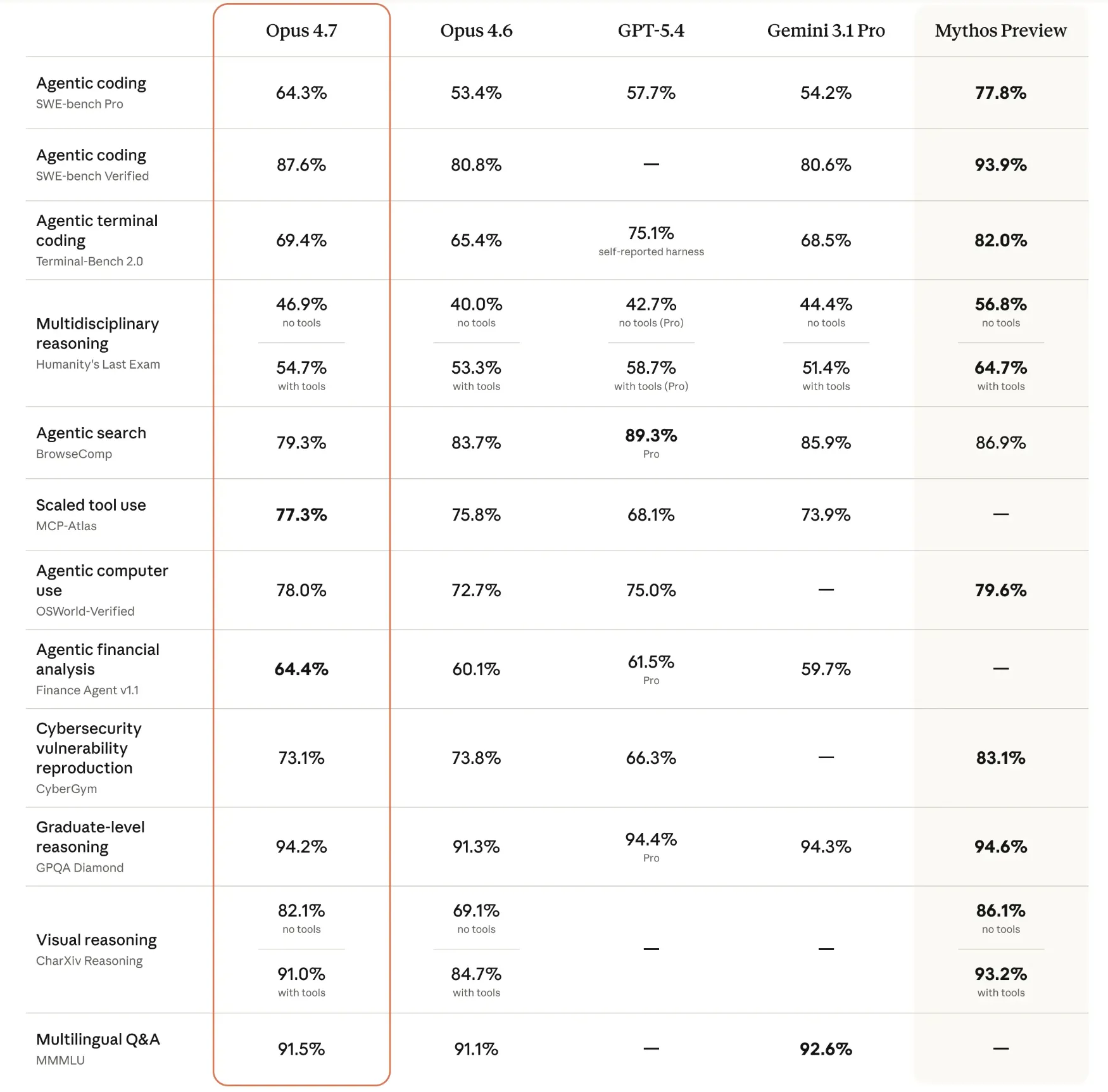
Claude opus 4.7 Benchmark Score (Source: Anthropic)

That said, the chart also shows where Opus 4.7 is not outright dominant. GPT-5.4 leads BrowseComp at 89.3%, so Claude is not the top pick here for agentic search. On Humanity’s Last Exam, Opus 4.7 performs strongly at 46.9% without tools and 54.7% with tools, but Mythos Preview and GPT-5.4 score higher. So the broader takeaway is clear: Claude Opus 4.7 looks like a very strong all-rounder with particular strength in coding and tool-using workflows, even if it is not the chart leader in every single benchmark.

Safety First: Project Glasswing and Cyber Safeguards

With great power comes great responsibility. The newest model by Anthropic was launched as part of the safety project, named Project Glasswing. The project makes sure that powerful AI like this model is created and implemented conscientiously.

The first model that provides a high-risk cybersecurity request detection is Opus 4.7, which detects hacking or vulnerability analysis requests. Anthropic has also launched a Cyber Verification Program. Under this program, legitimate security professionals have access to the full capabilities of this model in a defensive manner. This is an expression of safety as a fundamental characteristic and not an appendix.
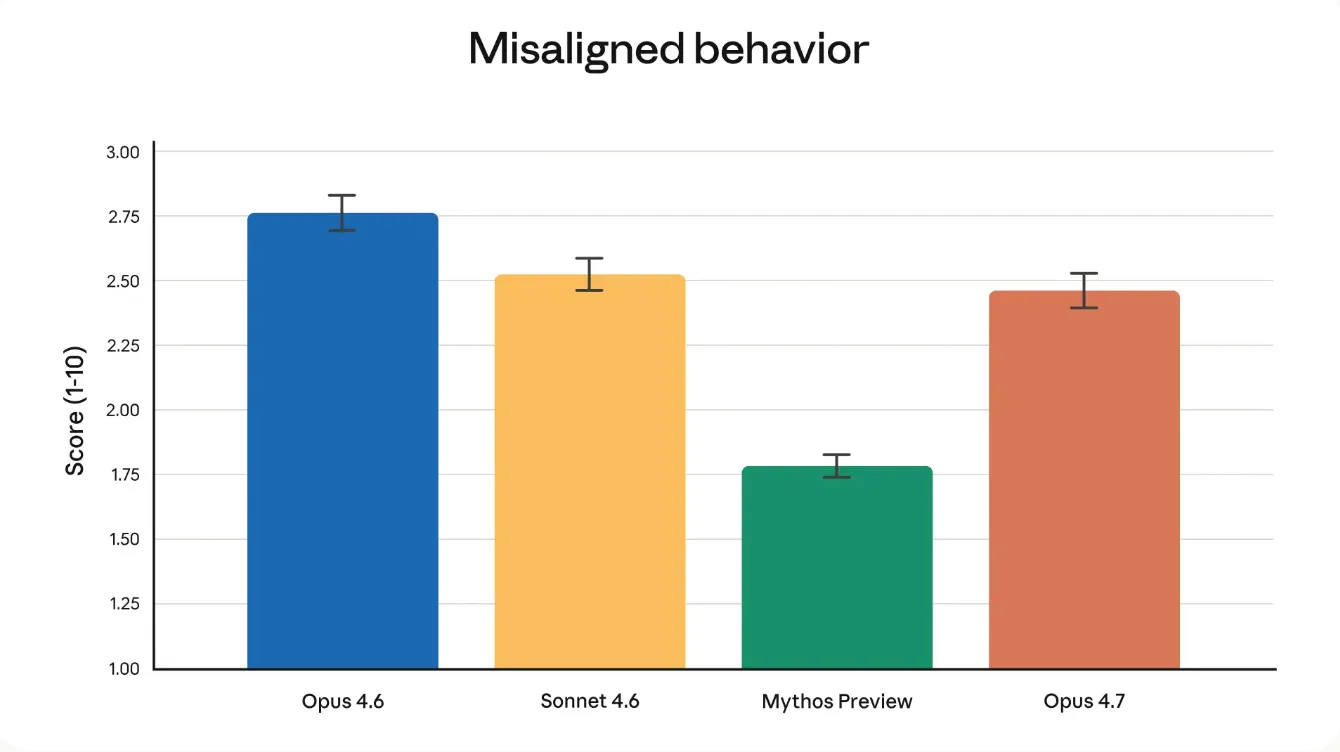
Overall misaligned behavior score from Anthropic’s automated behavioral audit. (Source: Anthropic)

Claude Opus 4.7: Availability and Pricing

The model can be accessed on all standard platforms:

  • Platforms: Claude.ai, Claude API, Amazon Bedrock, Google Cloud Vertex AI, Microsoft Foundry, and GitHub Copilot.
  • Pricing: The same price as Opus 4.6 (5/ million input tokens / 25/ million output tokens).[2]
  • Optimisation: Optimisation is supported at launch: Prompt caching (up to 90% savings) and batch processing (50% savings).

Hands-On with Claude Opus 4.7

Let’s see the model in action. Here are two examples of how you might use its new skills.

1. Chatbot Example: The Market Research Analyst

Imagine you need a quick analysis of a new market trend. You can assign Claude Opus 4.7 a specific role.

Prompt:

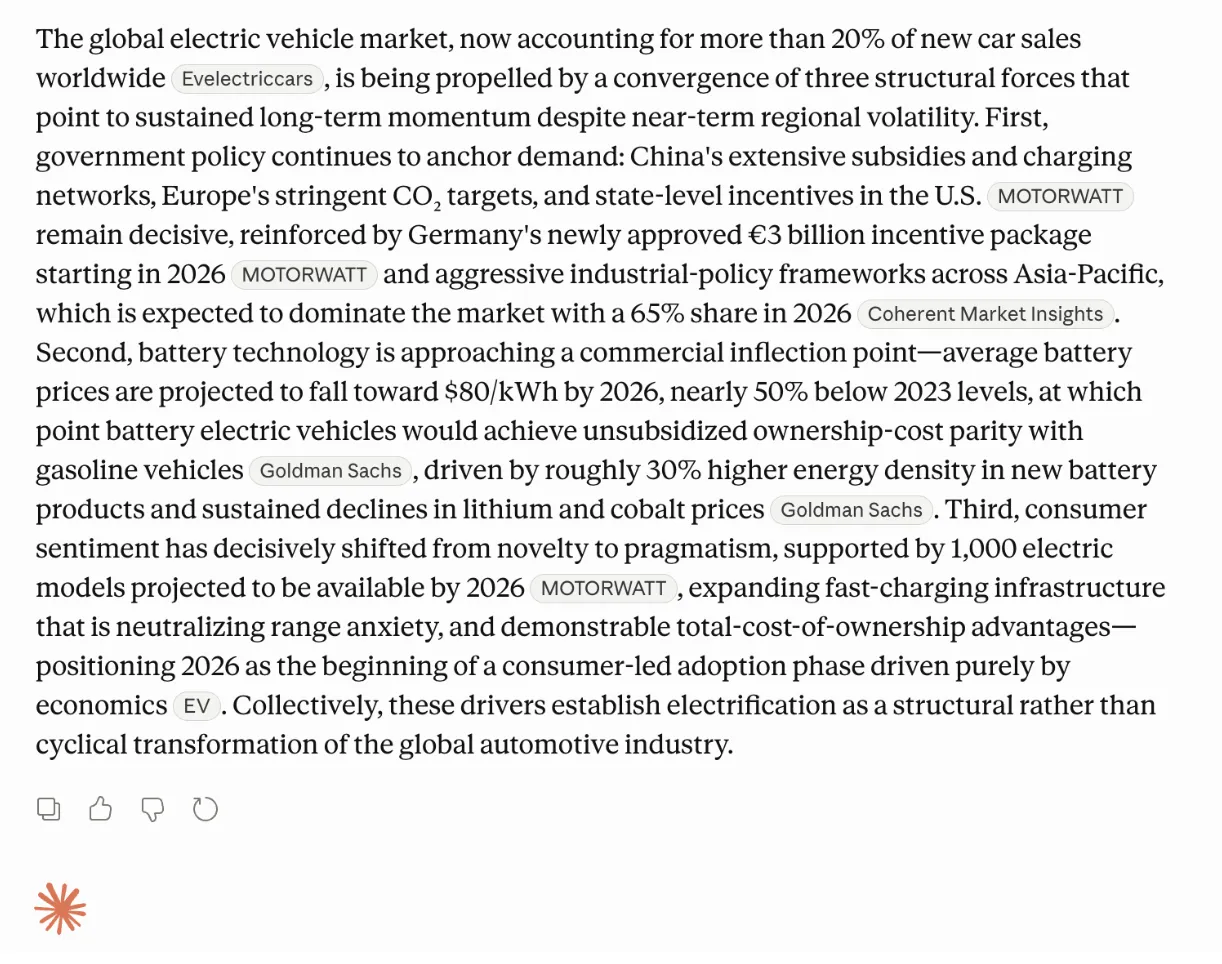
Act as a senior market research analyst. I need a concise, one-paragraph summary of the key growth drivers for the global electric vehicle (EV) market for an executive presentation. Focus on government incentives, battery technology advancements, and consumer sentiment. Use professional, confident language.

Output:
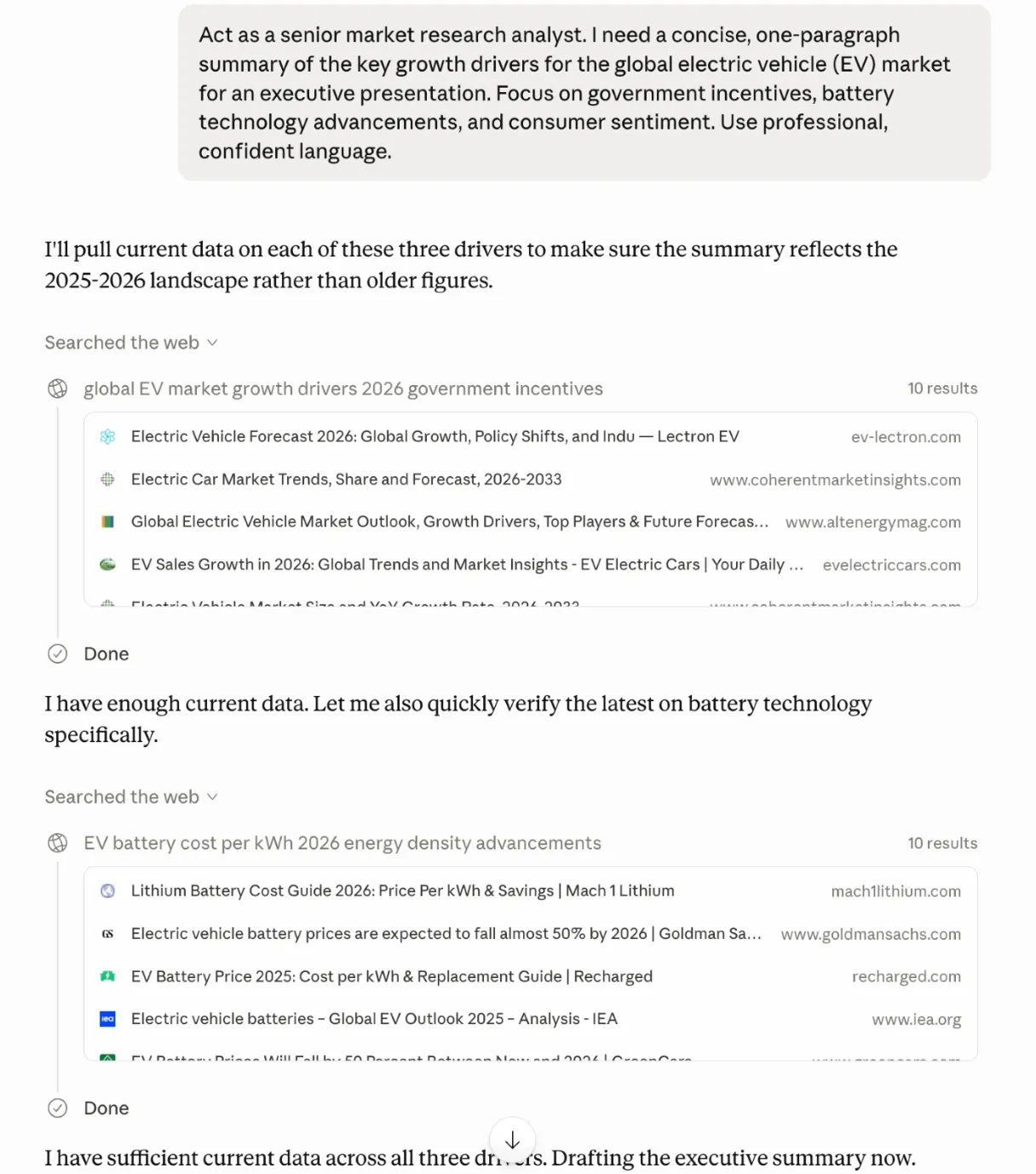
  • Claude Opus 4.7 hands-on
  • Claude Opus 4.7 hands-on

2. Coding Example: Building a Web App with Claude Code

Here, we’ll ask the model to perform an advanced software engineering task: creating a simple but complete web application.

Prompt:

Create a single HTML file for a “Project Time Tracker” web application. Use vanilla JavaScript and basic CSS. The app should have:

  1. An input field for a project name.
  2. A “Start Timer” button that records the start time.
  3. A “Stop Timer” button that calculates and displays the elapsed time for that project.
  4. A list below the controls where each completed project and its duration are displayed.

Output:

This code is clean, functional, and well-structured, showcasing the model’s ability to handle a complete, multi-part task correctly. The output is minimal, working, and simply perfect.

Conclusion

Claude Opus 4.7 is not an incremental update. It is a bold move towards highly specialised, autonomous AI which specialists can trust. The new Anthropic model is made to work with its advanced code-following, accuracy in following instructions, and strong vision. The emphasis on safety and control helps users to have confidence in using it in complicated systems. With the further development of AI, such models will not be used as tools but rather as a necessary part of the team.

Frequently Asked Questions

Is Claude Opus 4.7 available now?

Yes, it is available immediately on Claude.ai, the Claude API, and through cloud partners like Amazon Bedrock and Google Cloud Vertex AI.

Does Claude Opus 4.7 cost more than the previous version?

No, the pricing remains the same as Opus 4.6. However, the new tokenizer may cause a slight increase in token count for the same input.

What is the main benefit of high-resolution vision?

It allows the model to accurately read and interpret dense visual information like technical diagrams, financial reports, and detailed user interfaces.

How is this model safer for cybersecurity tasks?

It has built-in detectors to block high-risk cybersecurity requests and offers a verification program for legitimate security professionals to use its capabilities defensively.

Do I need to change my existing prompts for this model?

It is a good idea to review them. The model is more literal, so you should ensure your instructions are clear and specific to get the best results.

Technical content strategist and communicator with a decade of experience in content creation and distribution across national media, Government of India, and private platforms