Depending on which chatbot you ask, Elias Thorne might be a clockmaker, a lighthouse keeper, or a librarian. But if you ask ChatGPT or any of the other popular large language models to tell you a story, there’s a good chance he’ll appear, unbidden. And Elias’s stories are flooding the self-published AI generated book market, Youtube, and fake news sites.
Software engineer Daniel May first noticed the Elias takeover earlier this year; he found that on Google Trends, people weren’t searching for “Elias Thorne” until late 2025. Searches for the name really spiked in early 2026, while the related query “lighthouse keeper” also started trending upward in the last few years. He tested a few chatbots, including Grok, Deepseek, and Gemini, with the prompt “tell me a story,” and the chatbots frequently started with similar stories about lighthouses, clockmakers, or explorers.
In late May, researchers Sil Hamilton and David Mimno at Cornell University’s Department of Information Science published their paper, “Elias in the Lighthouse, Again?” on the preprint repository arXiv. They sampled 20,000 total stories from OpenAI’s ChatGPT, Anthropic’s Claude, and Google’s Gemini, and the Allen Institute for AI's chatbot using five prompts, and found that the same 11 words—names like Elias, Mara, and Elara, and occupations like lighthouse keeper, clockmaker, and librarian—appear in more than 88% of generated stories, with little difference between models. Unite.ai covered the study shortly after it was published.
The researchers posit in their paper that these themes show up so often in part because of the models’ safety and alignment tuning. “Model development today is like a big family tree. Most models are related to each other because developers synthesize a lot of training data with models even from different companies,” Hamilton told me in an email. He, Mimno, and their colleague Rebecca M. M. Hicke found this in a 2025 paper where they looked at specific words used across models. OpenAI’s first ChatGPT model, GPT-3.5, is the root of the family tree because it was used to make WildChat, a training set that’s since been used to make other training sets. “WildChat contains 1 million real conversations with ChatGPT, and 166 of these contain the name ‘Elias’ like here and here,” Hamilton added. “These are written in that familiar ‘lighthouse’ style. Models trained on WildChat copied this style, and developers unwittingly replicated it when using those models to generate newer datasets. It's like a virus.”
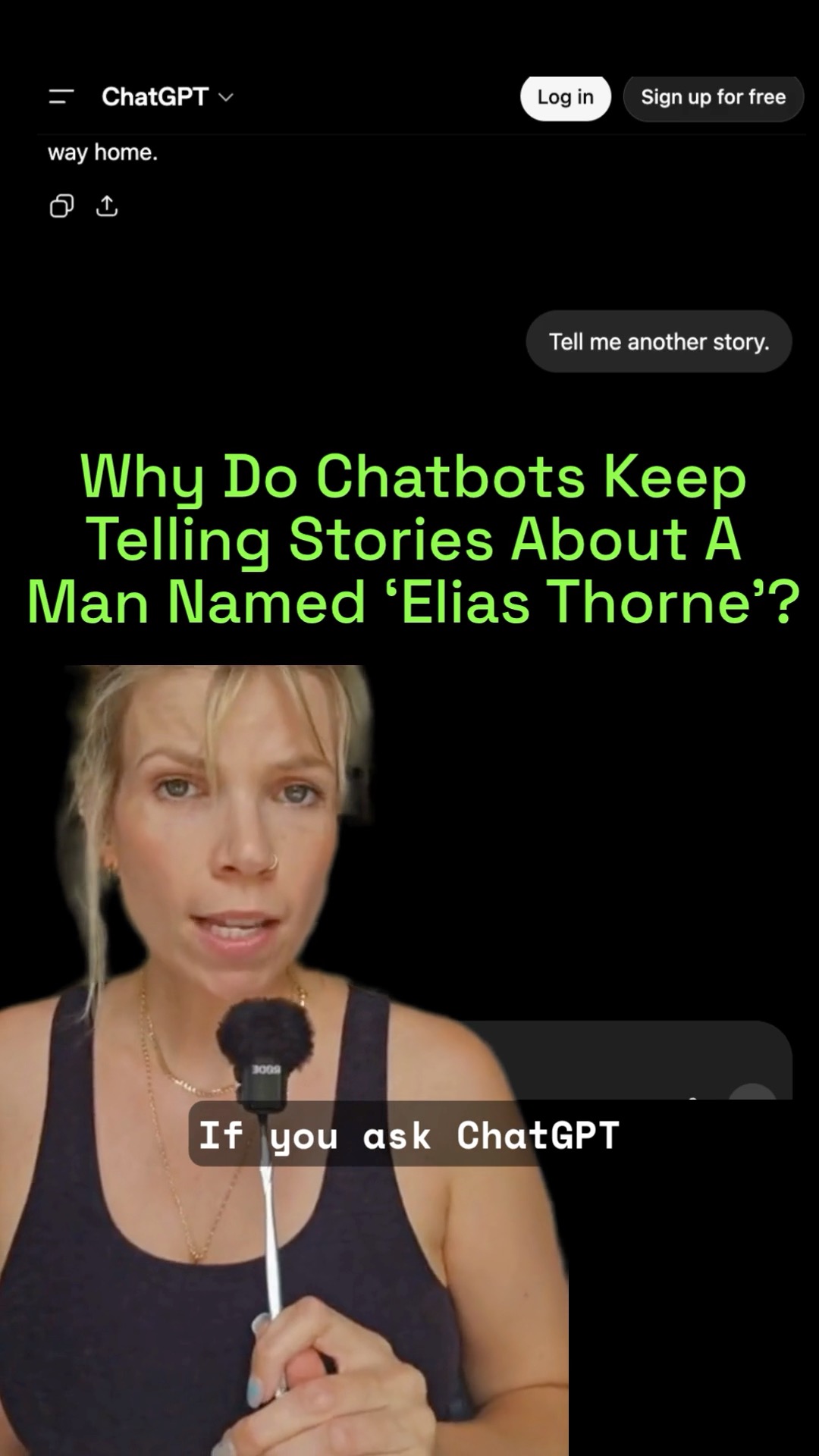
0:00
/2:36
Elias has since escaped chatbot containment. May noticed Elias Thorne popping up on Amazon as an author of alt-medicine cancer handbooks, a 2026 YouTube-algorithm guide, a book on Greek mythology, and a psychological thriller novella. “No human writes all of those,” May wrote in his blog post. “The first one sits in territory where bad advice causes real harm. The mode-collapsed name from the chat window is now a byline appearing across genres.”
When I searched Elias Thorne on Amazon, I found Elias as the protagonist in fantasy books and producing music, too: he’s “a brilliant but cynical archaeologist with a knack for unearthing what powerful institutions want to keep hidden” in one fantasy series, or a musical artist making ambient listening albums of birds and nature sounds. Fittingly, one Elias Thorne with an AI-generated author photo is also churning out AI grift books. In the last few years, AI-generated books have flooded Amazon’s self-publishing offerings, especially, with books containing dangerous misinformation and messy errors taking over the platform. AI-generated books are also making librarians’ jobs hell.
Elias has also escaped to the Youtube slop world: in one video from the channel Moments That Moved the World, a slop-illustrated story features the plight of “83-year-old Sergeant Major Elias Thorne.” On the AI slop site Wonderful Museums, “Snake Museum Owner Shot By Wife: Unpacking the Tragic Incident at Thorne’s Reptile Sanctuary” spins Elias Thorne’s story as a man shot by his wife. On another slop site called Tatticle, the “wealthiest man in Ohio,” Elias Thorne, died “with exactly twelve dollars in his pocket.” In these stories, Elias is usually a tragic figure, an aggrieved and unfairly-treated old man. He’s a similar character in a short story published by the BBC as a finalist in its 2024/2025 children's writing competition—but Elias is a real name, and could feasibly still be the subject of a human-written story (and there have been no accusations of the BBC’s children’s writing competition being infiltrated by AI slop).
But with all the world’s literature as its training data, why do LLMs seem to default so often to the lighthouse? It comes down to how model makers try to safety-align and sanitize their outputs. “We found many stories in WildChat are not safe for work. This led us to hypothesize that models going through alignment are preferring a small slice of WildChat stories, like a bottleneck,” Hamilton said. “It isn't that Elias stories are frequent, but that they're just so safe.” He said the researchers plan to explore this theory further in future research.
As for Elias, there is one example I’ve found of him existing pre-generative AI, as a time traveling mad scientist in the 1980’s trading card series Dinosaurs Attack!. And a real-life Elias that comes close to the stories told by LLMs did actually exist, Hamilton found—Elias Allen was a 16th century clockmaker in London.
About the author
Sam Cole is writing from the far reaches of the internet, about sexuality, the adult industry, online culture, and AI. She's the author of How Sex Changed the Internet and the Internet Changed Sex.