







🌘
Subscribe to 404 Media to get The Abstract, our newsletter about the most exciting and mind-boggling science news and studies of the week.
Scientists have discovered that people walking in crowds tend to spontaneously turn counterclockwise—regardless of the environment, from schoolyards to busy settings—a surprise finding that “may represent a manifestation of a deeper biological principle of symmetry breaking,” according to a study published in Nature Communications on Wednesday.
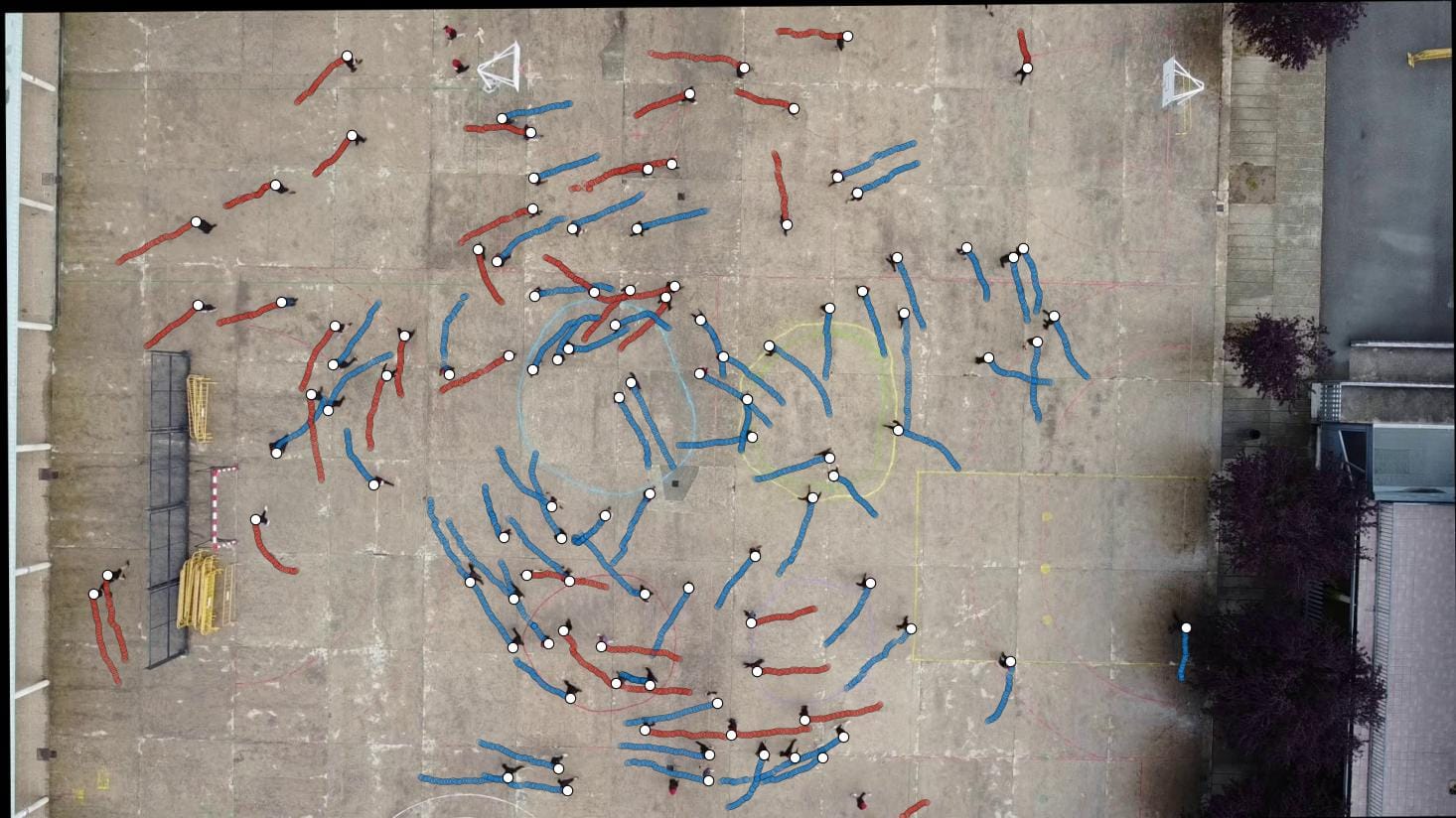
The bizarre finding was made essentially by accident; during the Covid-19 pandemic, researchers led by Iñaki Echeverría Huarte, a professor who studies pedestrian dynamics at the University of Navarra in Spain, studied the movements of pedestrians as part of a project to inform public health guidance on social distancing measures. But the videos revealed something unexpected—a consistent pattern of people turning counterclockwise when switching direction.
“The discovery was a serendipitous one (as sometimes happens in science),” Huarte told 404 Media in an email exchange that also included study co-author Claudio Feliciani, a professor who studies crowd dynamics at the University of Tokyo. “Since then, we have completed a series of experiments in Spain to test several hypotheses.”
“Curiously, during a conference where I was presenting the first part of this story, Claudio and I got talking and thought together: why not run an experiment in Japan?” he continued. “We were convinced the rotation would flip there, for several reasons (cultural ones, and the different type of avoidance behaviour that exists in Japan compared with Spain). However...it did not.”
Indeed, over the course of several experiments that took place in different environments in Spain and Japan, the counterclockwise bias persisted, suggesting that the team may have stumbled on a hidden rule of behavior. This preference showed up whether people were walking alone, or as part of a group, suggesting that it emerges from individuals, rather than as a collective phenomenon that is only present in crowds.
“We are now only sure that it is not a collective but an individual bias, and that is very, very robust,” said Feliciani. However, the team stopped short of describing the bias as a “universal law” until more research is conducted, especially in more complex scenarios, such as emergency evacuations or dense crowds.
For this study, the researchers analyzed the movements of hundreds of participants, including adults who were instructed to move freely in different settings, teenagers playing in their schoolyard in Spain, and children at a nursery school in Japan. They accounted for individual variations such as handedness (left or right), age, as well as local social etiquette about expected behavior in crowds.
In each situation, the participants displayed a clear counterclockwise bias in the rotation of their bodies as they moved to a new direction. Each group also contained people who turned predominantly clockwise or showed no rotational bias, but they were fewer in number than the counterclockwise turners. The nursery school children showed an even stronger bias toward counterclockwise turns, suggesting that it may not be a learned behavior, but something biologically rooted.
“It is likely biomechanical, but exactly why is hard to tell,” said Feliciani. He added that this symmetry-breaking motion appears to be unusual in animals, and that “most animals show no bias, and humans are probably the exception or, for sure, a rare case.”
That said, the study outlined a few exceptions, including temnothorax ants, which tend to turn left while exploring, and budgies, which show preferences in certain lateral directions during flight.
Huarte is working on follow-up studies that use virtual reality to shed light on the bias, but for now, this weird pattern remains unexplained. A better understanding of its origins could be useful for applications in busy settings like airports, museums, shopping centres, and other public spaces. It’s also an example of how unexpected behavior can be hidden in plain sight.
“I believe the real value of our discoveries lies in the fact that it can lead to other discoveries on how we process locomotor information and use them to move,” Feliciani concluded.
🌘
Subscribe to 404 Media to get The Abstract, our newsletter about the most exciting and mind-boggling science news and studies of the week.