


惯性聚合 高效追踪和阅读你感兴趣的博客、新闻、科技资讯
阅读原文 在惯性聚合中打开

推荐订阅源

让小产品的独立变现更简单 - ezindie.com
人人都是产品经理
人人都是产品经理
Cisco Talos Blog
Cisco Talos Blog
钛媒体:引领未来商业与生活新知
钛媒体:引领未来商业与生活新知
V
V2EX
博客园 - 三生石上(FineUI控件)
Martin Fowler
Martin Fowler
WordPress大学
WordPress大学
D
Docker
S
SegmentFault 最新的问题
博客园 - 聂微东
美团技术团队
Apple Machine Learning Research
月光博客
月光博客
奇客Solidot–传递最新科技情报
奇客Solidot–传递最新科技情报
Last Week in AI
Last Week in AI
M
MIT News - Artificial intelligence
F
Fortinet All Blogs
freeCodeCamp Programming Tutorials: Python, JavaScript, Git & More
The GitHub Blog
The GitHub Blog
GbyAI
GbyAI
L
LangChain Blog
Vercel News
Vercel News
博客园 - 叶小钗
MongoDB | Blog
MongoDB | Blog
Stack Overflow Blog
Stack Overflow Blog
H
Help Net Security
OSCHINA 社区最新新闻
OSCHINA 社区最新新闻
The Cloudflare Blog
Engineering at Meta
Engineering at Meta
T
Threat Research - Cisco Blogs
T
Threatpost
Scott Helme
Scott Helme
T
Tailwind CSS Blog
Latest news
Latest news
Stack Overflow Blog
Stack Overflow Blog
Blog — PlanetScale
Blog — PlanetScale
The Register - Security
罗磊的独立博客
P
Proofpoint News Feed
腾讯CDC
S
Schneier on Security
雷峰网
雷峰网
A
About on SuperTechFans
T
Tenable Blog
F
Full Disclosure
Cyberwarzone
Cyberwarzone
博客园_首页
有赞技术团队
有赞技术团队
K
Kaspersky official blog

Comments for Tech Journey

Comment on How to Decrypt an Enrypted SSL RSA Private Key (PEM / KEY) by plsa Comment on Cannot Connect to CIFS / SMB / Samba Network Shares & Shared Folders in Windows 10 by Jackson De Marco Comment on Install Microsoft .NET Framework 1.1 on Windows 10 / 8 / 7 / Vista (Fix RegSvcs.exe Error) by Kyle Comment on How to Convert SRT to Create 3D Subtitles (ASS or SUB/IDX) by Bob Comment on How to Allow Local Network When Using WireGuard VPN Tunnel in Windows 10 by Moohamat Thoiruddin Chrome / Edge Disables .CRX Installed Extensions (Workarounds to Turn On) Remove Disable Developer Mode Extensions Warning Popup in Chrome / Edge Fix Windows Not Remember & Save Folder Types or Folder Views Setting (Increase BagMRU Size Cache Memory Size) How to Change the Logo of vBulletin Forum to Custom Image
Unrecognised Disk Label When Creating Partition
LK · 2015-01-11 · via Comments for Tech Journey
Skip to content
Unrecognised Disk Label When Creating Partition
When creating and adding a primary partition on a new hard disk through Webmin, error occurred and the creation of new partition failed. The error message is similar to the following, where the drive name and size may differ, e.g. /dev/sda, /dev/sdc, /dev/sdd etc.

Failed to save partition : parted -s /dev/sdb unit cyl mkpart primary 0 30394 failed : Error: /dev/sdb: unrecognised disk label
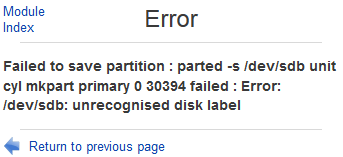
Add Partition Failed Unrecognised Disk Label

If you list the partition layout and all block devices information using “parted -l” command, it will give you similar error too:

Error: /dev/sdb: unrecognised disk label

Apparently Webmin cannot manage a new drive without any existing partition table. The resolution is to make a label on the disk first, with “parted” command.

Login to the server’s terminal which you want to install the new disk via console or SSH if remotely, and run the following command (replace the name of the disk with actual one assigned by Linux to the new disk):

$ sudo parted /dev/sdb
(parted) mklabel msdos
(parted) quit
If you prefer to use GTP GUID partition table, or have a large hard disk exceeding 2TB, or want to create a large partition exceeding 2TB, you can create a GPT partition with the following command instead of “mklabel msdos”:
(parted) mklabel gpt

Steps above create a blank table on the hard disk. Then, you can continue to add new partition using Webmin’s “Partitions on Local Disks” module.

Alternatively, you can continue to manually create the filesystem on the new partition created with parted, mkfs, and other commands. For example:

mkfs -t ext4 -q /dev/sdb1

Then, create a mount point for the new filesystem and mount the new file system:

mkdir /newdisk
mount /dev/sdb1 /newdisk

Ensure that the entry for the new filesystem and hard disk is recorded inside /etc/fstab so that it will mount automatically on system startup.

/dev/sdb1 /newdisk ext4 defaults 0 2

Where you can modify the parameters according to your need, with explanation below:

/dev/sdb1: Name for the partition
/newdisk: Mount point
ext4: Filesystem (fs) type
defaults : Mount options
0: Zero indicates to exclude this filesystem from dump command backup.
2: Second indicates the order which fsck filesystem check at boot. Only the root (/) filesystem should be specified with 1, all others should be 2.

Go to Top