


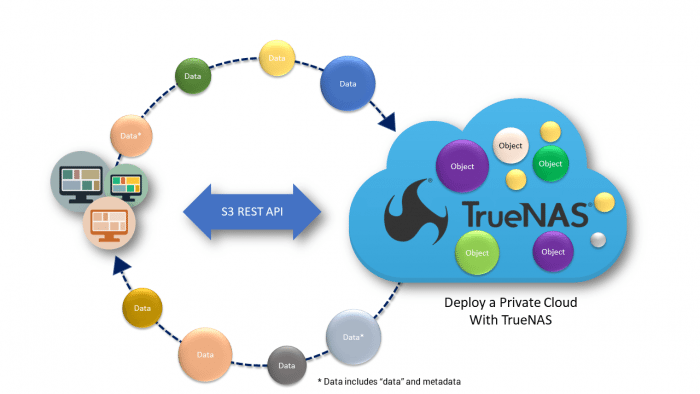
March 14, 2006 marks an important date in the history of the IT abstraction known as the cloud. On this day, Amazon introduced the S3 (Simple Storage Service) to the world and things have never been the same. Fast forward to August, 2017 and Amazon’s cloud service, of which S3 is a large part, is a $14.6B business and is growing at a rate of more than 50% per year. Unlike unified storage, which stores and manages data as files or blocks, S3 stores and manages data as objects.
2013 was the last time I found a public mention on how many objects are stored on the Amazon storage cloud and that number was 2 trillion. While it is unclear what that number is today, one can assume it has since tripled to 6 trillion. To put this number in perspective, there are currently 7.5 billion people in the world. Each person could store 800 of those 6 trillion objects. A truly astounding number that will only continue to increase over time.
The success of the Amazon S3 is due in large part to the many IT and business benefits cloud storage provides. Up until very recently, TrueNAS was a fully unified storage solution providing file and block protocol support for NFS, SMB, AFP, iSCSI, and Fibre Channel. TrueNAS 11, released in early July, added object storage. This means that TrueNAS customers can now build on-premise clouds that are fully Amazon S3-compliant. It also means that services and applications developed for the S3 can be migrated to TrueNAS, bringing these customers the benefits of the public cloud in their own data center.
This is an important development on several fronts. Despite the rapid adoption of public cloud storage, there are many who believe the adoption rate would be closer to universal if it were not for two concerns. One is the lingering concern over security and the other is the cost at scale.
Let’s discuss both in detail. Data stored on a public cloud is on infrastructure that belongs to and is owned by another entity. This would be Amazon for S3, Google for its Cloud Platform, and Microsoft for Azure. This loss of control is a source of concern for many IT professionals. If an enterprise owns the physical infrastructure on which its data lives, safeguards can be taken to prevent unauthorized access to the storage hardware and the data. Public clouds are multiuser systems where the data can be accessed by multiple users and organizations. While processes are designed and put in place to prevent the commingling of data, they sometimes fail. We all have seen or heard in the news where data in the cloud is exposed. In addition to the significant cost that a business can incur from data leakage (especially to a competitor), the business can also be subject to legal risk if the leakage involves certain classes of data.
The second concern deals with cost at scale. Since public cloud storage employs a pay-as-you-go model, it relieves new businesses from the burden of having to shell out a large amount of capital to build on prem storage infrastructure. Fledgling businesses can pay only for the storage they need and use. However, this model quickly breaks down as the business grows and there is more demand for ongoing storage. Case in point: A big cybersecurity organization moved from the cloud by using iXsystems storage and servers to build a private cloud and saved millions by cutting their Amazon S3 bill by over 80%. A recent iXsystems white paper covers the true cost of the public cloud in much greater detail.
Public cloud storage providers charge for their services in many ways. One is by the amount of data stored on their cloud and another is by the quantity of data retrieved from the cloud. For this exercise, let’s just consider the Amazon S3 storage cost. If you were to just store 1TB of data on the S3, the monthly cost is $26.50. However, if you were to store 100TB of data, the monthly cost is now $2,872.18. Over three years, the cost of storing 100TB of data would be $103,398.48. This is based on information from the Amazon AWS Calculator for the US-West (Northern California) region. How does that compare to a physical array from iXsystems? The TrueNAS X10 has a starting price of $5,500.
So what does this all mean? If you have been using the public cloud as a data store and have concerns about security and cost, perhaps it is time to consider the private cloud option, particularly if you already own a TrueNAS appliance. Private cloud with a TrueNAS? Yes. It’s here today and open for business.
Steve Wong, Director of Storage Product Management
此内容由惯性聚合(RSS阅读器)自动聚合整理,仅供阅读参考。 原文来自 — 版权归原作者所有。