







For nearly two decades, TrueNAS has been built on a simple belief: your data should remain under your control. That principle continues to drive how we design, deliver, and support the world’s most trusted open enterprise storage platform.
This blog describes how TrueNAS uses open-source software with an open-core business model to drive TrueNAS Open Storage for both Enterprises and the Community.
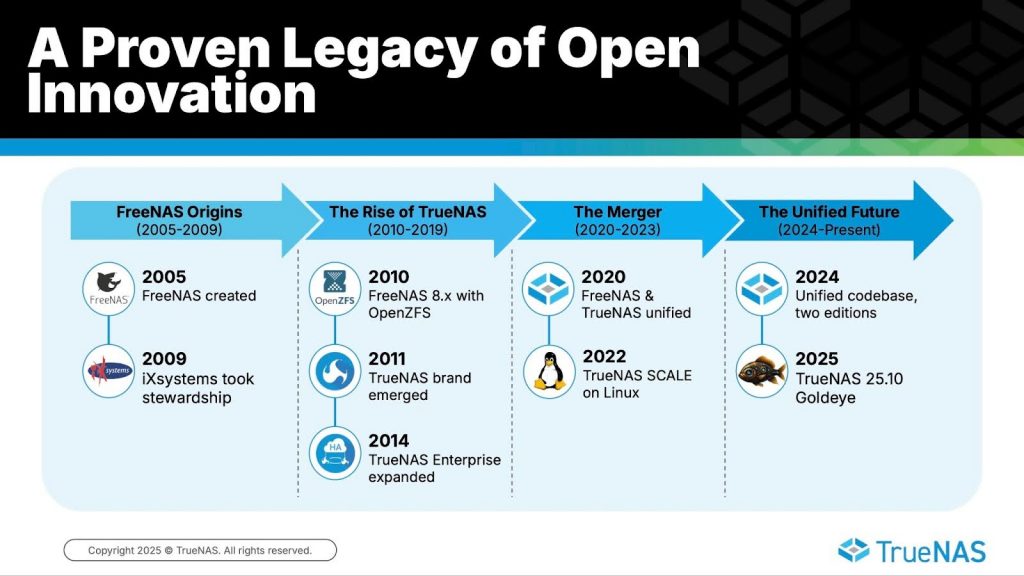
FreeNAS Origins
In 2005, FreeNAS was created by Olivier Cochard-Labbé, based on m0n0wall and FreeBSD.
By 2009, iXsystems – founded on Berkeley Software Design roots – took stewardship of the project, combining open-source software with purpose-built hardware to bring enterprise reliability to open storage.
The Rise of TrueNAS
In 2010, FreeNAS 8.x introduced a major rewrite, integrating OpenZFS.
By 2011, the TrueNAS brand emerged as the enterprise-grade counterpart to FreeNAS, backed by professional support and certified hardware.
In 2014, TrueNAS Enterprise expanded with high availability and Fibre Channel support for mission-critical workloads.
The Merger: FreeNAS Becomes TrueNAS
In 2020, FreeNAS and TrueNAS were unified under one family:
The Unified Future
By 2024, TrueNAS evolved into two editions – Community and Enterprise – built from a single unified codebase.
In 2025, TrueNAS 25.10 Goldeye introduced a versioned API and new TrueNAS Connect cloud management capabilities.
As the company rebranded fully as TrueNAS, the focus sharpened: to deliver enterprise-grade storage built on open standards, trust, and transparency.
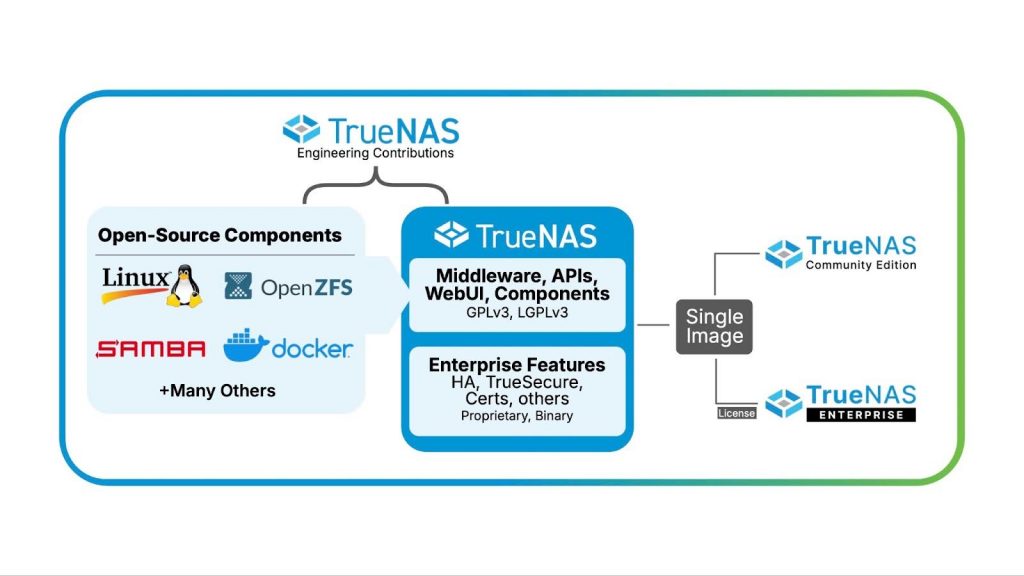
TrueNAS is engineered on open technologies – Including Linux, OpenZFS, Samba, and many others – that have stood the test of time.
Over the years, our engineering team has contributed critical advancements, including as an example to the OpenZFS project:
Our TrueNAS API (Middleware Business Logic) and User Interface are open source, released under both LGPLv3 and GPLv3 licenses and available on GitHub.
Only a set of enterprise modules – for example, those required for clustering, high availability, and FIPS 140 management – carry commercial licenses to sustain ongoing development.
This hybrid approach delivers the best of both worlds: open innovation and enterprise reliability.
Open-Source Powered by an Open-Core Model
TrueNAS is not funded by a large charitable foundation, like the Linux Foundation. Instead, the TrueNAS company self-funds development through the delivery and support of commercial offerings. This is an open-core business model funded without venture capital.
TrueNAS Community Edition is open-source, feature-complete, and will remain freely available. This level of openness is possible because the business is funded by an open-core business model.
The open-core model keeps TrueNAS Community Edition open and free. Enterprise offerings such as TrueNAS Enterprise appliances and TrueNAS Connect are paid offerings, funding engineering, support, testing, and long-term innovation for TrueNAS users around the world.
Enterprise revenues allow the team to continue releasing Community Edition without compromise. This creates a clear structure.
TrueNAS ships Community Edition and Enterprise as a single unified image. A license key activates enterprise features. This improves quality because every user runs the same code path.
Some enterprise components carry commercial licenses or are delivered as binary packages. These pieces are not required for Community Edition functionality and protect the TrueNAS business from unauthorized forks of enterprise-oriented proprietary functionality. They also allow TrueNAS to integrate third-party, proprietary software and/or drivers where it is needed or cost-effective.
TrueCommand and TrueNAS Connect follow this model. They add enterprise management and convenience. They are not required to operate Community Edition. However, TrueNAS does offer free versions of these software products.
This open-core structure stands in contrast to closed, proprietary storage vendors. Closed models avoid transparency and lock customers in, while open-core funds open-source, instead. It generates the funds for investment into engineering and user control, giving organizations enterprise-grade reliability while maintaining independence and data freedom.
The open-core model creates a self-sustaining cycle of innovation, quality, and trust across the entire TrueNAS ecosystem.
This creates a virtuous cycle we call the Open Storage Flywheel.
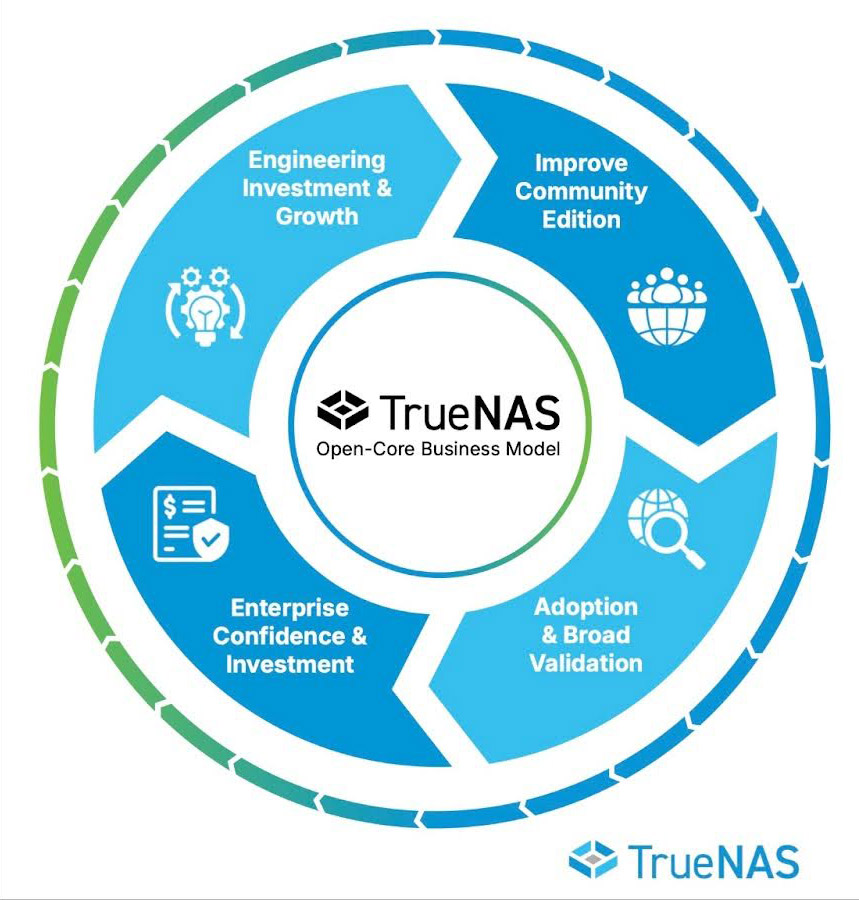
Community users benefit from faster innovation and a hardened core platform.
Enterprise customers gain advanced capabilities, reliability, and predictable performance at lower total cost.
TrueNAS directs resources into engineering instead of overhead, bureaucracy, or lock-in strategies.
Today, the results are becoming increasingly visible.
TrueNAS powers Amazon Prime Video’s global NBA coverage, delivering the reliability and scalability required for worldwide live production.
TrueNAS was named CIOReview’s Data Storage Company of the Year for its leadership in open enterprise storage.
The open-core business model is not just about saving cost. It is a force-multiplier model that increases quality, accelerates innovation, and strengthens trust across the entire user base.
TrueNAS remains committed to openness and enterprise-level execution. We will continue to:
TrueNAS proves that open and enterprise can coexist, in harmony, to the mutual benefit of all.
Openness drives innovation. Enterprise discipline sustains it.
That open-core combination makes TrueNAS the most trusted choice for organizations that demand freedom, performance, and peace of mind.
Modern organizations cannot afford closed systems that limit choice, slow innovation, restrict interoperability, and raise cost. TrueNAS proves that openness increases reliability and performance. It does not weaken them.
By using transparent standards, shared innovation, and a unified codebase refined across millions of deployments, TrueNAS gives organizations durable control over their data, their costs, and their roadmap.
The shift to open enterprise storage is not only a technology trend. It is a return to control, where you decide how your data is stored and how your future is built.
That future is already here with TrueNAS.
此内容由惯性聚合(RSS阅读器)自动聚合整理,仅供阅读参考。 原文来自 — 版权归原作者所有。