


惯性聚合 高效追踪和阅读你感兴趣的博客、新闻、科技资讯
阅读原文 在惯性聚合中打开

推荐订阅源

S
Securelist
腾讯CDC
L
LangChain Blog
aimingoo的专栏
aimingoo的专栏
Cyber Security Advisories - MS-ISAC
博客园_首页
CTFtime.org: upcoming CTF events
云风的 BLOG
云风的 BLOG
P
Proofpoint News Feed
罗磊的独立博客
爱范儿
爱范儿
freeCodeCamp Programming Tutorials: Python, JavaScript, Git & More
H
Help Net Security
Vercel News
Vercel News
MyScale Blog
MyScale Blog
博客园 - 叶小钗
The Register - Security
钛媒体:引领未来商业与生活新知
钛媒体:引领未来商业与生活新知
量子位
Y
Y Combinator Blog
C
Cyber Attacks, Cyber Crime and Cyber Security
NISL@THU
NISL@THU
GbyAI
GbyAI
SecWiki News
SecWiki News
M
MIT News - Artificial intelligence
Engineering at Meta
Engineering at Meta
P
Privacy International News Feed
月光博客
月光博客
奇客Solidot–传递最新科技情报
奇客Solidot–传递最新科技情报
C
Check Point Blog
博客园 - 聂微东
Project Zero
Project Zero
让小产品的独立变现更简单 - ezindie.com
Latest news
Latest news
V
Vulnerabilities – Threatpost
T
The Blog of Author Tim Ferriss
cs.CL updates on arXiv.org
D
Darknet – Hacking Tools, Hacker News & Cyber Security
T
Tor Project blog
F
Fortinet All Blogs
Recorded Future
Recorded Future
IT之家
IT之家
D
Docker
The GitHub Blog
The GitHub Blog
V
Visual Studio Blog
MongoDB | Blog
MongoDB | Blog
T
Threat Research - Cisco Blogs
Hugging Face - Blog
Hugging Face - Blog
C
CXSECURITY Database RSS Feed - CXSecurity.com
V
V2EX

TrueNAS – Open Enterprise Storage

What We Heard at NAB 2026 | TrueNAS - Open Enterprise Storage TrueNAS V160 Launched: High Performance, No All-Flash Tax TrueNAS 26 Is Here: What's New in This Major Release TrueNAS Connect: Enterprise Features on Your Own Hardware TrueNAS Immutability: Multi-Layered Data Protection & Ransomware Defense TrueNAS CEO Note to Community: We Are All TrueNAS TrueNAS 25.10.2 Goldeye: 100+ Fixes & What's New TrueNAS Names Brett Davis CEO for Enterprise Growth TrueNAS Plans for 2026: TrueNAS 26 & OpenZFS 2.4 Roadmap TrueNAS Connect Plus Now Available for All Community Users TrueNAS R60: High-Speed NVMe Storage for AI Workloads Introducing TrueNAS WebShare: Secure Web-Based File Sharing TrueNAS 25.10.1: Goldeye Matures, Performs, and Connects TrueNAS & Veeam v13: Turnkey Cyber‑Resilient Backups Customer Advantages of the TrueNAS Open Core Model TrueNAS Named Data Storage Company of the Year 2025 TrueNAS 25.10: Smarter, Streamlined Updates & Tools TrueNAS F-Series Shines at IBC with Two “Best of Show” Awards TrueNAS 25.10 “Goldeye”: NVMe‑oF, Unified, Simplified Storage Introducing TrueNAS Connect: Secure Monitoring & Alerts The ESG Advantage of Open Enterprise Architecture: Why TrueNAS Is the Sustainable Choice | TrueNAS - Open TrueNAS 25.10-RC1: New Features, Fixes & OpenZFS 2.3.4 Seamless Setup: Exploring TrueNAS Web-Driven Installation | TrueNAS - Open Enterprise Storage TrueNAS 25.10 “Goldeye” BETA is Available TrueNAS 25.10 “Goldeye” Highlights TrueNAS 25.04.2: Fangtooth restores Virtualization iXsystems Rebrands as TrueNAS to Reflect Market Momentum in Enterprise Storage | TrueNAS - Open Enterprise June 1 - Apps Migration Deadline for TrueNAS 24.04 and 23.10 TrueNAS 25.04.1: Fangtooth Unification Gains Momentum TrueNAS 24.10.2.2 Prepares for IP Addressing of Apps TrueNAS H30 and F100 add Fast Dedup with TrueNAS 25.04 Meet TrueNAS Community Edition – The Future of Open Storage TrueNAS Apps Made Easy with Electric Eel & Fangtooth TrueNAS H30 Secures Two ‘Best of Show’ Honors at NAB 2025 | TrueNAS - Open Enterprise Storage TrueNAS H30 Wins Best of Show Awards at NAB 2025 TrueNAS 25.04: Fangtooth is RELEASED Slash Your Virtualization Costs with TrueNAS Storage TrueCommand 3.1 Enhances Management and Monitoring TrueNAS 25.04: Fangtooth Unification Begins with New Features Fangtooth Unification Begins | TrueNAS iXsystems Experiences Record Growth in TrueNAS Enterprise Storage, Spins Off Server Business to Amaara How to Set Up and Install TrueNAS CORE Yes, You Can (Still) Virtualize TrueNAS TrueNAS enables Container Storage and Kubernetes | TrueNAS - Open Enterprise Storage TrueNAS 12.0-U2 is Released | TrueNAS - Open Enterprise Storage OpenZFS 2.0 Ships First on TrueNAS | TrueNAS - Open Enterprise Storage TrueNAS 12.0-U1 is Scheduled for early December | TrueNAS - Open Enterprise Storage iXsystems TrueNAS M60 Recognized as SDC Awards Storage Hardware Innovation of the Year Finalist | TrueNAS - TrueNAS 12.0 is Released! The TrueNAS Mini X and Mini X+ are here! Cross-Site Disaster Recovery with TrueNAS TrueNAS SCALE Release Plan | TrueNAS - Open Enterprise Storage iXsystems Unveils Industry's Fastest OpenZFS Storage System with Launch of TrueNAS M60 | TrueNAS - Open TrueNAS 12.0 BETA2 Showcases Performance Improvements | TrueNAS - Open Enterprise Storage Be One of the First to Test Drive TrueNAS 12.0 BETA | TrueNAS - Open Enterprise Storage TrueNAS is Multi-OS New-New TrueNAS Logo Unveiled | TrueNAS - Open Enterprise Storage Recession Proof Storage | FreeNAS 11.3-U3.1 Now Available - Issue #80 | TrueNAS - Open Enterprise Storage Open Source Infrastructure is Recession-Proof | TrueNAS - Open Enterprise Storage Understanding How OpenZFS Keeps Your Data Safe | TrueNAS - Open Enterprise Storage You Can Influence the TrueNAS CORE Roadmap! | TrueNAS - Open Enterprise Storage TrueNAS CORE is the new FreeNAS Setting Up Users, Permissions, and ACLs on FreeNAS | TrueNAS - Open Enterprise Storage TrueNAS Updates for VMware vSphere 7 | TrueNAS - Open Enterprise Storage How to Set Up Windows SMB Shares on FreeNAS | TrueNAS - Open Enterprise Storage FreeNAS and TrueNAS are Unifying Introducing the FreeNAS Mini E+ and All-Flash Minis | TrueNAS - Open Enterprise Storage Plex Permissions in FreeNAS 11.3 | TrueNAS - Open Enterprise Storage Latest TrueNAS and FreeNAS Release Delivers Wizards, Plugins, and Accelerated Replication | TrueNAS - Open How To Back Up Google Drive to FreeNAS | TrueNAS How To Enable Wireguard on FreeNAS 11.3 | TrueNAS - Open Enterprise Storage The Official FreeNAS Hardware Guide | TrueNAS - Open Enterprise Storage December 11 Plugins Update: ClamAV Fix & CloudStack FreeNAS Mini Black Friday Sale Starts Now! - Issue #73 | TrueNAS - Open Enterprise Storage Breaking Down the FreeNAS Mini E! | TrueNAS TrueCommand Shifts to Prime Time | TrueNAS - Open Enterprise Storage AMD EPYC 7002 Powers Scalable TrueNAS Solutions FreeNAS and TrueNAS 11.3 make their Debuts October 30 Plugins Update | TrueNAS - Open Enterprise Storage Overview of Datasets and Snapshots in FreeNAS | TrueNAS - Open Enterprise Storage September 13 Plugins Update | TrueNAS - Open Enterprise Storage Mount a TrueNAS or FreeNAS Share to a Docker Host | TrueNAS - Open Enterprise Storage Open ZFS vs. Btrfs | and other file systems | TrueNAS - Open Enterprise Storage ZFS vs. OpenZFS Backup Evolved: Asigra Plugin for FreeNAS Back Up Plugins and Jails on FreeNAS | TrueNAS Take Command of Your NAS Fleet with TrueCommand™ | TrueNAS - Open Enterprise Storage Run S3 Object Storage on FreeNAS and TrueNAS | TrueNAS - Open Enterprise Storage Sync Files to Dropbox with TrueNAS or FreeNAS February Plugin Updates & New Plugins for Testing Six Metrics for Measuring ZFS Pool Performance Part 2 | TrueNAS - Open Enterprise Storage Six Metrics for Measuring ZFS Pool Performance Part 1 | TrueNAS - Open Enterprise Storage TrueNAS M-Series Certified for Veeam Backup FreeNAS 11.1 is Now Available for Download! | TrueNAS FreeNAS 11.0 Released with VM & S3 Storage Support To SLOG or not to SLOG: How to best configure your ZFS Intent Log | TrueNAS - Open Enterprise Storage vCenter Web Client Plug-in for TrueNAS Now Available | TrueNAS - Open Enterprise Storage The ZFS ZIL and SLOG Demystified | TrueNAS - Open Enterprise Storage FreeNAS: A Worst Practices Guide | TrueNAS - Open Enterprise Storage FreeNAS vs TrueNAS
Why We Use ZFS - TrueNAS
iX Team · 2015-07-09 · via TrueNAS – Open Enterprise Storage

One of the key pieces of technology underlying TrueNAS and FreeNAS is the ZFS filesystem.  In 2001, developers at Sun Microsystems began work on ZFS and officially released it as part of OpenSolaris in 2005.  Three years later, a port of ZFS was released as part of FreeBSD 7. When we took the helm of the FreeNAS project in 2009, we realized it would be a fundamental part of the OS.  So what makes ZFS so great?

ZFS_Icon

Data Integrity

The main reason TrueNAS and FreeNAS use ZFS is to ensure data integrity.  One of the main ways ZFS protects your data is by putting volume management on the filesystem level.  This makes Copy-on-Write (CoW) technology possible. Normally when a block of data is modified, it will change its current location on the disk before the new write is completed.  If your system crashes or loses power in the process, that data will be lost.

With CoW, ZFS does not change the location of the data until the write is completed and verified, keeping your data safe in case your system has any problems.

To verify that data, ZFS utilizes checksum metadata to ensure that the data remains the same from write to write.  Individual blocks of data exist in a ‘tree’ of data where each ‘parent’ block adds up the checksum data of its ‘children’, meaning that every new write is tested, eliminating bitrot.  This eliminates what is known as the RAID write hole which allows for silent data corruption in standard RAID levels.

In addition to CoW, ZFS offers additional RAID protections over standard levels.  The first RAID configuration is RAID-Z3, which allows for up to 3 disk failures in a data volume.  Standard RAID only allows for 2 disk failures per volume.  In addition, ZFS offers the ability to set up a multi-disk mirror (nRAID).  Typically, your mirrors are composed of a single disk and its copy.  With a multi-disk mirror, you can have multiple copies.  It has a high cost in disk space, but it can add levels of data integrity not found in typical RAID and is great for read speeds.

Highly Scalable

ZFS is a 128 bit file that can handle enormous data pools of up to 1.84 × 10^19 times more data than 64-bit systems.  This means that the data limitations of ZFS surpass other operating systems, making it scalable and relevant for the foreseeable future.  ZFS also eliminates unnecessary limitations to file size along with the number of filesystems and directories, which can make system design difficult.

Intelligent Features

As mentioned previously, ZFS puts volume management on the filesystem level.  This means that you don’t need an additional storage controller to set up and manage your RAID without losing performance.  It also means you won’t need to manage your disks from another interface, simplifying administration.

FreeNAS and TrueNAS make setting up volumes a snap from its graphical Web Interface, keeping all your storage controls in one place.

ZFS’s transactional processing model also allows for ZFS to send writes to individual physical disks, rather than just the RAID volume.  Because of this, ZFS can stripe writes across RAID volumes and place synchronous writes together in a physical disk location, speeding up write performance.  The transactional model also means that there are no long waits for file system checking.  In the case you need to sync mirrors with only a bit of information, you don’t have to wait for it to sync any of the empty disk space, which can take a good deal of time.

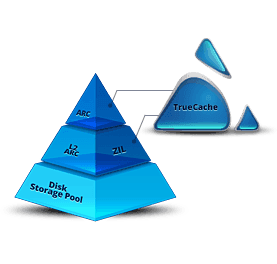
ZFS incorporates algorithms to make sure your Most Recently Used (MRU) and Most Frequently Used (MSU) data are stored in your fastest system storage media.  Spinning disks are notoriously slow and all flash solutions drive up your dollar per gigabyte cost significantly.  By utilizing these algorithms in combination with flash-based ZFS Intent Log write cache and L2ARC read cache devices, you can speed up your performance by orders of magnitude at minimal cost.
hybrid-storage-1.png

Built-In Snapshots and Replication

Another reason we use ZFS is for the intelligently designed Snapshot, Clone, and Replication features.  ZFS allows for snapshots to be taken on a singular or periodic basis and allows you to backup individual datasets as often as needed.  Snapshots allow for a simple rollback to prior states in case of file deletion or system instability.  ZFS Snapshots save disk pointers for data that would be discarded and only update based on what has changed since the last snapshot.

This translates into speedy clone and replication tasks and saves substantial time over traditional replication technology since ZFS replicates what has changed.  And because of the way ZFS manages snapshots and replication, you can have varying levels of compression between source and target servers.

Open Source

At iXsystems Open Source is in our veins.

We support and develop multiple open source projects as a company and implement it in our internal infrastructure.  Because TrueNAS is based on FreeNAS, an Open Source project, it’s important that the file system it uses is Open as well.  OpenZFS also enjoys a good deal of feature development and collaboration, is included in multiple products, and is a robust and mature filesystem.  Features are also incorporated on a modular basis known as feature flags.  This means that when there’s an update to something like Samba, it is added like a package rather than some sort of firmware.

Conclusion

ZFS is a mature, flexible file system that will be scalable well into the future.  It is based on Open technology with many individuals and commercial products contributing to  development and testing.  It has many intelligently designed features that improve the performance and ease of use of TrueNAS and FreeNAS.  Its volume management also comes with data integrity features not found in most file systems, ensuring that you have a safe place to store your data. To learn more about TrueNAS visit https://www.ixsystems.com/TrueNAS, call 1.855.GREP.4.IX or email sales@ixsystems.com.