



惯性聚合 高效追踪和阅读你感兴趣的博客、新闻、科技资讯
阅读原文 在惯性聚合中打开

推荐订阅源

Exploit-DB.com RSS Feed
WordPress大学
WordPress大学
云风的 BLOG
云风的 BLOG
Stack Overflow Blog
Stack Overflow Blog
MongoDB | Blog
MongoDB | Blog
腾讯CDC
V
V2EX
Martin Fowler
Martin Fowler
A
About on SuperTechFans
大猫的无限游戏
大猫的无限游戏
Blog — PlanetScale
Blog — PlanetScale
Cyber Security Advisories - MS-ISAC
酷 壳 – CoolShell
酷 壳 – CoolShell
C
Check Point Blog
博客园 - 【当耐特】
Cisco Talos Blog
Cisco Talos Blog
The Hacker News
The Hacker News
K
Kaspersky official blog
Security Latest
Security Latest
H
Help Net Security
博客园_首页
美团技术团队
Spread Privacy
Spread Privacy
博客园 - 司徒正美
Hugging Face - Blog
Hugging Face - Blog
S
SegmentFault 最新的问题
G
Google Developers Blog
NISL@THU
NISL@THU
爱范儿
爱范儿
I
Intezer
OSCHINA 社区最新新闻
OSCHINA 社区最新新闻
阮一峰的网络日志
阮一峰的网络日志
N
News and Events Feed by Topic
P
Privacy International News Feed
Application and Cybersecurity Blog
S
Security @ Cisco Blogs
Schneier on Security
雷峰网
雷峰网
人人都是产品经理
人人都是产品经理
V
Vulnerabilities – Threatpost
W
WeLiveSecurity
P
Palo Alto Networks Blog
G
GRAHAM CLULEY
Hacker News: Ask HN
Hacker News: Ask HN
I
InfoQ
The Cloudflare Blog
F
Full Disclosure
SecWiki News
SecWiki News
宝玉的分享
宝玉的分享
N
Netflix TechBlog - Medium

ByteByteGo Newsletter

A Guide to Multi-Tenancy: Benefits and Challenges AI Customer Support at Scale: The Travel Industry’s $Billion Bet How LLMs Learn to Be Helpful (RLHF vs DPO) How Microsoft Ships AI Agents at Enterprise Scale EP221: How Docker Works Under the Hood LAST CALL FOR ENROLLMENT: Become an AI Engineer - Cohort 7 Streaming vs Batch: Two Philosophies of Data Processing The Agent Loop: How AI Goes From Answering Questions to Doing Things ChatGPT vs Gemini vs Claude: How They Differ LAST CALL FOR ENROLLMENT: Become an AI Engineer - Cohort 7 Proof of Human: How to Verify a Person Is Real and Unique Multi-Region Architecture: Going Global Without Going Broke How OpenAI Delivers Low-Latency Voice AI for 900M Users Inside Thinking Machines’ Interaction Models How AI Agents Manage Memory and Avoid Forgetfulness EP220: RAG vs Graph RAG vs Agentic RAG Top Anti-Patterns to Avoid in Service Architecture Large Language Models vs Small Language Models An Ex-Meta L8’s Agentic Engineering Setup AI-Native Leaders: The Organizational Playbook for Engineering Transformation at Scale EP219: 12 Open-source LLMs Observability for Beginners: Logs, Metrics, Traces, and Everything Around Them LAST CALL FOR ENROLLMENT: Build with Claude Code - Cohort 2 How Open-Weight Models Changed the AI Landscape A Guide to AI Inference Engineering EP218: The Typical AI Agent Stack, Explained Must- Know Deployment Strategies: From Big-Bang to Progressive Delivery Love Teaching? ByteByteGo Is Hiring Part-Time AI & Engineering Instructors What Salesforce Learned from 20,000 Enterprise Agent Deployments Token Spend Out of Control? The Case for Smarter Routing EP217: Latency vs Throughput vs Bandwidth The Path of a Request: A Tour of Modern Web Architecture How OpenAI Built Its Data Agent A Practical Guide to Becoming an AI-Native Engineer How DoorDash Built a Testing System to Evaluate LLMs Must-Know Failure Modes in Distributed Systems How Airtable Built the Search Layer Behind Their AI Features How Vercel Cut Build Wait Times From 90 Seconds To 5 How CockroachDB Built Vector Indexing at Scale EP216: RAGs vs Agents 🚀 New cohort based course launch: Build with Claude Code A Guide to Async Patterns in API Design How Netflix is Using Multimodal AI to Power Video Search How Snapchat Serves a Billion Predictions Per Second How Grab is Using AI Agents to Boost Team Productivity EP215: The Anatomy of an AI Agent LAST CALL FOR ENROLLMENT: Become an AI Engineer - Cohort 6 A Guide To Event-Driven Architectural Patterns High Performance Rate Limiting at Databricks How Figma Upgraded Data Pipeline from Multi-Day Latency to Real-Time How Pinterest Built a Production MCP Ecosystem EP214: Claude Code vs. OpenClaw: 5 Design Dimensions Become an AI Engineer | Enrollment Ends Soon Container Design Patterns for Distributed Systems How Instacart Built a Search for Billions of Products Connecting LLMs to the Real World: Tool Use, Function Calling, and MCP EP213: MCP vs Skills, Clearly Explained A Beginner’s Guide to Kubernetes The Tech Stack Powering Wise How Stripe Detects Fraudulent Transactions Within 100 ms How Amazon Uses LLMs to Recommend Products EP212: Data Warehouse vs Data Lake vs Data Mesh B-Trees vs LSM Trees: Comparison and Trade-Offs How DoorDash Launches a New Country in One Week The Security Architecture of GitHub Agentic Workflow EP211: How the JVM Works A Guide to Relational Database Design Figma Design to Code, Code to Design: Clearly Explained How LinkedIn Feed Uses LLMs to Serve 1.3 Billion Users EP210: Monolithic vs Microservices vs Serverless Must-Know Cross-Cutting Concerns in API Development How Spotify Ships to 675 Million Users Every Week Without Breaking Things Nextdoor’s Database Evolution: A Scaling Ladder A Guide to Context Engineering for LLMs Our New Book on Behavioral Interviews Is Now Available on Amazon Database Performance Strategies and Their Hidden Costs How Datadog Redefined Data Replication How Meta Turned Debugging Into a Product How Roblox Uses AI to Translate 16 Languages in 100 Milliseconds EP208: Load Balancer vs API Gateway LAST CALL FOR ENROLLMENT: Become an AI Engineer - Cohort 5 How to Implement API Security How Anthropic’s Claude Thinks How Netflix Live Streams to 100 Million Devices in 60 Seconds How Agentic RAG Works? Last Chance to Enroll | Become an AI Engineer | Cohort-Based Course EP207: Top 12 GitHub AI Repositories Event Sourcing Explained: Benefits and Use Cases How OpenAI Codex Works
EP209: 12 Claude Code Features Every Engineer Should Know
2026-04-04 · via ByteByteGo Newsletter

This guide from Datadog provides best practices on how to use Cloud SIEM to detect threats, investigate incidents, and reduce blind spots across cloud and Kubernetes environments.

You’ll learn how to:

  • Analyze CloudTrail, GCP audit, and Azure logs for suspicious activity

  • Detect authentication anomalies and common attack patterns

  • Monitor Kubernetes audit logs for lateral movement and misuse

  • Correlate signals across services to accelerate investigations

Get the ebook

This week’s system design refresher:

  • 12 Claude Code Features Every Engineer Should Know

  • How Agentic RAG Works?

  • How does REST API work?

  • 7 Key Load Balancer Use Cases

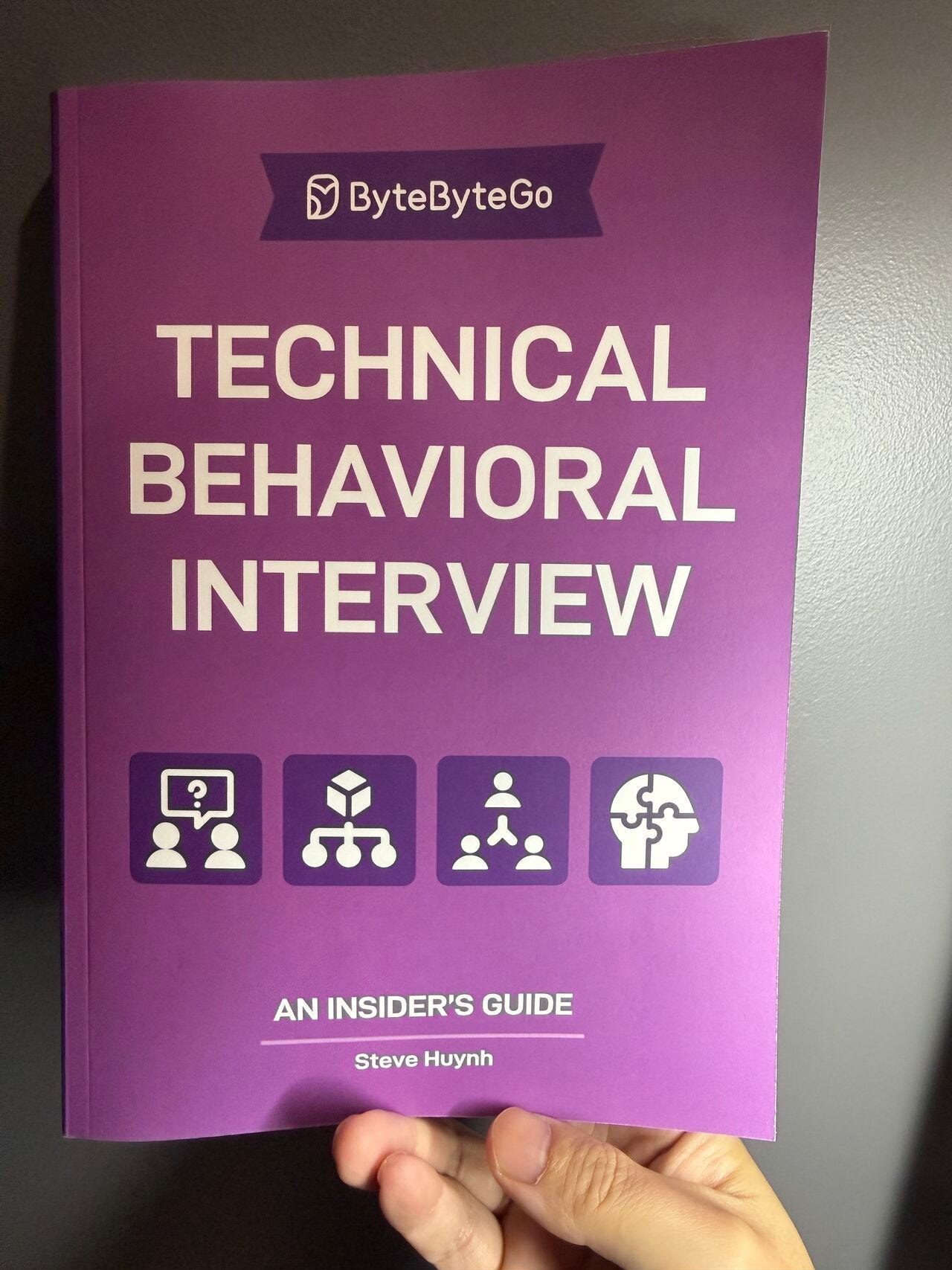
  • Our New Book on Behavioral Interviews Is Now Available on Amazon!
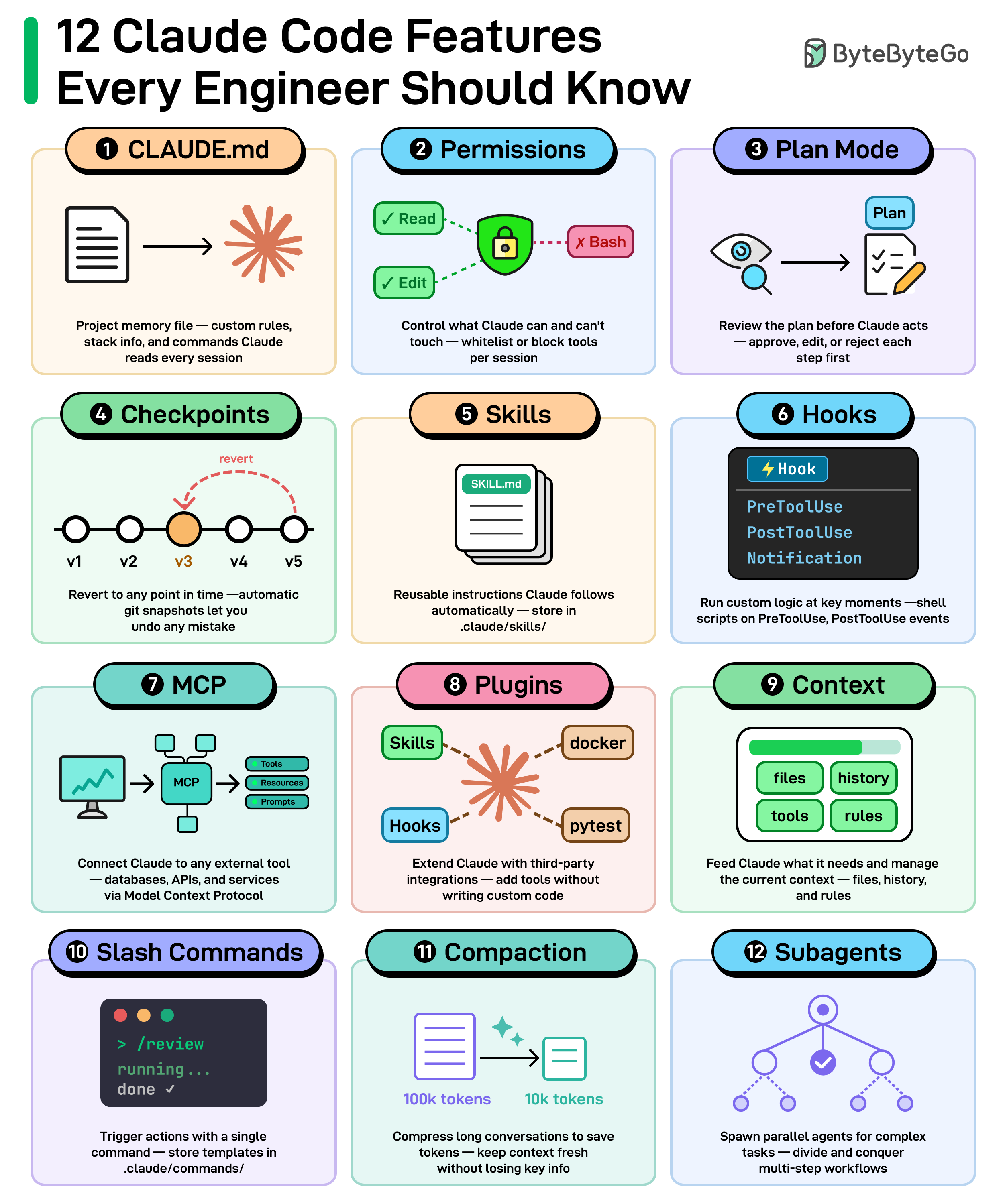
  1. CLAUDE. md: A project memory file to define custom rules and conventions. Claude reads at the start of every session.

  2. Permissions: Control which tools Claude can and can't use.

  3. Plan Mode: Claude plans before it acts. You can review them before any code changes.

  4. Checkpoints: Automatic snapshots of your project to revert to if something goes wrong.

  5. Skills: Reusable instruction files Claude follows automatically.

  6. Hooks: Run custom shell scripts on lifecycle events like PreToolUse or PostToolUse.

  7. MCP: Connect Claude to any external tools like databases and third-party services.

  8. Plugins: Extend Claude with third-party integrations containing skills, MCPs, and hooks.

  9. Context: Feed Claude what it needs and manage the current context window with /context.

  10. Slash Commands: Create shortcuts for tasks you run often. Type / and pick from your saved commands.

  11. Compaction: Compress long conversations to save tokens.

  12. Subagents: Spawn parallel agents for complex tasks. Divide large multi-step workflows and run them simultaneously.

Over to you: Which Claude Code feature do you use the most? Any features you wish were on this list?
Image

A traditional RAG has a simple retrieval, limited adaptability, and relies on static knowledge, making it less flexible for dynamic and real-time information.

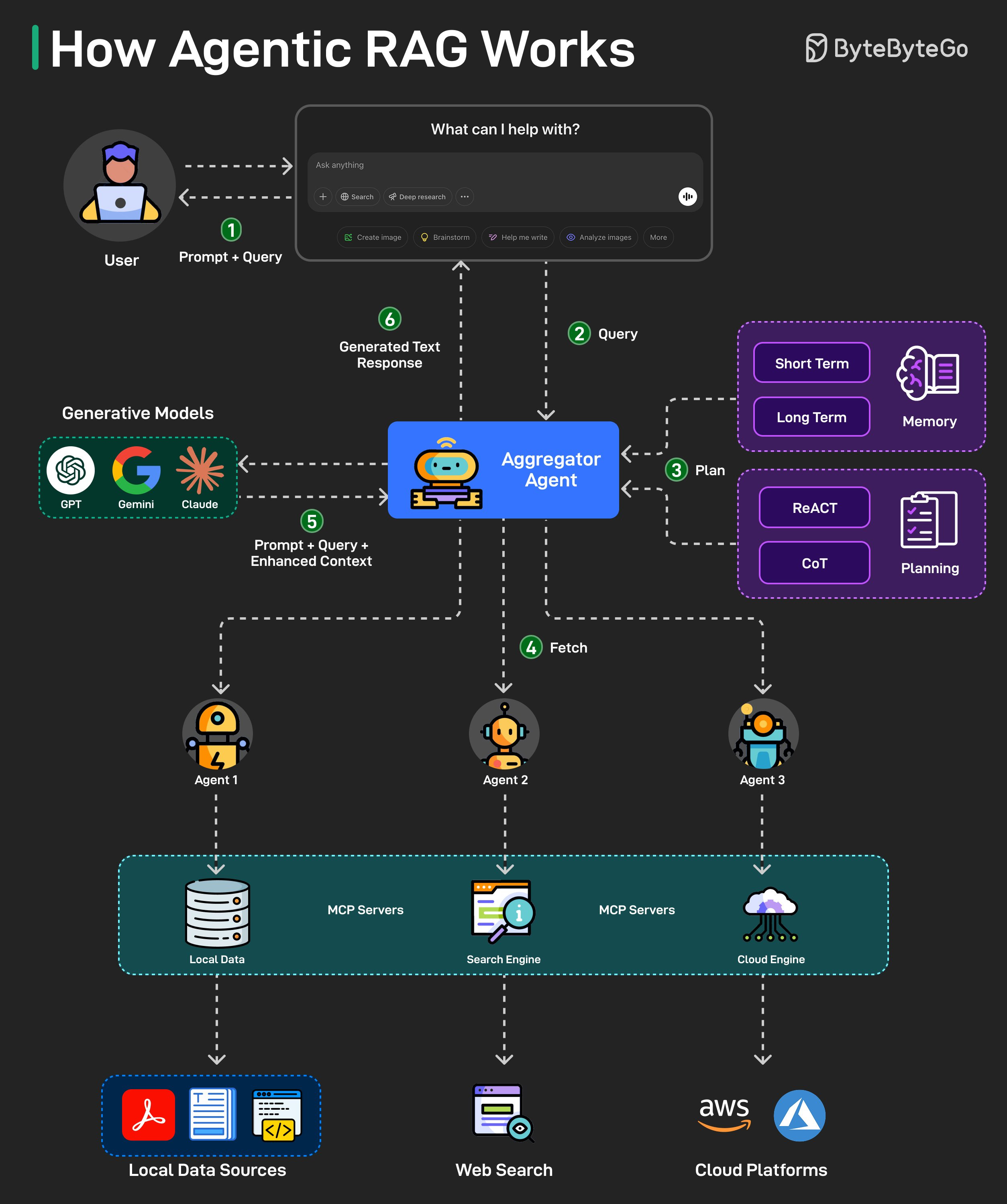
Agentic RAG improves on this by introducing AI agents that can make decisions, select tools, and even refine queries for more accurate and flexible responses. Here’s how Agentic RAG works on a high level:

  1. The user query is directed to an AI Agent for processing.

  2. The agent uses short-term and long-term memory to track query context. It also formulates a retrieval strategy and selects appropriate tools for the job.

  3. The data fetching process can use tools such as vector search, multiple agents, and MCP servers to gather relevant data from the knowledge base.

  4. The agent then combines retrieved data with a query and system prompt. It passes this data to the LLM.

  5. LLM processes the optimized input to answer the user’s query.

Unblocked gives Cursor, Codex, Claude and Copilot the organizational knowledge to generate mergeable code without the back and forth. It pulls context from across your engineering stack, resolves conflicts, and cuts the rework cycle by delivering only what agents need for the task at hand.

Unblock your agents

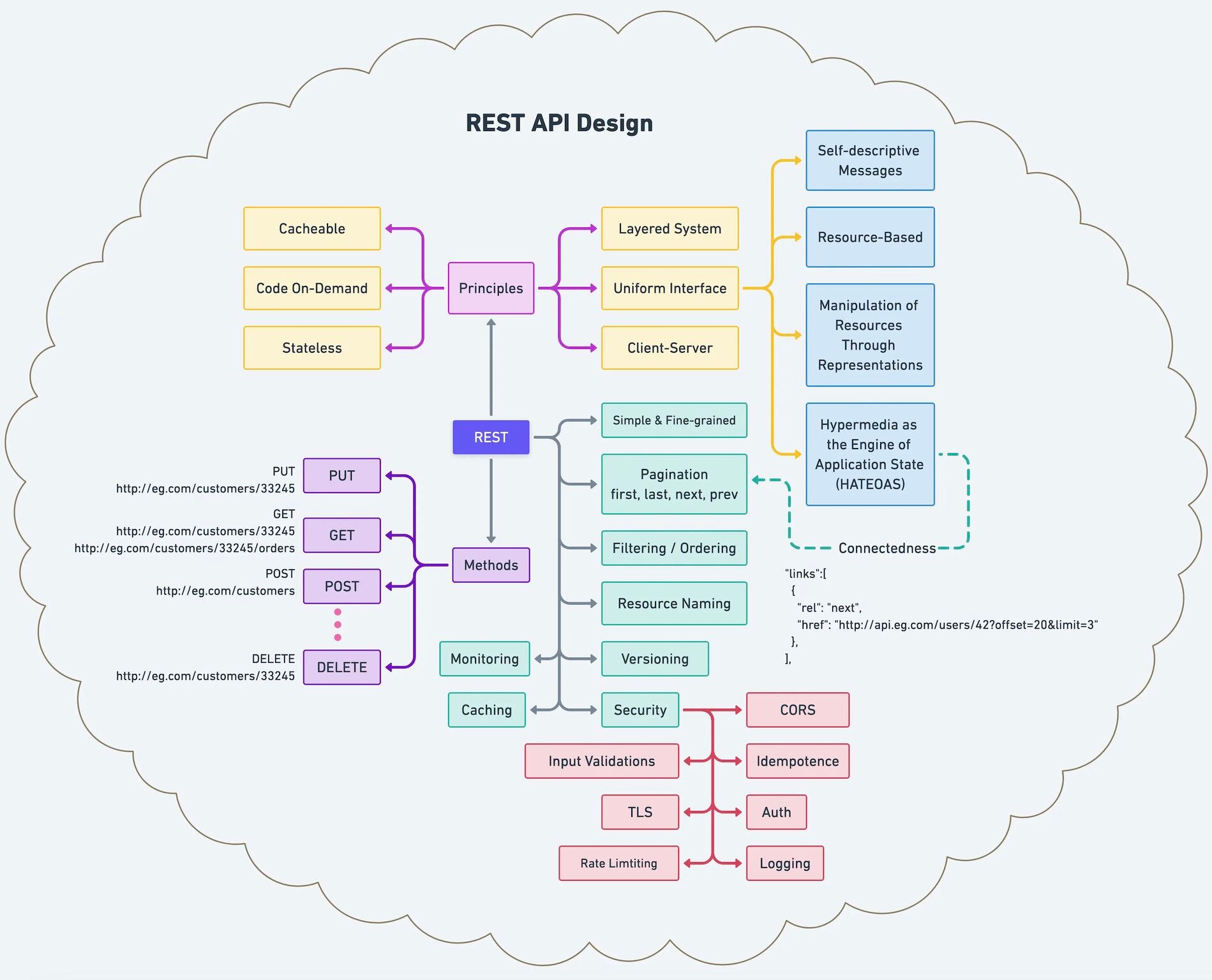
What are its principles, methods, constraints, and best practices? I hope the diagram below gives you a quick overview.
diagram
Image
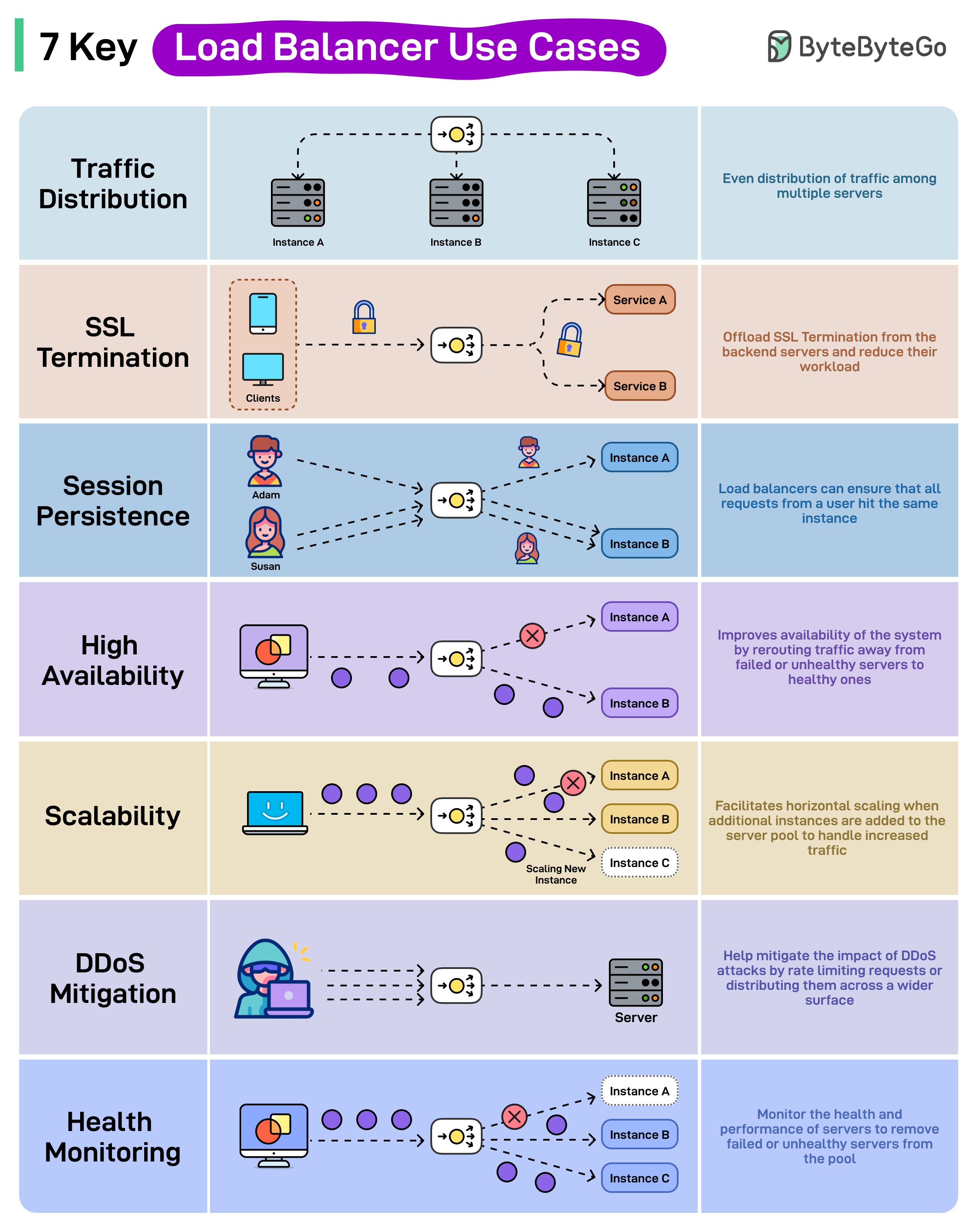
  1. Traffic Distribution: Load Balancers help evenly distribute traffic among multiple server instances.

  2. SSL Termination: Load Balancers can offload the responsibility of SSL termination from the backend servers, thereby reducing their workload.

  3. Session Persistence: Load Balancers ensure that all requests from a user hit the same instance to maintain session persistence.

  4. High Availability: Improves the system’s availability by rerouting traffic away from failed or unhealthy servers to healthy ones.

  5. Scalability: Load Balancers facilitate horizontal scaling when additional instances are added to the server pool to handle increased traffic.

  6. DDoS Mitigation: Load Balancers can help mitigate the impact of DDoS attacks by rate limiting requests or distributing them across a wider surface.

  7. Health Monitoring: Load Balancers also monitor the health and performance of server instances and remove failed or unhealthy servers from the pool.

Over to you: Which other load balancer use case will you add to the list?
No alternative text description for this image

The book is written by Steve Huynh and published by ByteByteGo. Steve is a former principal engineer at Amazon. His ability to break down complex interview dynamics into clear, actionable advice made this book possible. Still, it took us two years to get it ready.

Here's what's inside:

  • 130+ interview questions, from the most common to the ones that catch candidates off guard

  • 72 example stories showing what strong answers look like, from entry level to principal

  • Clear guidance on what interviewers look for, including key signals and red flags

  • High-Signal Storytelling, a framework to build a story bank for any behavioral interview

  • A practical prep plan and interview-day techniques for follow-ups and unexpected questions

Order your copy on Amazon

No posts