惯性聚合 高效追踪和阅读你感兴趣的博客、新闻、科技资讯
阅读原文 在惯性聚合中打开

推荐订阅源

Google Online Security Blog
G
Google Developers Blog
云风的 BLOG
云风的 BLOG
阮一峰的网络日志
阮一峰的网络日志
L
Lohrmann on Cybersecurity
Security Latest
Security Latest
博客园 - 【当耐特】
Microsoft Security Blog
N
Netflix TechBlog - Medium
Cyber Security Advisories - MS-ISAC
The GitHub Blog
The GitHub Blog
Vercel News
Vercel News
The Register - Security
T
Tenable Blog
D
Docker
OSCHINA 社区最新新闻
OSCHINA 社区最新新闻
有赞技术团队
有赞技术团队
C
CXSECURITY Database RSS Feed - CXSecurity.com
Simon Willison's Weblog
S
Schneier on Security
Scott Helme
Scott Helme
C
Cyber Attacks, Cyber Crime and Cyber Security
C
CERT Recently Published Vulnerability Notes
罗磊的独立博客
Threat Intelligence Blog | Flashpoint
H
Hackread – Cybersecurity News, Data Breaches, AI and More
K
Kaspersky official blog
Know Your Adversary
Know Your Adversary
freeCodeCamp Programming Tutorials: Python, JavaScript, Git & More
T
The Blog of Author Tim Ferriss
aimingoo的专栏
aimingoo的专栏
Spread Privacy
Spread Privacy
P
Proofpoint News Feed
博客园 - 聂微东
NISL@THU
NISL@THU
T
Threat Research - Cisco Blogs
Exploit-DB.com RSS Feed
A
Arctic Wolf
V2EX - 技术
V2EX - 技术
H
Heimdal Security Blog
C
Check Point Blog
D
DataBreaches.Net
H
Help Net Security
www.infosecurity-magazine.com
L
LangChain Blog
宝玉的分享
宝玉的分享
V
Vulnerabilities – Threatpost
PCI Perspectives
PCI Perspectives
Recent Announcements
Martin Fowler
Martin Fowler

ByteByteGo Newsletter

A Beginner’s Guide to Clocks, Causality, and Ordering in Distributed Systems Best Practices for Building AI Agents That Work in Production Inside Roblox’s Bet on World Models MCP vs A2A vs ACP: How AI Agents Actually Talk to Each Other A Guide to Multi-Tenancy: Benefits and Challenges AI Customer Support at Scale: The Travel Industry’s $Billion Bet How LLMs Learn to Be Helpful (RLHF vs DPO) How Microsoft Ships AI Agents at Enterprise Scale EP221: How Docker Works Under the Hood LAST CALL FOR ENROLLMENT: Become an AI Engineer - Cohort 7 Streaming vs Batch: Two Philosophies of Data Processing The Agent Loop: How AI Goes From Answering Questions to Doing Things ChatGPT vs Gemini vs Claude: How They Differ LAST CALL FOR ENROLLMENT: Become an AI Engineer - Cohort 7 Proof of Human: How to Verify a Person Is Real and Unique Multi-Region Architecture: Going Global Without Going Broke How OpenAI Delivers Low-Latency Voice AI for 900M Users Inside Thinking Machines’ Interaction Models How AI Agents Manage Memory and Avoid Forgetfulness EP220: RAG vs Graph RAG vs Agentic RAG Top Anti-Patterns to Avoid in Service Architecture Large Language Models vs Small Language Models An Ex-Meta L8’s Agentic Engineering Setup AI-Native Leaders: The Organizational Playbook for Engineering Transformation at Scale EP219: 12 Open-source LLMs Observability for Beginners: Logs, Metrics, Traces, and Everything Around Them LAST CALL FOR ENROLLMENT: Build with Claude Code - Cohort 2 How Open-Weight Models Changed the AI Landscape A Guide to AI Inference Engineering EP218: The Typical AI Agent Stack, Explained Must- Know Deployment Strategies: From Big-Bang to Progressive Delivery Love Teaching? ByteByteGo Is Hiring Part-Time AI & Engineering Instructors What Salesforce Learned from 20,000 Enterprise Agent Deployments Token Spend Out of Control? The Case for Smarter Routing EP217: Latency vs Throughput vs Bandwidth The Path of a Request: A Tour of Modern Web Architecture How OpenAI Built Its Data Agent A Practical Guide to Becoming an AI-Native Engineer How DoorDash Built a Testing System to Evaluate LLMs How Airtable Built the Search Layer Behind Their AI Features How Vercel Cut Build Wait Times From 90 Seconds To 5 How CockroachDB Built Vector Indexing at Scale EP216: RAGs vs Agents 🚀 New cohort based course launch: Build with Claude Code A Guide to Async Patterns in API Design How Netflix is Using Multimodal AI to Power Video Search How Snapchat Serves a Billion Predictions Per Second How Grab is Using AI Agents to Boost Team Productivity EP215: The Anatomy of an AI Agent LAST CALL FOR ENROLLMENT: Become an AI Engineer - Cohort 6 A Guide To Event-Driven Architectural Patterns High Performance Rate Limiting at Databricks How Figma Upgraded Data Pipeline from Multi-Day Latency to Real-Time How Pinterest Built a Production MCP Ecosystem EP214: Claude Code vs. OpenClaw: 5 Design Dimensions Become an AI Engineer | Enrollment Ends Soon Container Design Patterns for Distributed Systems How Instacart Built a Search for Billions of Products Connecting LLMs to the Real World: Tool Use, Function Calling, and MCP EP213: MCP vs Skills, Clearly Explained A Beginner’s Guide to Kubernetes The Tech Stack Powering Wise How Stripe Detects Fraudulent Transactions Within 100 ms How Amazon Uses LLMs to Recommend Products EP212: Data Warehouse vs Data Lake vs Data Mesh B-Trees vs LSM Trees: Comparison and Trade-Offs How DoorDash Launches a New Country in One Week The Security Architecture of GitHub Agentic Workflow EP211: How the JVM Works A Guide to Relational Database Design Figma Design to Code, Code to Design: Clearly Explained How LinkedIn Feed Uses LLMs to Serve 1.3 Billion Users EP210: Monolithic vs Microservices vs Serverless Must-Know Cross-Cutting Concerns in API Development How Spotify Ships to 675 Million Users Every Week Without Breaking Things Nextdoor’s Database Evolution: A Scaling Ladder A Guide to Context Engineering for LLMs EP209: 12 Claude Code Features Every Engineer Should Know Our New Book on Behavioral Interviews Is Now Available on Amazon Database Performance Strategies and Their Hidden Costs How Datadog Redefined Data Replication How Meta Turned Debugging Into a Product How Roblox Uses AI to Translate 16 Languages in 100 Milliseconds EP208: Load Balancer vs API Gateway LAST CALL FOR ENROLLMENT: Become an AI Engineer - Cohort 5 How to Implement API Security How Anthropic’s Claude Thinks How Netflix Live Streams to 100 Million Devices in 60 Seconds How Agentic RAG Works? Last Chance to Enroll | Become an AI Engineer | Cohort-Based Course EP207: Top 12 GitHub AI Repositories Event Sourcing Explained: Benefits and Use Cases How OpenAI Codex Works
Must-Know Failure Modes in Distributed Systems
ByteByteGo · 2026-05-29 · via ByteByteGo Newsletter

What does it mean for a distributed system to be up?

On a single machine, the answer is straightforward, since a program is either running or it has crashed, and the line between the two is usually obvious from a stack trace.

Distributed systems are not so simple. Every server can report healthy while users are seeing errors, the whole system can be technically working but stuck in a state it cannot recover from on its own, and it can quietly serve wrong data while every dashboard glows green.

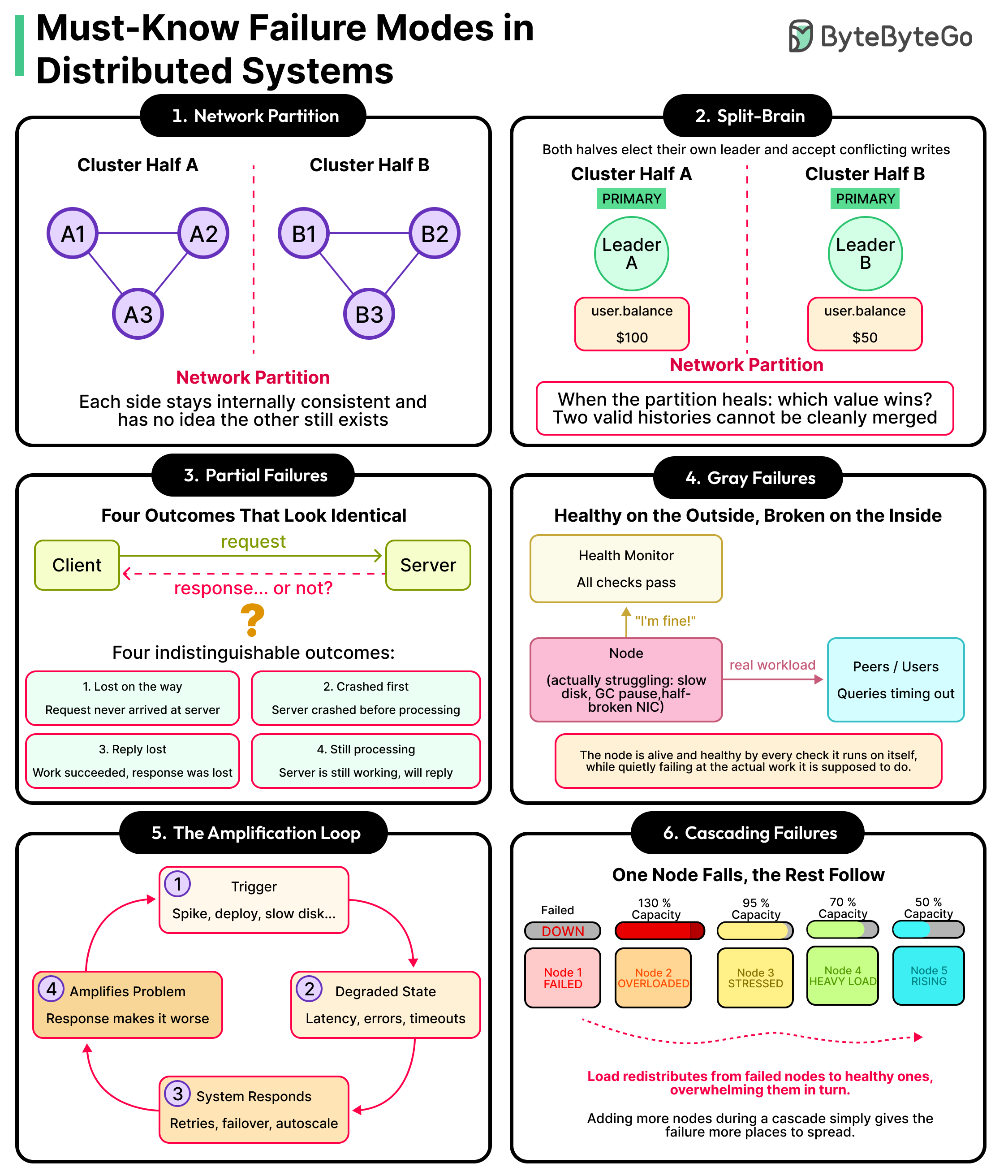
None of these may be because of bugs in the conventional sense. They are recurring failure patterns that have been showing up across systems for decades, with names, mechanisms, and standard ways of defending against them.

In this article, we will look at the most significant failure mode patterns in distributed systems and the standard approaches to deal with each of them.