惯性聚合 高效追踪和阅读你感兴趣的博客、新闻、科技资讯
阅读原文 在惯性聚合中打开

推荐订阅源

MyScale Blog
MyScale Blog
Apple Machine Learning Research
H
Help Net Security
雷峰网
雷峰网
V
Visual Studio Blog
G
Google Developers Blog
Microsoft Azure Blog
Hugging Face - Blog
Hugging Face - Blog
爱范儿
爱范儿
IT之家
IT之家
Engineering at Meta
Engineering at Meta
Microsoft Security Blog
aimingoo的专栏
aimingoo的专栏
大猫的无限游戏
大猫的无限游戏
M
MIT News - Artificial intelligence
月光博客
月光博客
A
About on SuperTechFans
B
Blog RSS Feed
奇客Solidot–传递最新科技情报
奇客Solidot–传递最新科技情报
The GitHub Blog
The GitHub Blog
N
Netflix TechBlog - Medium
J
Java Code Geeks
云风的 BLOG
云风的 BLOG
Blog — PlanetScale
Blog — PlanetScale

ByteByteGo Newsletter

Why An LLM’s Memory Gets Expensive and How to Fix It LLM Security Basics: The Full Threat Model Hiring: Part Time Instructor, Write Production Grade Code with AI A Detailed Guide to Idempotency, Delivery Semantics, and Deduplication How ChatGPT Optimizes its Agent Loop: Harness, API, and Inference Why DoorDash, Instacart, and Uber Eats Integrated LLMs Into Search Three Different Ways How NVIDIA Builds Open Models for the Age of AI Best Practices for Building AI Agents That Work in Production Inside Roblox’s Bet on World Models MCP vs A2A vs ACP: How AI Agents Actually Talk to Each Other A Guide to Multi-Tenancy: Benefits and Challenges AI Customer Support at Scale: The Travel Industry’s $Billion Bet How LLMs Learn to Be Helpful (RLHF vs DPO) How Microsoft Ships AI Agents at Enterprise Scale EP221: How Docker Works Under the Hood LAST CALL FOR ENROLLMENT: Become an AI Engineer - Cohort 7 Streaming vs Batch: Two Philosophies of Data Processing The Agent Loop: How AI Goes From Answering Questions to Doing Things ChatGPT vs Gemini vs Claude: How They Differ LAST CALL FOR ENROLLMENT: Become an AI Engineer - Cohort 7 Proof of Human: How to Verify a Person Is Real and Unique Multi-Region Architecture: Going Global Without Going Broke How OpenAI Delivers Low-Latency Voice AI for 900M Users Inside Thinking Machines’ Interaction Models How AI Agents Manage Memory and Avoid Forgetfulness EP220: RAG vs Graph RAG vs Agentic RAG Top Anti-Patterns to Avoid in Service Architecture Large Language Models vs Small Language Models An Ex-Meta L8’s Agentic Engineering Setup AI-Native Leaders: The Organizational Playbook for Engineering Transformation at Scale
A Beginner’s Guide to Clocks, Causality, and Ordering in ...
ByteByteGo · 2026-07-23 · via ByteByteGo Newsletter

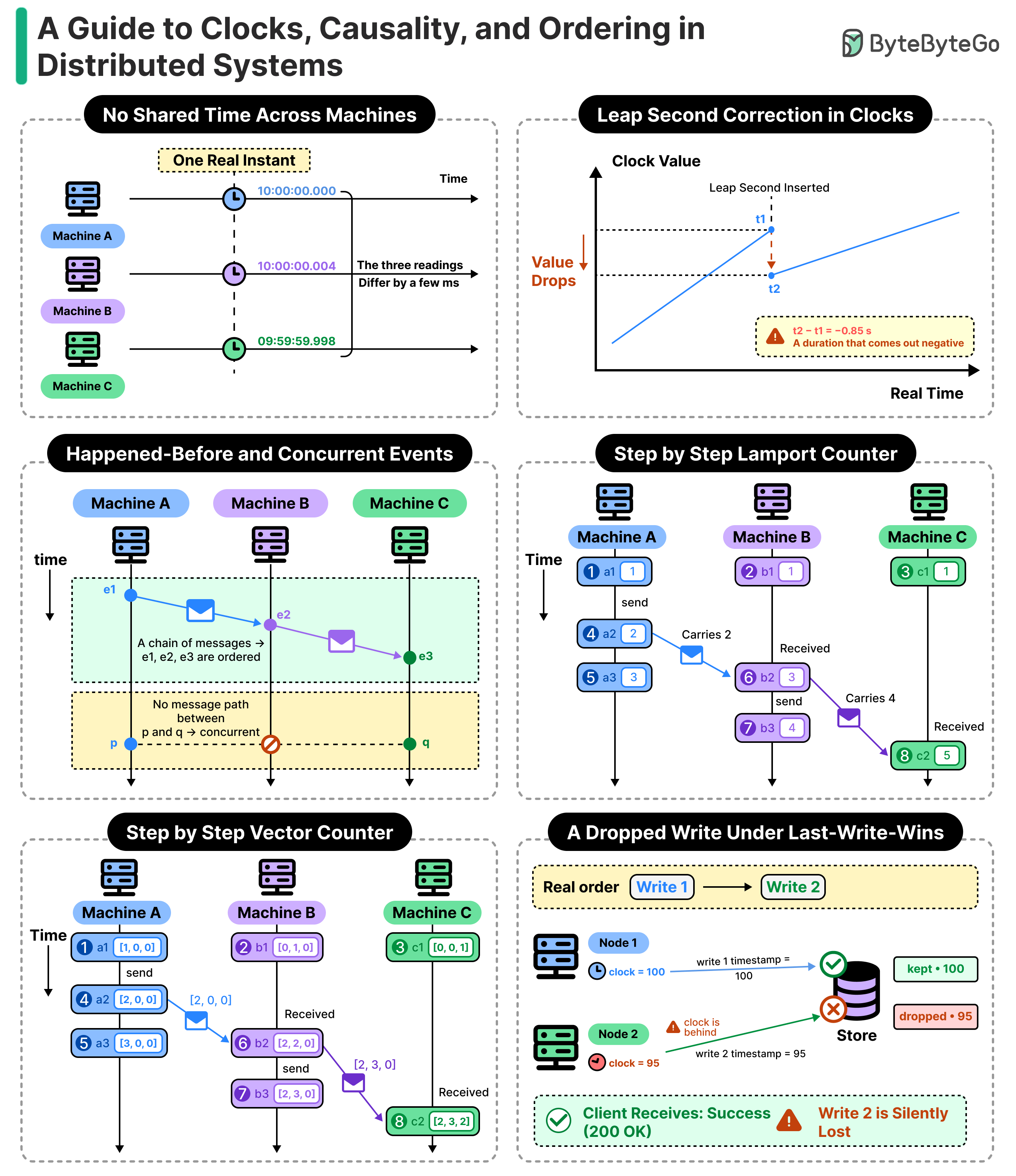
Why does something as simple as reading the time become a hard problem for distributed systems?

On a single computer, every event can be measured against one clock, so the order of the events is never in doubt. However, a distributed system, where work is spread across many independent machines, lacks a shared reference. Each machine can read time from its own hardware clock, but those clocks do not stay aligned. Network Time Protocol (NTP) tries to bring the clocks together, but it cannot eliminate the problem.

This becomes a real problem whenever correctness depends on the order in which things happened. If events on different machines are ordered by comparing timestamps, a small difference in the wrong direction can change the result. For example:

  • An update that happened later can be discarded in favor of an earlier one, because clock differences gave the earlier write the larger timestamp, and the newer data disappears with no error raised.

  • Logs gathered from several machines can place an effect before its cause, which makes tracing a problem much harder.

  • An operation that depends on a correct order, such as granting access only after the change that authorized it, can act on stale information.

In this article, we look at these ideas in detail:

  • Why a machine’s own clock is a poor basis for ordering events, and how close synchronization can realistically get

  • What it means for one event to have happened before another, and why some pairs of events have no defined order

  • Logical clocks and vector clocks, and what each one can and cannot determine

  • Why the order of events matters in practice, for replication, auditing, and debugging

  • Hybrid logical clocks and the problem they were designed to solve

  • How a globally distributed database such as Google Spanner approaches ordering at scale