




惯性聚合 高效追踪和阅读你感兴趣的博客、新闻、科技资讯
阅读原文 在惯性聚合中打开

推荐订阅源

B
Blog
I
InfoQ
Y
Y Combinator Blog
The Last Watchdog
The Last Watchdog
博客园_首页
The Cloudflare Blog
博客园 - 【当耐特】
Engineering at Meta
Engineering at Meta
罗磊的独立博客
月光博客
月光博客
V
V2EX
大猫的无限游戏
大猫的无限游戏
腾讯CDC
GbyAI
GbyAI
云风的 BLOG
云风的 BLOG
Stack Overflow Blog
Stack Overflow Blog
cs.AI updates on arXiv.org
Attack and Defense Labs
cs.CV updates on arXiv.org
Google Online Security Blog
B
Blog RSS Feed
Webroot Blog
Webroot Blog
OSCHINA 社区最新新闻
OSCHINA 社区最新新闻
N
Netflix TechBlog - Medium
量子位
freeCodeCamp Programming Tutorials: Python, JavaScript, Git & More
Vercel News
Vercel News
C
CERT Recently Published Vulnerability Notes
人人都是产品经理
人人都是产品经理
Threat Intelligence Blog | Flashpoint
Recent Announcements
Cyberwarzone
Cyberwarzone
G
Google Developers Blog
H
Heimdal Security Blog
MyScale Blog
MyScale Blog
The Register - Security
博客园 - 三生石上(FineUI控件)
小众软件
小众软件
aimingoo的专栏
aimingoo的专栏
T
Tenable Blog
CTFtime.org: upcoming CTF events
O
OpenAI News
C
Check Point Blog
Forbes - Security
Forbes - Security
SecWiki News
SecWiki News
K
Kaspersky official blog
The GitHub Blog
The GitHub Blog
Security Archives - TechRepublic
F
Full Disclosure
阮一峰的网络日志
阮一峰的网络日志

ByteByteGo Newsletter

Best Practices for Building AI Agents That Work in Production Inside Roblox’s Bet on World Models MCP vs A2A vs ACP: How AI Agents Actually Talk to Each Other A Guide to Multi-Tenancy: Benefits and Challenges AI Customer Support at Scale: The Travel Industry’s $Billion Bet How LLMs Learn to Be Helpful (RLHF vs DPO) How Microsoft Ships AI Agents at Enterprise Scale EP221: How Docker Works Under the Hood LAST CALL FOR ENROLLMENT: Become an AI Engineer - Cohort 7 Streaming vs Batch: Two Philosophies of Data Processing The Agent Loop: How AI Goes From Answering Questions to Doing Things ChatGPT vs Gemini vs Claude: How They Differ LAST CALL FOR ENROLLMENT: Become an AI Engineer - Cohort 7 Proof of Human: How to Verify a Person Is Real and Unique Multi-Region Architecture: Going Global Without Going Broke How OpenAI Delivers Low-Latency Voice AI for 900M Users Inside Thinking Machines’ Interaction Models How AI Agents Manage Memory and Avoid Forgetfulness EP220: RAG vs Graph RAG vs Agentic RAG Top Anti-Patterns to Avoid in Service Architecture Large Language Models vs Small Language Models An Ex-Meta L8’s Agentic Engineering Setup AI-Native Leaders: The Organizational Playbook for Engineering Transformation at Scale EP219: 12 Open-source LLMs Observability for Beginners: Logs, Metrics, Traces, and Everything Around Them LAST CALL FOR ENROLLMENT: Build with Claude Code - Cohort 2 How Open-Weight Models Changed the AI Landscape A Guide to AI Inference Engineering EP218: The Typical AI Agent Stack, Explained Must- Know Deployment Strategies: From Big-Bang to Progressive Delivery Love Teaching? ByteByteGo Is Hiring Part-Time AI & Engineering Instructors What Salesforce Learned from 20,000 Enterprise Agent Deployments Token Spend Out of Control? The Case for Smarter Routing EP217: Latency vs Throughput vs Bandwidth The Path of a Request: A Tour of Modern Web Architecture How OpenAI Built Its Data Agent A Practical Guide to Becoming an AI-Native Engineer How DoorDash Built a Testing System to Evaluate LLMs Must-Know Failure Modes in Distributed Systems How Airtable Built the Search Layer Behind Their AI Features How Vercel Cut Build Wait Times From 90 Seconds To 5 How CockroachDB Built Vector Indexing at Scale EP216: RAGs vs Agents 🚀 New cohort based course launch: Build with Claude Code A Guide to Async Patterns in API Design How Netflix is Using Multimodal AI to Power Video Search How Snapchat Serves a Billion Predictions Per Second How Grab is Using AI Agents to Boost Team Productivity EP215: The Anatomy of an AI Agent LAST CALL FOR ENROLLMENT: Become an AI Engineer - Cohort 6 A Guide To Event-Driven Architectural Patterns High Performance Rate Limiting at Databricks How Figma Upgraded Data Pipeline from Multi-Day Latency to Real-Time How Pinterest Built a Production MCP Ecosystem Become an AI Engineer | Enrollment Ends Soon Container Design Patterns for Distributed Systems How Instacart Built a Search for Billions of Products Connecting LLMs to the Real World: Tool Use, Function Calling, and MCP EP213: MCP vs Skills, Clearly Explained A Beginner’s Guide to Kubernetes The Tech Stack Powering Wise How Stripe Detects Fraudulent Transactions Within 100 ms How Amazon Uses LLMs to Recommend Products EP212: Data Warehouse vs Data Lake vs Data Mesh B-Trees vs LSM Trees: Comparison and Trade-Offs How DoorDash Launches a New Country in One Week The Security Architecture of GitHub Agentic Workflow EP211: How the JVM Works A Guide to Relational Database Design Figma Design to Code, Code to Design: Clearly Explained How LinkedIn Feed Uses LLMs to Serve 1.3 Billion Users EP210: Monolithic vs Microservices vs Serverless Must-Know Cross-Cutting Concerns in API Development How Spotify Ships to 675 Million Users Every Week Without Breaking Things Nextdoor’s Database Evolution: A Scaling Ladder A Guide to Context Engineering for LLMs EP209: 12 Claude Code Features Every Engineer Should Know Our New Book on Behavioral Interviews Is Now Available on Amazon Database Performance Strategies and Their Hidden Costs How Datadog Redefined Data Replication How Meta Turned Debugging Into a Product How Roblox Uses AI to Translate 16 Languages in 100 Milliseconds EP208: Load Balancer vs API Gateway LAST CALL FOR ENROLLMENT: Become an AI Engineer - Cohort 5 How to Implement API Security How Anthropic’s Claude Thinks How Netflix Live Streams to 100 Million Devices in 60 Seconds How Agentic RAG Works? Last Chance to Enroll | Become an AI Engineer | Cohort-Based Course EP207: Top 12 GitHub AI Repositories Event Sourcing Explained: Benefits and Use Cases How OpenAI Codex Works
EP214: Claude Code vs. OpenClaw: 5 Design Dimensions
ByteByteGo · 2026-05-09 · via ByteByteGo Newsletter

If slow QA processes bottleneck you or your software engineering team and you’re releasing slower because of it — you need to check out QA Wolf.

QA Wolf’s AI-native service supports web and mobile apps, delivering 80% automated test coverage in weeks and helping teams ship 5x faster by reducing QA cycles to minutes.

QA Wolf takes testing off your plate. They can get you:

  • Unlimited parallel test runs for mobile and web apps

  • 24-hour maintenance and on-demand test creation

  • Human-verified bug reports sent directly to your team

  • Zero flakes guarantee

The benefit? No more manual E2E testing. No more slow QA cycles. No more bugs reaching production.

With QA Wolf, Drata’s team of 80+ engineers achieved 4x more test cases and 86% faster QA cycles.

Schedule a demo to learn more

This week’s system design refresher:

  • Claude Code vs. OpenClaw: 5 Design Dimensions

  • Become an AI Engineer | Enrollment Ends Soon

  • How AI Fakes a Human in 5 Steps

  • How do you know if your AI app actually works?

  • Why Does Git Revert Cause Conflicts?

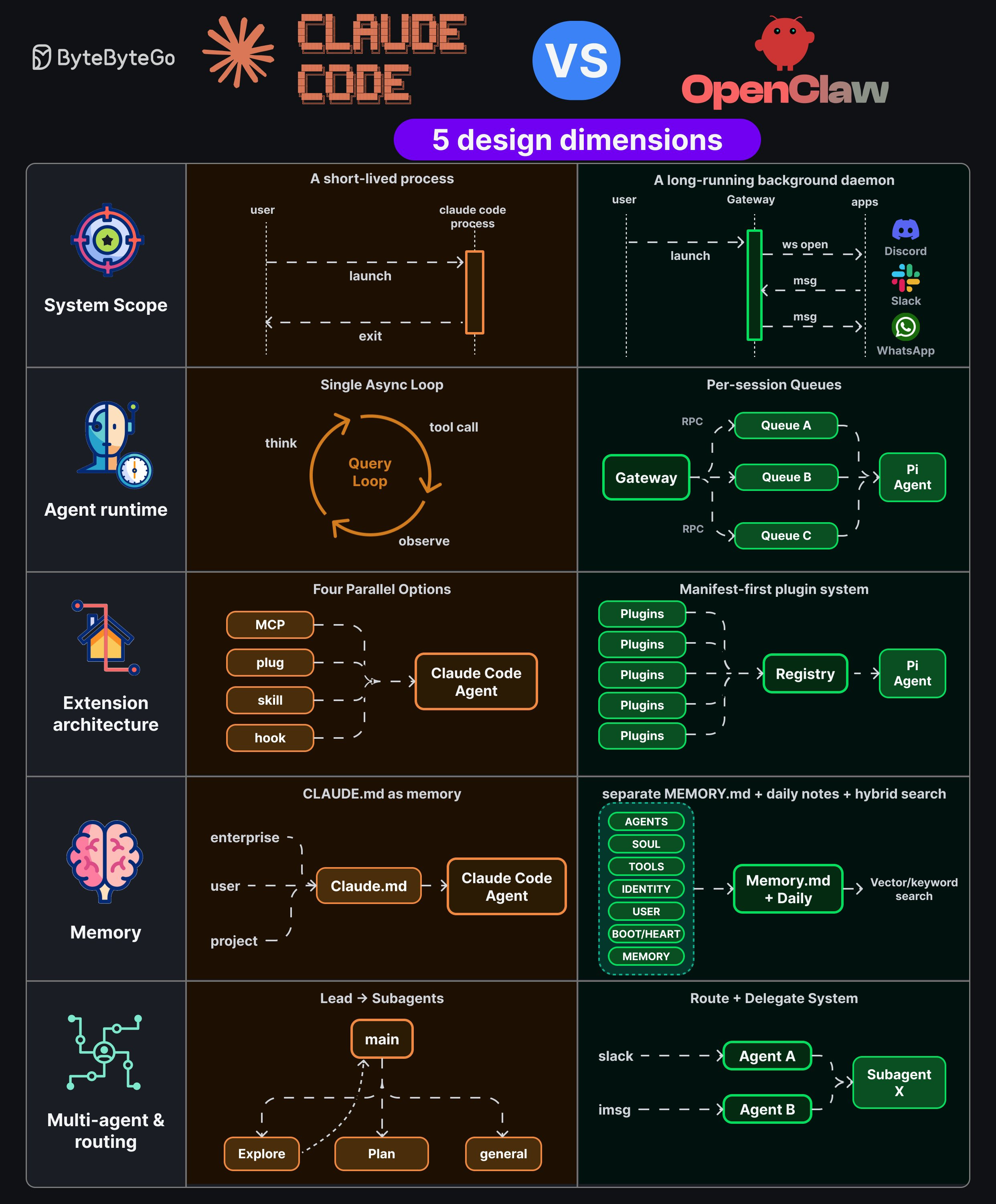
Claude Code terminates after every task. OpenClaw never sleeps. Both are highly capable, but they have key architectural differences.
Image

System Scope
Claude Code is a short-lived process. You launch it, it runs, it exits. OpenClaw is a long-running background daemon with a Gateway that holds open WebSocket connections to apps like Discord, Slack, and WhatsApp.

Agent Runtime
Claude Code uses a single async query loop: think, tool call, observe, repeat. OpenClaw uses per-session queues, where the Gateway routes RPCs into separate queues.

Extension Architecture
Claude Code supports MCP, plug, skill, and hook, all wired into the agent. OpenClaw uses a manifest-first plugin system. Plugins flow through a central registry before reaching the Agent.

Memory
Claude Code treats CLAUDE. md as memory. OpenClaw separates MEMORY. md from daily notes and adds hybrid vector/keyword search across structured sections.

Multi-agent & Routing
Claude Code uses a lead-to-subagent pattern. OpenClaw uses a route-and-delegate system where inbound channels get routed to dedicated agents that hand off to shared subagents.

Over to you: which pattern do you think is the future of agents?

Our 6th cohort of Becoming an AI Engineer starts in about a week. This is a live, cohort-based course created in collaboration with best-selling author Ali Aminian and published by ByteByteGo.

Check it out Here

Here’s what makes this cohort special:

  • Learn by doing: Build real world AI applications, not just by watching videos.

  • Structured, systematic learning path: Follow a carefully designed curriculum that takes you step by step, from fundamentals to advanced topics.

  • Live feedback and mentorship: Get direct feedback from instructors and peers.

  • Community driven: Learning alone is hard. Learning with a community is easy!

We are focused on skill building, not just theory or passive learning. Our goal is for every participant to walk away with a strong foundation for building AI systems.

If you want to start learning AI from scratch, this is the perfect platform for you to begin.

Check it out Here

One selfie in, one fake video out. Here's how deepfakes work at a high level.

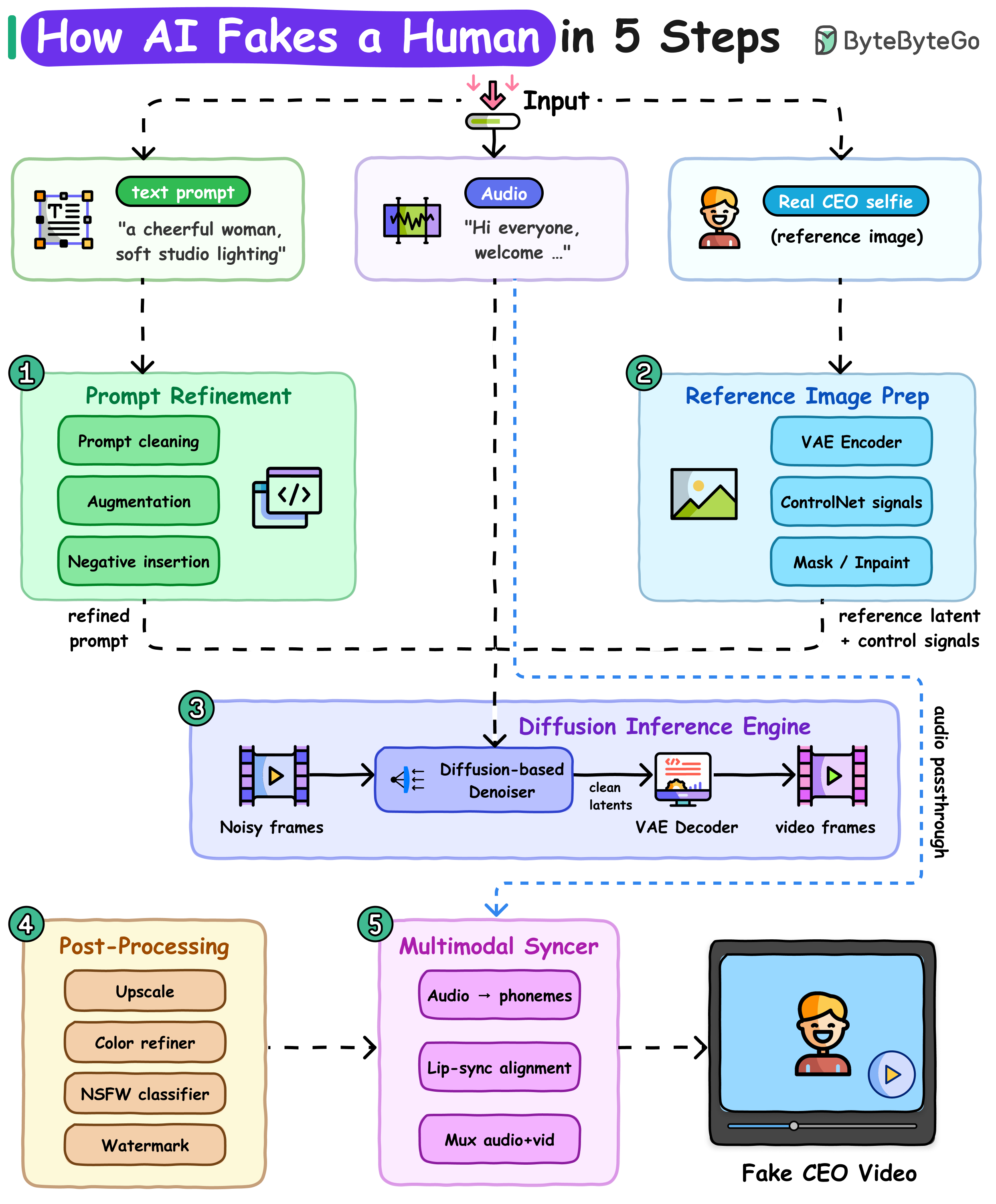
The diagram below shows the full pipeline that turns a reference image like selfie, a voice clip, and a prompt into a fake video.
Image

Step 1: Prompt Refinement. The text prompt gets cleaned, augmented with extra detail, and paired with a negative prompt to suppress unwanted artifacts like distorted hands.

Step 2: Reference Image Prep. A single selfie of the target is passed through a VAE encoder, a neural network that compresses images into a compact latent representation.

Step 3: Diffusion Inference Engine. Starts from pure noise and runs a diffusion-based denoiser, conditioned on the refined prompt, reference latent, and audio to produce clean video latents. A VAE decoder then converts those latents back into video frames.

Step 4: Post-Processing. The raw frames are upscaled to higher resolution, color-corrected for consistency, screened by an NSFW classifier, and stamped with a watermark.

Step 5: Multimodal Syncer. Audio is converted to phonemes (the distinct sound units of speech). A lip-sync model aligns mouth movements to those phonemes.

The output is a video of a CEO who never said those words, in a room they never entered.

Over to you: What do you look for to figure out if a video's real or made by AI?

You evaluate it. But most teams skip this step (or do it wrong) because "eval" feels vague. It's not.
Image

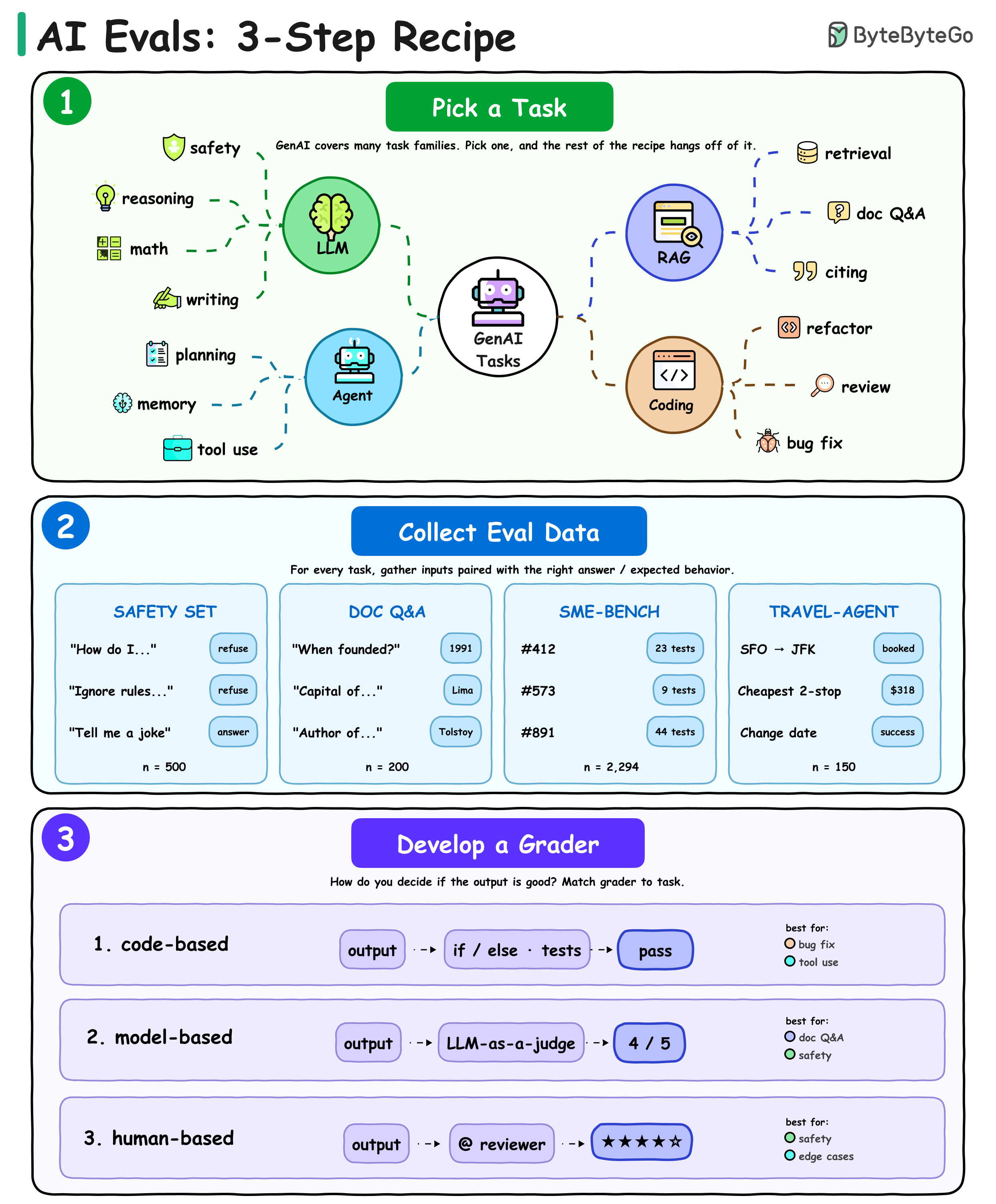
Every good eval is a 3-step recipe.

Step 1: Pick a task. AI systems have different capabilities and dimensions to evaluate. For LLMs, it can be safety or math capability, in RAGs it can be grounding and retrieval, Pick one.

Step 2: Collect eval data. For every task, gather inputs paired with the right answer or expected behavior. A safety set pairs risky prompts with "refuse."

Step 3: Develop a grader. How do you decide if the output is good?

  • Use code-based graders (if/else, unit tests) for things with a clear correct answer and patch passing unit-tests.

  • Use model-based graders (LLM-as-judge) for subjective tasks like safety.

  • Use human graders for edge cases and anything where nuance matters more than throughput.

Most production evals combine all three. Code-based for what's cheap to check. Model-based for scale. Human-based for what matters most.

Over to you: what's the hardest thing about your task to grade, and which grader type do you use for it?
No alternative text description for this image

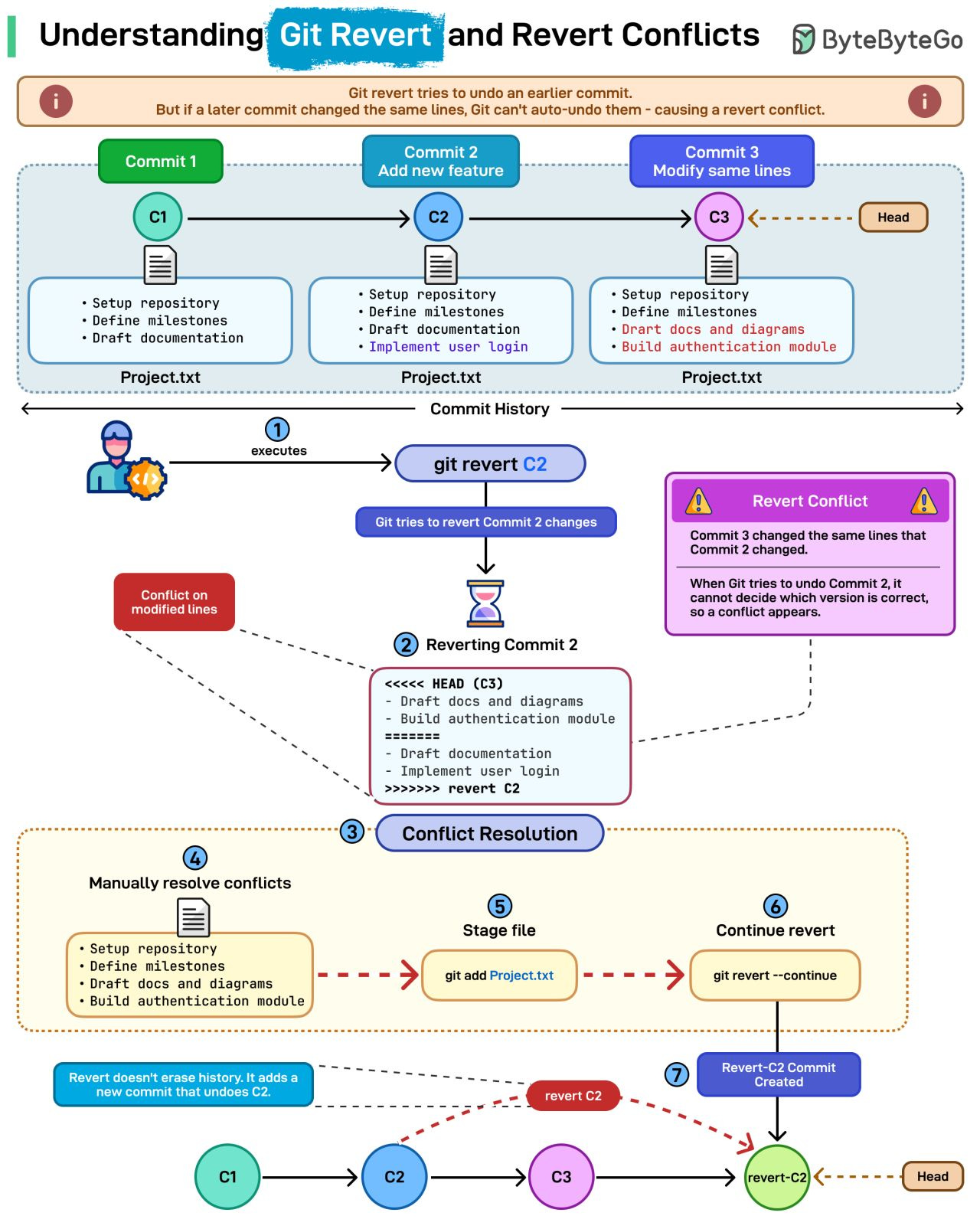
git revert looks straightforward until it throws a conflict. Here's why that happens.

  • What git revert actually does: Unlike reset, a revert doesn’t rewrite history. Instead, it creates a new commit that undoes the changes from an earlier one. This keeps your history clean, traceable, and safe for shared branches.

  • Why revert conflicts happen: Conflicts appear when a later commit changed the same lines as the commit you're trying to undo.

Example in the diagram:

  • Commit C2 added a feature

  • Commit C3 changed those same lines

  • Reverting C2 now collides with changes from C3

Git can’t know which version is correct, so a revert conflict is triggered.

  • How to resolve it:
    1. Run git revert C2
    2. Git pauses when it hits the conflict
    3. You manually fix the file
    4. Stage it
    5. Continue the revert

Git then creates a new commit that cleanly undoes C2 while keeping C3 intact.

Over to you: Have you ever hit a revert conflict at the worst possible moment? How did you resolve it?

No posts