
惯性聚合 高效追踪和阅读你感兴趣的博客、新闻、科技资讯
阅读原文 在惯性聚合中打开

推荐订阅源

T
Threatpost
Recorded Future
Recorded Future
Microsoft Azure Blog
M
MIT News - Artificial intelligence
酷 壳 – CoolShell
酷 壳 – CoolShell
I
InfoQ
博客园 - 司徒正美
Stack Overflow Blog
Stack Overflow Blog
Simon Willison's Weblog
爱范儿
爱范儿
D
Darknet – Hacking Tools, Hacker News & Cyber Security
V
Visual Studio Blog
H
Help Net Security
博客园_首页
钛媒体:引领未来商业与生活新知
钛媒体:引领未来商业与生活新知
B
Blog RSS Feed
美团技术团队
G
GRAHAM CLULEY
cs.CL updates on arXiv.org
C
Cyber Attacks, Cyber Crime and Cyber Security
腾讯CDC
G
Google Developers Blog
Cyberwarzone
Cyberwarzone
T
Tenable Blog
A
About on SuperTechFans
WordPress大学
WordPress大学
Engineering at Meta
Engineering at Meta
L
Lohrmann on Cybersecurity
C
Cisco Blogs
K
Kaspersky official blog
Recent Announcements
Vercel News
Vercel News
C
Cybersecurity and Infrastructure Security Agency CISA
有赞技术团队
有赞技术团队
P
Privacy & Cybersecurity Law Blog
Hugging Face - Blog
Hugging Face - Blog
S
Schneier on Security
Apple Machine Learning Research
Cloudbric
Cloudbric
Scott Helme
Scott Helme
Google Online Security Blog
cs.AI updates on arXiv.org
MyScale Blog
MyScale Blog
Cisco Talos Blog
Cisco Talos Blog
Attack and Defense Labs
Google DeepMind News
N
News and Events Feed by Topic
D
Docker
U
Unit 42
S
Security @ Cisco Blogs

Security @ Cisco Blogs

We third-party tested our firewall built for AI-scale. The test tools hit their limit first. SharpHound Recon Attack - How AI enhanced the threat hunt Machine Speed, Human Judgement: How AI Changed the SOC in 2026 Elevating Expertise in the SOC Educate at Event Speed: Cisco Live Security Operations Center What Working the Cisco Live SOC Taught Me About AI, Detection, and Response Cable to Cloud - A Product Engineer's Journey Through the Cisco Live AMER 2026 SOC The Experience Dividend: How Better Digital Experience Protects Revenue, Trust, and Growth AIM: Building an Agentic Tier-2 SOC Analyst at Cisco Live AMER 2026 Building the Agentic SOC at Cisco Live Americas 2026 Ten Years in the SOC at RSAC: What We Learned in 2026 Uplevelling Black Hat Threat Hunters Making Workflow Runs Explain Themselves: AI-Powered Run Summaries in Cisco XDR Automate Independent Testing Confirms Secure Email Threat Defense’s Email Security Strength Defenseclaw for On-Prem AI SOC Workflow at Black Hat Asia Cisco Secure Access with MCP Infrastructure at Black Hat Asia 2026 The Essence of Black Hat – Collaboration with Partners Black Hat Asia 2026: A Decade in Singapore Black Hat Asia 2026: Threat Hunters’ Corner Unveiling the Power of Integration: XDR, Splunk, Corelight, Arista and Palo Alto Networks in Action at Black Hat Asia Security in the Post-Mythos Era Cisco SASE with Meraki: Get in the Fast Lane to SASE Extending Zero Trust Across the Agentic AI Workflow Strengthening the Foundation: A Predictable, Customer focused Response to AI-Accelerated Vulnerability Discovery Quantum Resilience Needs a Common Language. Here’s Where to Start. Security at Cisco Live: Going Shields Up for the Agentic Era Identity Elevated: A New Unified Identity Experience in Cisco Cloud Control Security Needs a New Operating Model Cisco Secure Access and Microsoft Purview Integration for Simplified Data Protection Cisco Secure Access and Island Browser Enable Zero Trust Everywhere Finding what lives between the alerts: Announcing Cisco Talos Threat Hunting From Log Flood to Threat Signal: Cisco and Splunk Bring Context to Modern Defense Cisco Secure Access and Microsoft Edge for Business Integration Cisco’s Risk-Based Vulnerability Disclosure in the Age of AI Enhancing Cisco Secure Email Gateway: Safer Clicks and Cleaner Files AI-generated reporting: Lessons learned from Cisco Talos Incident Response Inside the SOC: AI-powered DNS defense against ransomware Security Insights: A Threat-First View for the Platform That Enforces Access From Strategy to Architecture: How Cisco is Building a Quantum-Safe Future AI-Ready, Simpler, and More Secure WAN: Cisco SD-WAN Innovations Designing for What’s Next: Securing AI-Scale Infrastructure Without Compromise Preparing for Post-Quantum Cryptography: The Secure Firewall Roadmap Mobile World Congress 2026: AI-powered Network Security Powering MWC Barcelona – Building a Unified SOC and NOC with Splunk in Record Time AI-powered Network Security at the Mobile World Congress 2026 SNOC Inside the Mobile World Congress 2026 SOC: Detecting Shadow Traffic with Firepower 6100 Data Optimization in Security: A Splunk Architect’s Perspective Inside the Talos 2025 Year in Review: A discussion on what the data means for defenders Zero Trust for Agentic AI: Safeguarding your Digital Workforce The Agent Trust gap: What Our Research Reveals About Agentic AI Security Meet Your Incident Responders
Why Network Segmentation Projects Fail: Four Patterns
Aamer Akhter · 2026-05-26 · via Security @ Cisco Blogs

In previous blogs, I’ve discussed why segmentation matters, the challenges of getting it right, and the benefits that organizations see when they fully commit to both macro- and micro-segmentation. Today, I want to flip the question around. Instead of asking what happens when segmentation succeeds, let’s ask: why do so many segmentation projects fail.

That question is the focus of the newly released Cisco 2026 Segmentation Report, which draws on a survey of 400 failed segmentation projects at U.S.-based organizations with 500 or more employees. The findings are illuminating—and occasionally surprising.

Four Patterns of Failure

When we evaluated each failed project against twelve factors spanning general IT project management and segmentation-specific challenges, four distinct failure patterns emerged:

  1. Perfect Storm (50%). Projects that failed on nearly every front at once. General IT project management issues and segmentation-specific technical challenges hit simultaneously.
  2. Diffuse Friction (33%). Projects that didn’t fail on any single front, but accumulated enough moderate friction across many dimensions that progress stalled.
  3. Operational Drag (9%). Projects where goals and sponsorship were sound, but the burden of creating and maintaining segmentation policies became unsustainable.
  4. Scope & Visibility Trap (8%). Projects defeated by expanding scope, unrealistic timelines, and inadequate visibility into a complex environment.
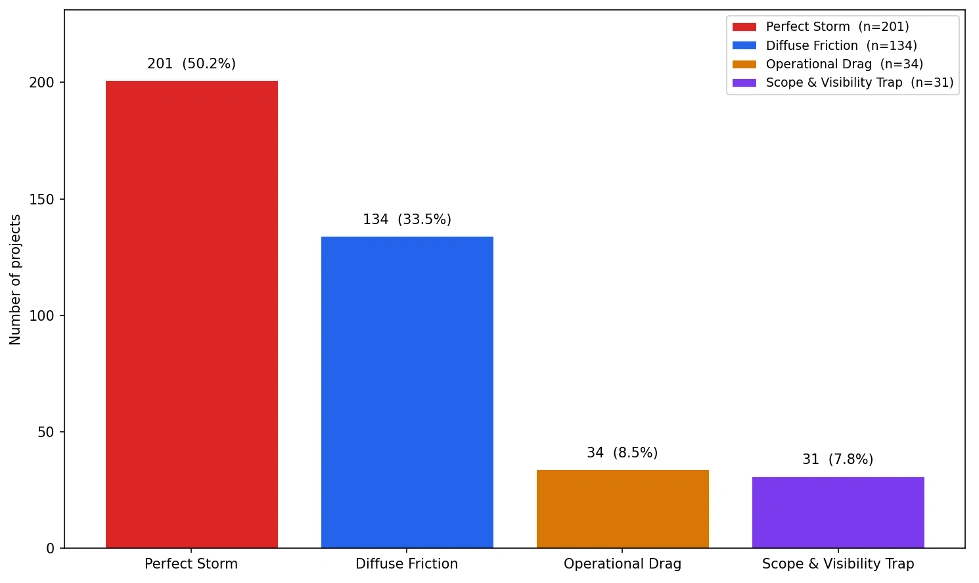
Four patterns of failure chart

The headline: more than 80% of failed projects stumble on multiple fronts at once, not on a single issue. Segmentation, it turns out, is rarely undone by one bad decision.

Where the Failures Concentrate

Not all segmentation projects are equally risky. Projects that include campus networks or use Layer 2 approaches (like VLANs) are especially prone to Perfect Storm or Scope & Visibility Trap failures. Projects involving IoT environments tend to fall into Diffuse Friction or Operational Drag. Interestingly, workload type (bare metal, virtualized, containerized, serverless) had no significant effect on failure patterns.

A Surprising Disconnect

Perhaps the most striking finding: when practitioners were asked what single change would have made the biggest difference, about 70% pointed to general IT project management fixes—even when the project had failed for segmentation-specific reasons. That ratio held across all four failure patterns.

The takeaway? Strong project management is a necessary foundation, but it’s not sufficient. When a segmentation-specific problem derails a project—a visibility gap, a policy maintenance burden, or tooling limitations—that problem needs a segmentation-specific fix. You can’t meet your way out of a missing asset inventory.

Read the Full Report

The full 2026 Cisco Segmentation Report goes deeper into each failure pattern, the environmental factors that shape them, and practical recommendations for teams planning segmentation projects. Download it here.


We’d love to hear what you think! Ask a question and stay connected with Cisco Security on social media.

Cisco Security Social Media

LinkedIn
Facebook
Instagram

Authors