

惯性聚合 高效追踪和阅读你感兴趣的博客、新闻、科技资讯
阅读原文 在惯性聚合中打开

推荐订阅源

Hacker News: Ask HN
Hacker News: Ask HN
WordPress大学
WordPress大学
H
Help Net Security
小众软件
小众软件
N
Netflix TechBlog - Medium
C
Check Point Blog
量子位
Last Week in AI
Last Week in AI
GbyAI
GbyAI
Martin Fowler
Martin Fowler
M
MIT News - Artificial intelligence
博客园 - 聂微东
Engineering at Meta
Engineering at Meta
让小产品的独立变现更简单 - ezindie.com
J
Java Code Geeks
D
DataBreaches.Net
Project Zero
Project Zero
P
Proofpoint News Feed
T
Threat Research - Cisco Blogs
Security Latest
Security Latest
Cisco Talos Blog
Cisco Talos Blog
Recorded Future
Recorded Future
I
Intezer
L
Lohrmann on Cybersecurity
Cyberwarzone
Cyberwarzone
博客园_首页
C
Cyber Attacks, Cyber Crime and Cyber Security
L
LangChain Blog
P
Palo Alto Networks Blog
V
V2EX
D
Darknet – Hacking Tools, Hacker News & Cyber Security
T
The Exploit Database - CXSecurity.com
The Hacker News
The Hacker News
Blog — PlanetScale
Blog — PlanetScale
G
GRAHAM CLULEY
T
The Blog of Author Tim Ferriss
C
Cisco Blogs
The Register - Security
L
LINUX DO - 热门话题
P
Privacy & Cybersecurity Law Blog
Scott Helme
Scott Helme
F
Full Disclosure
博客园 - 司徒正美
Recent Announcements
IT之家
IT之家
CTFtime.org: upcoming CTF events
Attack and Defense Labs
Cloudbric
Cloudbric
Help Net Security
Help Net Security
The Last Watchdog
The Last Watchdog

Security @ Cisco Blogs

We third-party tested our firewall built for AI-scale. The test tools hit their limit first. SharpHound Recon Attack - How AI enhanced the threat hunt Machine Speed, Human Judgement: How AI Changed the SOC in 2026 Elevating Expertise in the SOC Educate at Event Speed: Cisco Live Security Operations Center What Working the Cisco Live SOC Taught Me About AI, Detection, and Response Cable to Cloud - A Product Engineer's Journey Through the Cisco Live AMER 2026 SOC The Experience Dividend: How Better Digital Experience Protects Revenue, Trust, and Growth AIM: Building an Agentic Tier-2 SOC Analyst at Cisco Live AMER 2026 Building the Agentic SOC at Cisco Live Americas 2026 Ten Years in the SOC at RSAC: What We Learned in 2026 Uplevelling Black Hat Threat Hunters Making Workflow Runs Explain Themselves: AI-Powered Run Summaries in Cisco XDR Automate Independent Testing Confirms Secure Email Threat Defense’s Email Security Strength Defenseclaw for On-Prem AI SOC Workflow at Black Hat Asia Cisco Secure Access with MCP Infrastructure at Black Hat Asia 2026 The Essence of Black Hat – Collaboration with Partners Black Hat Asia 2026: A Decade in Singapore Black Hat Asia 2026: Threat Hunters’ Corner Unveiling the Power of Integration: XDR, Splunk, Corelight, Arista and Palo Alto Networks in Action at Black Hat Asia Security in the Post-Mythos Era Cisco SASE with Meraki: Get in the Fast Lane to SASE Extending Zero Trust Across the Agentic AI Workflow Strengthening the Foundation: A Predictable, Customer focused Response to AI-Accelerated Vulnerability Discovery Quantum Resilience Needs a Common Language. Here’s Where to Start. Security at Cisco Live: Going Shields Up for the Agentic Era Identity Elevated: A New Unified Identity Experience in Cisco Cloud Control Cisco Secure Access and Microsoft Purview Integration for Simplified Data Protection Cisco Secure Access and Island Browser Enable Zero Trust Everywhere Finding what lives between the alerts: Announcing Cisco Talos Threat Hunting From Log Flood to Threat Signal: Cisco and Splunk Bring Context to Modern Defense Cisco Secure Access and Microsoft Edge for Business Integration Why Network Segmentation Projects Fail: Four Patterns Cisco’s Risk-Based Vulnerability Disclosure in the Age of AI Enhancing Cisco Secure Email Gateway: Safer Clicks and Cleaner Files AI-generated reporting: Lessons learned from Cisco Talos Incident Response Inside the SOC: AI-powered DNS defense against ransomware Security Insights: A Threat-First View for the Platform That Enforces Access From Strategy to Architecture: How Cisco is Building a Quantum-Safe Future AI-Ready, Simpler, and More Secure WAN: Cisco SD-WAN Innovations Designing for What’s Next: Securing AI-Scale Infrastructure Without Compromise Preparing for Post-Quantum Cryptography: The Secure Firewall Roadmap Mobile World Congress 2026: AI-powered Network Security Powering MWC Barcelona – Building a Unified SOC and NOC with Splunk in Record Time AI-powered Network Security at the Mobile World Congress 2026 SNOC Inside the Mobile World Congress 2026 SOC: Detecting Shadow Traffic with Firepower 6100 Data Optimization in Security: A Splunk Architect’s Perspective Inside the Talos 2025 Year in Review: A discussion on what the data means for defenders Zero Trust for Agentic AI: Safeguarding your Digital Workforce The Agent Trust gap: What Our Research Reveals About Agentic AI Security Meet Your Incident Responders
Security Needs a New Operating Model
Raj Chopra · 2026-06-02 · via Security @ Cisco Blogs

Security teams are not struggling because they lack tools.

In most enterprises, the opposite is true. They have tools everywhere: firewalls, VPNs, identity systems, access controls, observability data, network telemetry, and cloud enforcement points. But together, they often create a new challenge: too many consoles, too much data, and too little shared context.

The real opportunity is not adding another tool. It is reimagining how security work gets done: with shared context, governed action, and AI agents that help teams move at business speed.

From fragmented tools to unified operations

Security issues rarely stay inside one product boundary. 

A user blocked from an application might involve VPN posture, zero trust policy, branch connectivity, identity context, firewall rules, or application performance. An urgent policy change might require understanding years of firewall rules, business intent, and compliance requirements. A security gap might remain open because the signals needed to fix it are spread across disconnected systems. 

That fragmentation has a real business cost.

Policy changes take longer than they should. Skilled administrators spend too much time decoding legacy rules or chasing knowledge that lives in someone’s head. And when something breaks, teams lose time trying to answer a basic question: is this a security issue, a network issue, an access issue, or all of the above? 

Bringing security into Cisco Cloud Control

That is the challenge Security in Cisco Cloud Control with AI Canvas is built to address. 

Security in Cloud Control brings Security Cloud Control into Cisco Cloud Control’s unified operations platform. The goal is simple and powerful: give teams one governed environment to manage security enforcement points, correlate alerts across Cisco domains, and act with shared context.
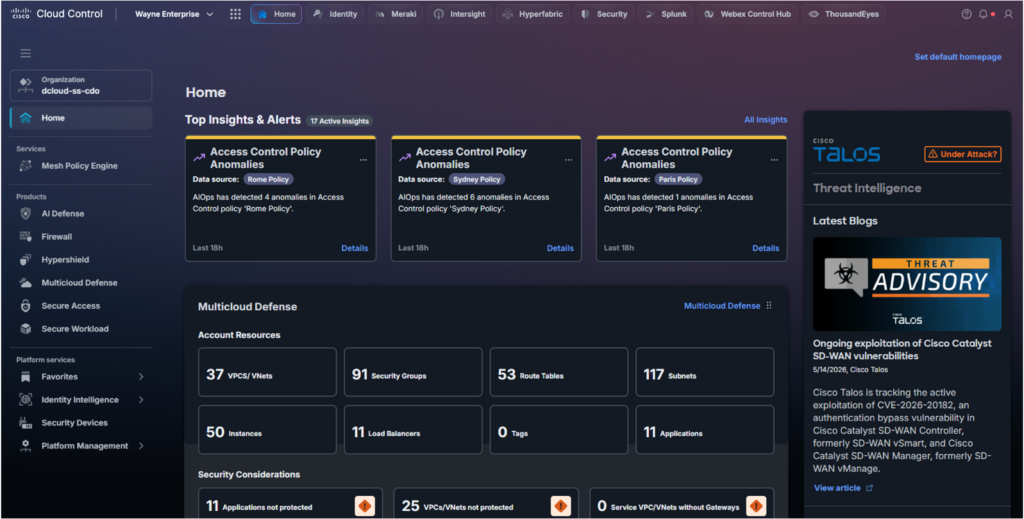
Bringing security into Cisco Cloud Control

But the bigger shift is not just where the work happens. 

It is how the work happens. 

With Cisco Cloud Control, security becomes part of a broader operational model across domains. Inventory, topology, policy, identity, network, observability, collaboration, and data center context can come together in one shared experience. Security decisions are only as good as the context behind them. 

Here’s what sets this model apart:

  • Unified context: Teams can connect security signals with network, identity, application, and infrastructure data.
  • Governed action: Operators can move from insight to action with validation and review built in.
  • Human-agent collaboration: AI agents can gather evidence, recommend next steps, and accelerate execution while humans stay in control.

Making complexity workable with AI Canvas

AI Canvas is where that complexity becomes workable. 

Inside AI Canvas, operators and AI agents investigate together in a shared workspace. They can correlate signals, build a timeline, trace dependencies, and move from question to resolution without losing context across handoffs. A Unified AI Assistant gives teams a natural language way to ask questions and get guidance. When an issue needs deeper investigation or execution, teams can escalate into AI Canvas with the right people, agents, and data in the same workspace. 

This matters because many of the hardest security problems are not purely technical. 

They are operational.

Take firewall policy. A business team may need urgent access changed for an application, but the rules are poorly documented, the original admin has moved on, and nobody wants to make a risky change under pressure. In the old model, that means manual analysis, multiple reviews, and expert time spent reconstructing intent. 

In the new model, an admin can describe the desired policy in plain language. The system can translate that intent into candidate rules, map the change back to the business requirement, explain the reasoning, and validate the update before deployment. That does not remove the human from the decision. It gives the human better context, faster. 

Agentic operations for real security work

The same pattern applies to zero trust. 

A team may not know that some users are reaching sensitive applications through VPN in a way that violates access best practices. Finding that manually could require continuous analysis across large volumes of event data. An AI agent can monitor for that pattern, surface the risk, explain why it matters, recommend configuration changes, and let an admin approve or refine the action. 

That is the practical value of agentic operations. 

Not AI for the sake of AI. Not automation without oversight. But AI that helps skilled teams move faster, preserve institutional knowledge, reduce risk, and spend less time stitching together fragmented evidence. 

Agentic operations rest on three core principles:

  • Human in the loop: Teams stay in control, bringing judgment and accountability to every important decision.
  • Cross-domain context: Agents connect signals across networking, identity, policy, observability, and enforcement points so teams see the full picture.
  • Purpose-built intelligence: Security workflows need agents that understand the domain, environment, and impact of every recommendation.

This is how AI becomes more than an assistant. It becomes a collaborator. 

A new era for security operations

Security in Cisco Cloud Control with AI Canvas is about bringing security work into the same operating model the rest of IT needs: unified context, governed action, and collaboration between people and AI agents. 

The end state is not a world where every task is automated blindly. 

It is a world where security teams can define once, enforce where needed, investigate with full context, and act with confidence. 

Security teams have never needed more tools. They need a better way to work. 

And with Security in Cisco Cloud Control with AI Canvas, that new operating model is here.


We’d love to hear what you think! Ask a question and stay connected with Cisco Security on social media.

Cisco Security Social Media

LinkedIn
Facebook
Instagram