





“The network is evolving from carrying human-generated traffic to enabling AI-powered operations.”
SD-WAN is the policy and routing layer that connects branches, campuses, data centers, and cloud services across any transport. Most enterprise networks were built around a durable assumption: people generate traffic.
Employees open applications, join meetings, access cloud services, and exchange data in patterns that are largely understandable. SD-WAN evolved to make those interactions more reliable, secure, and cost-effective.
AI is beginning to break that assumption. As copilots become autonomous agents, machines increasingly generate network traffic on behalf of people: retrieving data, calling APIs, coordinating actions, and making decisions across sites, clouds, and edge environments. A single AI agent request can trigger dozens of machine-to-machine exchanges that no human initiated directly.
For CIOs, the issue is not simply whether AI will consume more bandwidth. It is whether the network can recognize, prioritize, secure, and assure a new class of traffic whose business importance may be high even when no person is directly in the loop.
Much of the enterprise AI conversation centers on models, GPUs, data platforms, and agents. Those investments matter, but every useful AI service depends on the network paths that connect users, data, models, tools, and locations. Depending on the workload, AI can change those paths in four important ways:
The readiness gap: In a 2026 survey of 3,472 IT and networking leaders, organizations reported an average 34% increase in campus and branch traffic tied to AI over the previous year. Yet only 15% said their networks were flexible and adaptable enough to support AI at the required scale, and 73% said they already face or expect capacity limits within the next 24 months. (Cisco and Foundry research, 2026).
This is not an argument that current network architectures are obsolete. It is a signal that the assumptions behind them are evolving – and that application experience, operating resilience, and policy enforcement can no longer be treated as separate concerns.
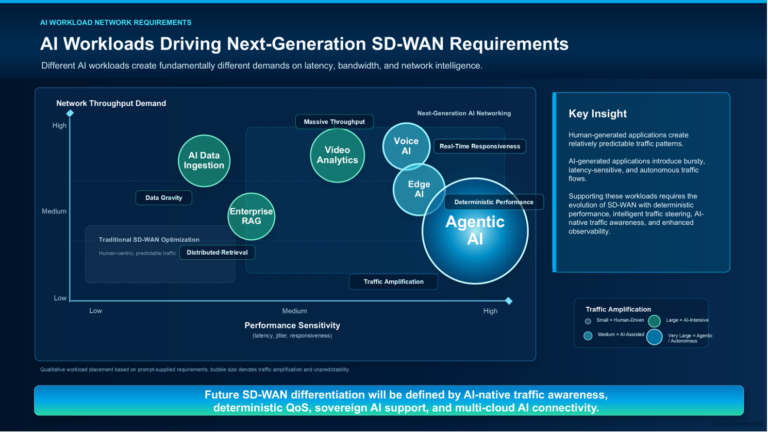
Treating AI as one workload hides the design problem. An AI voice assistant is highly sensitive to latency. Retrieval-augmented generation (RAG) distributes queries across models and data sources. Video analytics and data ingestion can demand sustained throughput. Edge AI and autonomous robots need predictable performance close to where the business operates.
Agentic AI adds another dimension: amplification. One request can cause an agent to retrieve information, invoke APIs, consult other agents, and execute a workflow. This can create multiple machine-to-machine exchanges and, in complex workflows, many more. Capacity still matters, but visibility and policy matter just as much.
Consider a large fulfillment center where autonomous robots move inventory between storage and packing stations. In 2025, Amazon reported deploying more than one million robots and said its AI fleet-coordination technology would improve robot travel efficiency by 10%. Their safety controls remain local, but fleet coordination, telemetry, inventory systems, and cloud services depend on reliable connectivity. SD-WAN can help maintain operations by prioritizing critical traffic, steering it across the best available path, and applying consistent policy across locations.
The same principle applies to digital agents. When autonomous workflows approve transactions, support customers, or coordinate supply chains, the network must distinguish critical interactions from background activity and respond as conditions change. That is where the conversation moves from AI infrastructure in general to the role of SD-WAN.
SD-WAN sits at the point where application intent meets real network conditions. It already connects branches, campuses, data centers, cloud services, and the internet while applying policy across diverse transport. In the AI era, that position becomes more strategic: SD-WAN can evolve from optimizing largely human-initiated application traffic to helping assure machine-generated workflows that are dynamic, distributed, and business-critical.
That evolution will require stronger capabilities in four areas:
These capabilities connect the technical behavior of AI workloads to outcomes CIOs care about: resilience, customer experience, compliance, and the ability to scale AI safely. They also make networking an early design decision for AI programs, not a constraint discovered after deployment.
Cloud and mobility reshaped enterprise networking because they changed where applications lived and how people reached them. AI is the next shift because it changes what generates traffic, how quickly conditions change, and how directly network behavior affects business operations.
The network is evolving from carrying human-generated traffic to enabling AI-powered operations. For CIOs, the opportunity is to position SD-WAN as the policy, assurance, and visibility layer that helps enterprise AI perform reliably, securely, and at scale.
1 https://www.aboutamazon.com/news/operations/amazon-million-robots-ai-foundation-model
What is AI-generated network traffic?
AI-generated network traffic is data that machines produce on behalf of users, such as AI agents retrieving data, calling APIs, or coordinating workflows. Unlike human-generated traffic, it can be bursty, distributed, and business-critical even when no person is directly in the loop.
How does SD-WAN support AI workloads?
SD-WAN identifies AI-related traffic, steers latency-sensitive flows onto the best available path and applies consistent security and data-handling policy across locations. This helps AI services perform reliably as traffic becomes more distributed and dynamic.
What is the difference between human-generated and AI-generated traffic?
Human-generated traffic follows understandable patterns tied to people like opening apps and joining meetings. AI-generated traffic is machine-initiated, can amplify a single request into many downstream exchanges, and shifts more rapidly across sites, clouds, and edge environments.
Why do AI workloads strain existing networks?
AI increases traffic volume, latency sensitivity, and distribution simultaneously. In a 2026 Cisco and Foundry survey, only 15% of organizations said their networks were flexible enough to support AI at scale, and 73% expected capacity limits within 24 months.
此内容由惯性聚合(RSS阅读器)自动聚合整理,仅供阅读参考。 原文来自 — 版权归原作者所有。