


惯性聚合 高效追踪和阅读你感兴趣的博客、新闻、科技资讯
阅读原文 在惯性聚合中打开

推荐订阅源

W
WeLiveSecurity
博客园 - 【当耐特】
Microsoft Azure Blog
WordPress大学
WordPress大学
Stack Overflow Blog
Stack Overflow Blog
cs.AI updates on arXiv.org
IT之家
IT之家
Cloudbric
Cloudbric
The Register - Security
小众软件
小众软件
PCI Perspectives
PCI Perspectives
G
Google Developers Blog
AI
AI
OSCHINA 社区最新新闻
OSCHINA 社区最新新闻
Google DeepMind News
宝玉的分享
宝玉的分享
Recent Commits to openclaw:main
量子位
TaoSecurity Blog
TaoSecurity Blog
cs.CV updates on arXiv.org
F
Full Disclosure
N
Netflix TechBlog - Medium
博客园_首页
Last Week in AI
Last Week in AI
A
Arctic Wolf
B
Blog RSS Feed
J
Java Code Geeks
C
Cybersecurity and Infrastructure Security Agency CISA
I
InfoQ
aimingoo的专栏
aimingoo的专栏
云风的 BLOG
云风的 BLOG
NISL@THU
NISL@THU
MyScale Blog
MyScale Blog
H
Hackread – Cybersecurity News, Data Breaches, AI and More
Jina AI
Jina AI
有赞技术团队
有赞技术团队
S
Schneier on Security
L
Lohrmann on Cybersecurity
P
Privacy & Cybersecurity Law Blog
T
Threat Research - Cisco Blogs
P
Palo Alto Networks Blog
S
Security @ Cisco Blogs
Security Archives - TechRepublic
Security Latest
Security Latest
Vercel News
Vercel News
博客园 - 司徒正美
Webroot Blog
Webroot Blog
Hacker News: Ask HN
Hacker News: Ask HN
A
About on SuperTechFans

VMware Blogs

Diagnostics for VMware Cloud Foundation (VCF) 9.1 with Old Versions of VCF Components Mastering Infrastructure Policies in VMware Cloud Foundation Automation 9.1 Modernizing the Private Cloud: Why VCF 9.1 Lifecycle Management is a Game Changer Announcing the VMware Cloud Foundation 9.1 Upgrade Planning Tool VCF Breakroom Chats Episode 86 – Containers Made Easy: The New “Container-as-a-Service” in VCF 9.1 Securing Your VCF 9.1 Infrastructure with the Symantec Identity Security Platform Virtually Speaking: The AI Reality Check with Dave Linthicum Zero Touch Provisioning: Activating Edge Sites with VMware Cloud Foundation Edge 9.1 VCF Breakroom Chats Episode 85 – Cloning Success at Scale: Inside VCF 9.1’s App Stack Formation VMware Cloud on AWS の使用状況を確認できる API Unlocking the Full Potential of Programmable Infrastructure with VMware Cloud Foundation 9.1 – New Features and Capabilities Smarter Patching at Scale: Vulnerability Assessment and Remediation with VMware Tanzu Platform Encrypted vMotion Offload to Intel QAT in VMware Cloud Foundation 9.1 Deepen Your Expertise: Four Key Benefits of Attending Increase Deployment Flexibility with VCF Edge Automation 1.0.3 Avi Advantage: Automating Certificate Management of VCF Workloads More Memory, Less Effort: Configuring Memory Tiering in VCF 9.1 Why APJ Networking Professionals Need Private Cloud Expertise VCF 9.1 Networking: Simpler VPC Connectivity Control VCF 9.1 Networking: Exploring Network Services for Virtual Private Clouds VCF Networking 9.1: Seamless DDI Integration with Infoblox The Open Source Advantage: Building from Source for Ultimate Security Expand Shared VMDKs with Clustered Applications in VMware vSAN for VCF 9.1 Monetizing Zero-Trust Security with VCF 9.1 and VMware vDefend VMware vSAN Protection and Recovery Enhancements for VCF 9.1 Deliver Production SQL Server DBaaS with VMware Data Services Manager 9.1 Maximizing Profitability: VCF 9.1 Cost-Focused Approach for VMware Cloud Service Providers Modernizing Your Infrastructure: Introducing VMware Cloud Foundation 9.1 to VCSPs VCF 9.1 is Available: Explore the New Features in Hands-on Labs What’s New with vSphere in VMware Cloud Foundation 9.1? Resizing VMware vCenter in VMware Cloud Foundation 9 Non-Disruptive VMware vCenter Patching in VMware Cloud Foundation 9.1 VMware vCenter Virtual Hardware Gets an Upgrade in vSphere with VCF 9.1 AI Has Changed the Threat Landscape. Is Your Infrastructure Ready? Simplifying Storage with the New Effective Capacity View in VMware vSAN for VCF 9.1 Auto-RAID in VMware vSAN for VCF 9.1 – Comprehensive System-Managed Data Resilience Introducing VMmark 4.1: Enhanced Power Efficiency Benchmarking for Private Cloud Infrastructure Advanced Memory Tiering Enhancements in VMware Cloud Foundation 9.1 VCF 9.1 Is Here. See It in Action. 博通發布 VMware Cloud Foundation 9.1 How Broadcom Is Helping Enterprises Win the AI Security Sprint How to Prepare for the World of AI Driven Exploits Avi Innovations for VCF 9.1: Powering Kubernetes, Agentic AI and VPC Workloads VCF 9.1: The Secure, Cost-Effective Private Cloud Platform for Production AI Announcing VCF 9.1: Modern Private Cloud Built for Efficiency and Resilience Announcing VMware Cloud Foundation Edge 9.1: A Scalable, Autonomous Edge Platform Accelerate, Streamline, and Control Your Self-Service Private Cloud with VMware Cloud Foundation 9.1 Deploy Modern Apps Faster, Scale Smarter, and Lower Your TCO with VMware vSphere Kubernetes Service in VCF 9.1 Scale Smarter, Save More: Redefining Infrastructure Economics with VMware vSphere in VCF 9.1 AI with VCF 9.1 on AMD GPUs: Build with open frameworks and simplify management, at a lower TCO Streamline, Simplify and Protect all your AI workloads with VCF 9.1 Simplify Workload Connectivity and Enhance Network Scale and Performance with VCF 9.1 VMware and CrowdStrike Deliver New Integration for Cyber Recovery Workflows How Many Users Can Your LLM Server Really Handle? From Infrastructure to Agents: A Hands-On Guide to Secure Private AI with Broadcom – Part 2 The New Frontier: Leading the Cloud-Native Evolution Replicating VMware vSphere Configuration Profile Desired State Webinar Recap: Design and Architecture Considerations for VMware vSphere Kubernetes Service on VMware Cloud Foundation Kubernetes 1.36: What Actually Changed for Enterprise Platforms Enhance Lateral Security and Ingress Load Balancing for Kubernetes Workloads Avi Load Balancer Analytics: Root Cause Application Performance Issues in Minutes Analyst Insight Series #3: Policy-Driven Governance and Multi-Tenant Control Post-Quantum Readiness on VMware Cloud Foundation Registration Is Live for Las Vegas | $ave with Early-Bird May 21, 2026: What’s New in VMware Tanzu Data Intelligence 10.4 From Infrastructure to Agents: A Hands-On Guide to Secure Private AI with Broadcom – Part 1 Stop Guessing: Advanced Monitoring and Troubleshooting for Data Services CPU, Disk, Network, and Memory Workload Profiles for DVD Store Database Testing How VMware Salt Automates Compliance Across Private Cloud Analyst Insight Series #2: Operational Scalability and Lifecycle Management MCP vs. APIs: Why You Need Both for AI Applications The Real Constraint on Enterprise AI isn’t GPUs; It’s Power Deploying Harbor Service in Air-Gapped VMware Cloud Foundation 9.0 Why Enhanced DirectPath Wins for High-Performance Apps Bridging the (.Local) Gap: A Split-Domain Design for VMware Cloud Foundation Deployment Observability on VMware vSphere Kubernetes Service VMware Cloud on AWS: Introducing the Usage Report APIs Converging VMware vSphere to VMware Cloud Foundation 9.0: The Top 10 Questions Answered May 6, 2026: What’s New in Tanzu Platform 10.4: Powering Agentic Apps at Scale VMware Tanzu RabbitMQ Powers the Modern Data Lakehouse with New Spark Integration and Enterprise Tooling Tanzu Data Intelligence 10.4 Delivers AI-Driven Analytics, Unified Real-Time Operations, and Sovereign Resilience Enterprise-Ready Agents Made Simple & Safe with VMware Tanzu Platform Agent Foundations Introducing Tanzu Platform 10.4: Extending Platform as a Service to Agentic Applications How AI-Assisted Analytics in Tanzu Data Intelligence Can Help Remove the SQL Bottleneck From Prototype to Production: Securing Database MCP at Enterprise Scale The Compelling Case for a Private Cloud Data Intelligence Platform The Unification Dividend: Consolidating Database Operations on VMware Cloud Foundation The Modern Spring Workflow Is Enterprise-Ready and AI-Boosted [TAM Blog] セキュアブート証明書の有効期限切れに関する注意点と対応について Accelerate Lateral Security and Ingress Load Balancing for Kubernetes Workloads From Platform to Data: Building a Cloud-Native Developer Experience On-Prem with VMware Cloud Foundation How VMware Cloud Foundation (VCF) Training Helps Keep Top Tech Talent in APJ Build Your Case for Attending VMware Explore 2026 Spring 開発元が提供する商用サポート「VMware Tanzu® Spring Essentials」とは VMware Cloud on AWS より i7i.metal-24xl インスタンスの提供開始 VMware Advanced Memory Tiering Tips for Success VMware Cloud Foundation Edge 9.0: Two-Host Edge Site Deployment with Brownfield Import Your Database Is About to Become an AI Tool. Is It Ready? Applying GitOps Principles to Maintain Desired State Configuration using VMware vSphere Configuration Profile – Part 3 Webinar Recap: Converging VMware vSphere to VMware Cloud Foundation 9.0
VCF 9.1 Licensing: Programmatic, Centralized, and Built to Scale
vmwareblogs · 2026-05-18 · via VMware Blogs

The licensing framework for VMware Cloud Foundation (VCF) 9.1 continues to evolve, reducing complexity and administrative overhead. Previously, license usage acknowledgment was a recurring manual task — one that had to be performed every 180 days by an administrator with the right access. VCF 9.1 eliminates the manual cycle entirely. Licensing is no longer a manual chore, but now a seamless part of your infrastructure. Whether you are managing a single site or a large enterprise with multi-tenant environments, new licensing updates including license programmability provide the operational flexibility you need to run a private cloud efficiently. 

For organizations, these licensing enhancements simplify VCF deployment by leveraging VCF Operations and the Business Services console. They also streamline license management while providing the flexibility required for advanced deployment scenarios. 

1. Automated License Process

Previously in connected mode deployments, administrators had to manually acknowledge refreshed license files once every 180 days.

VCF 9.1 connected mode deployment does away with the manual administrative overhead and implements automated license file downloads every 24 hours. Once connected mode is selected, automation of the license usage process becomes the default behavior. License usage data is transmitted to Broadcom every 24 hours, and an updated license file is downloaded and applied automatically—with no administrator intervention required. Customers who prefer to review the license file before updating can configure licensing to be in disconnected mode and manually click to send their license usage files once every 180 days.
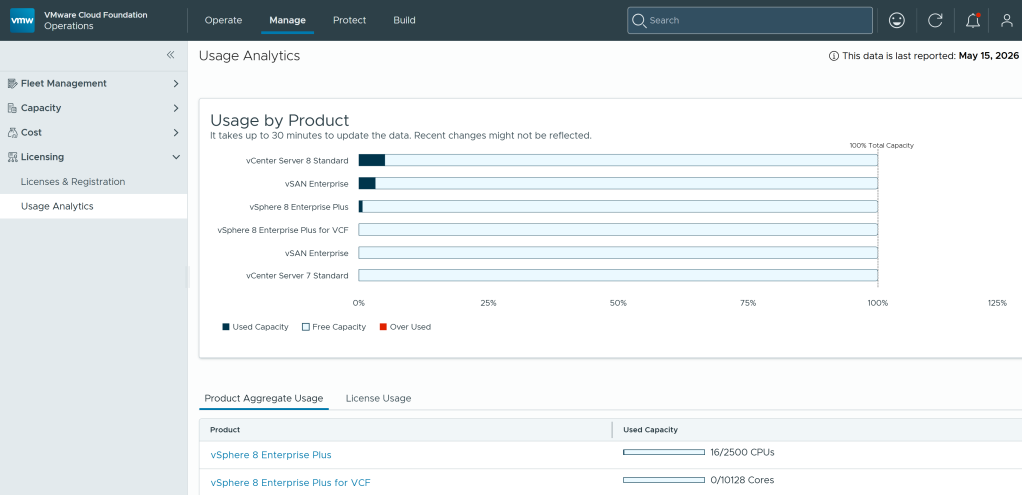
Figure 1. VCF Operations provides a view of licensing capacity, used licensing capacity, free capacity, and licensing issues across VCF 9.1 and earlier licenses.
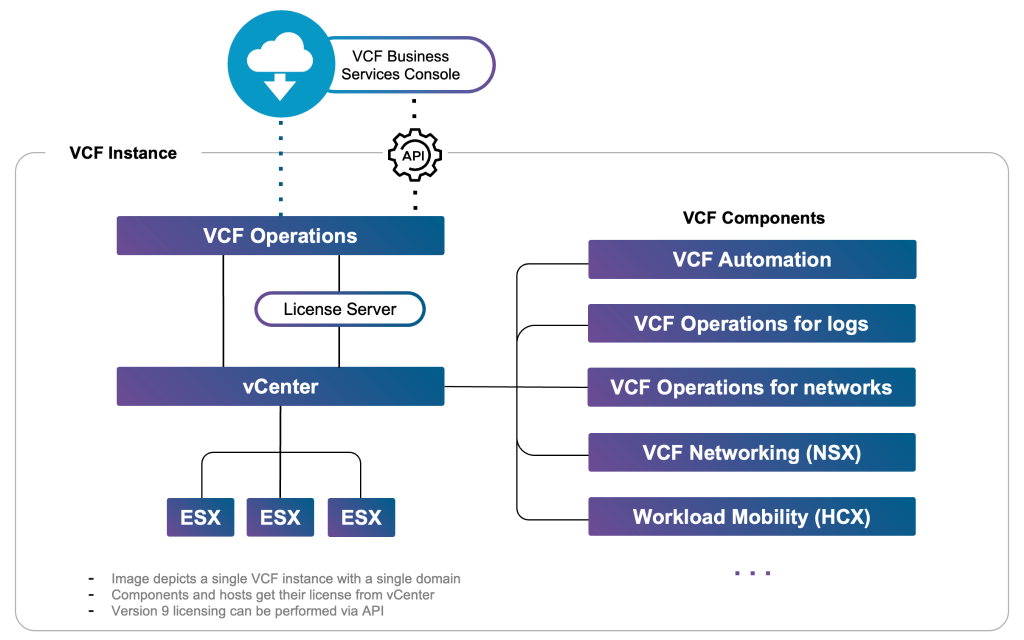
2. New License Server Architecture

Figure 2. VCF 9.1 introduces a local license server as part of its architecture designed specifically for centralized license management. This new component centralizes all licensing data with enhanced protection.

Streamlined Management:

  • The license server installation is automatic with the VCF Operations installation.
  • The license server is automatically upgraded during new versions of VCF Operations. 

A local license server allows for flexible scaling and control of licenses without impacting VCF Operations. VCF Operations continues to be where you manage licenses. 

3. Multi-License Flexibility: One vCenter, Multiple License Types

Previously, organizations needed to deploy separate vCenter instances for different primary license types, such as VCF and VCF Edge. VCF 9.1 simplifies this by supporting multiple primary licenses and even licenses from multiple Site IDs within a single vCenter instance.

Consider a retailer that uses standard VCF licenses for its core data centers but relies on VCF Edge licenses for its multiple store locations.

Previously, these environments would be managed separately. With VCF 9.1, the retailer can manage both the core data center hosts and the remote store hosts within the same vCenter.

This allows:
  • Unified visibility to view and manage the entire fleet.
  • Reduced complexity by consolidating multiple vCenter instances of different primary license types.
  • Expanded options to deploy infrastructure based on business needs.

4. License Management for Large Enterprises with Role-Based Access Control and Multi-Tenant Support

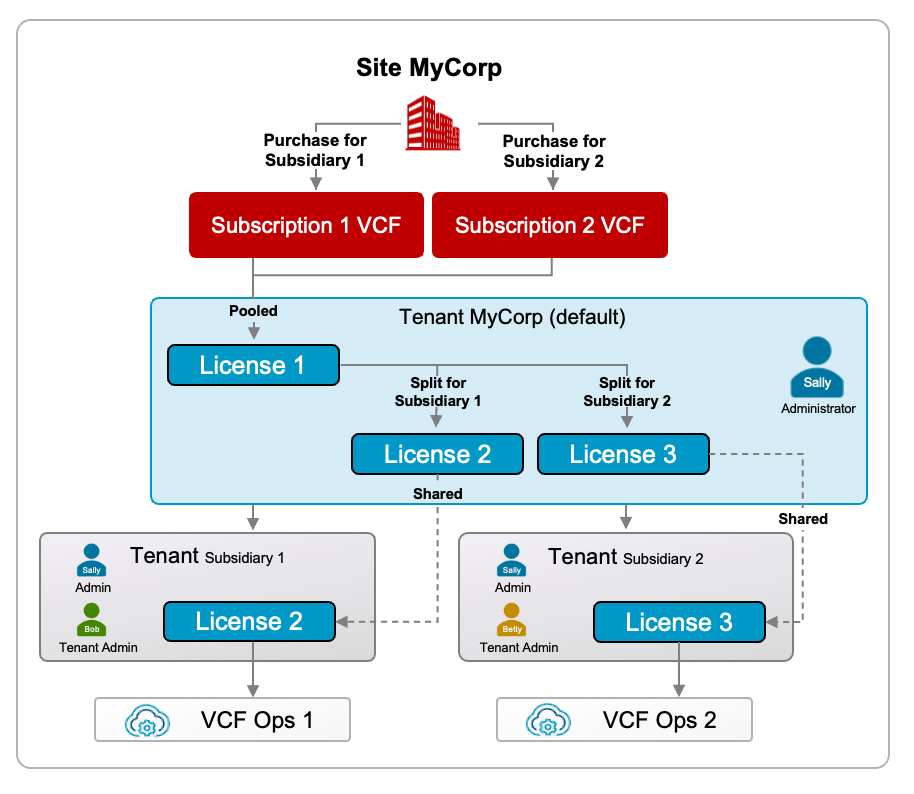
Figure 3. There are now granular role-based licensing controls through the VCF Business Services console, enabling precise delegation of license management responsibilities. This allows different departments to manage their own licenses while the main license administrator maintains overall oversight.

Three New Licensing Roles:

  • License Refresh Role – Executes specific licensing actions without full administrative rights.
  • Tenant License Manager – Manages licenses for a single tenant in isolation.
  • Read-Only Role – Provides read-only visibility for compliance and reporting.

The Business Services console now supports tenant-specific licensing, including license sharing between tenants. This architecture allows service providers and large enterprises to delegate multi-tenant license management safely while maintaining control and visibility.

Administrators managing the overall licenses can limit license management permissions to specific departments or tenants. For example, compliance teams can be provided with read-only auditing capabilities without administrative access. Operational teams receive the exact permissions they need to manage licenses and nothing more.

5. Licensing APIs for Enterprise Customers

With the previous release, licensing APIs were available for use by service providers only.  Licensing APIs are now accessible to all customers in VCF 9.1. Customers operating in disconnected environments can build programmable automation with APIs to transfer license files through internal management networks. 

Integration Opportunities:

  • Automated license file distribution across multiple locations.
  • Integration with existing IT automation platforms.

API availability transforms licensing from a manual administrative task into an automated, programmable component of infrastructure operations.

VCF 9.1 Licensing Is Easier

These VCF 9.1 licensing improvements represent more than incremental updates—they make licensing easier. For organizations planning VCF 9.1 adoption, the licensing enhancements deliver immediate simplicity.

The licensing framework in VCF 9.1 aligns with modern operational requirements for greater automation, flexibility, and programmability. 

Simplified Operations:

  • Streamlined license management with APIs through the VCF Business Services console and VCF Operations.
  • Unified license tracking eliminates compliance complexity.
  • Automated license renewal removes manual 180-day license usage cycles.

Enterprise-Scale Flexibility:

  • Single-fleet deployment across multiple sites.
  • Multi-subsidiary license management for organizations with separate IT departments.
  • API-driven licensing enables programmatic administration and integration.

The licensing framework in VMware Cloud Foundation 9.1 is further simplified. Automated programmable maintenance, centralized control, and flexible multi-tenant governance give enterprises greater confidence to manage licensing at the scale they need. API-driven capabilities give operations teams the precision to manage their distributed environments efficiently. 

Customers can refer to the Specific Program Documentation (SPD) for VCF license details. For enterprises modernizing their private cloud, Broadcom has made VCF license management straightforward and purpose-built to scale as your deployments grow and change. For teams managing private cloud at scale, VCF 9.1 improves the speed and time needed for licensing. Explore the VCF 9.1 launch page to learn more about how your infrastructure can benefit.


Acknowledgements

Special thanks for contributions to this blog:

Michael Curnutt, Anurag Dalmia, Ali Emadi, Mei Huang, Morry Katz, Mauricio Mayorga, and Jeremy Winkler


For detailed technical documentation on VCF 9.1 licensing implementation, visit the VMware Cloud Foundation documentation.

Resources

Broadcom Announces VMware Cloud Foundation 9.1

VMware Cloud Foundation: Launch Page VCF 9.1, Webpage 

VCF 9.1 Licensing Documentation

Getting started with VMware Cloud Foundation (VCF) or VMware vSphere Foundation (VVF) V9 Licensing

VCF Specific Program Documentation (“SPD”)

Blog: VCF 9.0 Licensing

Blog: Scale, Simplify, and Secure Your Private Cloud Operations with VCF 9.1


Discover more from VMware Cloud Foundation (VCF) Blog

Subscribe to get the latest posts sent to your email.