







The security landscape just shifted under our feet – again. Over the last 18 months, AI-assisted vulnerability discovery has compressed the timeline from novel CVE published to weaponized exploit in the wild from weeks down to hours. Researchers (and bad actors) are now using LLMs to chain together previously unrelated weaknesses into novel zero-day attack paths. The volume of disclosed vulnerabilities keeps climbing, and the half-life of “unpatched, but probably fine” is collapsing.
For platform engineers, this means the old rhythm of quarterly patch windows, hand-rolled CVE spreadsheets and “we’ll get to it after the next release,” is no longer a defensible posture. The only durable answer is the boring one: Rapidly apply first-party, vendor-supplied, vendor-supported security fixes across the entire estate before the chained exploit lands in your environment.
The problem isn’t whether to patch. It’s knowing what to patch, where it lives, and how to quickly roll it out without disrupting the business. With VMware Tanzu Platform 10.4, this can all be done across your entire Tanzu Platform foundation fleet, in a single workflow.

Figure 1: The Tanzu Platform vulnerability insights dashboard in Tanzu Hub delivers fleet-wide visibility of vulnerability exposure within your Tanzu Platform application estate.
I wrote last year about the daunting questions platform engineers faced when a critical CVE drops in a DIY environment. Where did it come from? Which of our components are affected? Which applications are at risk? How do we fix it without breaking everything? Those questions haven’t gone away. What’s changed is the clock. When attackers can use AI to enumerate exposed surface area at scale and chain low severity CVEs into high severity exploits, “we’ll triage at that next sprint” stops being a viable strategy.
Using traditional, third-party vulnerability scanners to detect vulnerabilities across your Tanzu Platform environments give you a wall of CVEs without telling you which buildpack, stemcell or tile is the actual source or which applications need restaging to pick up a fix. Platform engineers end up having to reverse engineer the relationship between the published CVE and their own running estate. That manual correlation work is exactly where days (or even weeks) get burned. That’s time wasted, and time you don’t have.
The first step toward a strong posture isn’t patching; it’s knowing what you have, whether it’s vulnerable, supported, or end of life. You can’t fix what you can’t see.
With Tanzu Platform, Tanzu Hub gives you these details and helps you act on them. Deploy Tanzu Hub and connect it to your existing foundations, and within minutes it begins reporting the full posture of every Tanzu Platform-managed component across the estate: Buildpacks, stemcells, stacks, services, images, first-party tiles and foundation management artifacts. No scanners running inside your foundations. No agents to deploy on workloads. Tanzu Platform’s vulnerability insights dashboard enables you to see:
If you’ve ever spent a Friday night grepping CycloneDX SBOMs trying to determine whether Log4j is hiding in your environment, this is the dashboard you wanted.
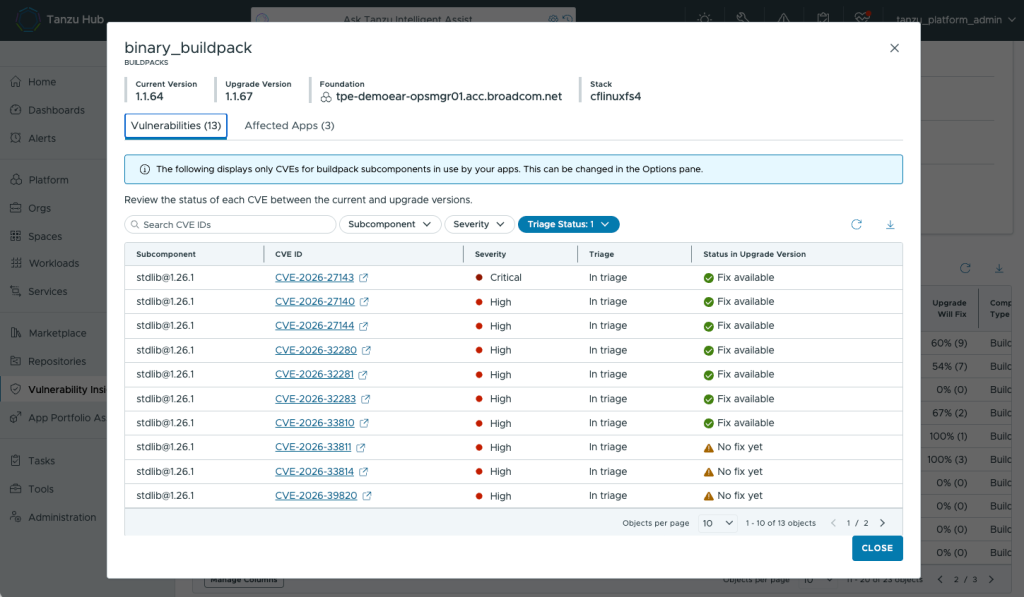
Figure 2: A screenshot shows vulnerability impacts to a binary_buildpack version that currently affects 3 running applications. Using the Tanzu Platform vulnerability insights dashboard, a platform engineer can understand the applications impacted, severity, triage status, and if an upgrade version is available containing the fix.
And for regulated, air-gapped, or otherwise internet-restricted environments (financial services, public sector, defense, etc), Tanzu Hub supports updating vulnerability data without an outbound internet connection, so the same visibility applies whether your foundation sits in a public cloud region or fully air-gapped.
Knowing what to patch is half the win. The other half is sequencing fleet-wide rollout that respects compatibility, EOGS dates, and the realities of your change windows. That’s where vulnerability insights and upgrade planner come together, and in Tanzu Platform 10.4, the integration is where the value really compounds.
From the vulnerability insights dashboard in Tanzu Hub, a platform engineer can click “View Remediations,” pick a target foundation, and see in real-time (against the actually-installed versions) exactly how many components have available remediations, what percentage of CVEs an upgrade will address, and how much of the foundation that it touches. One more click, opens Upgrade Planner with that foundation pre-populated, the latest patch goal preselected, and a generated plan that includes:
Want a Long Term Support-based plan instead of the latest Tanzu Platform patch? Toggle the upgrade goal. Want to validate against a refreshed read of the foundation? Click Regenerate Plan. Want to hand it to your change advisory board? Export it.
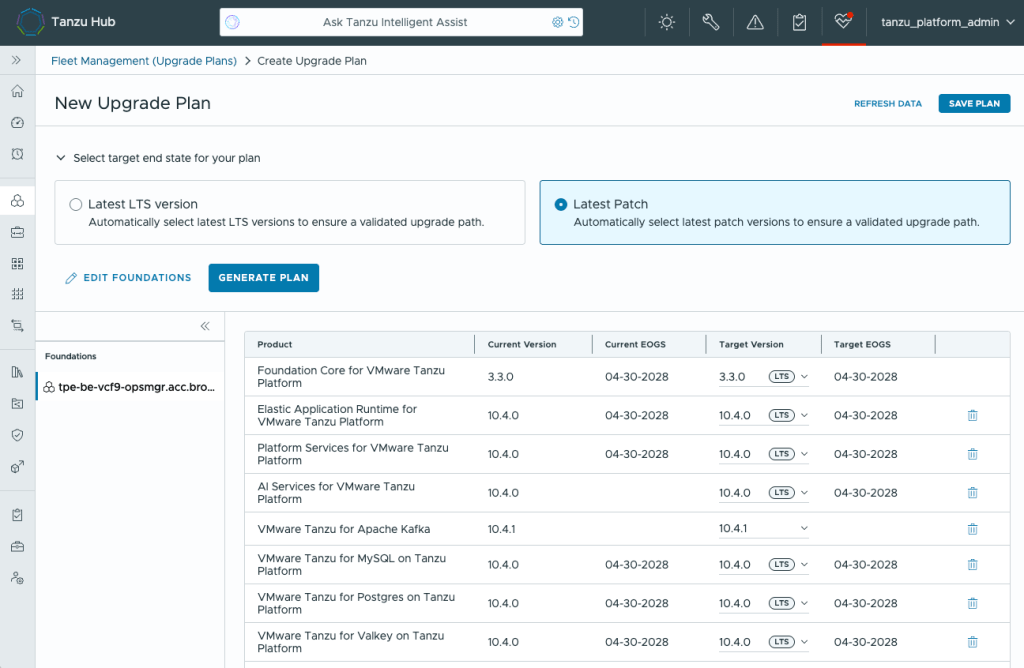
Figure 3: New upgrade planner integration in Tanzu Hub provides upgrade paths that ensure compatibility with Foundation core and product dependencies, EOGS dates, CVE resolution, and more.
And in Tanzu Platform 10.4, the platform expands what’s possible without a full control plane upgrade. Stack and Buildpack upgrades can now be applied independently, and tile upgrades can now run in parallel. Translation: The path between “a critical CVE was disclosed this morning” and “the patched Buildpack is running across the fleet” is shorter than it’s ever been.
A note for developers: Platform engineers aren’t the only ones who benefit. Tanzu Platform 10.4 also introduces a tailored app-first view in Tanzu Hub that surfaces the same vulnerability data (Tanzu Buildpack CVEs, Spring Library compliance, runtime stack status) alongside the app’s operational health. When a fix lands and an app needs to pick it up, developers can resolve it with a single “Restage” button. No application code changes required. Shared data, two audiences, one source of truth.
The reason this matters in 2026 is that AI is not just helping defenders; it’s helping attackers, and faster. The Tanzu Division’s General Manager, Purnima Padmanabhan, recently framed this in a recent article, and the dynamics are worth naming plainly:
The defensive answer isn’t a new scanner or another dashboard bolted onto the side of the SDLC. It’s a platform where assessment, remediation planning, and rollout are the same pre-engineered workflow, and driven by vendor-supplied fixes that come with vendor support behind them. That’s the entire point of a pre-engineered platform: The undifferentiated heavy lifting of staying secure is built in, not built by you.
This is also where the “Three R’s” we’ve talked about – Repave, Repair, and Rotate – stop being a concept, and become a daily operational reality. Tanzu Hub gives platform engineers the visibility and the emergency button to bulk restage all affected applications to remediate a critical vulnerability. When the next major CVE drops, you don’t need to discover where it lives, hand-build the upgrade matrix, and pray the rollout doesn’t break anything. You see it, you plan it, you ship it.
A strong security posture in the AI era isn’t a matter of working harder on patches. It’s a matter of compressing the loop between detect, assess, plan, patch until it’s tight enough that an AI-assisted exploit can’t outrun your remediation cycle.
Tanzu Hub is how you compress that loop. Connect your foundations, get a real-time read on the security posture of every Tanzu-managed component, and turn any one of those findings into a generated, compatibility-safe upgrade plan in just a few clicks.
Read the blog: Learn how Tanzu Platform 10.4 extends the simplicity of a private cloud PaaS into the Agentic Era.
Watch the webinar: What’s New in Tanzu Platform 10.4 replay on demand.
Explore Tanzu Hub further: Dive into our deep-dive blog series to learn how Tanzu Hub unifies multi-foundation operations, optimizes workload placement, and provides visual, app-to-infra observability across your entire fleet.
此内容由惯性聚合(RSS阅读器)自动聚合整理,仅供阅读参考。 原文来自 — 版权归原作者所有。