







Afternoon all,
The conflict in the Middle East and turmoil in the markets is throwing up questions for a Government committed to tackling the cost of living.
The easy questions are whether they should pull any big fiscal levers quickly, and whether the best way to provide cost of living support is by delaying a fuel duty rise. Answers – no. We don’t know where petrol prices will be next week, let alone in six months’ time when the 1p increase in fuel duty is due. Energy bills will fall in April regardless of world events and matter much more in the winter. Our Chart of the week considers where the cost of living squeeze will be felt most – and energy clearly trumps petrol.
The harder question is what to do if energy bills do spike. Any support will be harder to afford after recent increases in the cost of government borrowing (taking them higher than where they were in October). Should families be supported via bill reductions or income boosts? Income boosts maintain the incentive to consume less energy but bill reductions may support a path for lower interest rates in a world where inflation expectations are sensitive to energy prices.
And how should support be targeted? We can surely do better than the costly universal support in 2022. Hopefully the price effect proves temporary and support this winter won’t be necessary, but either way we need to develop the means to target support based on income and energy use. And just in case it isn’t temporary, we’ve been considering how the Government should support low and middle income families. Watch this space…
Have a great weekend,
Ruth
Chief Executive
Resolution Foundation
On standby? As you prepare for the risk of another energy price shock, check out this useful little tool which compares the energy use of everyday activities. You might be surprised to learn that your kindle is using more power than that ChatGPT query. And if you’re anything like me and have to reboil the kettle more than once because you forgot to make your tea, remember you’re tossing £0.03 away like nobody’s business.
Noses to the grindstone. Researchers have used decades of American Time Use Surveys to ask who bunks off at work? The short answer is plenty, but it’s hard to predict who. Around 60 per cent of workers report doing non-work at work, averaging 45 minutes a day. The authors find there may be fewer shirkers in the workforce than 20 years ago, but those that shirk still shirk just as much as ever. Most loafing is hard to predict, but low paid workers shirk less and being short on leisure time outside of work is correlated with shirking more. NB – reading this informative newsletter definitely doesn’t count as shirking.
Earning androids. How does a rising minimum wage impact automation adoption? This paper finds that boosting the wage floor causes an uptick in robot recruitment. Using three decades of US census microdata, the authors look at manufacturing firms sitting on opposite sides of state borders, where the local economy is identical but the wage floor differs. The big find is that a 10 per cent rise in the minimum wage raises the probability of importing and installing industrial robots by roughly 8 per cent relative to the mean. The authors don’t study the impact on employment, so the jury’s still out on how this affects workers in the short-term. Despite many warnings, aggregate employment among jobs at ‘high risk’ of automation in 2013 continued to grow for a decade afterwards. The question may be less whether the robots are coming, and more whether the productivity gains end up in workers’ or employers’ pockets.
A wealth of lessons. Much like our neighbours across the pond, the Wealth of Nations will enjoy its semiquincentennial* this year, and this timely article asks what Adam Smith actually stood for. Libertarians have long claimed him as their patron saint of free markets, but he was also pro progressive taxation, railed against monopolies and excoriated accumulation of wealth at the expense of the many: “No society can surely be flourishing and happy”, he wrote, “of which the far greater part of the members are poor and miserable”. And even though he’s known as Tariff-Hater-in-Chief, Smith thought sometimes trade barriers were needed due to unfair terms or security reasons. Not sure these apply when to Britain and the EU, but whichever side of the argument you’re on, you can probably find a tidy Smith quote to back you up.
*250th anniversary
Something for the weekend | The darling buds of Mais
Next week, the Chancellor will give her second Mais lecture. While it’s unusual to have two, the ladies do have some catching up to do since the first female Mais lecture happened only five years ago. In Reeves’ first lecture she set out “stability, investment, and reform” as her model for growing the nation’s economy. The question now is whether she can move from framework to delivery.
She’s expected to touch on closer trade with Europe, the role of innovation and AI, and local growth strategies. Our recent work considered trade in detail and recommended reassessing the UK’s relatively high default tariff regime and prioritising regulatory alignment in highly traded EU-dependent sectors such as pharmaceuticals. But we’ll be listening for something more: a Chancellor willing to say clearly that growth isn’t just one priority among many – it’s the one that makes the others possible.
We’re also hoping to soon see news on government action to tackle the youth unemployment crisis. Young people out of work and education represent both a human cost and a long-term drag on any growth agenda. A £500 million expansion of the existing Jobs Guarantee would be a great place to start.
Chart of the week
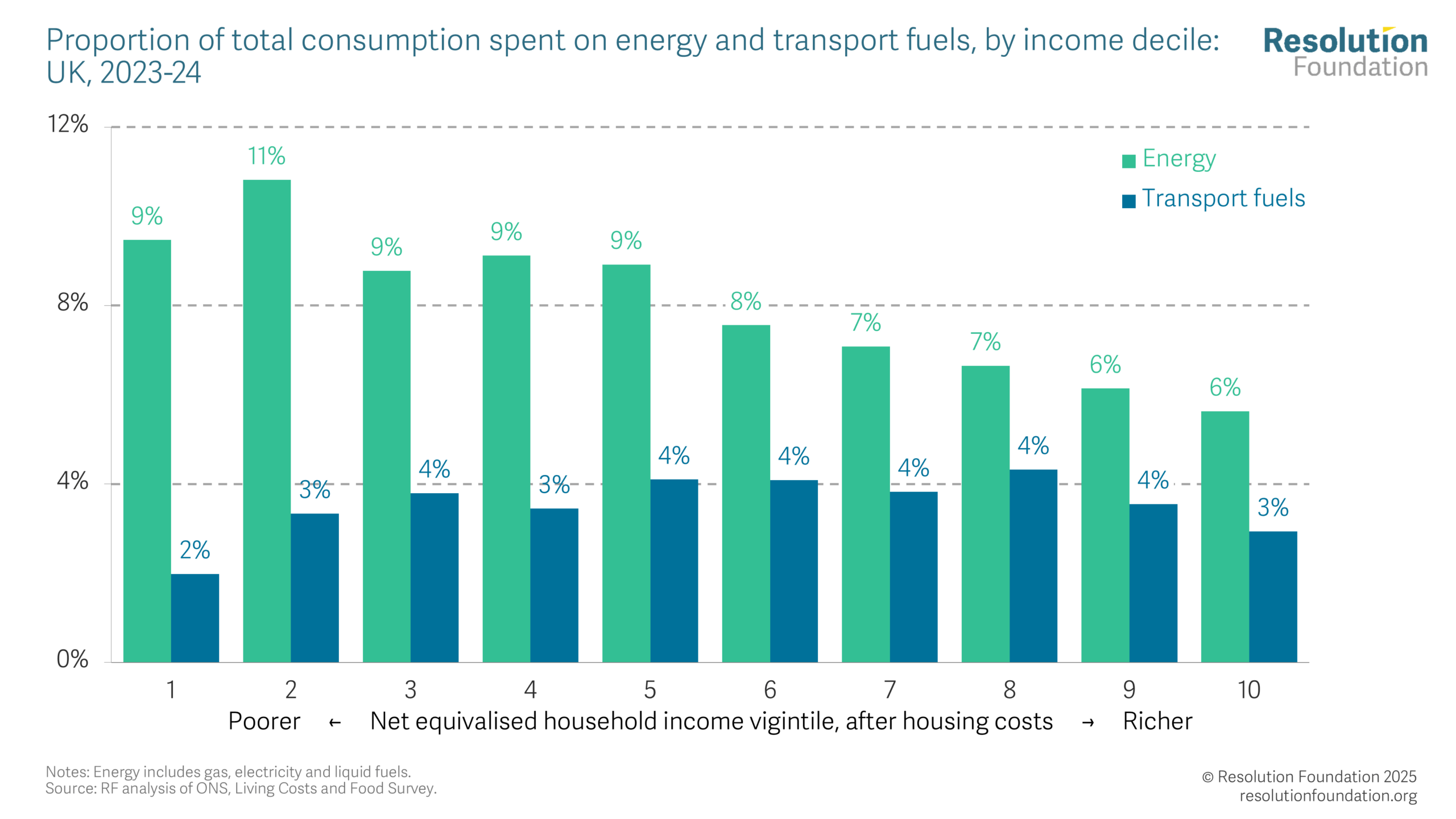
Oil prices have been ricocheting around the psychologically unnerving $100 per barrel mark this week, and gas prices have held three-fifths higher than before this conflict. While oil prices hit forecourts fast, energy bills are protected until July with the April price cap drop of £117 locked in. Policy debates have focused on cutting fuel duty or subsidising energy bills. Neither should be done in a hurry, but what if support proves necessary? Petrol and energy bills have followed different trends recently. The one-in-two commuters who travel to work by car will have noticed price rises this week – up 3.53p per litre on Monday compared to the previous week, equivalent to almost £2 more to fill a typical tank. But even accounting for that uptick, filling up a car was still £5 cheaper in real terms compared with February 2020 (since other prices rose faster). At the same time the energy price cap has risen by 26 per cent, or £362, in real terms. Our Chart of the Week looks at how those price levels hit budgets across the income spectrum. Energy takes up more spending than petrol across all households, and even more so for poorer households. Transport fuels are smaller overall and without much of an income slant (although the poorest households spend least). For a government worried about the cost of living, the biggest squeeze for most households undoubtedly comes from energy.
此内容由惯性聚合(RSS阅读器)自动聚合整理,仅供阅读参考。 原文来自 — 版权归原作者所有。