





Afternoon all,
When Zack Polanski and Liz Truss agree on something, hold onto your hats. A (to me) surprising number of people have come out this week in favour of a reintroduction of the sort of energy price cap scheme seen in 2022. Are memories really so short?
In dealing with an energy price shock the Government faces some tricky trade-offs between generosity and universality of support, and between intervening on incomes or on prices. We’ve laid out our position on how the Government should help struggling households but there are a range of reasonable options. The one that is really dangerous, though, is an uncapped promise not to let bills rise regardless of what happens. This is not the time for the UK public finances to take a huge unlimited bet on the path of energy markets.
Lots else going on this week, from a unanimous (for the first time in over four years) MPC, to more welcome support for NEETs, and a 25 per cent increase in the number of Mais lectures delivered by women. Read on to learn why the Chancellor could have expected to hear more interruptions than her male predecessors, why she shouldn’t let up on her planning reform enthusiasm, plus a new puzzle in the labour market stats.
Have a great weekend,
Ruth
Chief Executive
Resolution Foundation
More of a comment than a question. Are men and women treated differently when presenting at academic economic seminars? Take a wild guess. This paper analysed recordings of more than 2,000 seminars and tracked the interruptions. Women were interrupted 10-20 per cent more than men – with interjections more likely to be hostile, patronising, or mid-sentence. These increased interruptions came from both men and women in the audience – although when it comes to the additional *mid-sentence* interruptions experienced by women “All of these…are by male audience members”. Better moderation could help address the problem. So could basic professional courtesy.
Anatomy of inflation. Sometimes the memory of one crisis fades and the lessons are forgotten before the next one arrives. That’s not the case with this timely ECB paper on the causes of the European price spike that saw inflation shoot from below 1 per cent in January 2021 to over 10 per cent in October 2022. Turns out, it wasn’t all about energy. Instead, what we got was 2.4 percentage points from energy supply disruptions, 1.5 points from fiscal and monetary policy, and then the rest from broader demand and non-energy supply factors (remember all that post-pandemic supply chain chaos?). The hawkish fantasy of raising rates six months earlier would have trimmed peak inflation by just 1.6 percentage points, at the cost of significantly lower growth. With the Bank of England holding rates steady, the paper’s conclusion that there are no good options, only less bad ones, feels grimly current.
Britain’s bear necessities. In the week the Chancellor doubled down on AI as one of her big bets for the UK economy, not everyone was feeling so optimistic. Archie Hall, a journalist at The Economist, makes the devil’s advocate case for Britain losing out in the oncoming techno-shuffle. Here’s how it might shake out: right now, services are more than half of British exports, including high value lawyerly and consultancy work that AI models are primed to gobble up. Meanwhile, economic dynamism has fallen at just the wrong time, with low tech investment and sector-switching, and too few firm births and deaths (although with a recent uptick). British households, stuffed with cash, property and fixed income, are also poorly positioned to benefit from an AI-driven equity boom. Add in a failure to build data centres, a nasty debt load vulnerable to rising interest rates, and technophobia among the political class and you’ve got a quick-fire plan for being left in the global economic dust. Alternatively, here’s the bull case on how doubling down on talent and tech hubs can keep Britain alive in the AI race.
Flexibility and fertility. Falling fertility is both a social policy hot topic and a source of fiscal fears – a shrinking pool of taxpayers propping up a growing population of pensioners. Recent research identifies one effective boost: flexible working. When one partner works from home, lifetime fertility runs 0.22 children per woman higher than when neither does – and when both partners work from home, that rises to 0.32 children. Scaling to the US, that’s 291,000 extra births in 2024 – an astonishing 8 per cent of all American babies, and more than the fertility contribution of all government early childhood spending combined. Unfortunately, the UK is already a WFH frontrunner, so we may have run out of road on this. We’ll be publishing our own fertility paper soon, so watch this space…
Construction criticism. Building more is a key plank of the Government’s growth strategy – and ostensibly an anathema to planning officers. Michael Hill of Britain Remade has dug into the weeds of a development in Hackney recommended for refusal, making for a Kafkaesque descent into planning hell. The proposal is for 80,500 sqm of commercial space and 78 homes in a high demand area. The developer submitted an application seven times longer than War and Peace to demonstrate compliance with 42 Hackney policies and 75 London policies – but it still wasn’t enough. Maddeningly, the scheme was criticised for simultaneously being too tall and too short; providing too much office space and also not enough; having green roofs for improving biodiversity but also disturbing local wildlife. Worst of all, it was penalised for casting shadows on itself. Good job the Chancellor reiterated her commitment to coming back to housing and planning even as she made three new bets for growth this week.
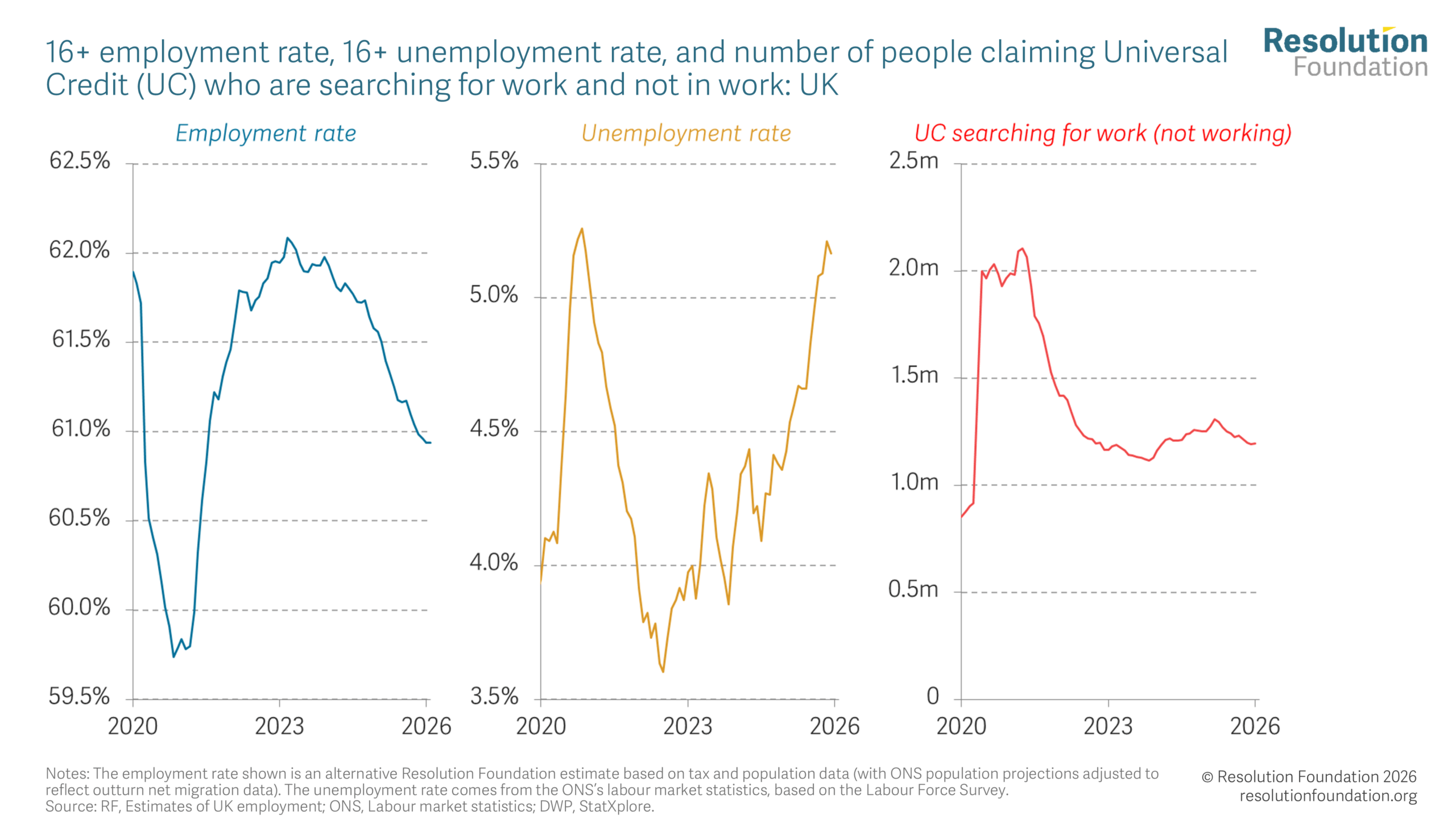
The mood music around the labour market has not been…upbeat in recent months. Despite the welcome news this week that unemployment did not increase in the latest ONS statistics (and in fact *fell* in the single month measure, from 5.4 per cent in December to 4.9 per cent in January), youth unemployment still reached a fourteen-year high. But for our Chart of the Week, we’ve decided to explore another labour market puzzle that the nation can add to its list, alongside what’s up with the LFS and what is our employment rate. This chart compares the RF estimate of the employment rate (based on real time indicators), the unemployment rate and the quantity of unemployed people claiming Universal Credit (UC) since 2020. As employment falls, so unemployment rises, and vice versa. So far so good. But what’s going on with UC claimants? The number of unemployed people has risen by half a million since the start of 2023. Over the same period, UC work search claimants have only grown by 27,000. The LFS data also doesn’t suggest any evidence that this is due to an uptick in unemployed people claiming different benefits. This is weird – and is one reason the OBR forecast was slightly better than expected a few weeks ago. We will be watching whether or not it continues as unemployment remains elevated.
此内容由惯性聚合(RSS阅读器)自动聚合整理,仅供阅读参考。 原文来自 — 版权归原作者所有。