







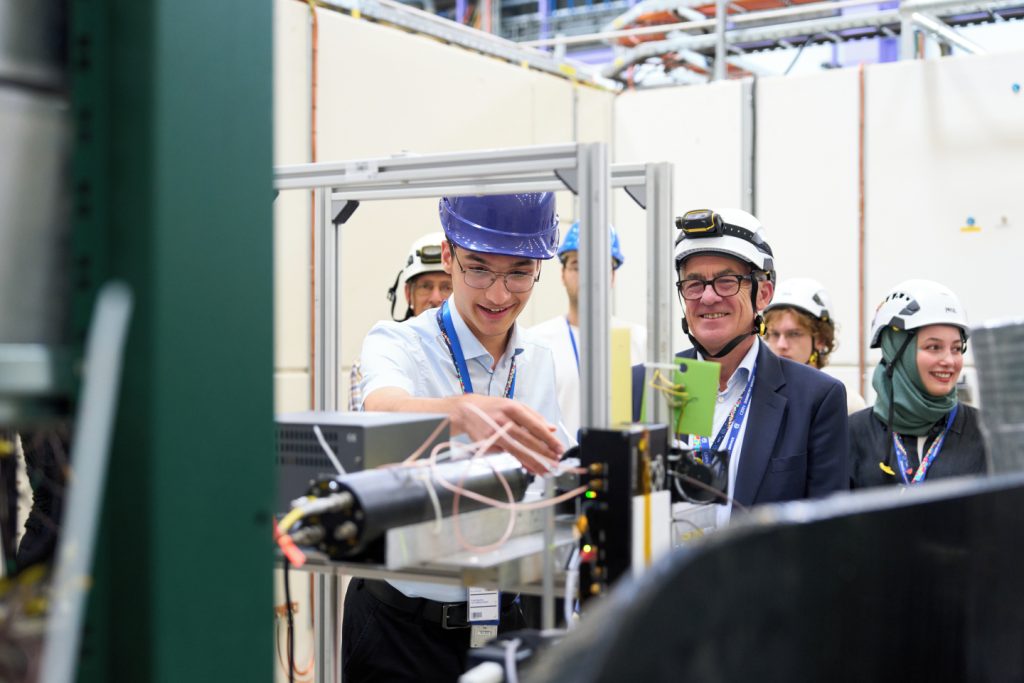
“I’ve learnt two things: one is that physicists are really strong. The second is that there is a lot of data.”
“The experience we had here at CERN is truly unique. It is the highest level possible that a high-school student can work in physics. This is a great opportunity for high-school students to familiarise themselves with experiments, engineering, different computer programs, etc. The impact is huge. I must say that it really changed the direction of my life.”
Beamline for Schools (BL4S) is a competition enabled by generous supporters of the CERN & Society Foundation, which invites high-school students from around the world to propose an experiment they want to perform on the beamline of a particle accelerator. A team of experts from CERN evaluates all the proposals received and creates a shortlist of 50 teams, all of whom receive prizes. Based on the scientific merit of their proposals, five of these teams are chosen to travel to CERN, DESY and ELSA at The University of Bonn to put their ideas to the test!
In 2026, the competition received 712 applications from students across 89 countries – that’s thousands of young people working together to explore what might be possible, combining scientific knowledge, curiosity and fresh perspectives in proposals that push the boundaries of their understanding of physics.

This year’s winners were: Team attoPION (India), Team PionIST 3 (Türkiye), Team Mobile MIPS (UK), Team Centauri Stars (USA) and Team POLARIS (Bangladesh).
In August, the teams arrived at their respective labs to bring their proposals to life. Over the course of their stay, students worked closely with scientists, engineers and technical experts to prepare, refine and carry out their experiments. From setting up equipment and analysing data to troubleshooting unexpected challenges, they experienced the realities of scientific research first-hand.
The impact of the programme can best be understood through the experiences of the students themselves. We recently caught up with this year’s winning teams to hear about their experiences. Here’s what they said:
“Ever since I was a young child, all I ever asked was ‘why?’. I was really curious to know what else we can explore, what else we can do. Coming here to this programme was like ‘Wow, I can find out so many more things’”. (UK team)
“After they announced we won, there was silence for a few moments – we couldn’t believe it. It was an unbelievable, extraordinary moment for us.” (Türkiye team)
“We are very grateful to be here. It was a great experience – there is no other programme where you can work with such accelerators, play around with the beam and work with such expensive equipment. It was our first international travel. Before, we had never been outside of India. It has been great.” (India team)
“We got to see first-hand that physics is more than theory. We had never experienced the practical part in classrooms. I was into theoretical physics, but now I’m shifting more towards practical physics. Everything here had a lot of impact on me.” (Bangladesh team)
“It’s truly an extremely special experience and it will shape our lives in the future. Thank you – we are extremely grateful.” (USA team)
This competition is widening access to physics for young people from around the world, and inviting them to trust their own raw ability, to develop that ability by engaging with experts, to deepen their understanding of what a career in research might really look and feel like, and most importantly, to build the resilience and confidence that come from tackling real scientific challenges. As the 2026 winners return home, they take with them not only new scientific skills, but also the confidence to ask bigger questions and pursue careers that once seemed out of reach.
There is nothing quite like it.
The Beamline for Schools competition is made possible thanks to philanthropic support.
By supporting Beamline for Schools, donors help ensure that the next generation of scientists, engineers, and innovators can continue to turn curiosity into discovery.
This article is taken from our LinkedIn newsletter!
此内容由惯性聚合(RSS阅读器)自动聚合整理,仅供阅读参考。 原文来自 — 版权归原作者所有。