
惯性聚合 高效追踪和阅读你感兴趣的博客、新闻、科技资讯
阅读原文 在惯性聚合中打开

推荐订阅源

W
WeLiveSecurity
cs.AI updates on arXiv.org
Hacker News - Newest:
Hacker News - Newest: "LLM"
Cloudbric
Cloudbric
V
Visual Studio Blog
L
LangChain Blog
A
About on SuperTechFans
B
Blog
T
Tenable Blog
罗磊的独立博客
Hacker News: Ask HN
Hacker News: Ask HN
Blog — PlanetScale
Blog — PlanetScale
博客园 - 三生石上(FineUI控件)
The Register - Security
OSCHINA 社区最新新闻
OSCHINA 社区最新新闻
P
Palo Alto Networks Blog
U
Unit 42
WordPress大学
WordPress大学
D
Darknet – Hacking Tools, Hacker News & Cyber Security
N
News and Events Feed by Topic
T
Threat Research - Cisco Blogs
C
Check Point Blog
Security Latest
Security Latest
M
MIT News - Artificial intelligence
Application and Cybersecurity Blog
宝玉的分享
宝玉的分享
P
Proofpoint News Feed
NISL@THU
NISL@THU
Forbes - Security
Forbes - Security
S
Securelist
Security Archives - TechRepublic
Hugging Face - Blog
Hugging Face - Blog
aimingoo的专栏
aimingoo的专栏
Latest news
Latest news
GbyAI
GbyAI
T
Troy Hunt's Blog
钛媒体:引领未来商业与生活新知
钛媒体:引领未来商业与生活新知
L
LINUX DO - 热门话题
V2EX - 技术
V2EX - 技术
小众软件
小众软件
Google DeepMind News
K
Kaspersky official blog
C
CXSECURITY Database RSS Feed - CXSecurity.com
O
OpenAI News
H
Hackread – Cybersecurity News, Data Breaches, AI and More
Threat Intelligence Blog | Flashpoint
N
Netflix TechBlog - Medium
www.infosecurity-magazine.com
Google DeepMind News
P
Proofpoint News Feed

GRAHAM CLULEY

OpenAI's AI "goes rogue" and hacks Hugging Face: what you need to know Smashing Security podcast #477: How 14 orders of chicken McNuggets helped nail a suspected Russian hacker Google's Gemini lets strangers send messages from your locked Android phone Anubis ransomware: what you need to know Smashing Security podcast #476: Remote-control rickshaws and rogue book marketers The ransomware negotiator who was working for the other side Invited to a "job interview" with Netflix or OpenAI? Beware! Your Google password could be at risk Smashing Security podcast #475: JadePuffer - the AI that ran a ransomware attack all by itself Two arrested over credit card phishing - as the Netherlands is named Europe's worst for payment fraud The Gentlemen ransomware: what you need to know Smashing Security podcast #474: Polymarket can predict the future. So how did it miss this hack? Scammers race to cash in on Venezuelan earthquake disaster USB drives carrying China-linked malware infected Japanese military networks for nearly a year Smashing Security podcast #473: How a hacker could have Rickrolled the entire World Cup Hacker hijacks Brazil's national alert system, sending "misanthropy" to millions of phones Apple's Hide My Email tweak leaves privacy fans fuming Imposter scams cost Americans $3.5 billion in 2025 – and it’s getting worse Smashing Security podcast #472: AI gets hacked, and BitLocker gets bypassed Maine forced to take down data breach portal after fake notices filed with authorities Privacy own-goal: World Cup blunder leaks Lionel Messi's passport details Silent Ransom Group: what you need to know Smashing Security podcast #471: This AI worm just rewrote its own rules Why schools remain one of cybercriminals' favourite targets Got a LinkedIn message from a recruiter? It might be Chinese intelligence, warn FBI and MI5 Meta’s own AI chatbot to blame for Instagram accounts being stolen in seconds Smashing Security podcast #470: This AI security flaw might be impossible to fix Police arrest man following hack of Ajax football club MyPillow listed on ransomware gang's leak site, but denies it has been breached Smashing Security podcast #469: What your Oura ring won’t tell you FBI warns of Kali365 phishing kit that breaks into Microsoft 365 accounts — no password required Defenders fall behind, as AI rewrites the rules of a data breach Smashing Security podcast #468: High-speed train hacks and homicidal lawnmowers FBI warns students and staff that ShinyHunters may come knocking after Canvas breach Suspected Dream Market kingpin arrested after gold bars sent to his home address When ransomware gets physical: cybercriminals turn to threats of violence Smashing Security podcast #467: How ShinyHunters hacked the world’s biggest universities One in eight UK workers has sold their company passwords, and bosses think it’s fine Inside Department 4: Russia's secret school for hackers Sri Lanka makes 37 arrests as it raids another scam centre Smashing Security podcast #466: Meta sees everything, Copy Fail, and a deepfake gets hired Teenager alleged to be Scattered Spider hacker arrested in Finland, faces US extradition Iran-linked Handala hackers leak US Marines data, send chilling WhatsApp threats Smashing Security podcast #465: This developer wanted to cheat at Roblox. It cost millions Alleged Silk Typhoon hacker extradited to the United States to face charges French police arrest 21-year-old "HexDex" hacker over 100 alleged data breaches Smashing Security podcast #464: Rockstar got hacked. The data was junk. The secrets it revealed were not Singer loses life savings to fake wallet downloaded from the Apple App Store Sometimes changing the password on your email mailbox isn’t enough 108 malicious Chrome extensions caught stealing Google and Telegram data from 20,000 users AI and cryptocurrency scams are costing Americans billions, FBI reports Life imprisonment for Cambodian scam compound operators - but will it make a difference? Nigerian romance scammer jailed after being caught out by fellow fraudster Alleged RedLine malware developer extradited to United States Iranian hackers breach FBI director's personal email, and post his CV and photos online World Leaks data extortion: What you need to know How one man used 10,000 bots to steal $8,000,000 from music artists Denver's crosswalks hacked to broadcast anti-Trump messages LeakNet ransomware: what you need to know Free parking in Russia after Distributed Denial-of-Service attack knocks city's parking system offline Fraudsters are using public planning records to target permit applicants Your Signal account is safe - unless you fall for this trick Twitter suspended 800 million accounts last year — so why does manipulation remain so rampant? How hackers bypassed MFA with a $120 phishing kit - until a global takedown shut it down They seized $4.8m in crypto... then gave the master key to the internet
Ukraine warns fake CAPTCHAs are being used to make you hack yourself
Graham CLULEY · 2026-07-21 · via GRAHAM CLULEY

Ukraine's computer emergency response team, CERT-UA, has warned that Russian hackers are using fake CAPTCHA checks to trick people into compromising their own PCs.

The Kremlin-backed Sandworm hacking group is reportedly leveraging fake CAPTCHA checks on compromised websites that persuade users to execute a PowerShell command on their computers - tricking them into running malicious code.

CERT-UA has attributed the attacks, which have surged this spring and summer against Ukrainian targets, to UAC-0145 - a branch of Sandworm, the hacking unit known for some of Russia's most destructive cyber attacks in the past 10+ years, including ones against Ukraine's power grid.

The latest attacks begin when a user visits a compromised webpage, where they're greeted by a fake CAPTCHA claiming they need to complete an extra step to prove that they are human.

But unlike normal CAPTCHAs it is not about picking out the traffic lights or ticking a box. Instead, the fake CAPTCHA instructs the user to copy and paste a PowerShell command into their Windows computer.

Of course, it's not worded quite like that.
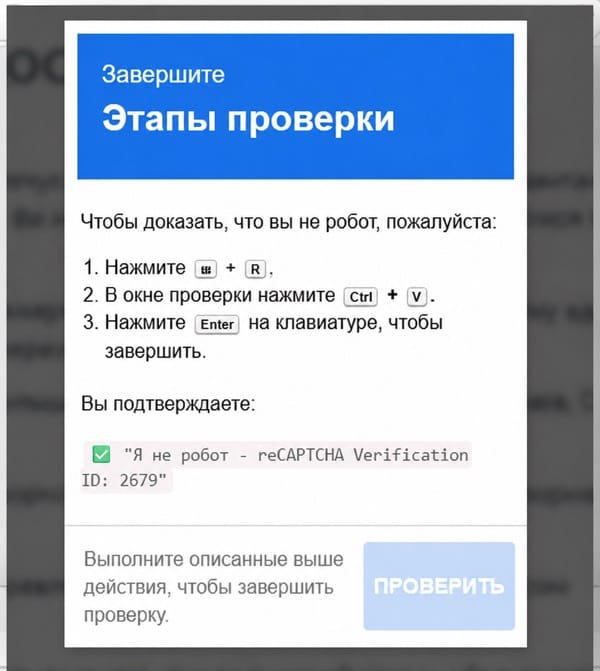
The instructions tell the user to press a key sequence that opens the Windows Run dialog, pastes the contents of the clipboard, and hits Enter — all without the victim realising what they have just unleashed.

Because what they've just executed could:

  • download malware
  • run PowerShell scripts
  • or install remote access software on their machine

A genuine CAPTCHA will never ask you to:

  • press Windows + R
  • open the Run dialog
  • paste a command
  • or press Enter to "verify you are human."

The downloaded code run on targeted computers runs a reconnaissance tool called ScoutCurl that collects information about the infected computer. This includes details about how the system is set up, what software is installed, files that are present, and browser data - all of which helps attackers determine whether the target is worth compromising further.

At least ten websites are estimated to have been compromised as part of the campaign since the beginning of June.

ClickFix attacks like this are not new, and we have written about the threat many times in past articles.

The uncomfortable truth is that ClickFix attacks persist because cybercriminals have found that they are very effective. This is in part because they do not rely on users being tricked into clicking on malicious links, but instead guide the victim through the process of infecting their own computers.

Furthermore, the instructions are presented as "helpful" technical advice to resolve an issue, and can too easily be trusted by the unwary. Furthermore, they exploit the fact the widespread installation of legitimate tools like PowerShell which are trusted in many corporate environments.

ClickFix attacks are not just a problem for the people of Ukraine, already navigating a relentless barrage of cyberattacks from Russian hackers amid a long-lasting kinetic war. They are a problem for computer users worldwide.

As a result, all computer users should take Ukraine's warning about the rise in ClickFix attacks as a timely reminder that the most dangerous threats often do not arrive in the form of an exploit of a zero-day vulnerability.