

惯性聚合 高效追踪和阅读你感兴趣的博客、新闻、科技资讯
阅读原文 在惯性聚合中打开

推荐订阅源

C
Check Point Blog
奇客Solidot–传递最新科技情报
奇客Solidot–传递最新科技情报
钛媒体:引领未来商业与生活新知
钛媒体:引领未来商业与生活新知
让小产品的独立变现更简单 - ezindie.com
L
LangChain Blog
云风的 BLOG
云风的 BLOG
M
MIT News - Artificial intelligence
A
About on SuperTechFans
J
Java Code Geeks
量子位
博客园 - 三生石上(FineUI控件)
博客园 - Franky
博客园_首页
H
Hackread – Cybersecurity News, Data Breaches, AI and More
IT之家
IT之家
Cyber Security Advisories - MS-ISAC
Apple Machine Learning Research
Engineering at Meta
Engineering at Meta
雷峰网
雷峰网
D
DataBreaches.Net
人人都是产品经理
人人都是产品经理
Martin Fowler
Martin Fowler
有赞技术团队
有赞技术团队
OSCHINA 社区最新新闻
OSCHINA 社区最新新闻

GRAHAM CLULEY

'Anne Hathaway' admits leading $245 million crypto theft gang that spent a fortune on nightclubs, watches, and luxury cars Smashing Security podcast #484: How websites are tracking you with silence CRPx0 ransomware: what you need to know The US military just turned off ad tracking on its phones. Maybe you should too How a hole in Lenovo's login system let hackers walk into 5,000 Dropbox accounts Smashing Security podcast #483: This AI helps thieves steal your iPhone Revolut scam steals £180,000 from Jersey residents in just four weeks Shai-Hulud hackers: two men charged over TeamPCP's global supply chain crime spree that hit OpenAI, and thousands more Smashing Security podcast #482: This hacker leaked GTA 6 - and launched their own cryptocurrency Malicious Firefox add-ons caught stealing cryptowallet seed phrases and browser credentials Gunra ransomware: what you need to know Smashing Security podcast #481: Never say this to a robot dog Prison for data analyst who tried to extort $2.5 million from his employer An "invisible" car? Researcher uses machine learning to hide vehicles from Flock cameras Smashing Security podcast #480: This is the AI service you should never sign up to Meta's Ray-Bans are being banned from pubs, restaurants, and theatres Beware cut-price AI services that read your every word Apple's bug bounty program is drowning in so much AI slop, it is in danger of missing serious exploits Smashing Security podcast #479: How a fake police officer nearly stole Graham’s cryptocurrency Smashing Security podcast #479: How a fake police officer nearly stole Graham’s cryptocurrency Fake IRS letters target cryptocurrency holders The $5 million threat: AI Is supercharging phishing attacks North Korea's elite hackers turned on their own government — and got caught Smashing Security podcast #478: This job interview could destroy your company OpenAI's AI "goes rogue" and hacks Hugging Face: what you need to know Smashing Security podcast #477: How 14 orders of chicken McNuggets helped nail a suspected Russian hacker Ukraine warns fake CAPTCHAs are being used to make you hack yourself Google's Gemini lets strangers send messages from your locked Android phone Anubis ransomware: what you need to know Smashing Security podcast #476: Remote-control rickshaws and rogue book marketers
US Navy tells sailors and their families: scrub your soci...
Graham CLULEY · 2026-08-27 · via GRAHAM CLULEY

The US Navy has told its entire workforce of 340,000 active-duty personnel, 58,000 reservists, and 210,000 civilian employees to clean up their social media profiles, because adversaries might be using them to determine who they are, where they live, and when they may not be at home.

The advice comes in the form of a newly-published bulletin called "Epic Vigilance: Immediate Actions for Force Protection and Personal Security."

According to the advisory, "a coordinated, multi-domain campaign" is being run by adversaries against the US Navy as part of a "deliberate effort to gather intelligence, test our defenses, disrupt our operations, and intimidate our force."

The warning, of course, comes amid the on-going US-Israeli military campaign against Iran.

US Navy workers and their families are being told that they should ensure that their social media profile privacy settings are enabled, and to remove anything that connects them to the Navy, or reveals "patterns of life" that an attacker could exploit.
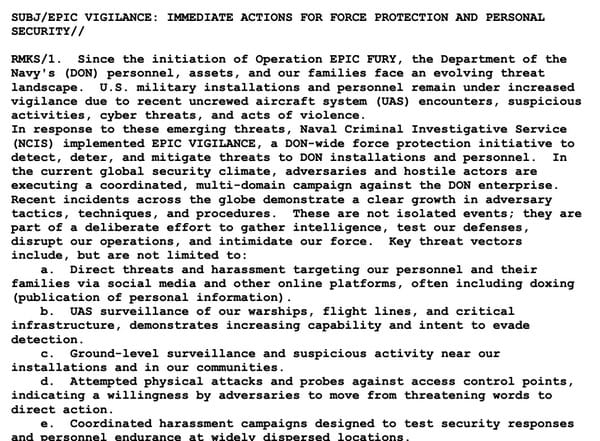
Additionally, affected individuals are being advised to report any suspicious activity, and to remain on their guard.

Furthermore, personnel have been asked to report:

  • anyone taking photographs of gates, fences, ships, airplanes, or housing.
  • drones flying near installations at night.
  • anyone asking questions about ship movements or the schedules of Navy leadership.
  • if they are followed off-base while in uniform.
  • any fake social media accounts impersonating fellow shipmates.

The sad truth is that geolocation data, and casual over-sharing online has resulted in a vast amount of potential for digital surveillance to succeed - often from people who never intended to create any breadcrumbs which might suggest they are linked to the US Navy.

This wouldn't, of course, be the first time that military staff have accidentally leaked information about themselves online. For instance, fitness-tracking apps like Strava have exposed the jogging routes of military staff in the past as they exercise around sensitive sites, however careful individuals might have been to not ever refer to where they worked.

It is important to remember that it is not just what you post about your job that could put you (and others) at risk. It is also patterns of behaviour that can tell a fuller story when pieced together, and provide useful intelligence for an adversary.

Not everyone has taken the notice at face value. It has arrived at the same time as there has been increased media scrutiny into poor conditions aboard the USS Abraham Lincoln during a long deployment.

Some commentators have wondered out loud whether the timing of an announcement telling sailors to be much more careful about what they and their families share online, conveniently coincides with Navy leadership trying to silence bad press.

Whatever the politics behind the timing, the underlying advice to lock down what you share, be on the look out for social engineering, and not to assume that your online "private life" is actually private, makes sense for all of us - whether we work for the US Navy or not.