



惯性聚合 高效追踪和阅读你感兴趣的博客、新闻、科技资讯
阅读原文 在惯性聚合中打开

推荐订阅源

C
CERT Recently Published Vulnerability Notes
freeCodeCamp Programming Tutorials: Python, JavaScript, Git & More
WordPress大学
WordPress大学
CTFtime.org: upcoming CTF events
V
Visual Studio Blog
Stack Overflow Blog
Stack Overflow Blog
aimingoo的专栏
aimingoo的专栏
C
Check Point Blog
cs.AI updates on arXiv.org
T
Tor Project blog
P
Proofpoint News Feed
让小产品的独立变现更简单 - ezindie.com
Latest news
Latest news
L
LINUX DO - 热门话题
罗磊的独立博客
T
Tenable Blog
The Hacker News
The Hacker News
美团技术团队
N
Netflix TechBlog - Medium
V
Vulnerabilities – Threatpost
阮一峰的网络日志
阮一峰的网络日志
Last Week in AI
Last Week in AI
博客园 - 司徒正美
Jina AI
Jina AI
Cyberwarzone
Cyberwarzone
云风的 BLOG
云风的 BLOG
S
Secure Thoughts
Cloudbric
Cloudbric
S
Security @ Cisco Blogs
奇客Solidot–传递最新科技情报
奇客Solidot–传递最新科技情报
Microsoft Security Blog
Spread Privacy
Spread Privacy
U
Unit 42
雷峰网
雷峰网
C
CXSECURITY Database RSS Feed - CXSecurity.com
Webroot Blog
Webroot Blog
爱范儿
爱范儿
博客园 - 【当耐特】
Know Your Adversary
Know Your Adversary
P
Privacy International News Feed
P
Palo Alto Networks Blog
Google Online Security Blog
The Last Watchdog
The Last Watchdog
博客园 - 聂微东
Help Net Security
Help Net Security
Hacker News: Ask HN
Hacker News: Ask HN
F
Full Disclosure
cs.CL updates on arXiv.org
S
Security Affairs
Project Zero
Project Zero

Todyl Blog

CyberChef: How to Decode & Decrypt Malicious Scripts (Step-by-Step Guide) Achieving Zero Trust with SASE: A Practical Roadmap for Modern Network Securityso like MSP Security Maturity Assessment: Why 79% of MSPs Are Stuck in 2025 The Rising Threat of Malicious AI: What Every Organization Needs to Know Iran Cyber Threat 2026: What SMBs and MSPs Need to Know The OneStart AI Browser Deception Cyber Insurance Requirements Based on Industry Why Third-Party Security Certification Is Your MSP's Competitive Edge Why Cyber Insurance Carriers Are Shifting to Security Assurance Iran Conflict and Cyber Risk: What North American Organizations Need to Know ‍ Why Cyber Resilience Requires Security, Compliance, and Insurance MSP Security Services: How to Position Identity Protection as Competitive Advantage Identity Security Gap Assessment: A Step-by-Step Guide for MSPs How Credential Theft Attacks Are Costing MSP Clients Millions Do I Need Cyber Insurance as a Small Business? Advanced Persistent Threats (APTs) Explained Preparing for CMMC Level 1: What Your Organization Needs to Do The Real Cost of Doing Nothing in Cybersecurity MSP Security: Build vs Buy SOC The Rise of a Cybercrime Alliance: What LockBit, Qilin, and DragonForce Mean for Business Risk Cyber Threat Recovery Strategies for MSPs What MSPs Need to Know about CIRCIA Final Rule ClickFix: The Evolution of Copy-Paste Social Engineering Akira Ransomware: Threat Assessment of a Scalable RaaS Operation The Dos and Don’ts of Applying for a Cyber Insurance Policy What Is Threat Hunting? A Practical Guide for MSPs and SMBs The Business Case for Cyber Threat Management Evaluating Free and Open Source SIEM Tools in 2026 How organizations can combat BEC Using SASE to help meet cyber insurance requirements Introducing the Anomaly Framework Stopping Identity Threats with ITDR through MXDR Security Operations Over Tools Beyond Tools: A Strategic Approach to Data Security Cyber Threat Response Strategies for MSPs Threat Advisory: Email Account Compromise BECs In the Wild: When Millions of People Are Expecting the Same Email Michigan and Wisconsin Proposed Age Verification Bills and the Impact on VPNs and SASE: What You Need to Know Cyber Threat Detection Strategies for MSPs Cyber Threat Prevention Strategies for MSPs Simplifying CMMC Level 1 with Todyl GRC How to Complete Your CMMC Level 1 Self-Assessment: A Step-by-Step Walkthrough Cyber Threats Don't Take Time Off How MSPs Build Lasting Client Relationships Through Proactive Operations Risk Management for MSPs: Why Business Context Changes Everything 5 Pillars for Security Program Growth in 2025 Building Resilience in a Perimeter-less World with Defense-in-Depth Aligning Technology Implementation to Business Outcomes Top 5 Myths about Cybersecurity How Conditional Access Transforms Your Cybersecurity Program Why MSPs need to embrace a prescriptive model How Texas SB 2610 Positions MSPs as Strategic Risk Advisors Simplifying cybersecurity maturity with managed cloud SIEM Addressing firewall vulnerabilities Understanding the Pitfalls of RDP MSP Zero-Day Response Plan: When Security Tools Can't Help You Old is Gold: Tackling Persistent Vulnerabilities How MXDR drives operational efficiencies Using SASE for secure remote access How to find the best endpoint security solution The Cyber Insurance Crisis: Why MSPs and Their Clients Are Struggling What to ask of a prospective endpoint security vendor Thinking Red, Acting Blue: Turning Attack Tactics in Your Favor Zero-Day Attacks and False Alarms: Lessons for MSPs Dissecting the Recent Rise in 2025 Zero Days MSP Security Monitoring Strategy: Identity and Cloud Blind Spots Introducing the Todyl Community: A Collaborative Platform for MSPs Threat Advisory: PDFast Freeware Compromise Navigating Today’s Cybersecurity Threat Landscape: Where MSPs Should Start Threat Advisory: Understanding the Recent SonicWall SSL VPN Vulnerability and How to Protect Your Clients Partner Spotlight: GoTech IT Solutions Threat Advisory: SQL Injection in FortiClient CVE-2023-48788 The Importance of SSL Inspection Navigating Compliance Frameworks: Common Challenges and Effective Solutions Making the most of SASE Web Filtering Iran & Middle-East Geopolitical Shifts: Emerging Cyber Risks for SMBs MSP Security KPIs That Matter: Beyond Vanity Metrics to Business Outcomes MSP Challenges Looking into 2025 Combining EDR and NGAV for Defense-in-Depth Starting Your Security Framework Journey: A Practical Implementation Guide Cyber Insurance vs. Warranties: Key Risk Management Elements Akira Ransomware: A Persistent Threat to MSP Operations Transforming Cyber Insurance for MSPs and Their Clients Two Truths, Double Whammy: Why Vulnerability Remediation Needs a Rethink Using LAN ZeroTrust for segmentation The role of SIEM in incident response Partner Spotlight: 917 Solutions Threat Advisory: Business Email Compromise Campaign using OVPN for Obfuscation Beyond Implementation: Creating an Ongoing Security Framework Program ClickFix: Fake Captcha Leads to Real Damage Streamlining Security and Compliance Information Gathering with Assessments EpiBrowser: A Sophisticated PUP Masquerading as Chromium Partner Spotlight: AnchorSix Tips to Help MSPs Set Goals for the New Year How SIEM helps detect insider threats Massive Wave of Network Security Vulnerabilities Demands Immediate Action FortiJump: The FortiManager Zero-Day Vulnerability Explained Use cases of SASE: Software-defined perimeter Threat Advisory: LightPerlGirl Malware Why MSPs Must Prioritize CIS Critical Security Controls v8.1 for Client Success
One Action MSPs can take to Address Risk and Secure Clients
Ken Patterson · 2026-01-09 · via Todyl Blog

Acting Today to Secure Tomorrow

Cybersecurity can feel endless.

For Managed Service Providers (MSPs), every week brings another vulnerability to patch, another compliance update to interpret, and another headline reminding clients why cybersecurity can’t wait. But even knowing all that, taking the first step toward meaningful improvement can feel impossible when everything feels urgent.

The good news? You don’t need to do everything at once to make a difference.

Security maturity doesn’t begin with a massive overhaul or a full framework rollout. It begins with one meaningful action that sparks lasting change for your business and your clients.

The Power of “Eating the Frog”

There’s an old saying in productivity circles: eat the frog first. In this case, the “frog” is the hardest or most important task. By tackling it first thing in the day, the rest feels manageable.

Cybersecurity has its own frogs. Every MSP has one:

  • The patch policy you’ve meant to standardize for months.
  • The outdated MFA rollout plan waiting for client approval.
  • The incident response playbook that still lives in a shared folder and hasn’t been tested in a year.

Those tasks might not be glamorous, but they’re the ones that truly move the needle. When you “eat the frog” early, you regain momentum and control. Instead of reacting to the next alert or audit, you’re proactively improving security posture, one deliberate action at a time.

And that’s what progress in cybersecurity really is: momentum.

Small Wins, Big Results

The most resilient organizations didn’t get there overnight. They got there by stacking consistent, achievable wins. Each one, in turn, strengthened their foundation.

These small actions compound over time. For example:

  • Automating patching closes thousands of known vulnerabilities with one policy update.
  • Auditing privileged accounts removes unnecessary access and reduces insider risk.
  • Testing backups ensures recovery points actually work when incidents occur.
  • Scheduling tabletop exercises helps teams practice and improve response readiness.

Individually, none of these are revolutionary. But together, they build a layered defense that’s stronger, smarter, and easier to manage.

And for MSPs, these small wins create something just as valuable: proof of progress.

Clients can see tangible steps forward—fewer vulnerabilities, faster response times, clearer reports—and that visibility translates directly into trust.

Momentum Over Perfection

Perfection is the enemy of progress.

MSPs may hesitate to act until every control, every client configuration, or every compliance checklist is complete. But cybersecurity doesn’t work that way. Threats evolve too fast, and waiting for perfect conditions only widens the gap between your intentions and your clients’ actual protection.

Momentum matters more.

Each action you take creates measurable improvement.

Each improvement builds resilience.

And resilience, over time, becomes your competitive advantage.
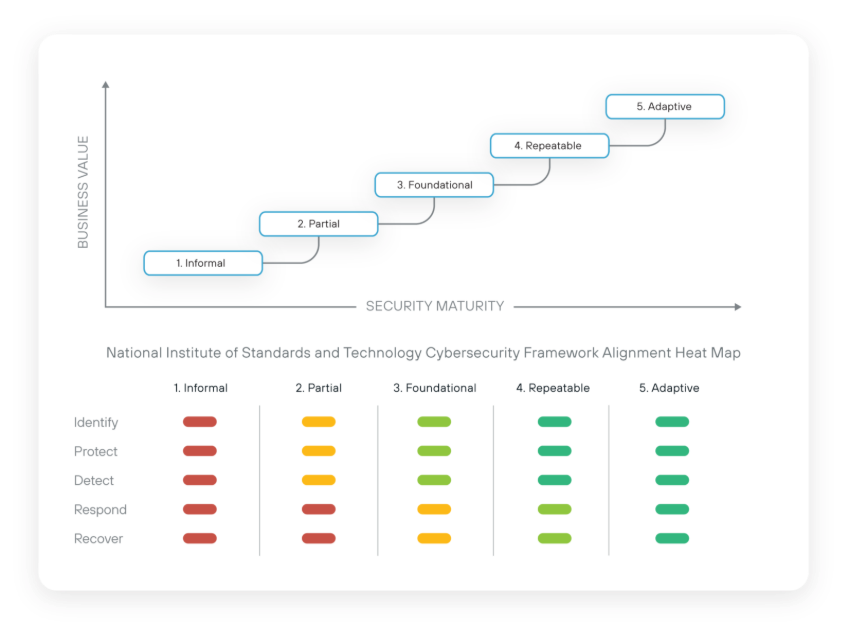
Security Maturity as it maps to NIST's Cybersecurity Framework

Clients don’t expect you to be perfect. They expect you to be consistent. They want to know that you’re moving forward, identifying priorities, and taking real steps that make them safer today than they were yesterday.

That’s what momentum looks like in cybersecurity: not grand gestures, but steady motion in the right direction.

The Compounding Effect of Progress

When MSPs focus on small, deliberate actions, the impact grows beyond security outcomes.

Operationally, stronger controls mean fewer emergencies and less reactive work.

Financially, risk reduction can lower insurance premiums and avoid costly downtime.

Strategically, it improves retention and helps justify premium service offerings.

Culturally, it fosters a mindset of continuous improvement—within your team and your clients alike.

Momentum compounds in every direction. A single improvement today sets the stage for smoother operations tomorrow and creates more capacity to take the next meaningful step.

Over time, what began as a small action becomes a measurable advantage that strengthens every part of your MSP’s business.

Making Action Achievable

For many MSPs, the biggest challenge isn’t knowing what to do next. It’s juggling too many disconnected systems to actually get it done.

Security data lives in one platform, compliance tracking in another, and client reporting somewhere else entirely. The result is constant context-switching, manual correlation, and the feeling that even simple improvements take too much effort to execute.

That’s why centralization matters.

Todyl brings threat, risk, and compliance management together in one place, giving MSPs a single source of truth for their entire cybersecurity program. Instead of managing multiple tools or spreadsheets, you can see everything—from threat exposure to control maturity to framework alignment—in one cohesive view.

This consolidation helps MSPs:

  • Spot and prioritize risks faster with unified threat visibility
  • Track compliance progress automatically across frameworks and clients
  • Simplify reporting and communication with clear, consistent insights
  • Turn fragmented data into actionable strategy

By streamlining the operational side of cybersecurity, Todyl makes it easier to take meaningful action. You spend less time chasing information and more time improving your clients’ security posture.

It’s how MSPs move from reactive management to proactive control—building momentum not just for one client, but across their entire portfolio.

This October, Start Your Momentum

We’re all aware of the impact of cybersecurity, but progress doesn’t require perfection. It requires action.

So this October, Cybersecurity Action Month, make your move.

Choose one thing that’s been sitting on your list and commit to finishing it:
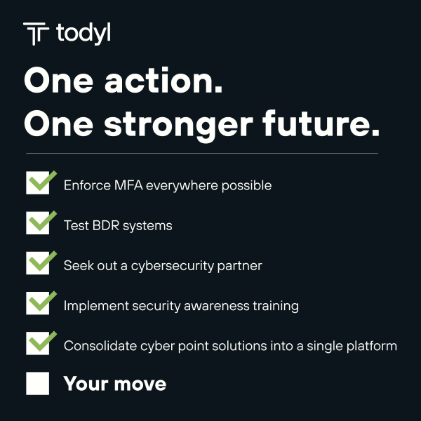
Enforce MFA everywhere possible, Test BDR Systems, Seek out a Cybersecurity Partner, Implement security awareness training, Consolidate cyber point solutions into a single platform. Your Move.

Because one taking one meaningful action today reduces risk tomorrow. It’s how security maturity starts, and how client confidence grows.

Want to take the next step in your cybersecurity maturity journey? Read our guide on aligning your model with NIST’s Cybersecurity Framework to see how to get started.

About Ken Patterson

Ken Patterson leads the charge for Todyl to develop and grow the relationships within the IT Channel and internally at Todyl for everyone's benefit. His 20-plus years of technology experience range from creating a Community for a top peer group/coaching company and the leading distributor/marketplace to owning and running multiple MSPs to hands-on technical support, implementation, managing, and building an Operations Center.