


惯性聚合 高效追踪和阅读你感兴趣的博客、新闻、科技资讯
阅读原文 在惯性聚合中打开

推荐订阅源

量子位
T
The Blog of Author Tim Ferriss
U
Unit 42
Microsoft Security Blog
WordPress大学
WordPress大学
Vercel News
Vercel News
MongoDB | Blog
MongoDB | Blog
P
Proofpoint News Feed
D
DataBreaches.Net
The GitHub Blog
The GitHub Blog
大猫的无限游戏
大猫的无限游戏
C
Check Point Blog
Blog — PlanetScale
Blog — PlanetScale
I
InfoQ
Y
Y Combinator Blog
F
Full Disclosure
B
Blog
钛媒体:引领未来商业与生活新知
钛媒体:引领未来商业与生活新知
G
Google Developers Blog
博客园_首页
OSCHINA 社区最新新闻
OSCHINA 社区最新新闻
月光博客
月光博客
博客园 - 三生石上(FineUI控件)
博客园 - 叶小钗
S
SegmentFault 最新的问题
腾讯CDC
Cyber Security Advisories - MS-ISAC
V
Visual Studio Blog
Apple Machine Learning Research
人人都是产品经理
人人都是产品经理
Recent Commits to openclaw:main
The Register - Security
奇客Solidot–传递最新科技情报
奇客Solidot–传递最新科技情报
Microsoft Azure Blog
云风的 BLOG
云风的 BLOG
Last Week in AI
Last Week in AI
F
Fortinet All Blogs
C
CXSECURITY Database RSS Feed - CXSecurity.com
Hugging Face - Blog
Hugging Face - Blog
T
Threatpost
GbyAI
GbyAI
G
GRAHAM CLULEY
L
Lohrmann on Cybersecurity
T
The Exploit Database - CXSecurity.com
P
Palo Alto Networks Blog
L
LangChain Blog
T
Tenable Blog
C
Cisco Blogs
T
Threat Research - Cisco Blogs
Google Online Security Blog

Todyl Blog

CyberChef: How to Decode & Decrypt Malicious Scripts (Step-by-Step Guide) Achieving Zero Trust with SASE: A Practical Roadmap for Modern Network Securityso like MSP Security Maturity Assessment: Why 79% of MSPs Are Stuck in 2025 The Rising Threat of Malicious AI: What Every Organization Needs to Know Iran Cyber Threat 2026: What SMBs and MSPs Need to Know The OneStart AI Browser Deception Cyber Insurance Requirements Based on Industry Why Third-Party Security Certification Is Your MSP's Competitive Edge Why Cyber Insurance Carriers Are Shifting to Security Assurance Iran Conflict and Cyber Risk: What North American Organizations Need to Know ‍ Why Cyber Resilience Requires Security, Compliance, and Insurance MSP Security Services: How to Position Identity Protection as Competitive Advantage Identity Security Gap Assessment: A Step-by-Step Guide for MSPs How Credential Theft Attacks Are Costing MSP Clients Millions Do I Need Cyber Insurance as a Small Business? Advanced Persistent Threats (APTs) Explained Preparing for CMMC Level 1: What Your Organization Needs to Do The Real Cost of Doing Nothing in Cybersecurity MSP Security: Build vs Buy SOC The Rise of a Cybercrime Alliance: What LockBit, Qilin, and DragonForce Mean for Business Risk Cyber Threat Recovery Strategies for MSPs What MSPs Need to Know about CIRCIA Final Rule Akira Ransomware: Threat Assessment of a Scalable RaaS Operation The Dos and Don’ts of Applying for a Cyber Insurance Policy What Is Threat Hunting? A Practical Guide for MSPs and SMBs The Business Case for Cyber Threat Management Evaluating Free and Open Source SIEM Tools in 2026 How organizations can combat BEC Using SASE to help meet cyber insurance requirements Introducing the Anomaly Framework Stopping Identity Threats with ITDR through MXDR Security Operations Over Tools Beyond Tools: A Strategic Approach to Data Security Cyber Threat Response Strategies for MSPs Threat Advisory: Email Account Compromise BECs In the Wild: When Millions of People Are Expecting the Same Email Michigan and Wisconsin Proposed Age Verification Bills and the Impact on VPNs and SASE: What You Need to Know Cyber Threat Detection Strategies for MSPs Cyber Threat Prevention Strategies for MSPs Simplifying CMMC Level 1 with Todyl GRC How to Complete Your CMMC Level 1 Self-Assessment: A Step-by-Step Walkthrough Cyber Threats Don't Take Time Off How MSPs Build Lasting Client Relationships Through Proactive Operations Risk Management for MSPs: Why Business Context Changes Everything 5 Pillars for Security Program Growth in 2025 One Action MSPs can take to Address Risk and Secure Clients Building Resilience in a Perimeter-less World with Defense-in-Depth Aligning Technology Implementation to Business Outcomes Top 5 Myths about Cybersecurity How Conditional Access Transforms Your Cybersecurity Program Why MSPs need to embrace a prescriptive model How Texas SB 2610 Positions MSPs as Strategic Risk Advisors Simplifying cybersecurity maturity with managed cloud SIEM Addressing firewall vulnerabilities Understanding the Pitfalls of RDP MSP Zero-Day Response Plan: When Security Tools Can't Help You Old is Gold: Tackling Persistent Vulnerabilities How MXDR drives operational efficiencies Using SASE for secure remote access How to find the best endpoint security solution The Cyber Insurance Crisis: Why MSPs and Their Clients Are Struggling What to ask of a prospective endpoint security vendor Thinking Red, Acting Blue: Turning Attack Tactics in Your Favor Zero-Day Attacks and False Alarms: Lessons for MSPs Dissecting the Recent Rise in 2025 Zero Days MSP Security Monitoring Strategy: Identity and Cloud Blind Spots Introducing the Todyl Community: A Collaborative Platform for MSPs Threat Advisory: PDFast Freeware Compromise Navigating Today’s Cybersecurity Threat Landscape: Where MSPs Should Start Threat Advisory: Understanding the Recent SonicWall SSL VPN Vulnerability and How to Protect Your Clients Partner Spotlight: GoTech IT Solutions Threat Advisory: SQL Injection in FortiClient CVE-2023-48788 The Importance of SSL Inspection Navigating Compliance Frameworks: Common Challenges and Effective Solutions Making the most of SASE Web Filtering Iran & Middle-East Geopolitical Shifts: Emerging Cyber Risks for SMBs MSP Security KPIs That Matter: Beyond Vanity Metrics to Business Outcomes MSP Challenges Looking into 2025 Combining EDR and NGAV for Defense-in-Depth Starting Your Security Framework Journey: A Practical Implementation Guide Cyber Insurance vs. Warranties: Key Risk Management Elements Akira Ransomware: A Persistent Threat to MSP Operations Transforming Cyber Insurance for MSPs and Their Clients Two Truths, Double Whammy: Why Vulnerability Remediation Needs a Rethink Using LAN ZeroTrust for segmentation The role of SIEM in incident response Partner Spotlight: 917 Solutions Threat Advisory: Business Email Compromise Campaign using OVPN for Obfuscation Beyond Implementation: Creating an Ongoing Security Framework Program ClickFix: Fake Captcha Leads to Real Damage Streamlining Security and Compliance Information Gathering with Assessments EpiBrowser: A Sophisticated PUP Masquerading as Chromium Partner Spotlight: AnchorSix Tips to Help MSPs Set Goals for the New Year How SIEM helps detect insider threats Massive Wave of Network Security Vulnerabilities Demands Immediate Action FortiJump: The FortiManager Zero-Day Vulnerability Explained Use cases of SASE: Software-defined perimeter Threat Advisory: LightPerlGirl Malware Why MSPs Must Prioritize CIS Critical Security Controls v8.1 for Client Success
ClickFix: The Evolution of Copy-Paste Social Engineering
Keira Stevens · 2026-02-05 · via Todyl Blog

Executive Summary

ClickFix represents a highly effective social engineering technique that exploits user trust and legitimate system interfaces to achieve initial compromise. First observed in October 2023, this attack method convinces victims to manually execute malicious commands by copying and pasting content into the Windows "Run" dialog box or terminal, effectively circumventing traditional security controls designed to prevent automated execution.

The sophistication of ClickFix campaigns has evolved dramatically since their inception. Modern variants leverage trusted brand identities, employ JavaScript injection to populate clipboard contents automatically, and have expanded beyond Windows to target macOS and Linux systems. By exploiting the human element rather than technical vulnerabilities, threat actors have created an attack vector that remains effective even against organizations with robust endpoint security.

Key characteristics of ClickFix attacks include:

  • Social engineering focus: Exploits user behavior and trust rather than technical vulnerabilities
  • Evasion capabilities: Bypasses traditional security solutions by leveraging legitimate system tools and processes
  • Rapid adoption: Multiple threat actor groups and APT organizations have incorporated this technique since mid-2024
  • Server-side controls: Threat actors implement IP blacklisting, geographic filtering, and bot detection to evade security research and analysis

What's New? Recent Developments

ClickFix Becomes the Dominant Initial Access Vector

Microsoft's 2025 Digital Defense Report revealed that ClickFix emerged as the most prevalent initial access method in 2025, representing 47% of observed attacks. This dramatic surge demonstrates how rapidly threat actors have adopted and scaled this technique across their operations.  
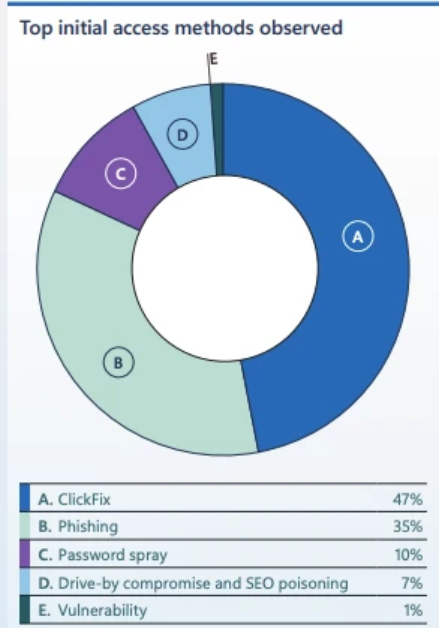
graph showing ClickFix dominance

Image courtesy Microsoft, link above

Advanced Cloudflare-Themed Social Engineering

Modern ClickFix campaigns increasingly leverage fake Cloudflare bot verification pages, which have become ubiquitous across the legitimate web. These sophisticated lures include several enhancements designed to maximize victim compliance:

  • Dynamic OS detection: Commands automatically adapt based on the victim's operating system (Windows, macOS, Linux)
  • Instructional videos: Embedded video tutorials demonstrate exactly how to execute the malicious commands
  • Social proof indicators: Fake counters displaying "users verified in the last hour" and countdown timers create urgency and authenticity
  • Professional design: High-fidelity replicas of legitimate Cloudflare interfaces that are nearly indistinguishable from authentic verification pages

As noted by Push Security researchers: "It almost looks like Cloudflare shipped a new kind of bot check service. The embedded video, countdown timer, and counter for 'users verified in the last hour' all serve to increase the sense of authenticity, and put extra pressure on the victim to complete the check."  

Blue Screen of Death (BSOD) Impersonation

Threat actors have begun weaponizing one of Windows' most recognizable error screens. These attacks use full-screen browser windows to display convincing BSOD replicas that include malicious "recovery" commands. Victims, believing their system has crashed, follow the displayed instructions to "restore" their computer, unknowingly executing the attacker's payload.  

Fake Windows Update Screens

Building on the BSOD concept, attackers have also developed fake Windows Update interfaces that mimic the familiar blue update screen. These displays instruct victims to execute commands to "complete" or "accelerate" the update process, leveraging users' familiarity with legitimate Windows update procedures that sometimes require system intervention.  

FileFix: The Next Evolution

FileFix represents a significant evolution of the ClickFix technique, moving the attack vector from the Run dialog to Windows File Explorer. Instead of copying PowerShell commands, victims are instructed to paste malicious file paths or commands directly into the File Explorer address bar, leading to malware execution through file system manipulation.  

Cache Smuggling: Invisible Payload Delivery

A particularly insidious development uses cache smuggling techniques. In these attacks:

  1. Victims visit a compromised or malicious website that appears to display benign images or content
  2. Malicious payloads are embedded within image files or other seemingly harmless content and stored in the browser cache
  3. JavaScript code later retrieves these cached files, via a typical clickfix attack, and extracts the hidden malicious code
  4. The payload executes without triggering traditional download-based detection mechanisms

This technique effectively bypasses security controls that monitor network traffic and file downloads, as the malicious content technically arrived through a previous, apparently benign web request and is retrieved locally from cache.

Recent Notable Attacks

PhantomCaptcha: Geopolitical Targeting

Security researchers uncovered PhantomCaptcha, a sophisticated spearphishing operation targeting Ukrainian government agencies and international NGOs, including the Red Cross and UNICEF. The campaign employed the following methodology:

  • Victims received convincing fake Zoom meeting invitations via email
  • Links directed targets to credential-harvesting sites displaying fraudulent CAPTCHA verification prompts
  • The "verification token" victims were instructed to copy and paste actually contained PowerShell commands
  • Successful execution installed a WebSocket-based Remote Access Trojan (RAT) capable of real-time system control and data exfiltration

This campaign demonstrates how ClickFix techniques have been adopted by APT-level threat actors for geopolitically motivated operations.

TikTok "Activation Guide" Scams

A viral ClickFix campaign spread rapidly through TikTok, leveraging the platform's algorithm to reach millions of potential victims. The scam purported to offer:

  • Free Windows activation keys and commands
  • Cracked Microsoft 365 licenses
  • Adobe Photoshop activation bypasses
  • Fake Spotify Premium subscriptions

Videos instructed viewers to copy and execute commands that appeared to activate these services but instead installed information stealers, cryptocurrency miners, and remote access tools. The campaign's virality was amplified by teenagers and young adults sharing the videos with friends, believing they were distributing helpful software hacks.

KongTuke Campaign: Widespread Web Compromise

The KongTuke campaign represented a mass-compromise operation affecting thousands of legitimate websites:

  • Attackers compromised WordPress sites, content management systems, and poorly secured web servers
  • Injected malicious JavaScript created fake CAPTCHA verification prompts on infected pages
  • Visitors attempting to access legitimate content were presented with ClickFix-style lures
  • Multiple payload variants were observed, including information stealers and banking trojans

Researchers also documented a FileFix variant within this campaign that deployed a PHP-based RAT through Windows File Explorer manipulation, demonstrating the attackers' technical sophistication and willingness to employ multiple attack vectors simultaneously.

From Obscure Technique to Mainstream Threat

APT Adoption

The effectiveness of ClickFix has attracted attention from nation-state threat actors. Security researchers have observed multiple Advanced Persistent Threat (APT) groups incorporating ClickFix-style lures into their operational toolkits, including:

  • MuddyWater (Iranian APT): Integrated ClickFix techniques into spearphishing campaigns targeting Middle Eastern government and critical infrastructure organizations
  • APT28 (Russian GRU): Employed ClickFix lures in operations against European government entities and defense contractors

This adoption by sophisticated state-sponsored groups validates the technique's effectiveness against even security-conscious targets and suggests ClickFix will remain a persistent threat for years to come.

Commercialization and Commoditization

The underground cybercrime economy has rapidly commoditized ClickFix capabilities. Specialized builders and "ClickFix-as-a-Service" offerings are now readily available on dark web forums and Telegram channels:

Basic packages ($200-$500):

  • Pre-built phishing page templates
  • Simple command obfuscation
  • Basic CAPTCHA and error message themes

Premium subscriptions ($1,000-$1,500/month):

  • Professional Cloudflare and reCAPTCHA template designs
  • Multi-language support for international targeting
  • Anti-analysis features (VM detection, geographic filtering, researcher IP blacklists)
  • Automated obfuscated command generation
  • Real-time campaign statistics and victim tracking dashboards
  • Regular template updates to evade detection
  • Customer support and customization services  

This commercialization has dramatically lowered the technical barrier to entry, enabling low-skill cybercriminals to execute sophisticated social engineering campaigns. The availability of turnkey ClickFix tools ensures this threat will continue proliferating across the threat landscape.

The Future of ClickFix

Blurring Execution Boundaries

The next evolution of ClickFix attacks will likely continue blurring the distinction between code executing locally on the victim's system and code running within the browser sandbox. This convergence creates detection challenges:

  • WebAssembly exploitation: Using WASM to perform malicious operations that bridge browser and system contexts
  • Progressive Web Apps (PWAs): Abusing PWA capabilities to gain persistent access and expanded permissions
  • Browser extension manipulation: Tricking users into installing or enabling malicious browser extensions through ClickFix-style social engineering
  • Clipboard API abuse: Exploiting browser clipboard access to pre-populate commands without user visibility
  • Cross-platform scripting: Developing universal payloads that detect and adapt to any operating system environment

AI-Enhanced Social Engineering

As artificial intelligence becomes more accessible, threat actors will likely leverage generative AI to create hyper-personalized ClickFix campaigns:

  • Dynamic content generation based on victim profiling
  • Real-time conversation simulation in chatbot-style lures
  • Automated translation for global targeting without language barriers
  • Voice and video deepfakes integrated into instructional content

Existing Detection Rules

Todyl's Security Platform includes multiple detection rules specifically designed to identify ClickFix attacks:

ClickFix RunDLL32 Execution for Stage 1

Detects when a ClickFix attack leverages rundll32.exe to execute a remote DLL payload, a common technique for initial stage execution that loads additional malware components.

ClickFix PowerShell Download for Stage 1

Identifies when a user executes a PowerShell command containing ClickFix-associated phrases such as "I am not a robot reCAPTCHA" or "I am Human" through the Windows Run dialog, indicating a social engineering compromise.

ClickFix MSHTA Download for Stage 1

Detects MSHTA-based ClickFix attacks where victims paste commands invoking Microsoft's HTML Application host to download and execute malicious scripts or applications.

ClickFix Windows Run Dialog Misuse for Stage 1

Monitors suspicious modifications to the Windows RunMRU (Most Recently Used) registry key, which records commands executed through the Run dialog and often contains forensic evidence of ClickFix attacks.

Learn more

For more information on ClickFix being stopped in the wild, read this piece on how our team uncovered an attack live.

For similar breakdowns and threat coverage, read more threat intelligence from Todyl’s research team.