









Sign up to see the future, today
Can’t-miss innovations from the bleeding edge of science and tech
We love apes. We love that they’re uncanny but pure reflections of our human quirks and foibles, at times silly, and at others sagacious. So what does an ape’s laugh say about them? And what does it say about humans?
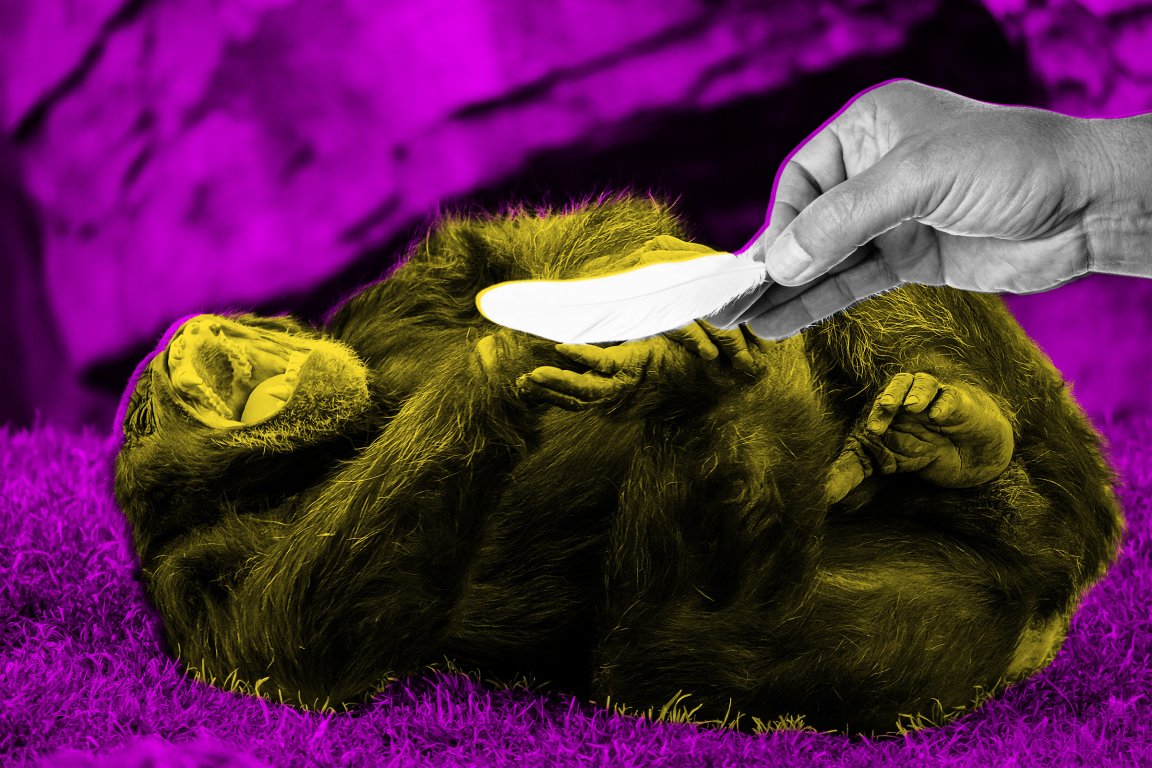
Exploring these differences formed the crux of a new study that documented laughing patterns between primates — a very serious avenue of inquiry that involved tickling apes. For science, of course.
The findings, published in the journal Communications Biology, revealed a rich spectrum of laughter across the species. Humans displayed the most variety, switching between giggles and guffaws, and changing up the tempo of their laughs. Apes, meanwhile, tended to stick with fixed patterns and tempos.
“I think we can say we are the masters of laughter,” study coauthor Chiara De Gregorio, a researcher at the University of Warwick, told The New York Times.
“We can have a small, polite laugh in front of the Queen of England, and then we are in the pub with our friends, and we laugh so much in a different way,” De Gregorio added. “We can even laugh in a way that communicates to the other person that we actually didn’t find the joke they said funny.”
Loudly evacuate the air in your nostrils all you want — the researchers say this provides some intriguing insights into how our complex vocals evolved. Laughter is a “universal form of human non-linguistic vocal expression and, being shared by all extant great apes offers a valuable proxy for tracing the evolution of vocal control that ultimately enabled language,” they wrote in the study.
In their experiments, the researchers recorded the laughter of 13 young apes in captivity, including orangutans, gorillas, bonobos, and chimpanzees. Their humans were four children and no adults. (Perhaps because they’re not yet self-conscious enough to change their laugh for an audience.)
Intriguingly, when tickled, all species of primates, including humans, laughed in isochronous fashion, or at regular intervals, as if to a beat. Ha ha ha! The pause between each “ha” was consistent. But this changed with laughter during play. It became less regular, probably because the subjects were moving around a lot more.
The researchers concluded that this meant that tickling laughter provided an “unaltered” look at each species’ natural laughing rhythm, and as a result, acts a “window onto the evolutionary changes undergone by the phonatory-respiratory system of hominids,” they wrote.
Humans tended to laugh at a quicker tempo and were the only species to modulate their tempo based on the context, laughing faster during tickling than play. And our closest relatives, chimps and bonobos, laughed faster than our most distant primate ones, gorillas and orangutans. That’s no coincidence, as it shows an evolutionary trend in vocal flexibility.
For social creatures like apes, the researchers note, being able to switch up your laugh is useful, conveying “socially relevant information about emotional state, intent, and disposition.”
“Laughter is such an important part of our way of communication,” De Gregorio told the NYT. “It’s able to communicate way more than, ‘I’m playing and I’m having fun.'”
The researchers are the first to admit that the study is very small, so further work will need to bear out their findings. At the very least, they’ve demonstrated that the way you chuckle, chortle, or cachinnate is no laughing matter.
More on biology: You Are Not Prepared to Learn the Size of Neanderthal Infants