





Sign up to see the future, today
Can’t-miss innovations from the bleeding edge of science and tech
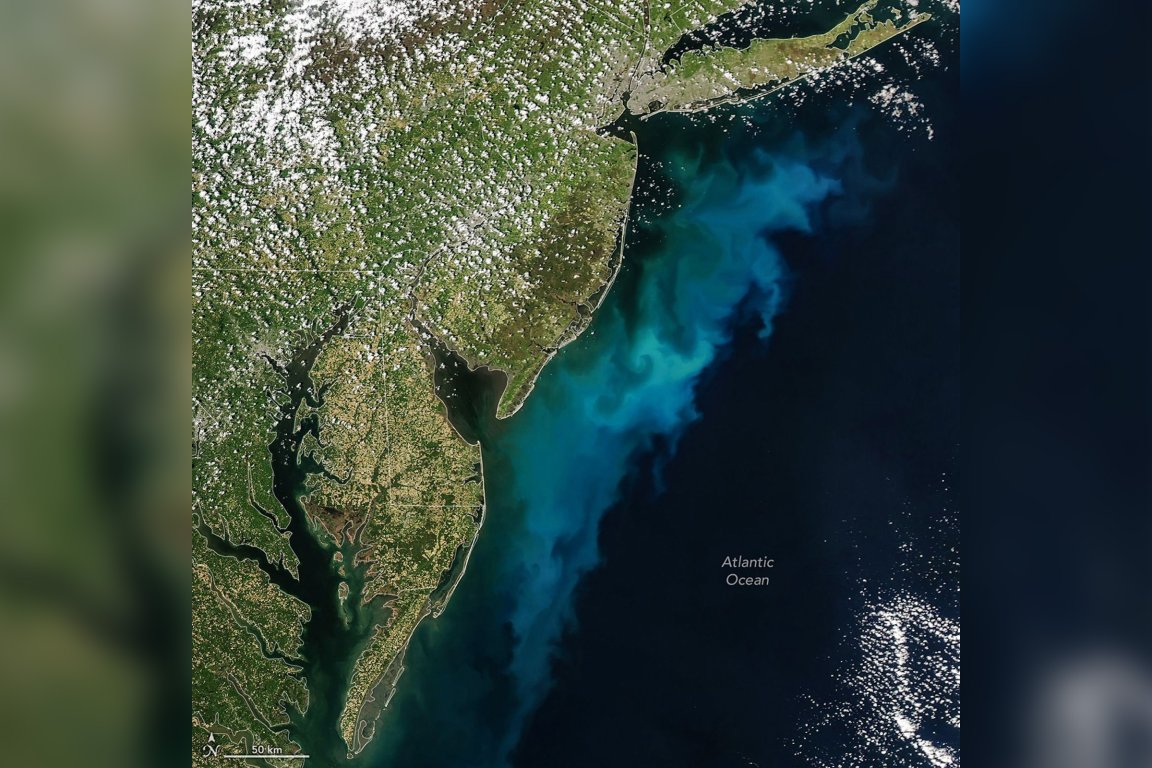
NASA satellites are tracking an intriguing patch of colored plumes in the waters off the US’s Mid-Atlantic coast.
Swirling with vivid hues of green and turquoise, and tinged with a little brown, the stained waters were first detected by orbital observatories in early April. But they were most intense in the Mid-Atlantic Bight, an area where the waters from several bays, including the Chesapeake, merge with the open ocean, according to an update from the space agency.
Discerning what’s swirling through these so-called “noisy” and “dirty” coastal waters is a challenge to scientists, because they can be caused by a hodgepodge of phenomena, unlike in the open ocean, which is fairly uniform. The colorful plumes could be tinged by sediments, plant life, and other organic matter. They could also be the result of phytoplankton blooms, meaning periods when the microscopic algae rapidly explode in number. Or it could be a combination of all of the above.
Thanks to the latest NASA satellites like PACE — which stands for Plankton, Aerosol, Cloud, Ocean Ecosystem — oceanographers can make more confident conclusions than ever. Some of the colors in the images may be due to outflows from coastal rivers and sediment churned up by spring storms, but “there are likely phytoplankton blooms happening,” Anna Windle, a NASA research scientist supporting the PACE science team, said in an agency statement.
Windle added that diatoms — single-celled algae — “typically dominate blooms early in the spring, but we are seeing some signs of coccolithophores mixed in as well.”
Diatom-dominated blooms tend to happen in the spring and look greenish in natural-color satellite imagery, according to NASA. Coccolithophores, which are phytoplankton clad in a sort of limestone armor plating, produce a milkier, turquoise colored bloom, and typically occur in late spring or summer.
Scientists don’t track these colorful plumes as mere curiosities. They serve as a barometer of phytoplankton populations, and as such, a health check of the ocean’s ecosystems at large. Phytoplankton are the ocean’s main carbon recycles and produce at least half of the Earth’s oxygen, and are a source of food for other aquatic creatures. Scientists worry that fluctuations in phytoplankton populations could be changing the color of the ocean and affecting the depth that light can penetrate its surface.
Phytoplankton blooms often dissipate as quickly as they appear, though this is normally part of a healthy cycle. Initially, they feast on an abundance of nutrients present in the water after cold winter winds bring the nutrients to the surface.
“But over time, as big spring phytoplankton blooms grow, they deplete the nutrients,” Oscar Schofield, an oceanographer Rutgers University, said in the NASA release. “Unless big river outflows or storms replenish the nutrients, we’ll likely see this bloom start to decline in the coming weeks.”
More on biology: Scientists Say They’ve Figured Out What That Golden Orb Found at the Bottom of the Pacific Ocean Actually Was