


Given a URL startUrl and an interface HtmlParser, implement a Multi-threaded web crawler to crawl all links that are under the same hostname as startUrl.
Return all URLs obtained by your web crawler in any order.
Your crawler should:
startUrlHtmlParser.getUrls(url) to get all URLs from a webpage of a given URL.startUrl.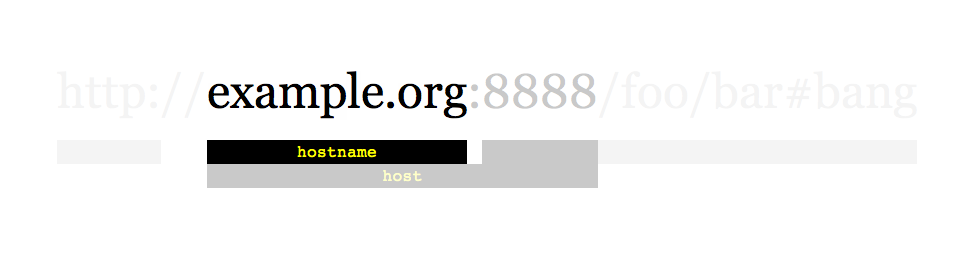
As shown in the example URL above, the hostname is example.org. For simplicity's sake, you may assume all URLs use HTTP protocol without any port specified. For example, the URLs http://leetcode.com/problems and http://leetcode.com/contest are under the same hostname, while URLs http://example.org/test and http://example.com/abc are not under the same hostname.
The HtmlParser interface is defined as such:
interface HtmlParser {
  // Return a list of all urls from a webpage of given url.
  // This is a blocking call, that means it will do HTTP request and return when this request is finished.
  public List<String> getUrls(String url);
}
Note that getUrls(String url) simulates performing an HTTP request. You can treat it as a blocking function call that waits for an HTTP request to finish. It is guaranteed that getUrls(String url) will return the URLs within 15ms. Single-threaded solutions will exceed the time limit so, can your multi-threaded web crawler do better?
Below are two examples explaining the functionality of the problem. For custom testing purposes, you'll have three variables urls, edges and startUrl. Notice that you will only have access to startUrl in your code, while urls and edges are not directly accessible to you in code.
Example 1:
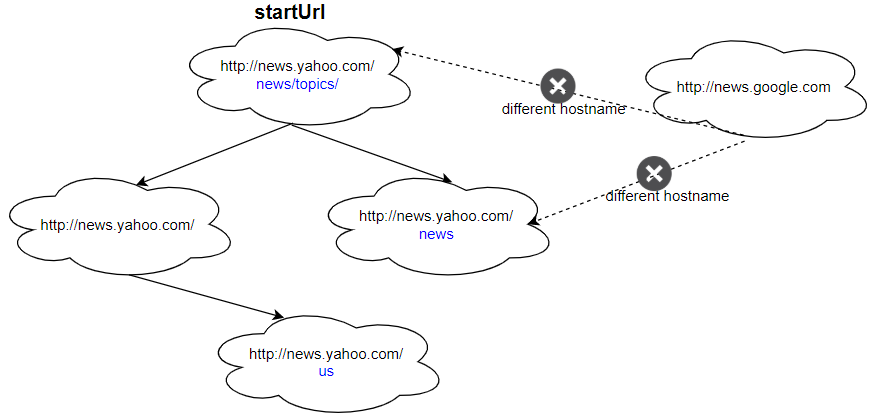
Input:
urls = [
  "http://news.yahoo.com",
  "http://news.yahoo.com/news",
  "http://news.yahoo.com/news/topics/",
  "http://news.google.com",
  "http://news.yahoo.com/us"
]
edges = [[2,0],[2,1],[3,2],[3,1],[0,4]]
startUrl = "http://news.yahoo.com/news/topics/"
Output: [
  "http://news.yahoo.com",
  "http://news.yahoo.com/news",
  "http://news.yahoo.com/news/topics/",
  "http://news.yahoo.com/us"
]
Example 2:
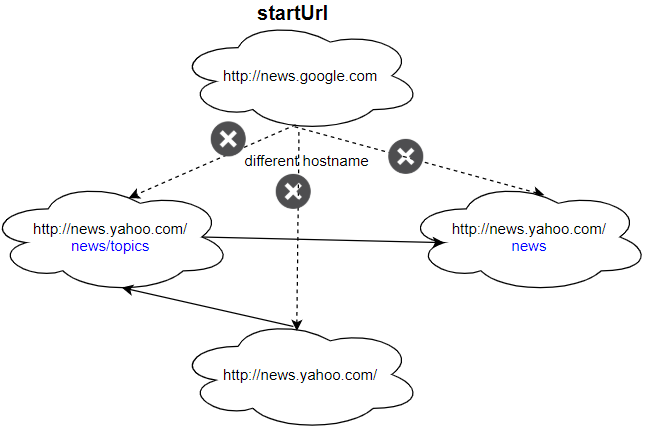
Input:
urls = [
  "http://news.yahoo.com",
  "http://news.yahoo.com/news",
  "http://news.yahoo.com/news/topics/",
  "http://news.google.com"
]
edges = [[0,2],[2,1],[3,2],[3,1],[3,0]]
startUrl = "http://news.google.com"
Output: ["http://news.google.com"]
Explanation: The startUrl links to all other pages that do not share the same hostname.
Constraints:
1 <= urls.length <= 10001 <= urls[i].length <= 300startUrl is one of the urls.1 to 63 characters long, including the dots, may contain only the ASCII letters from 'a' to 'z', digits from '0' to '9' and the hyphen-minus character ('-').Follow up:
The main goals are:
The key idea is partition URLs by hashing.
Suppose there are N machines.
Each URL has a unique owner.
For example
Each URL always belongs to exactly one machine.
This immediately solves duplicate crawling.
Machine A crawls one page
It discovers
Instead of checking all URLs locally, it computes
Then sends
Each node only stores
No global visited set exists.
Without partitioning
That's terrible.
With consistent ownership
Only one network message.
A good hash distributes URLs uniformly.
Expected work
Very balanced.
Instead of
real systems use
because machines may join or leave.
Otherwise
Need fault tolerance.
Several approaches.
Persist work queue.
Instead of
use
If machine dies
another worker continues.
Replication.
Each partition has
If primary dies
Replica becomes primary.
Exactly like
Checkpoint visited URLs.
Suppose machine processed
Persist
Crash
Restart
Continue.
Interview answer:
Each partition should periodically persist its frontier and visited metadata (or store them in a replicated distributed queue/database). If a worker fails, another worker can take ownership of that partition and resume crawling without starting over.
This is the interesting one.
In one machine
works.
Distributed?
No.
Machine A
Machine B
Machine A isn't actually done.
Need global termination detection.
Coordinator.
Each node periodically reports
Crawler finishes when
Every node
Need to account for messages in flight.
Example
Cannot terminate early.
Real systems maintain
or
When
Done.
More sophisticated algorithms exist.
Examples
Usually unnecessary in interviews.
A concise answer might be:
I would partition the URL space across machines using a deterministic hash (or consistent hashing), so each URL has a single owner. Each node maintains only the visited set and work queue for the URLs it owns. When a node crawls a page and discovers new URLs, it hashes each URL and forwards it only to its owner. This avoids duplicate crawling, balances work across machines, and minimizes communication because every URL is sent to exactly one destination instead of broadcasting lookups.
For fault tolerance, I would persist each partition's frontier in a durable distributed queue or replicate partitions so another node can take over if one fails. A failed worker can resume from the last checkpoint instead of restarting.
To detect completion, I would use a coordinator that tracks whether every node's work queue is empty, all workers are idle, and there are no URLs currently being transferred between nodes. Only when all three conditions hold can the distributed crawler safely terminate.
This demonstrates understanding of partitioning, fault tolerance, and distributed termination detection, which are the core concepts interviewers are looking for.
# """
# This is HtmlParser's API interface.
# You should not implement it, or speculate about its implementation
# """
#class HtmlParser(object):
#    def getUrls(self, url):
#        """
#        :type url: str
#        :rtype List[str]
#        """

from typing import List
from threading import Thread, Lock
from queue import Queue
from urllib.parse import urlparse


class Solution:
    def crawl(self, startUrl: str, htmlParser: 'HtmlParser') -> List[str]:
        hostname = urlparse(startUrl).netloc

        visited = {startUrl}
        lock = Lock()

        q = Queue()
        q.put(startUrl)

        def worker():
            while True:
                url = q.get()

                # Sentinel: stop the worker.
                if url is None:
                    q.task_done()
                    break

                try:
                    for next_url in htmlParser.getUrls(url):
                        if urlparse(next_url).netloc != hostname:
                            continue

                        with lock:
                            if next_url in visited:
                                continue
                            visited.add(next_url)

                        q.put(next_url)
                finally:
                    q.task_done()

        NUM_THREADS = 8
        threads = []

        for _ in range(NUM_THREADS):
            t = Thread(target=worker)
            t.start()
            threads.append(t)

        # Wait until all URLs have been processed.
        q.join()

        # Stop all workers.
        for _ in range(NUM_THREADS):
            q.put(None)

        for t in threads:
            t.join()

        return list(visited)
You call q.join() when you want to wait until all queued tasks have been processed.
Without it:
the main thread may continue before workers finish.
Internally:
put() increments an unfinished task countertask_done() decrements itq.join() blocks until the counter reaches 0For producer-consumer problems like 1242. Web Crawler Multithreaded, the common pattern is:
此内容由惯性聚合(RSS阅读器)自动聚合整理,仅供阅读参考。 原文来自 — 版权归原作者所有。