





Given two nodes of a binary tree p and q, return their lowest common ancestor (LCA).
Each node will have a reference to its parent node. The definition for Node is below:
class Node {
    public int val;
    public Node left;
    public Node right;
    public Node parent;
}
According to the definition of LCA on Wikipedia: “The lowest common ancestor of two nodes p and q in a tree T is the lowest node that has both p and q as descendants (where we allow a node to be a descendant of itself).”
Example 1:
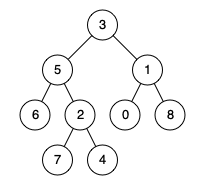
Input: root = [3,5,1,6,2,0,8,null,null,7,4], p = 5, q = 1
Output: 3
Explanation: The LCA of nodes 5 and 1 is 3.
Example 2:
Input: root = [3,5,1,6,2,0,8,null,null,7,4], p = 5, q = 4
Output: 5
Explanation: The LCA of nodes 5 and 4 is 5 since a node can be a descendant of itself according to the LCA definition.
Example 3:
Input: root = [1,2], p = 1, q = 2
Output: 1
Constraints:
[2, 10^5].-10^9 <= Node.val <= 10^9Node.val are unique.p != qp and q exist in the tree.Use a set to store nodes. Start from p and obtain all the nodes from p to the root node using the nodes’ parents. Then start from q and move towards the root. If a node is already in the set, then the node is a common ancestor of p and q. The first common ancestor that is in the set is the lowest common ancestor of p and q.
The idea is as follows: we will use 2 pointers (pointerA, pointerB) that go from nodeA and nodeB upwards respectively. Assume nodeA locates at a shallower level than nodeB, i.e. depth(nodeA) < depth(nodeB), pointerA will reach the top quicker than pointerB.
Suppose the difference in depth between nodeA and nodeB is diff.
By the time pointerA reaches the top, pointerB will be diff levels behind. Now if pointerA resets its path and continues upwards from nodeB instead of nodeA, it will need diff steps to reach the level of nodeA, by which time pointerB has already caught up and will be at the same level of pointerA (pointerB restarts from nodeA after reaching the top).
Now the only thing to do is to compare pointerA and pointerB on the way up. If pointerA and pointerB points to the same node, we’ve found the lowest common ancestor.
通俗点说,就是两个list,不管他们长短相差多少,把短的连到长的list,然后把长的list连到短的list, 总的长度就是一样了。那么当他们reach 到同样的node的时候,那个node就是 lca
 1 /*
 2 // Definition for a Node.
 3 class Node {
 4     public int val;
 5     public Node left;
 6     public Node right;
 7     public Node parent;
 8 };
 9 */
10
11 class Solution {
12     public Node lowestCommonAncestor(Node p, Node q) {
13         Set<Node> set = new HashSet<Node>();
14         Node temp = p;
15         while (temp != null) {
16             set.add(temp);
17             temp = temp.parent;
18         }
19         temp = q;
20         while (temp != null) {
21             if (set.contains(temp))
22                 break;
23             else
24                 temp = temp.parent;
25         }
26         return temp;
27     }
28 }
29
30 ############
31
32 /*
33 // Definition for a Node.
34 class Node {
35     public int val;
36     public Node left;
37     public Node right;
38     public Node parent;
39 };
40 */
41
42 class Solution {
43     public Node lowestCommonAncestor(Node p, Node q) {
44         Node a = p, b = q;
45         while (a != b) {
46             a = a.parent == null ? q : a.parent;
47             b = b.parent == null ? p : b.parent;
48         }
49         return a;
50     }
51 }
此内容由惯性聚合(RSS阅读器)自动聚合整理,仅供阅读参考。 原文来自 — 版权归原作者所有。