








Ahead of our upcoming Next.js Conf 2025, Next.js 16 is now available.
This release provides the latest improvements to Turbopack, caching, and the Next.js architecture. Since the previous beta release, we added several new features and improvements:
proxy.ts to clarify network boundary.For reminder, those features were available since the previous beta release:
updateTag() and refined revalidateTag()useEffectEvent(), <Activity/>next/image defaults, and moreUpgrade to Next.js 16:
For cases where the codemod can't fully migrate your code, please read the upgrade guide.
Cache Components are a new set of features designed to make caching in Next.js both more explicit, and more flexible. They center around the new "use cache" directive, which can be used to cache pages, components, and functions, and which leverages the compiler to automatically generate cache keys wherever it’s used.
Unlike the implicit caching found in previous versions of the App Router, caching with Cache Components is entirely opt-in. All dynamic code in any page, layout, or API route is executed at request time by default, giving Next.js an out-of-the-box experience that’s better aligned with what developers expect from a full-stack application framework.
Cache Components also complete the story of Partial Prerendering (PPR), which was first introduced in 2023. Prior to PPR, Next.js had to choose whether to render each URL statically or dynamically; there was no middle ground. PPR eliminated this dichotomy, and let developers opt portions of their static pages into dynamic rendering (via Suspense) without sacrificing the fast initial load of fully static pages.
You can enable Cache Components in your next.config.ts file:
We will be sharing more about Cache Components and how to use them at Next.js Conf 2025 on October 22nd, and we will be sharing more content in our blog and documentation in the coming weeks.
Note: as previously announced in the beta release, the previous experimental
experimental.pprflag and configuration options have been removed in favor of the Cache Components configuration.
Learn more in the documentation here.
Next.js 16 introduces Next.js DevTools MCP, a Model Context Protocol integration for AI-assisted debugging with contextual insight into your application.
The Next.js DevTools MCP provides AI agents with:
This enables AI agents to diagnose issues, explain behavior, and suggest fixes directly within your development workflow.
Learn more in the documentation here.
proxy.ts (formerly middleware.ts)proxy.ts replaces middleware.ts and makes the app’s network boundary explicit. proxy.ts runs on the Node.js runtime.
middleware.ts → proxy.ts and rename the exported function to proxy. Logic stays the same.Note: The
middleware.tsfile is still available for Edge runtime use cases, but it is deprecated and will be removed in a future version.
Learn more in the documentation here.
In Next.js 16 the development request logs are extended showing where time is spent.
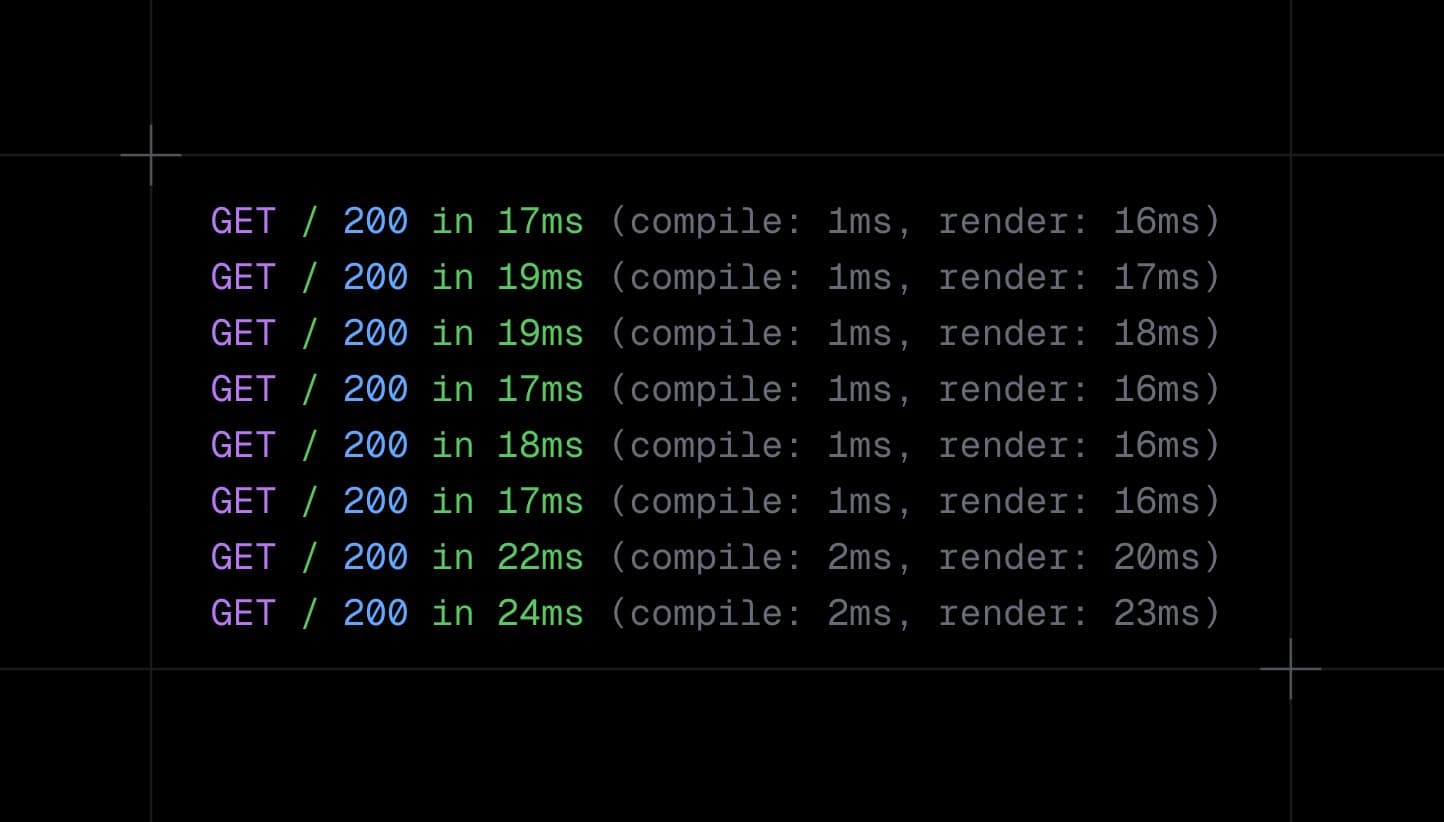
The build is also extended to show where time is spent. Each step in the build process is now shown with the time it took to complete.
The following features were previously announced in the beta release:
Turbopack has reached stability for both development and production builds, and is now the default bundler for all new Next.js projects. Since its beta release earlier this summer, adoption has scaled rapidly: more than 50% of development sessions and 20% of production builds on Next.js 15.3+ are already running on Turbopack.
With Turbopack, you can expect:
We're making Turbopack the default to bring these performance gains to every Next.js developer, no configuration required. For apps with custom webpack setups, you can continue using webpack by running:
Turbopack now supports filesystem caching in development, storing compiler artifacts on disk between runs for significantly faster compile times across restarts, especially in large projects.
Enable filesystem caching in your configuration:
All internal Vercel apps are already using this feature, and we’ve seen notable improvements in developer productivity across large repositories.
We’d love to hear your feedback as we iterate on filesystem caching. Please try it out and share your experience.
create-next-appcreate-next-app has been redesigned with a simplified setup flow, updated project structure, and improved defaults. The new template includes the App Router by default, TypeScript-first configuration, Tailwind CSS, and ESLint.
Following the Build Adapters RFC, we've worked with the community and deployment platforms to deliver the first alpha version of the Build Adapters API.
Build Adapters allow you to create custom adapters that hook into the build process, enabling deployment platforms and custom build integrations to modify Next.js configuration or process build output.
Share your feedback in the RFC discussion.
Built-in support for the React Compiler is now stable in Next.js 16 following the React Compiler's 1.0 release. The React Compiler automatically memoizes components, reducing unnecessary re-renders with zero manual code changes.
The reactCompiler configuration option has been promoted from experimental to stable. It is not enabled by default as we continue gathering build performance data across different application types. Expect compile times in development and during builds to be higher when enabling this option as the React Compiler relies on Babel.
Install the latest version of the React Compiler plugin:
Next.js 16 includes a complete overhaul of the routing and navigation system, making page transitions leaner and faster.
Layout deduplication: When prefetching multiple URLs with a shared layout, the layout is downloaded once instead of separately for each Link. For example, a page with 50 product links now downloads the shared layout once instead of 50 times, dramatically reducing the network transfer size.
Incremental prefetching: Next.js only prefetches parts not already in cache, rather than entire pages. The prefetch cache now:
Trade-off: You may see more individual prefetch requests, but with much lower total transfer sizes. We believe this is the right trade-off for nearly all applications. If the increased request count causes issues, please let us know. We're working on additional optimizations to inline data chunks more efficiently.
These changes require no code modifications and are designed to improve performance across all apps.
Next.js 16 introduces refined caching APIs for more explicit control over cache behavior.
revalidateTag() (updated)revalidateTag() now requires a cacheLife profile as the second argument to enable stale-while-revalidate (SWR) behavior:
The profile argument accepts built-in cacheLife profile names (like 'max', 'hours', 'days') or custom profiles defined in your next.config. You can also pass an inline { expire: number } object. We recommend using 'max' for most cases, as it enables background revalidation for long-lived content. When users request tagged content, they receive cached data immediately while Next.js revalidates in the background.
Use revalidateTag() when you want to invalidate only properly tagged cached entries with stale-while-revalidate behavior. This is ideal for static content that can tolerate eventual consistency.
Migration guidance: Add the second argument with a
cacheLifeprofile (we recommend'max') for SWR behavior, or useupdateTag()in Server Actions if you need read-your-writes semantics.
updateTag() (new)updateTag() is a new Server Actions-only API that provides read-your-writes semantics, expiring and immediately reading fresh data within the same request:
This ensures interactive features reflect changes immediately. Perfect for forms, user settings, and any workflow where users expect to see their updates instantly.
refresh() (new)refresh() is a new Server Actions-only API for refreshing uncached data only. It doesn't touch the cache at all:
This API is complementary to the client-side router.refresh(). Use it when you need to refresh uncached data displayed elsewhere on the page after performing an action. Your cached page shells and static content remain fast while dynamic data like notification counts, live metrics, or status indicators refresh.
The App Router in Next.js 16 uses the latest React Canary release, which includes the newly released React 19.2 features and other features being incrementally stabilized. Highlights include:
useEffectEvent: Extract non-reactive logic from Effects into reusable Effect Event functionsdisplay: none while maintaining state and cleaning up EffectsLearn more in the React 19.2 announcement.
| Change | Details |
|---|---|
| Node.js 20.9+ | Minimum version now 20.9.0 (LTS); Node.js 18 no longer supported |
| TypeScript 5+ | Minimum version now 5.1.0 |
| Browsers | Chrome 111+, Edge 111+, Firefox 111+, Safari 16.4+ |
These features were previously deprecated and are now removed:
| Removed | Replacement |
|---|---|
| AMP support | All AMP APIs and configs removed (useAmp, export const config = { amp: true }) |
next lint command | Use Biome or ESLint directly; next build no longer runs linting. A codemod is available: npx @next/codemod@canary next-lint-to-eslint-cli . |
devIndicators options | appIsrStatus, buildActivity, buildActivityPosition removed from config. The indicator remains. |
serverRuntimeConfig, publicRuntimeConfig | Use environment variables (.env files) |
experimental.turbopack location | Config moved to top-level turbopack (no longer in experimental) |
experimental.dynamicIO flag | Renamed to cacheComponents |
experimental.ppr flag | PPR flag removed; evolving into Cache Components programming model |
export const experimental_ppr | Route-level PPR export removed; evolving into Cache Components programming model |
Automatic scroll-behavior: smooth | Add data-scroll-behavior="smooth" to HTML document to opt back in |
unstable_rootParams() | We are working on an alternative API that we will ship in an upcoming minor |
Sync params, searchParams props access | Must use async: await params, await searchParams |
Sync cookies(), headers(), draftMode() access | Must use async: await cookies(), await headers(), await draftMode() |
Metadata image route params argument | Changed to async params; id from generateImageMetadata now Promise<string> |
next/image local src with query strings | Now requires images.localPatterns config to prevent enumeration attacks |
These features have new default behaviors in Next.js 16:
| Changed Behavior | Details |
|---|---|
| Default bundler | Turbopack is now the default bundler for all apps; opt out with next build --webpack |
images.minimumCacheTTL default | Changed from 60s to 4 hours (14400s); reduces revalidation cost for images without cache-control headers |
images.imageSizes default | Removed 16 from default sizes (used by only 4.2% of projects); reduces srcset size and API variations |
images.qualities default | Changed from [1..100] to [75]; quality prop is now coerced to closest value in images.qualities |
images.dangerouslyAllowLocalIP | New security restriction blocks local IP optimization by default; set to true for private networks only |
images.maximumRedirects default | Changed from unlimited to 3 redirects maximum; set to 0 to disable or increase for rare edge cases |
@next/eslint-plugin-next default | Now defaults to ESLint Flat Config format, aligning with ESLint v10 which will drop legacy config support |
| Prefetch cache behavior | Complete rewrite with layout deduplication and incremental prefetching |
revalidateTag() signature | Now requires cacheLife profile as second argument for stale-while-revalidate behavior |
| Babel configuration in Turbopack | Automatically enables Babel if a babel config is found (previously exited with hard error) |
| Terminal output | Redesigned with clearer formatting, better error messages, and improved performance metrics |
| Dev and build output directories | next dev and next build now use separate output directories, enabling concurrent execution |
| Lockfile behavior | Added lockfile mechanism to prevent multiple next dev or next build instances on the same project |
Parallel routes default.js | All parallel route slots now require explicit default.js files; builds fail without them. Create default.js that calls notFound() or returns null for previous behavior |
| Modern Sass API | Bumped sass-loader to v16, which supports modern Sass syntax and new features |
These features are deprecated in Next.js 16 and will be removed in a future version:
| Deprecated | Details |
|---|---|
middleware.ts filename | Rename to proxy.ts to clarify network boundary and routing focus |
next/legacy/image component | Use next/image instead for improved performance and features |
images.domains config | Use images.remotePatterns config instead for improved security restriction |
revalidateTag() single argument | Use revalidateTag(tag, profile) for SWR, or updateTag(tag) in Actions for read-your-writes |
next dev and next start commandsnext.config.ts: Run next dev, next build, and next start commands with --experimental-next-config-strip-types flag to enable native TypeScript for next.config.ts.We'll aim to share a more comprehensive migration guide ahead of the stable release in our documentation.
Share your feedback and help shape the future of Next.js:
Next.js is the result of the combined work of over 3,000 individual developers. This release was brought to you by:
Huge thanks to @mischnic, @timneutkens, @unstubbable, @wyattjoh, @Cy-Tek, @lukesandberg, @OoMNoO, @ztanner, @icyJoseph, @huozhi, @gnoff, @ijjk, @povilasv, @dwrth, @obendev, @aymericzip, @devjiwonchoi, @SyMind, @vercel-release-bot, @Shireee, @eps1lon, @dharun36, @kachkaev, @bgw, @yousefdawood7, @TheAlexLichter, @sokra, @ericx0099, @leerob, @Copilot, @fireairforce, @fufuShih, @anvibanga, @hayes, @Milancen123, @martinfrancois, @lubieowoce, @gaojude, @lachlanjc, @liketiger, @styfle, @aaronbrown-vercel, @Samii2383, @FelipeChicaiza, @kevva, @m1abdullahh, @F7b5, @Anshuman71, @RobertFent, @poteto, @chloe-yan, @sireesha-siri, @brian-lou, @joao4xz, @stefanprobst, @samselikoff, @acdlite, @gwkline, @bgub, @brock-statsig, and @karlhorky for helping!
此内容由惯性聚合(RSS阅读器)自动聚合整理,仅供阅读参考。 原文来自 — 版权归原作者所有。