






Next.js 15.2 includes updates for debugging errors, metadata, Turbopack, and more:
Upgrade today, or get started with:
We've added both visual and quality improvements to errors you may encounter while building your application. Let's walk through each area of improvements:
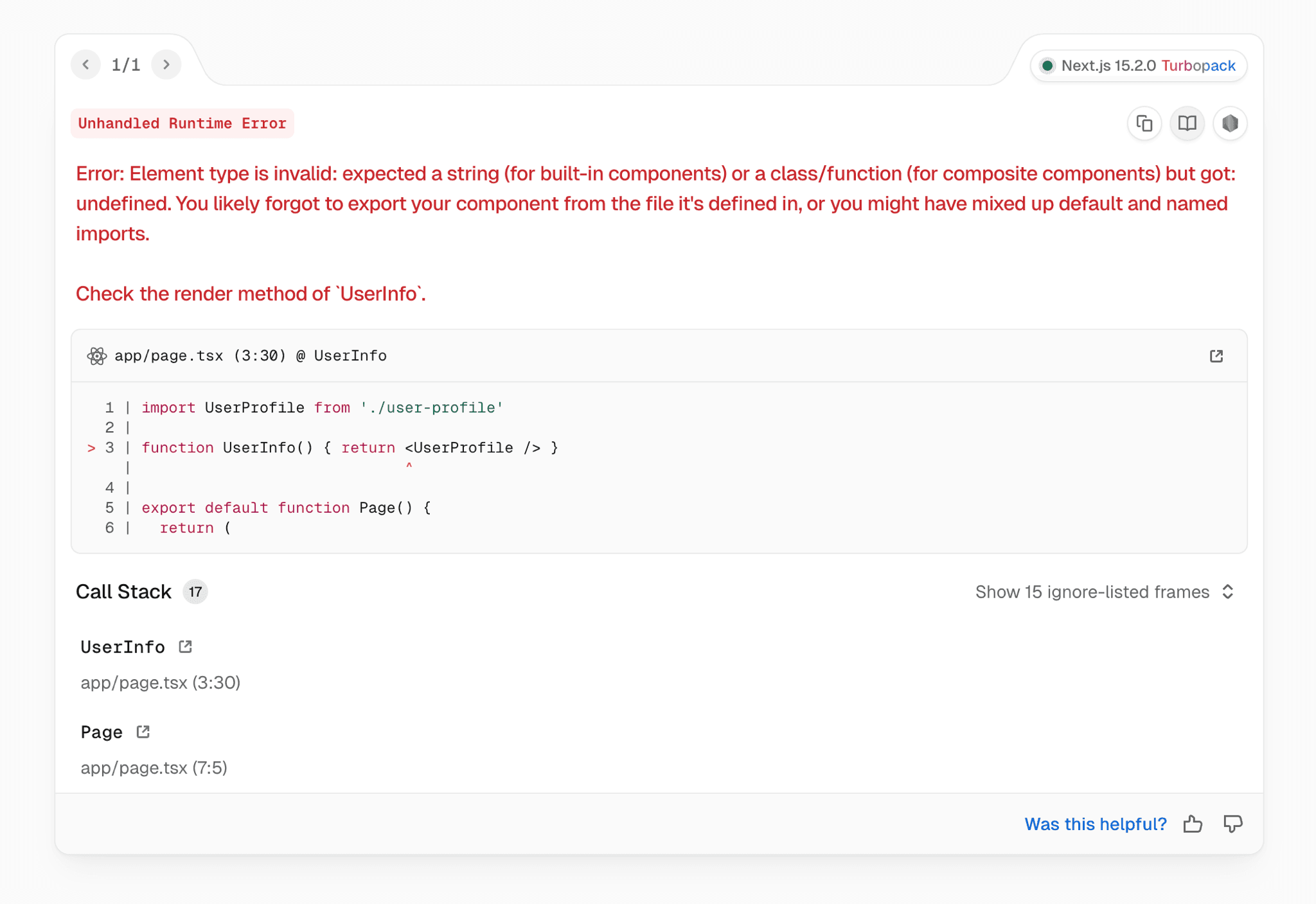
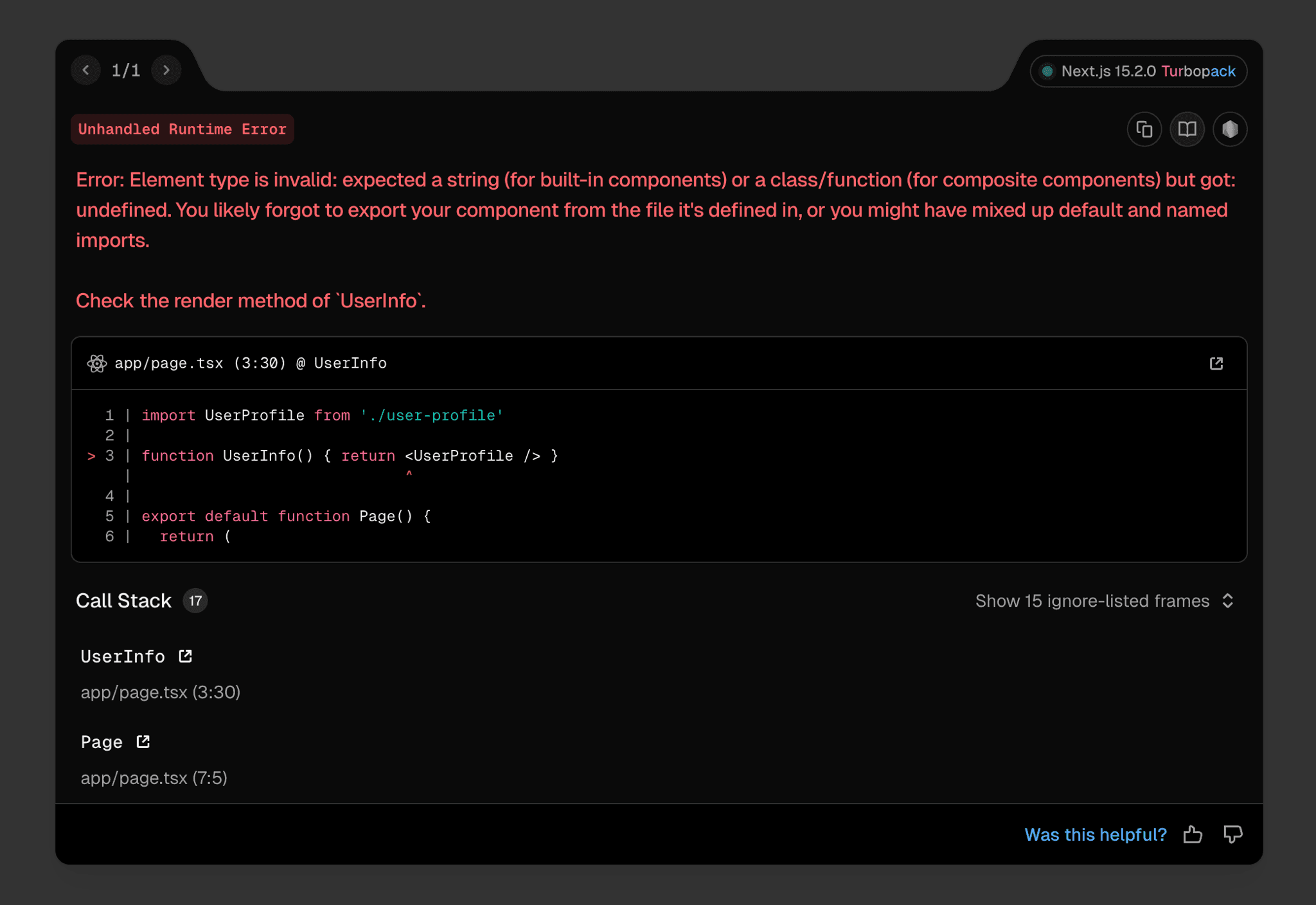
We've overhauled the UI and presentation of error messages in Next.js, making them easier to understand. The new design highlights the core details of the error—such as the message, the relevant code frame, and the call stack—while reducing noise from code in libraries or dependencies. This means you can quickly get to the root of what went wrong and start fixing it faster.
Leveraging the newly introduced owner stacks feature in React, we're now able to provide higher fidelity into where your errors are coming from. Next.js will now be able to surface the subcomponent responsible for throwing the error, skipping over intermediary elements that weren't responsible for creating the element that caused the error.
We're also making it easier to customize your indicator preferences without needing to add additional configuration.
We've added a feedback section at the bottom of error overlays that lets you rate how helpful the error message was. Your opinion helps us understand common pain points and improve error messages to make debugging easier.
We've consolidated development information into a new, streamlined indicator that shows details like rendering mode and build status.
During compilation, you'll notice a dimmed, animated Next.js logo when navigating between routes. The logo brightens once compilation is complete and React begins rendering, providing a visual cue of your application's state.
Opening the dev indicator now displays:
Future updates will expand this menu to include:
This unified approach puts all crucial development information in one accessible location. We'll continue to refine and expand this feature in future releases based on your feedback.
It can often be necessary to fetch dynamic data, or perform some async operation, in generateMetadata. In prior versions of Next.js, this metadata needed to finish generating before the initial UI would be sent so it could be included in the document <head>.
This meant that for many pages where a fast initial UI was available, the initial paint was still delayed by data requirements that did not affect what the user would see visually. We've improved this in 15.2 by allowing the initial UI to be sent to the browser even before generateMetadata has completed.
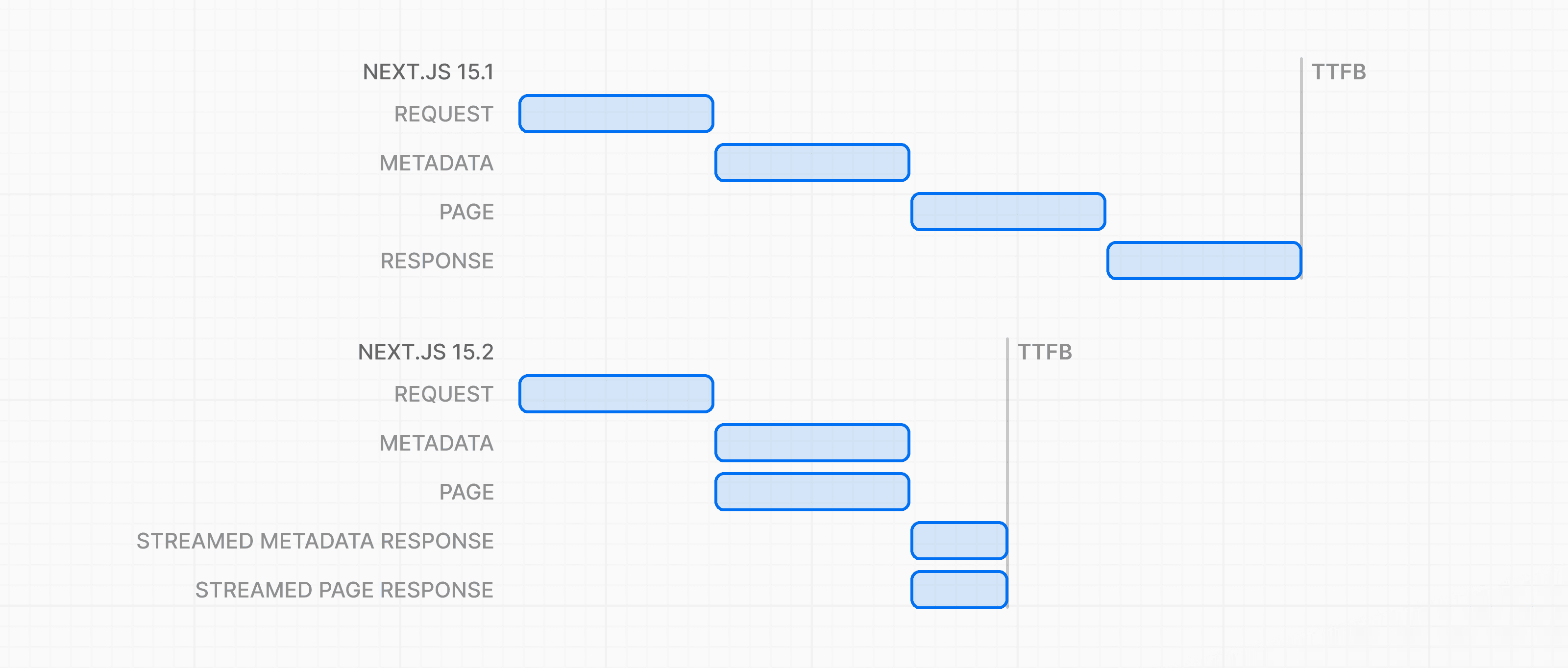
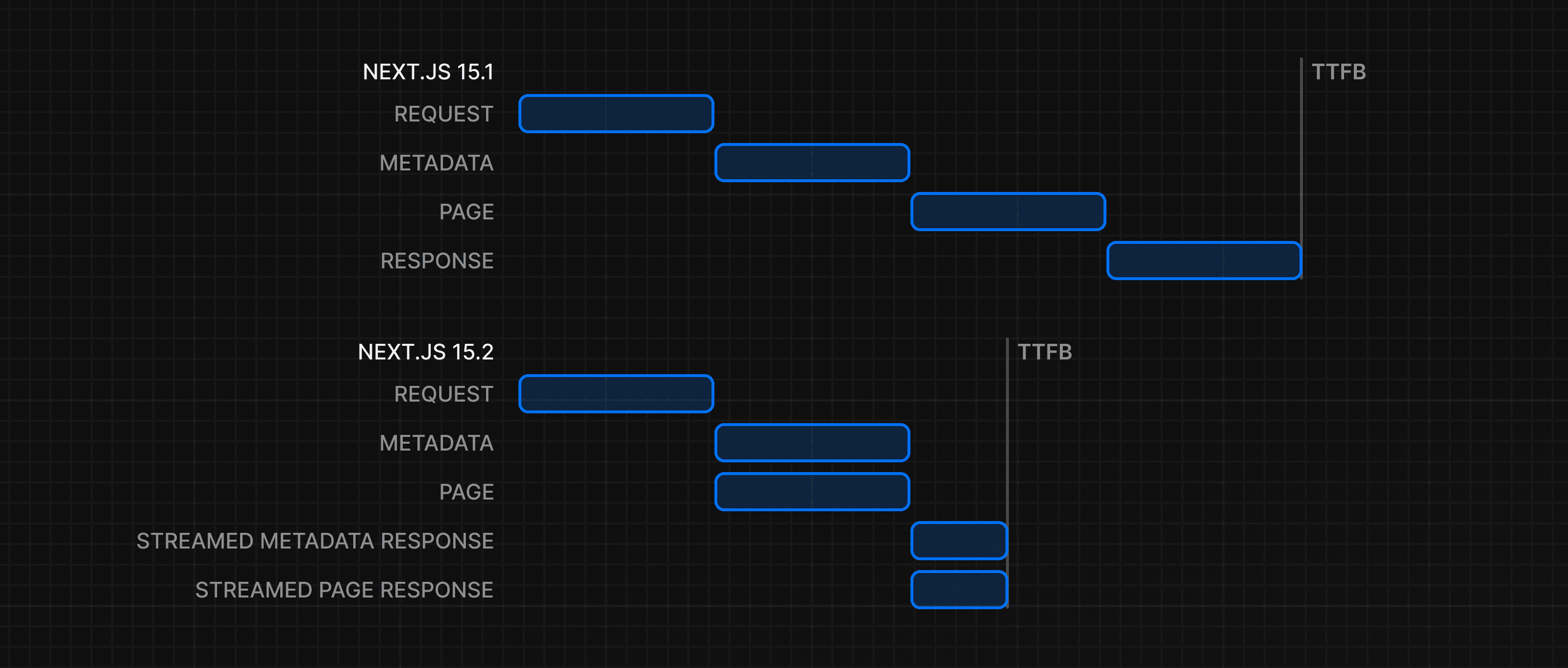
However, to maintain compatibility with bots and crawlers that expect metadata to be available in the <head> of the document, we continue to delay sending HTML to certain bot user agents. If you need more fine-grained control over which bots receive this treatment, you can customize the regex used to serve them via the htmlLimitedBots option in next.config.js.
Learn more about streaming metadata.
Turbopack was marked stable with Next.js 15.
We've been working on improving Turbopack's performance, particularly in scenarios without persistent caching. As part of this release, we've introduced the following enhancements:
With these improvements, Turbopack should now be faster than Webpack in virtually all cases. If you encounter a scenario where this isn't true for your application, please reach out—we want to investigate these.
We've also made progress on persistent caching and production builds. Although these features aren't ready for an experimental release yet, we've started testing them on real-world projects. We'll share more detailed metrics once they're available for broader use.
We've added a feature flag to enable the new experimental View Transitions API in React. This new API allows you to animate between different views and components in your application.
To enable this feature, add the following to your next.config.js:
Note: This feature is highly experimental and may change in future releases.
For more information on how to use this feature, please refer to the original View Transition pull request in the React repository. This work builds on the native browser implementation of View Transitions.
We will be publishing more documentation and examples as stability progresses.
We've been working on a new experimental flag to allow using the Node.js runtime for the Next.js Middleware.
To enable this feature, add the following to your next.config.js:
You can then specify the Node.js runtime in your Middleware config export:
Note: This feature is not yet recommended for production use. Therefore, Next.js will throw an error unless you are using the
next@canaryrelease instead of the stable release.
We are planning to take this opportunity to improve and reshape the Middleware API. If you have any suggestions or requests, please let us know. Node.js Middleware was a top community request and we are excited to have this addressed.
"use cache" as a standalone feature. Stay tuned for more details in the coming releases. Learn more about "use cache".--api flag to create a headless API-only with create-next-app (PR)images.qualities with next/image (PR)no-html-link-for-pages (PR)"use action" directive is incorrectly used (PR)global-error alongside dev overlay during development (PR)metadata and <Link> components (PR)next/image requests (PR)reportError (PR)Next.js is the result of the combined work of over 3,000 individual developers. This release was brought to you by:
Huge thanks to @mischnic, @Marukome0743, @JamBalaya56562, @creationix, @noreiller, @styfle, @abdonrd, @ollyw, @aymericzip, @davidhu2000, @attilarepka, @devpla, @dydals3440, @huozhi, @wbinnssmith, @suu3, @PapatMayuri, @Sahil4883, @abyii, @molebox, @sokra, @maciej-ka, @abvthecity, @damiensedgwick, @alitas, @RiskyMH, @ytreister, @sommeeeer, @n1ckoates, @yongholeeme, @spidersouris, @gurkerl83, @cassiossantos, @Netail, @tknickman, @eur00t, @cseas, @nnnnoel, @Manoj-M-S, @lfades, @matmannion, @mikeboensel, @nphmuller, @apostolos, @k15a, @pavelee, @locothedev, @vexcat, @Zach-Jaensch, @decepulis, @gadcam, @lukahartwig, @jsanford8, @RobinMalfait, @raunofreiberg, @mohsen1, @skushagra, @amannn, @HQidea, @jrandolf, @smit-err, @littledivy, @k35o, @martinsione, @CvX, @msereniti, @Timer, @Iftee97, @chibicode, @RobPruzan, @PlagueFPS, @bjunix, @maximevtush, @michaelven, @sedlukha, @johannpinson, @AxelUser, @Nayeem-XTREME, @IcaroG, @blurrah, @lachlanjc, @ashi009, @conico974, @raphaelcosta, @dulmandakh, @khuezy, @Knoa0405, @wangsijie, @stefanprobst, @wentsul, @loopy-lim, @bratvanov, @hedgeday, and @cassian-goode for helping!
此内容由惯性聚合(RSS阅读器)自动聚合整理,仅供阅读参考。 原文来自 — 版权归原作者所有。