











Next.js 16.2 includes performance improvements, better debugging, improvements for Agents, and over 200 Turbopack fixes and improvements.
next dev startup--inspect for next start: Attach the Node.js debugger to your production serverWe also published dedicated deep-dive posts for two major areas of this release:
postcss.config.ts, tree shaking improvements, Server Fast Refresh, and 200+ bug fixesAGENTS.md in create-next-app, browser log forwarding, and next-browser (experimental)Upgrade today, or get started with:
We've significantly improved the time it takes before localhost:3000 is ready during next dev. On the same machine and project, startup is ~87% faster compared to Next.js 16.1 on the default application.
We contributed a change to React that makes Server Components payload deserialization up to 350% faster. The previous implementation used a JSON.parse reviver callback, which crosses the C++/JavaScript boundary in V8 for every key-value pair in the parsed JSON. Even a trivial no-op reviver makes JSON.parse roughly 4x slower than without one.
The new approach uses a two-step process: plain JSON.parse() followed by a recursive walk in pure JavaScript. This eliminates the boundary-crossing overhead and adds optimizations like short-circuiting plain strings that don't need transformation.
In real-world Next.js applications, this translates to 25% to 60% faster rendering to HTML, depending on the RSC payload size.
The default error page shown in production has been redesigned. When your application encounters an error and you haven't defined a custom global-error.tsx or error.tsx, Next.js renders a built-in fallback page. This fallback has been updated with a cleaner, more modern design.
Next.js now logs Server Function execution in the terminal during development. Each log shows the function name, its arguments, execution time, and the file it's defined in.
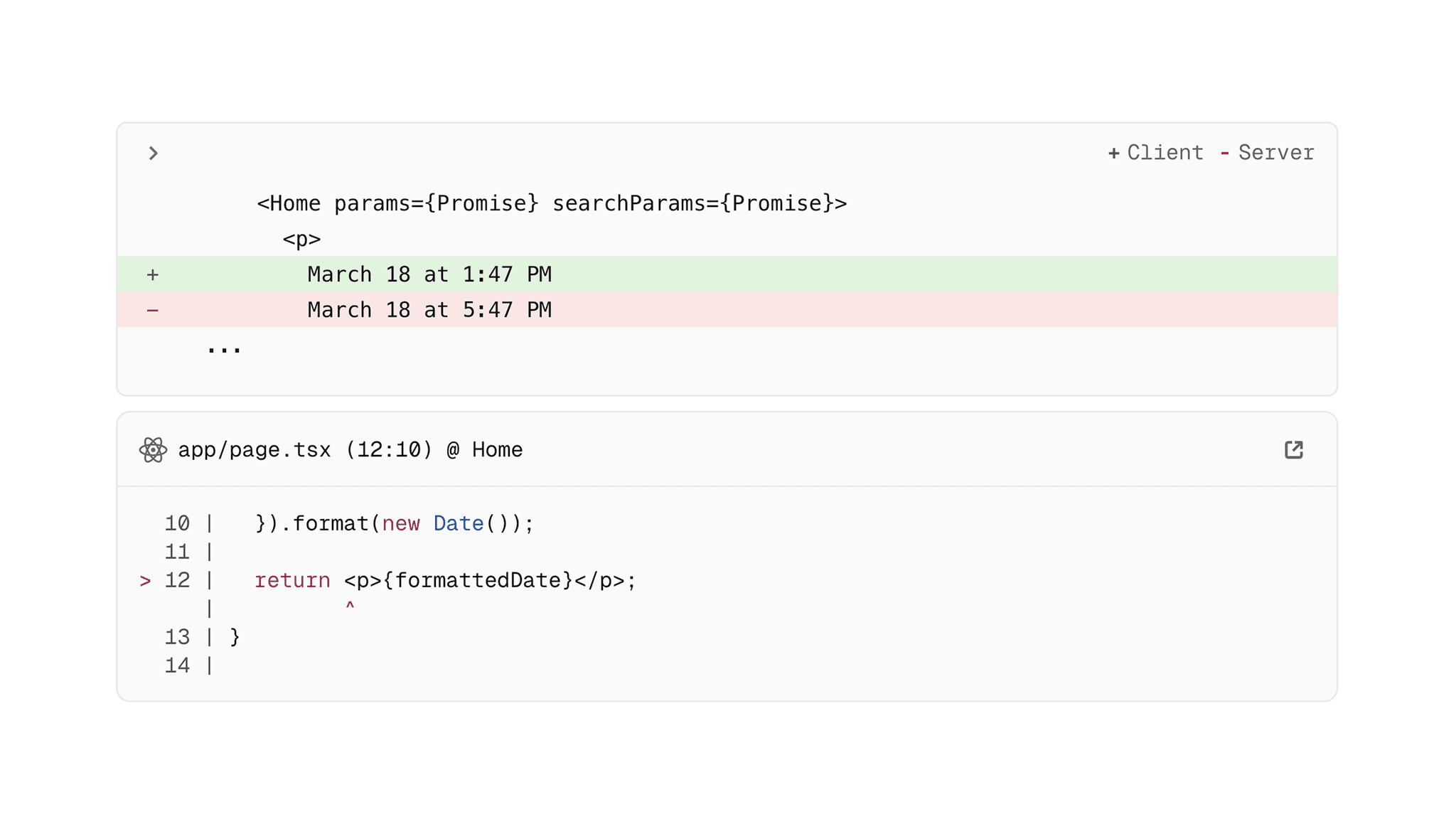
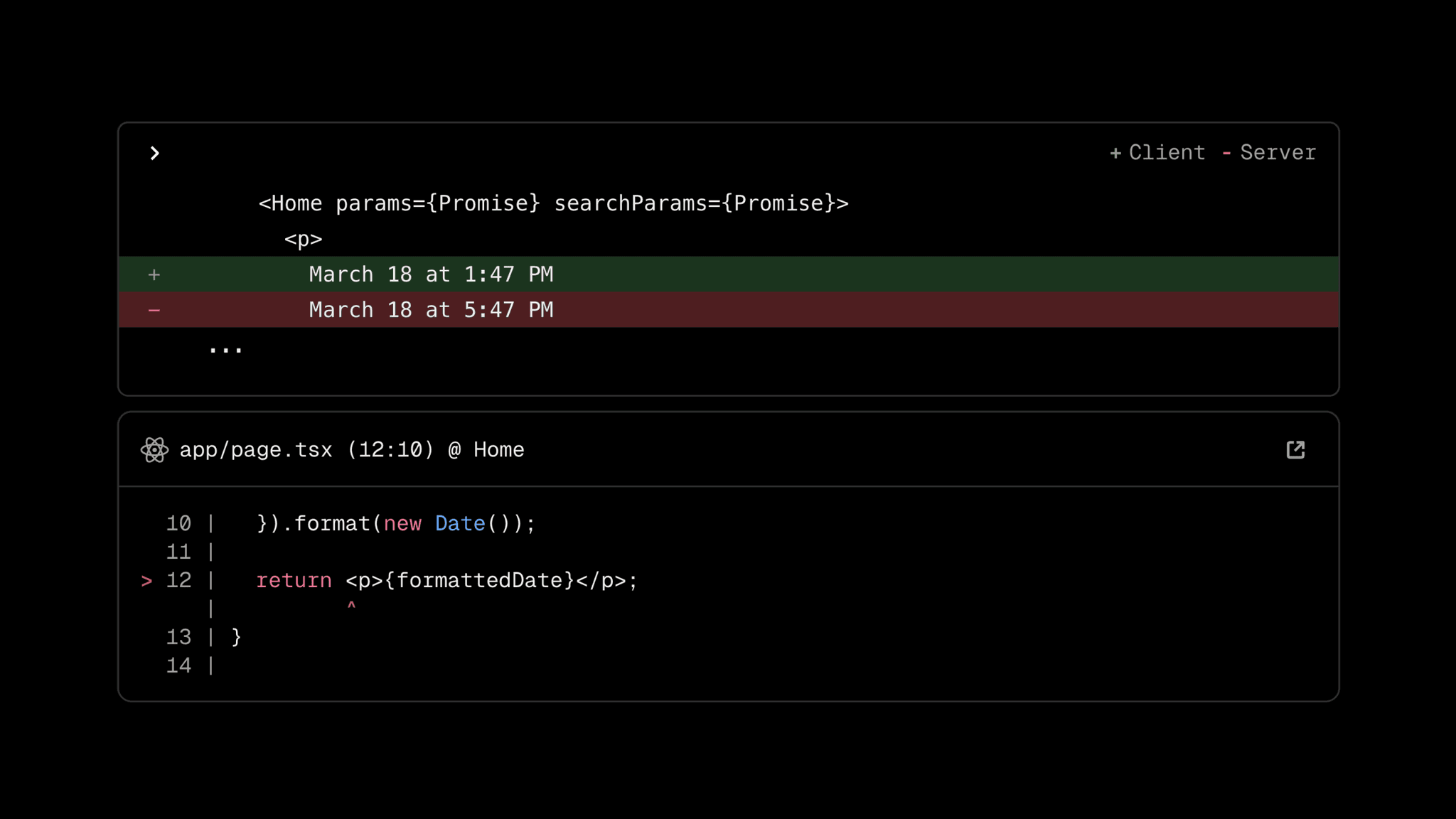
When a hydration mismatch occurs, the error overlay now clearly labels which content came from the server and which from the client. The diff uses a + Client / - Server legend, making it immediately clear what diverged.
--inspect for next startNext.js 16.1 introduced next dev --inspect for attaching the Node.js debugger during development. In 16.2, this extends to next start, allowing you to attach a Node.js debugger to your production server.
This is useful for debugging issues or profiling CPU and memory usage.
For more information on how to use the Node.js debugger, see the Chrome documentation.
transitionTypes Prop for next/linkThe <Link> component now accepts a transitionTypes prop — an array of strings that specifies the types of View Transitions to apply when navigating. Each type is passed to React.addTransitionType during the navigation Transition, allowing you to trigger different animations based on the navigation direction or context.
This is only supported in the App Router, since the Pages Router does not use React Transitions for navigation. transitionTypes on Pages Router links is silently ignored, so shared link components work across both routers.
To learn more about view transitions, see the documentation.
ImageResponseImageResponse has been updated with significant improvements:
ImageResponse for basic images, up to 20x faster for complex imagestext-indent, text-decoration-skip-ink, box-sizing, display: contents, position: static, and percentage values for gapLearn more about ImageResponse.
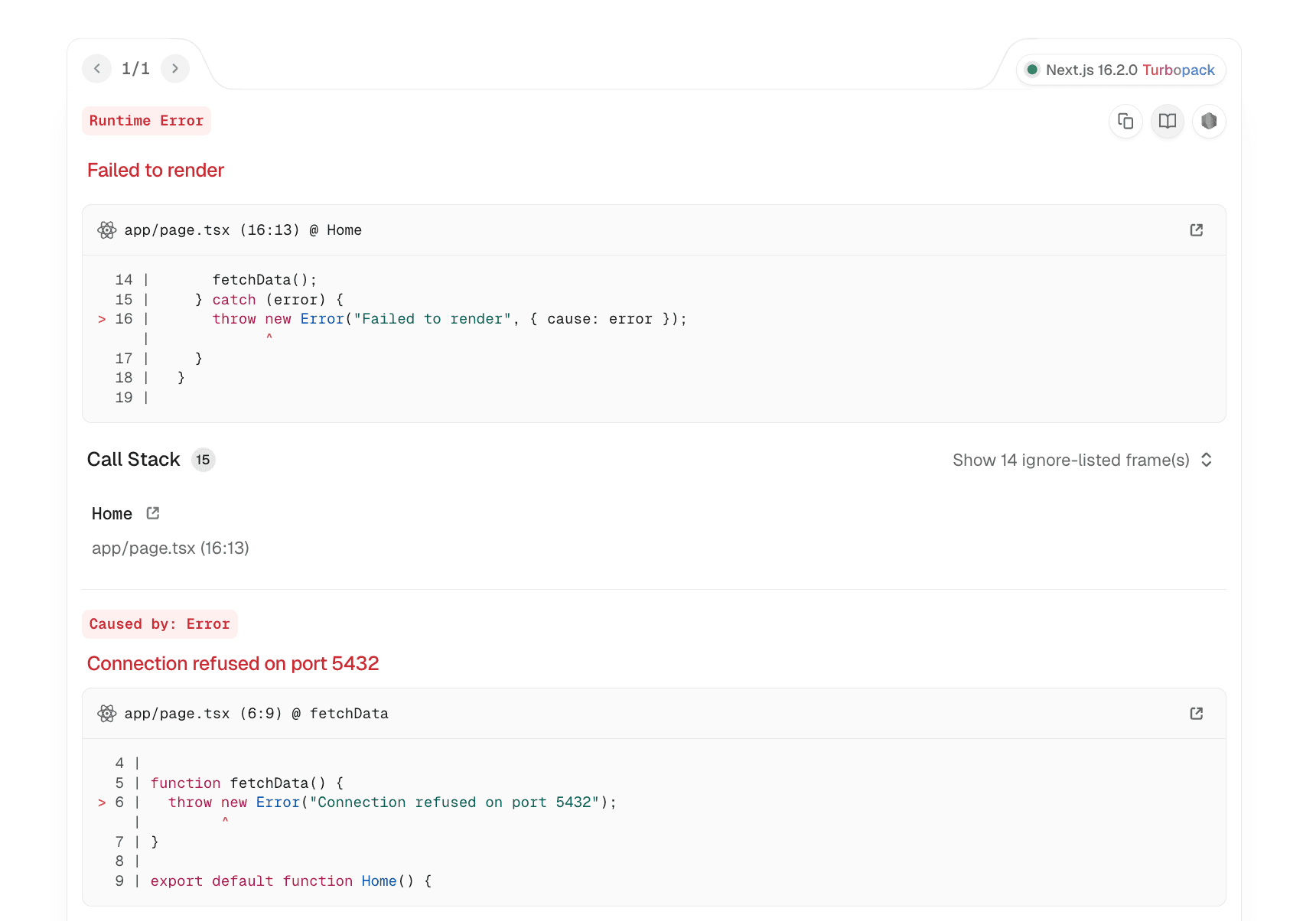
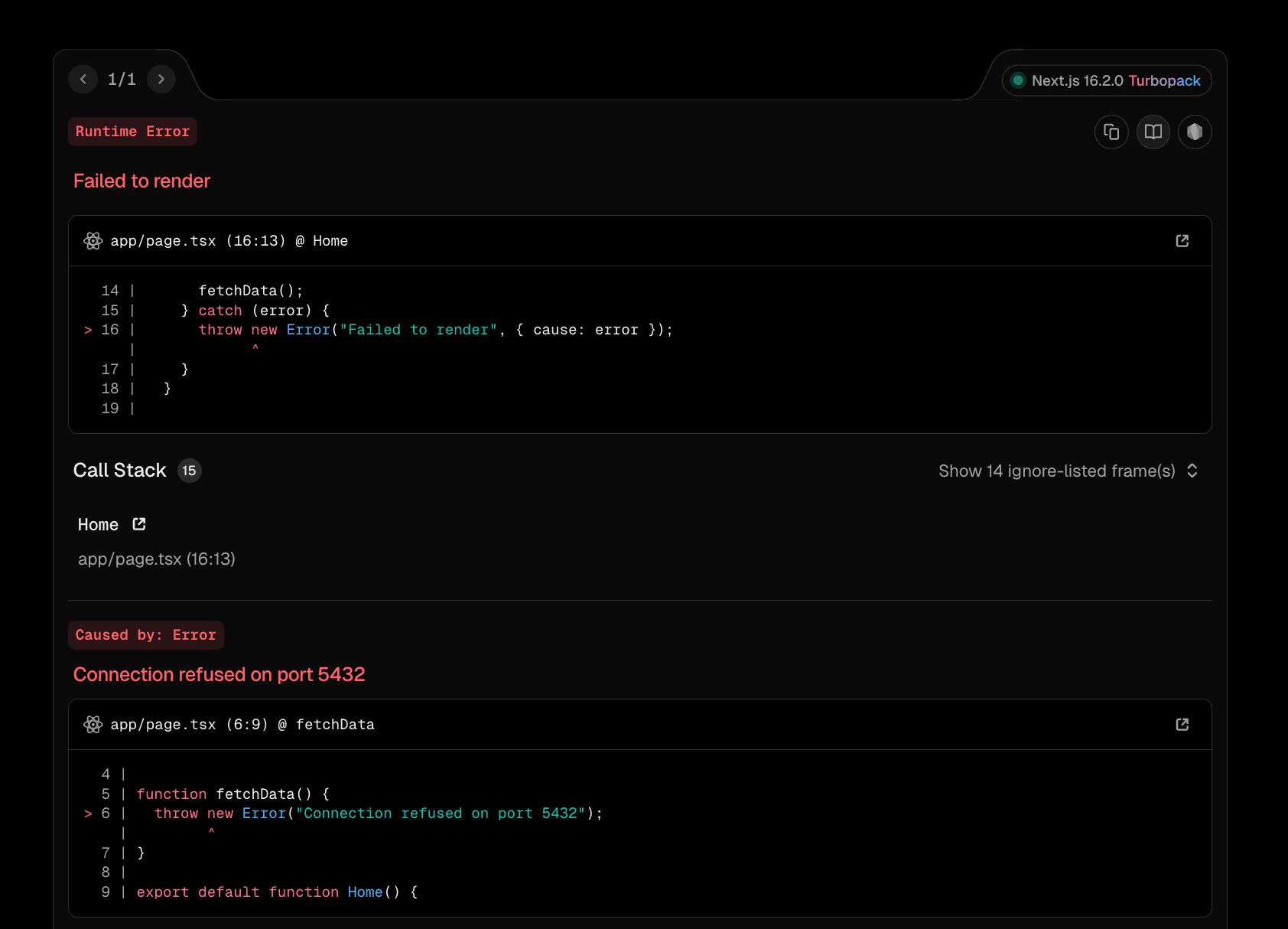
The error overlay now displays Error.cause chains, making it easier to debug errors that wrap other errors. Causes are shown in a flat list below the top-level error, up to 5 levels deep.
Adapters are now stable. This is a new API that allows platforms to customize the build process.
This is useful for deployment platforms or custom build integrations that need to modify the Next.js configuration or process the build output.
We will share a more detailed overview of Adapters next week.
Multiple icon files with the same base name but different extensions are now handled automatically in your app directory (e.g., icon.png and icon.svg). This is useful for browser fallback support. Modern browsers can use SVG icons while older browsers fall back to PNG. Both formats are rendered as separate <link> tags.
unstable_catchError()Extending the error recovery experience with the error.js file convention, unstable_catchError() provides more granular control of the error boundaries on the component level. By creating a custom error boundary using unstable_catchError(), you can place it anywhere in your component tree.
Compared to a custom React error boundary, unstable_catchError() is designed to work with Next.js out of the box:
unstable_retry() re-renders the page from the server in transition.redirect() and notFound() work by throwing special errors under the hood. unstable_catchError() handles these seamlessly, so they're not accidentally caught by your error boundary.The error boundary created by unstable_catchError() receives the props passed from the call site and the ErrorInfo value as the second argument, which is the same shape as the props passed to the error.js file convention.
Just like error.js, unstable_catchError() can only be called from Client Components.
unstable_retry() in error.tsxA new unstable_retry() prop is now available in error.tsx components. Previously, the reset() prop only cleared the error state and re-rendered the children, which works for temporary rendering errors but doesn't help when the error originates from data fetching or the RSC phase.
unstable_retry() calls router.refresh() and reset() within a startTransition(), providing built-in retry logic that re-fetches data and re-renders the segment. This is expected to be preferred over reset() for most error recovery scenarios.
experimental.prefetchInliningNext.js 16 introduced per-segment prefetching, where the client issues individual requests for each segment in the route tree. This improves cache efficiency as shared layouts between sibling routes are fetched once and reused, but increases request volume.
The new experimental.prefetchInlining option bundles all segment data for a route into a single response, reducing the number of prefetch requests to one per link. The trade-off is that shared layout data is duplicated across inlined responses rather than being cached and reused.
This is a stepping stone toward a size-based heuristic where small segments are inlined automatically and larger segments remain separate.
experimental.cachedNavigationsThis flag independently controls the Cached Navigations behavior, which caches static and dynamic Server Components data from navigations and the initial HTML loads so that repeat visits can be served instantly. Requires cacheComponents to be enabled.
experimental.appNewScrollHandlerA reworked scroll and focus management system for App Router using React Fragment refs. The new handler improves how focus is managed after navigations. Instead of focusing the first focusable descendant deep within a segment (which could skip past content), it now blurs the active element, matching how browser navigations work.
Share your feedback and help shape the future of Next.js:
Next.js is the result of the combined work of over 3,770 individual developers. This release was brought to you by:
Huge thanks to @acdlite, @unstubbable, @mischnic, @sokra, @ztanner, @mmastrac, @bgw, @lukesandberg, @wyattjoh, @huozhi, @eps1lon, @jwueller, @brookemosby, @delbaoliveira, @icyJoseph, @gaojude, @hanzala-sohrab, @dango0812, @ijjk, @msmx-mnakagawa, @Juneezee, @davidgolden, @LucianBuzzo, @devjiwonchoi, @alexcarpenter, @jaffarkeikei, @BradErz, @mintydev789, @naaa760, @Suhaib3100, @pavan-sh, @amannn, @fireairforce, @JamBalaya56562, @wheresrhys, @ericrav, @lubieowoce, @Thomas465xd, @bgub, @wbinnssmith, @Netail, @robert-j-webb, @bencmbrook, @shadcn, @sigmachirality, @abhishekmardiya, @vvscode, @feedthejim, @freek-boon-greenberry, @andrewimm, @alubbe, @FurryR, @01-binary, @andrewdamelio, @swarnava, @gnoff, @kristiyan-velkov, @styfle, @haydenbleasel, @rishishanbhag, @tdarthur, @lavanitha, and @karlhorky for helping!
此内容由惯性聚合(RSS阅读器)自动聚合整理,仅供阅读参考。 原文来自 — 版权归原作者所有。