



惯性聚合 高效追踪和阅读你感兴趣的博客、新闻、科技资讯
阅读原文 在惯性聚合中打开

推荐订阅源

Cyberwarzone
Cyberwarzone
Vercel News
Vercel News
freeCodeCamp Programming Tutorials: Python, JavaScript, Git & More
奇客Solidot–传递最新科技情报
奇客Solidot–传递最新科技情报
aimingoo的专栏
aimingoo的专栏
B
Blog RSS Feed
A
About on SuperTechFans
T
The Blog of Author Tim Ferriss
爱范儿
爱范儿
腾讯CDC
S
SegmentFault 最新的问题
Exploit-DB.com RSS Feed
The Hacker News
The Hacker News
J
Java Code Geeks
大猫的无限游戏
大猫的无限游戏
B
Blog
IT之家
IT之家
Spread Privacy
Spread Privacy
K
KPMG report finds enterprise disconnect between AI and its ROI | CIO
C
Cisco Blogs
Recent Announcements
H
Hacker News: Front Page
AI
AI
I
InfoQ
H
Heimdal Security Blog
T
Threatpost
Cisco Talos Blog
Cisco Talos Blog
Threat Intelligence Blog | Flashpoint
I
Intezer
W
WeLiveSecurity
SecWiki News
SecWiki News
MongoDB | Blog
MongoDB | Blog
宝玉的分享
宝玉的分享
博客园 - 【当耐特】
云风的 BLOG
云风的 BLOG
T
Threat Research - Cisco Blogs
V2EX - 技术
V2EX - 技术
N
News and Events Feed by Topic
cs.CV updates on arXiv.org
O
OpenAI News
阮一峰的网络日志
阮一峰的网络日志
T
Troy Hunt's Blog
www.infosecurity-magazine.com
博客园 - 司徒正美
Apple Machine Learning Research
雷峰网
雷峰网
T
Tor Project blog
有赞技术团队
有赞技术团队
Schneier on Security
Last Week in AI
Last Week in AI

Microsoft Azure Blog

Azure Databricks delivers proven business value | Microsoft Azure Blog Frontier models and production agents: Advancing Microsoft Foundry for the agentic era | Microsoft Azure Blog Built to bounce back: How Azure resiliency evolved | Microsoft Azure Blog External key management for Azure Managed HSM Meet Brain: The AI system behind Azure reliability | Microsoft Azure Blog Proving application resilience on Azure with Chaos Studio | Microsoft Azure Blog How to design, build, and optimize cloud infrastructure for long-term efficiency Claude in Microsoft Foundry is now generally available | Microsoft Azure Blog The 2026 Agent Confidence Index: Where 300 builders see real momentum | The Microsoft Cloud Blog Accelerate modern Linux workloads with Azure Files | Microsoft Azure Blog Optimizing PostgreSQL on Azure directly in Visual Studio Code From insight to action: The next phase of agentic cloud operations | Microsoft Azure Blog Modernize your data with Azure Storage: Plan and migrate with confidence | Microsoft Azure Blog 3 things leaders need to know from Microsoft Build 2026 | Microsoft Azure Blog Claude Fable 5 available today in Microsoft Foundry: Powering the next era of autonomous agents AI alone won’t change your business. The system running it will. Announcing Microsoft Discovery general availability and Microsoft Discovery app preview A Developer’s Guide to Managing Models, Cost and Quality in Microsoft Foundry Foundry IQ: Build smarter agents faster with unified knowledge and serverless retrieval Microsoft Build 2026: Building agentic apps with Microsoft Fabric and Microsoft Databases New Azure Cobalt 200 VMs deliver 50% performance improvement, fully optimized for modern agentic AI workloads Claude Opus 4.8 is now available in Microsoft Foundry Azure NetApp Files for EDA workloads: From revolution to breakthrough at scale Azure IaaS: Deploy high-performance workloads with a system-level approach Azure Files Entra-Only identities: Advancing cloud-native identity and security From commit to cloud: Powering what’s next for PostgreSQL Advancing enterprise AI: New SAP on Azure announcements from SAP Sapphire 2026 Red Hat Summit 2026: Platform modernization and AI on Microsoft Azure Red Hat OpenShift Build AI apps with Azure Cosmos DB: Key trends from Cosmos Conf 2026 Scaling cloud and AI: Microsoft Azure’s commitment to Europe’s digital future Azure IaaS: Defense in depth built on secure-by-design principles Enforcing trust and transparency: Open-sourcing the Azure Integrated HSM Microsoft named a Leader in the IDC MarketScape: Worldwide API Management 2026 Vendor Assessment OpenAI’s GPT-5.5 in Microsoft Foundry: Frontier intelligence on an enterprise ready platform Microsoft Discovery: Advancing agentic R&D at scale Introducing Azure Accelerate for Databases: Modernize your data for AI with experts and investments Cloud Cost Optimization: Principles that still matter Optimize object storage costs automatically with smart tier—now generally available Microsoft named a Leader in The Forrester Wave™ for Sovereign Cloud Platforms How Drasi used GitHub Copilot to find documentation bugs Cloud Cost Optimization: How to maximize ROI from AI, manage costs, and unlock real business value Azure IaaS: Keep critical applications running with built-in resiliency at scale Building sovereign AI at the edge: Microsoft and Armada collaborate to deliver Azure Local on Galleon modular datacenters Navigating digital sovereignty at the frontier of transformation Microsoft named a Leader in 2026 Gartner® Magic Quadrant™ for Integration Platform as a Service AI for nuclear energy: Powering an intelligent, resilient future | The Microsoft Cloud Blog What’s new with Microsoft in open-source and Kubernetes at KubeCon + CloudNativeCon Europe 2026 Advancing agentic AI with Microsoft databases across a unified data estate FabCon and SQLCon 2026: Unifying databases and Fabric on a single data platform Microsoft at NVIDIA GTC: New solutions for Microsoft Foundry, Azure AI infrastructure and Physical AI From legacy to leadership: How PostgreSQL on Azure powers enterprise agility and innovation
Powering multi-cluster workloads with seamless cross‑cluster networking for Azure Kubernetes Fleet Manager
Deepak Bansal, Brendan Burns · 2026-05-23 · via Microsoft Azure Blog

As organizations modernize their application portfolios, we are witnessing a fundamental shift in how cloud-native infrastructure is architected. No longer is the question “How do we scale a cluster?” but rather “How do we scale across clusters, regions, and clouds while maintaining operational simplicity?”

Today, we are thrilled to announce the public preview of cross-cluster networking for Azure Kubernetes Fleet Manager. This capability represents the next evolution in multi-cluster management by introducing transparent E-W multi-cluster networking powered by Advanced Container Networking Services.

The challenge of multi-cluster networking

Whether driven by regulatory requirements, regional disaster recovery, or the need to isolate blast domains, organizations of every size often run multiple Azure Kubernetes Service (AKS) clusters. However, managing these clusters has historically introduced a “networking tax.” Traditional approaches rely on complex VPNs, gateways, and manual service discovery, adding latency and operational complexity.

Even when operating just a few clusters and especially when operating large scale fleets of clusters, teams need consistent, reliable cross‑cluster connectivity to support scenarios like failover, shared services architectures, and seamlessly shifting workloads across regions for capacity or latency. At the same time, platform teams want to abstract infrastructure details from developers, enabling seamless cluster-level changes without disrupting applications.

Our vision: Multi-cluster management with seamless networking

In response to similar challenges, we built Azure Kubernetes Fleet Manager. Fleet Manager is designed to simplify multi-cluster Kubernetes for everyone. While Fleet Manager has already simplified workload propagation (deploying to many clusters) and update orchestration (safe, staged upgrades), the network remained a challenge.

With the introduction of Cilium-based cross-cluster networking in Azure Kubernetes Fleet Manager, we are delivering a managed, high-performance network that can span your entire fleet.

This capability extends the Kubernetes networking model across clusters, enabling services and workloads to communicate across cluster boundaries as if they were local, while preserving cluster-level isolation and governance.

Built on an open-source foundation, this capability uses Cilium for dataplane and Kubefleet for fleet-level orchestration, both active Cloud Native Computing Foundation (CNCF) projects. This ensures transparency, portability, and alignment with the broader Kubernetes ecosystem, while benefiting from continuous innovation from the open-source community.

The following diagram shows how clusters in a fleet are connected through a unified, managed network, enabling seamless communication, service discovery, and policy enforcement.
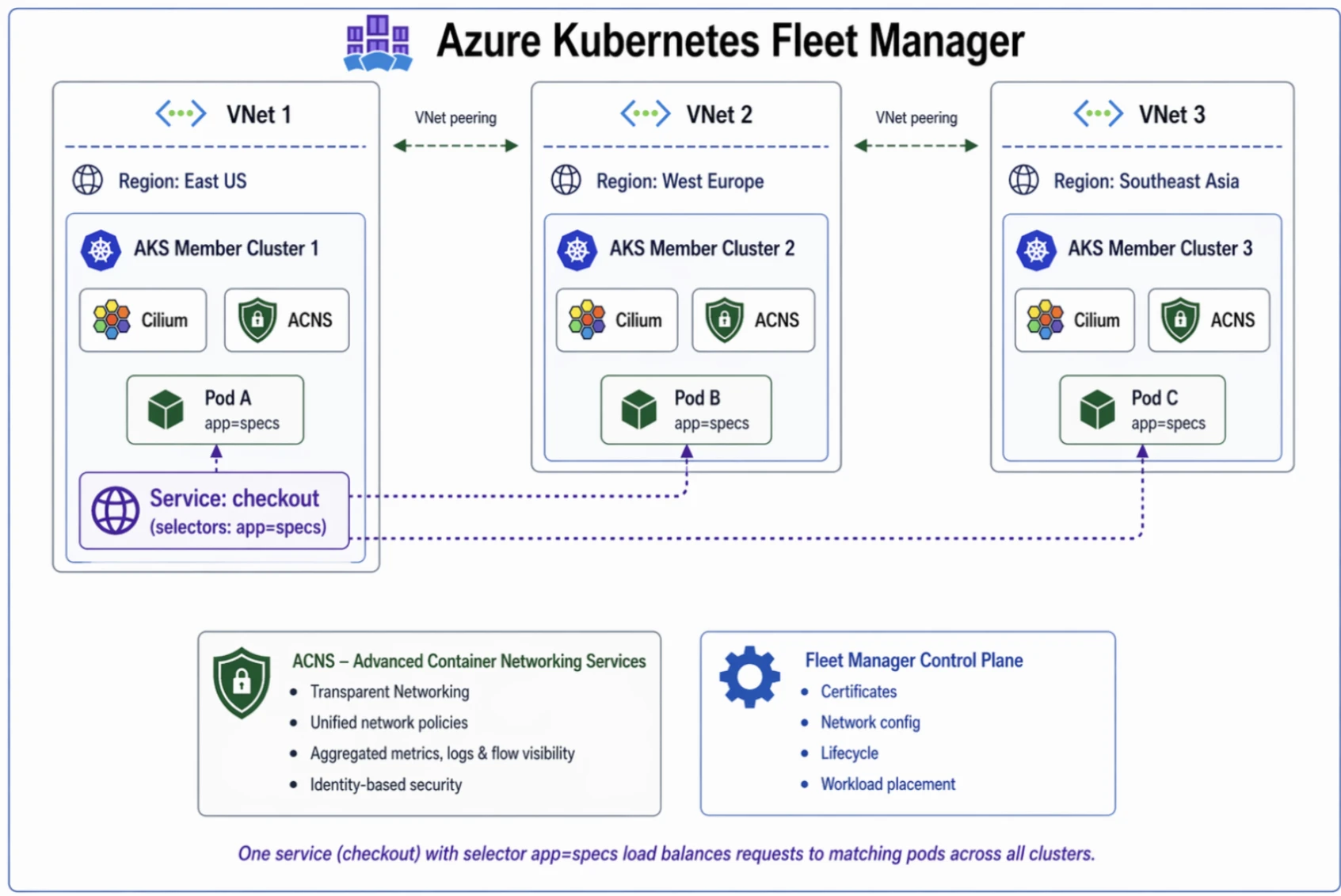
Azure Kubernetes Fleet Manager flowchart.

Key capabilities include:

  • Seamless east-west connectivity: Using eBPF-based routing with power of Azure CNI powered by Cilium and Advanced Container Networking Services, pods can communicate across clusters with native performance, no proxies or gateways required.
  • Global service discovery: With a simple annotation (service.cilium.io/global=true), a standard Kubernetes Service becomes “global.” Cross-cluster networking automatically discovers endpoints across joined member clusters, providing transparent load balancing and failover.
  • Multi‑cluster observability: Gain a unified view of network health across clusters with aggregated metrics, logs, and flow visibility. Advanced Container Networking Services integrates Cilium telemetry to provide consistent insights, faster troubleshooting, and end‑to‑end visibility across the fleet.
  • Unified security and governance: Security policies are no longer confined by cluster boundaries. Through Advanced Container Networking Services, you can now enforce enterprise-grade network policies and gain deep observability across your entire global footprint, ensuring identity-based security follows your workloads wherever they run.
  • Zero-touch management: Fleet Manager handles the complex lifecycle, managing certificates, and network configurations, so you don’t have to.

These capabilities are using eBPF to enable efficient routing, policy enforcement, and observability for high-performance networking

Strategic resilience with cross-cluster networking

In a digital-first economy, resilience is a competitive advantage. Cross-cluster networking enables customers to build architectures that are inherently resilient to single-cluster or single-region failures.

Whether you are running “Shared Services” clusters to support hundreds of tenants or building “Global Services” that route traffic to the healthiest available endpoints, cross-cluster networking for Azure Kubernetes Fleet Manager ensures your infrastructure is as agile as your business needs.

We are committed to providing the most robust, secure, and performant platform for multi-cluster environments. Cross-cluster networking is a big step towards a future where the physical boundaries of a cluster no longer limit the innovation within it.

Getting started with cross-cluster networking

Cross-cluster networking for Azure Kubernetes Fleet Manager is designed to minimize operational complexity:

Prerequisites for your clusters:

  • Azure CNI powered by Cilium as the networking dataplane.
  • Advanced Container Networking Services enabled.

Set up cross-cluster networking:

  1. Join clusters to a Fleet.
  2. Associate the members with a cross-cluster network profile.
  3. Deploy services with global annotations to enable cross-cluster communication.

Once configured, Fleet Manager automatically deploys and manages the required components, enabling direct pod-to-pod communication across clusters without additional gateways or overlays.

This managed approach removes the burden of setting up and maintaining Cilium multi-cluster components manually, allowing teams to focus on application delivery instead of infrastructure management.

See it in action: Watch the Cross-Cluster Networking for Azure Kubernetes Fleet Manager Video Guide to learn more and see a quick demo.

Documentation and resources

If you have feedback or would like to learn more, reach out to your Microsoft account team or share feedback through the Azure Kubernetes Service community channels, we would love to hear from you!