


Microsoft Azure Databricks delivers the first-party advantage of Databricks on Microsoft—and for customers, that advantage shows up as real, measurable value. It is the same Databricks platform your teams already know, co-engineered with Microsoft and delivered as a native Azure service, so it fits naturally into the Microsoft tools, identity, and governance your organization already runs.
The advantage is built-in, not bolted on. Microsoft and Databricks co-engineer the service, share one integration roadmap across the Microsoft data and AI stack, and align go-to-market so you get one motion, one bill, and one support path. For technical teams, that means deeper native integration and stronger performance. For the business, it means lower cost, less risk, and faster time to value.
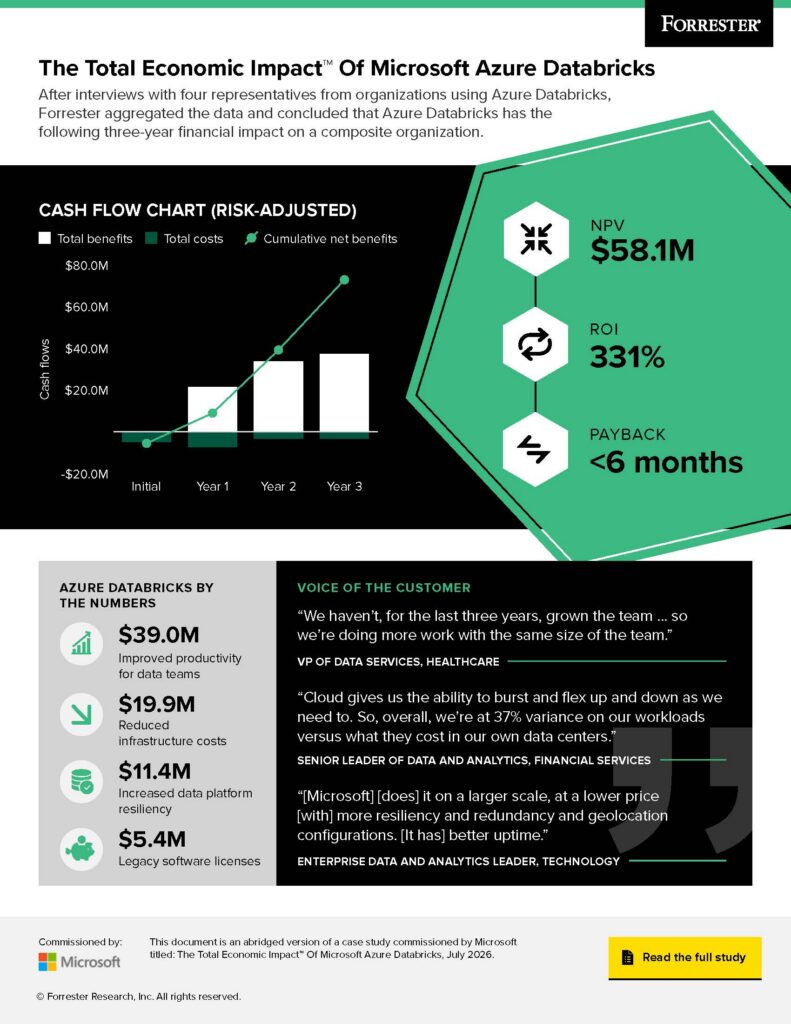
The strategic partnership drives an accelerated integration roadmap and continuous optimization for improved performance; however, decision-makers constantly ask about what business value all of this translates to. To address this key question, Microsoft commissioned a Forrester Total Economic Impact™ study of Azure Databricks. It found that a composite organization based on interviewed customers realized a three-year 331% return on investment, $58.1 million in net present value, and recovered its investment in less than six months.
| 331% Return on investment | $58.1M Net present value | < 6 months Payback period |
Commissioned study conducted by Forrester Consulting on behalf of Microsoft, June 2026. Results are over three years and represent a composite organization based on interviewed customers and may not be typical; actual results will vary.
Forrester interviewed Azure Databricks customers and built a composite organization to model the impact: a $6 billion company in a regulated industry, running about 10 petabytes of data.
Before Azure Databricks, its data estate was fragmented and expensive. It was unreliable at scale and hard to govern. Afterward, the results were clear: $75.6 million in benefits against $17.5 million in cost over three years translating to $58.1 million in net present value.
The value came from four places:
Forrester listed more benefits it didn’t put a price on: native Azure services integration, faster insights, wider access to data, and governance through Unity Catalog. That’s where the return starts.
Those returns come down to one thing. Azure Databricks is a true first-party Azure service, co-engineered by Microsoft and Databricks, it plugs into the tools your teams already use. That removes the extra data copies, tooling, and integration work that raise costs elsewhere.
A great example is the Azure Databricks Genie integration with Microsoft Copilot Cowork. You can add context of your business and build on that intelligence into the tools your teams already use with this integration. Genie lets anyone question the lakehouse in plain language—now inside Microsoft Teams, Microsoft 365 Copilot, and more recently in Copilot Cowork, where it grounds tasks in trusted data through Genie Ontology. Every answer is scoped by Unity Catalog to exactly what each user is permitted to see, so intelligence reaches the flow of work without loosening governance.
The same depth runs across the rest of the platform:
These are the integrations that Forrester valued but didn’t price separately however, they are critical factors driving productivity and cost benefits that were quantified.
Value also depends on speed, and that’s been tested. Principled Technologies, an independent firm, ran an industry-standard, TPC-DS-like decision-support benchmark on a 10-terabyte dataset. Azure Databricks completed a single query stream in up to 21.1% less time than Databricks on AWS (with autoscale disabled) and ran four concurrent query streams more than nine minutes faster.
Choosing a data and AI platform is a long-term decision, and with Azure Databricks the pieces reinforce each other. The integration drives the savings Forrester measured. The performance keeps those gains steady as usage grows. And it all rests on one foundation: a first-party partnership that puts Microsoft and Databricks engineering, roadmap, and support behind your data estate. The value isn’t a claim, it’s been measured: a three-year 331% return, with payback in under six months. It’s why so many teams choose to run their lakehouse on Azure Databricks.
Explore further
此内容由惯性聚合(RSS阅读器)自动聚合整理,仅供阅读参考。 原文来自 — 版权归原作者所有。