








As organizations increasingly embrace the agentic era for AI, customer demands for compute are reshaping the architecture of cloud infrastructure as we know it. Today at Microsoft Build 2026, we are announcing the early access preview for Azure Cobalt 200 Arm-based Virtual Machines (VMs), designed from the ground up for scale-out, cloud-native, and Linux-based agentic AI workloads, with up to 50% better generational performance over Cobalt 100.
Cobalt 200 is purpose-built from silicon to servers to services—integrating Microsoft’s latest innovations in security, networking, storage, and offload to outperform traditional Arm-based compute. That hardware-software co-optimization lets us push the boundaries of scale, security, and cost for AI inferencing, data pipelines, and the web and API tiers that power modern services. Agents are unique from traditional workloads: they reason, make sequential decisions, and run continuously at scale—demanding a fundamentally different computational profile. Cobalt 200 is built for exactly this environment, delivering 50% performance gains for the workloads defining the next era of enterprise AI, making agents faster, more capable, and economically viable at scale.
Microsoft Azure Cobalt 100, our first custom-built processor for cloud-native workloads is now deployed in 32 Azure datacenter regions around the world, with cloud analytics leaders like Databricks and Snowflake adopting Cobalt 100 to optimize their cloud footprint, while customers like Amadeus, OneTrust, Siemens, Sprinklr, and Temenos have achieved significant real-world performance and efficiency gains.
Within Microsoft’s own cloud services, Azure Cobalt 100 VMs are delivering up to 45% better performance while using 35% fewer compute cores compared to its previous compute platform. Microsoft Defender for Endpoint (MDE) saw 40% better performance in its cyber data curator, enabling faster threat response at massive scale.
With Cobalt 200 VMs, we are applying everything we learned towards supporting these demanding services to raise the bar even further.
The Cobalt 200 CPU represents a significant leap forward in performance, security, and efficiency. At the heart of every Cobalt 200 VM is the Cobalt 200 System-on-Chip (SoC), our second-generation Arm processor built around the Arm Neoverse V3 Compute Subsystems, the highest-performance V-series core in Arm’s portfolio. Fabricated on TSMC’s 3nm (N3P) process, Cobalt 200 features a modern chiplet architecture, custom accelerators, and a custom memory controller.
Key innovations in Cobalt 200 VMs include:
Cobalt 200 delivers the per-core performance and scalability needed to power modern agentic AI workloads. Each Cobalt 200 core is a full physical core, paired with dedicated 3 MB of L2 cache, and leading memory bandwidth per core. These design points enable higher isolation and sustained performance under load, which allow agentic workloads to pack more agent sandboxes per VM while meeting latency and throughput requirements.
Cobalt 200 VMs show a broad generational uplift over Cobalt 100 on the workloads that matter most in production.
With cloud workloads, we observe:
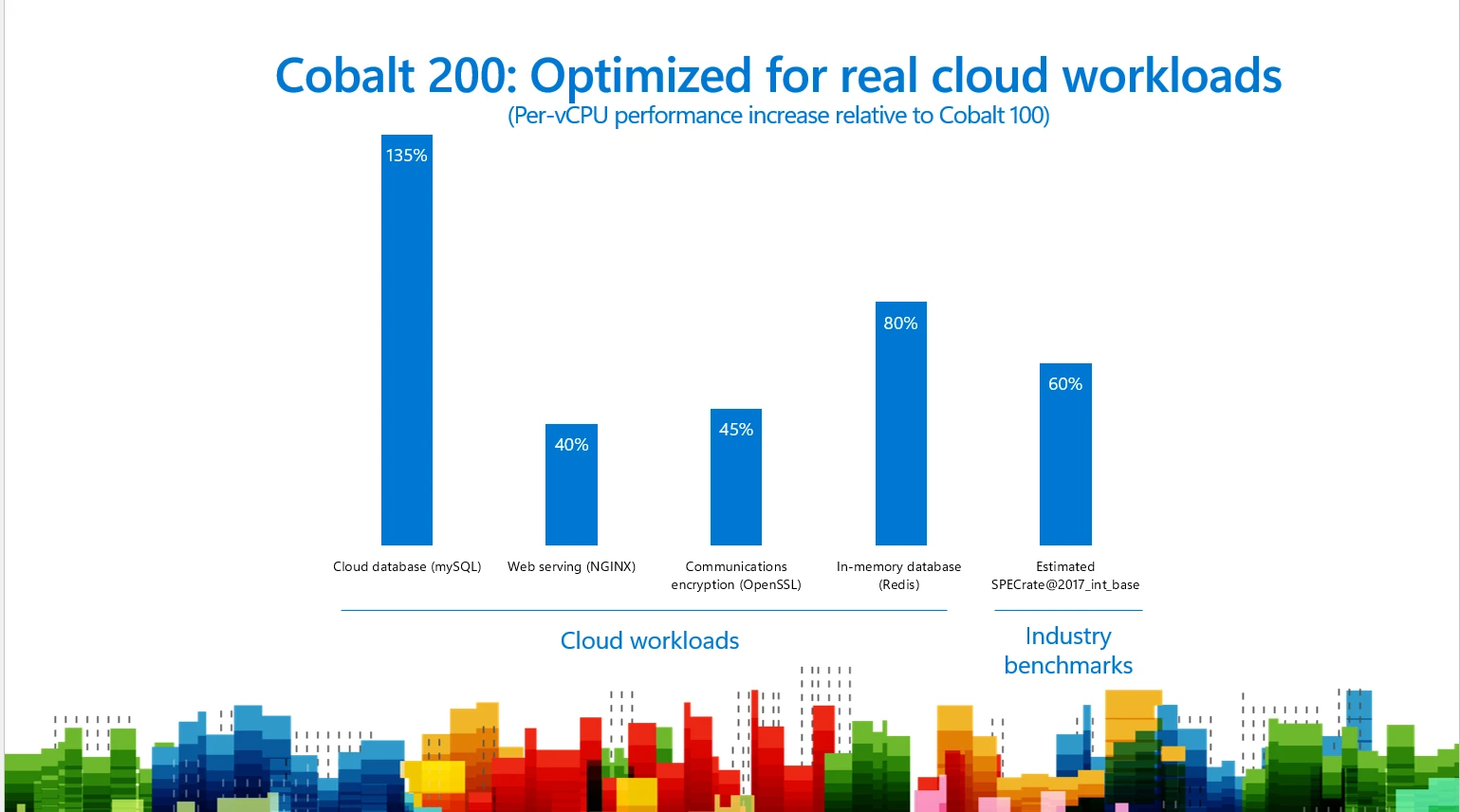
The uplift measured is visible in real hyperscale services. Taken together, these results show that Cobalt 200 raises the floor on per-core performance across cloud-native applications, databases, analytics, caches, and communications workloads.
We have been working closely with our technology partners and customers during the preview period to ensure Cobalt 200 Arm-based VMs deliver strong results across a wide range of real-world workloads. Leading software development companies and enterprises are already evaluating and adopting these VMs for their most demanding applications.
Teradata is excited to be an early preview partner for Microsoft’s Cobalt 200 VMs. Microsoft has been a strong partner, and we value the opportunity to help shape the design and specifications to better meet the needs of our joint customers. Early testing has been encouraging, and we look forward to continued collaboration.
—Brandon Mincey, Engineering Fellow, Teradata
Elastic is committed to delivering best-in-class performance with the Search AI Platform that powers observability, security, search, and AI solutions. Performance and cost efficiency are critical for teams running these workloads at scale and our initial testing of the new Cobalt 200 VMs shows promise for further improvements in these areas. We look forward to bringing these benefits to Elasticsearch users on Azure through our continued collaboration with Microsoft.
—Yuvraj Gupta, Director, Product Management, Elastic
Agentic AI is reshaping the cloud and creating demand for infrastructure that can efficiently orchestrate and scale millions of intelligent interactions in real time. Our collaboration with Microsoft on Cobalt 200, built on Arm Neoverse CSS V3, reflects how purpose-built Arm-based compute is enabling the next generation of AI-driven services while continuing to deliver exceptional performance for cloud-native applications.
—Eddie Ramirez, Vice President of go-to-market, Cloud AI Business Unit, Arm
Cobalt 200 delivers key advances for production Linux workloads on Arm, including memory encryption enabled by default, built-in acceleration for compression and encryption, and higher throughput for data-intensive cloud services. Ubuntu gives organizations a consistent platform for cloud-native and agentic AI workloads across Azure, and Ubuntu Pro keeps it production-ready with long-term security maintenance and Livepatch, which now brings rebootless kernel updates to Arm so always-on services stay available.
—Jehudi Castro-Sierra, Public Cloud Alliance Director, Canonical
The Arm developer ecosystem continues to thrive. Cobalt 200 Arm-based VMs deliver full compatibility for workloads currently running on Cobalt 100 VMs, making migration seamless. Major developer platforms and languages—including C++, .NET, Java, Python, and Rust—provide Arm-native versions with optimizations that fully leverage the capabilities of the Arm architecture.
The broader ecosystem has embraced Arm with native support across popular infrastructure and deployment solutions. GitHub Actions supports Arm through both self-hosted and GitHub-hosted runners. Azure Kubernetes Service (AKS) supports Arm agent nodes as well as mixed x86 and Arm architecture clusters. Containerized workloads benefit from the growing availability of Arm-native container images across the ecosystem.
Microsoft’s own cloud services are among the first to adopt Cobalt 200 Arm-based VMs, building on the success of Cobalt 100 adoption across our most demanding, mission-critical workloads.
Dataverse is the core application and data platform underpinning Dynamics and Power Platform workloads, requiring high performance, scalability, and low latency to deliver a responsive customer experience.
We deployed the Power Apps platform on Cobalt 100 for its improved performance and power efficiency. We are validating Cobalt 200 now and excited by the performance gains we are seeing–up to 60% better performance for our base workload over Cobalt 100.
—Mauktik Gandhi, VP Engineering, Agent 365 Platform
Azure SQL Database is a natural fit for Cobalt 200 Arm-based VMs. The built-in compression and cryptography accelerators are particularly impactful for database workloads—by offloading compression and encryption tasks to the Cobalt 200 accelerator, Azure SQL is able to reduce the use of critical compute resources, prioritizing them for customer queries and transactions.
Our teams collaborated from the beginning to ensure that the architecture of Cobalt 200 is optimized for hosting databases in Azure. We are excited about the performance gains we are seeing over Cobalt 100 and looking forward to broader availability later this year.
—Shireesh Thota, Corporate Vice President, Azure Databases
Cobalt 200 VMs significantly expand our Arm VM portfolio based on customer feedback to support a broader set of workloads. While Cobalt 100 offered General Purpose (Dp,Dpl), and Memory Optimized (Ep) VM families, Cobalt 200 adds two more VM families: the High-Memory Optimized Mpsv4 VMs and Dense Local Storage Lpsv5 VMs, bringing more choice across compute, memory, and storage profiles.
All VM series deliver up to 85 Gbps of network bandwidth and 70 Gbps of remote storage throughput, except Mpsv4/Mpdsv4, which provide up to 70 Gbps of network bandwidth and 46 Gbps of remote storage throughput. Most series are available with or without local NVMe disks, while Lpsv5 includes local NVMe storage across all sizes, giving customers flexibility to optimize for cost or performance.
| VM family | vCPUs | Mem-to-vCPU Ratio | Local NVMe storage | Best-fit workloads |
|---|---|---|---|---|
| General Purpose Dplsv7/Dpldsv7 | 1–128 | 2:1 | Yes – Up to 7 TiB | Most non-memory-intensive and scale-out workloads such as microservices, small databases, caches, gaming servers, and more. |
| General Purpose Dpsv7/Dpdsv7 | 1–128 | 4:1 | Yes – Up to 7 TiB | Most scale-out enterprise workloads such as web and application servers, small to medium databases, caches, and more. |
| Memory Optimized Epsv7/Epdsv7 | 1–128 | 8:1 | Yes – Up to 7 TiB | Large relational and NoSQL databases, in-memory caches such as Redis and Memcached, and real-time analytics. |
| (New) High Memory Optimized Mpsv4/Mpdsv4 | 1–84 | 16:1 | Yes – Up to 4.4 TiB | Large in-memory databases, ERP systems, large-scale caching layers, and memory-intensive analytics workloads. |
| (New) Storage Optimized Lpsv5 | 1–128 | 8:1 | Yes – Up to 23 TB | Data pre-processing and staging, relational and NoSQL databases with local storage requirements, big data analytics, and search/index engines. |
All Cobalt 200 VMs will support remote disk types including Standard SSD, Standard HDD, Premium SSD, and Ultra Disk storage. You can deploy these new VMs using existing methods, including the Azure portal, SDKs, APIs, PowerShell, and the command-line interface (CLI).
Cobalt 200 Arm-based VMs are now available in preview. The new VMs will be available in preview in the following regions: West US3, East US2, Central US, Sweden Central, East US, West US2, Spain Central, and Indonesia Central, with additional regions to be announced.
The announcement of Cobalt 200 Arm-based Virtual Machines marks the next chapter in Azure’s purpose-built infrastructure journey. With our end-to-end systems approach—designing the CPU in-house and optimizing it for Azure’s infrastructure—we are delivering a tightly integrated platform that offers performance, power efficiency, and security for our customers.
Whether you’re accelerating product development, scaling analytics platforms, running mission-critical databases, or improving user experiences, Cobalt 200 Arm-based VMs offer a compelling choice for modern cloud workloads. We are excited to see how our customers and partners create breakthrough products and services on this new platform.
Try the Cobalt 200 Arm-based VMs today in early access preview and experience the next generation of Azure’s custom infrastructure innovation.
Thank you for joining us on this exciting journey.
Get early access to Azure Cobalt 200 VMs.
此内容由惯性聚合(RSS阅读器)自动聚合整理,仅供阅读参考。 原文来自 — 版权归原作者所有。