

Staff Program Manager





AI is changing the pace of open source development and the security challenges that come with it. Maintainers are reviewing unfamiliar contributions, managing new attack surfaces, and responding to vulnerabilities with limited time and resources.
Session 4 of the GitHub Secure Open Source Fund tested a practical response. The Secure Fund invested more than $500,000 across 50 projects, pairing maintainers with GitHub Security Lab experts, GitHub security tools, AI-assisted workflows, and a peer community.
One lesson emerged consistently: AI can help maintainers investigate, prioritize, and respond faster. Maintainers still provide the context, judgement, and accountability required to decide what ships.
OpenClaw was invited to participate in Session 4 because it is GitHub’s fastest-growing open source project, and its maintainers wanted to strengthen its security posture.
By the end of Session 4, OpenClaw developed an incident response plan, expanded its use of GitHub security tooling, audited its GitHub Actions workflows, and strengthened its processes for identifying and responding to security issues.
The maintainers shared:
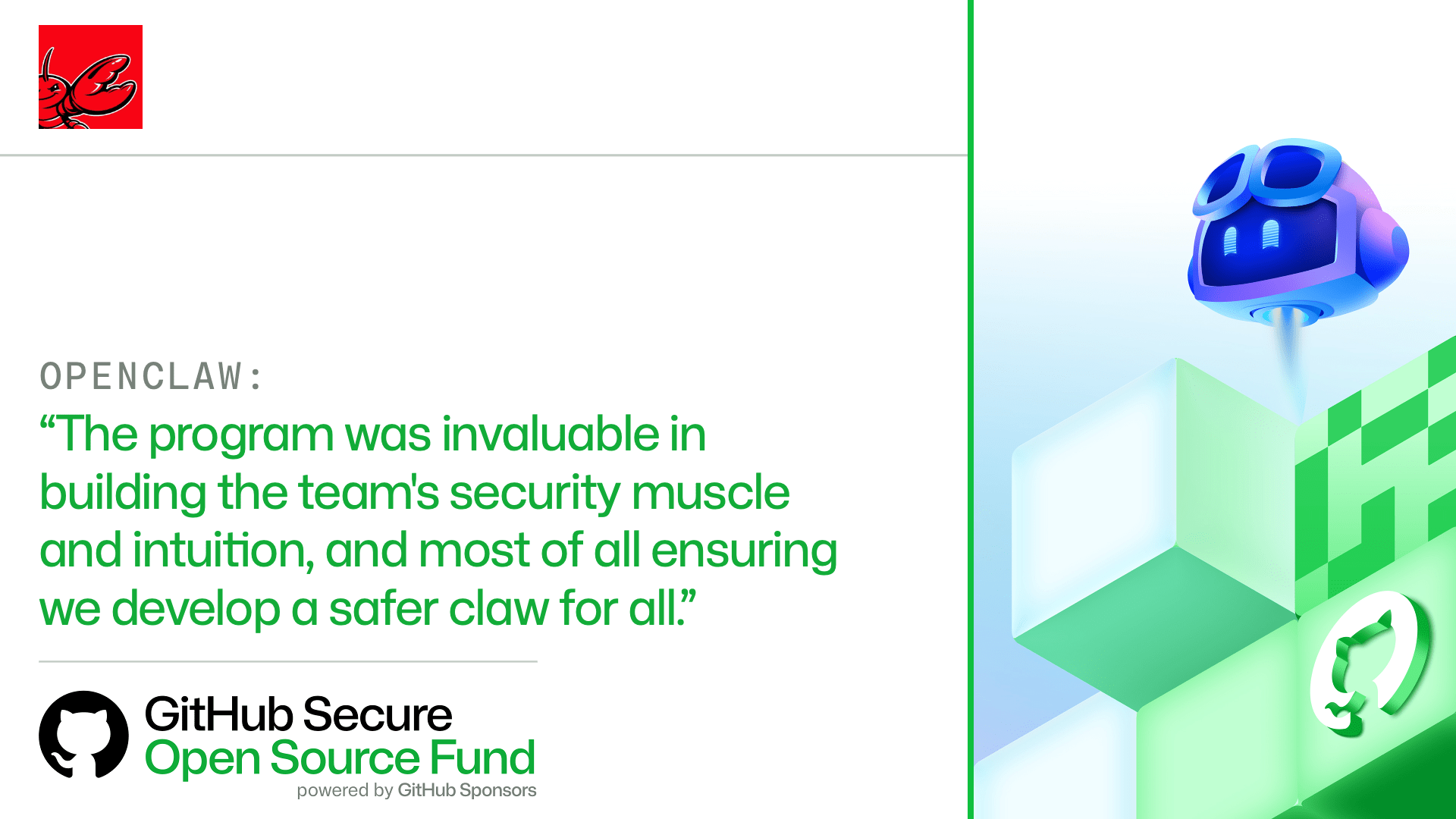
OpenClaw’s experience reflects the broader story of Session 4. While the specific risks varied across the cohort, maintainers shared a consistent need: the knowledge, tools, and expert support to secure software as AI changed how they built it.
Across the program, maintainers turned that support into concrete security improvements. Projects strengthened established practices, prepared for emerging AI-related risks, and explored how tools like GitHub Copilot could support vulnerability triage, threat modeling, code review, and remediation.
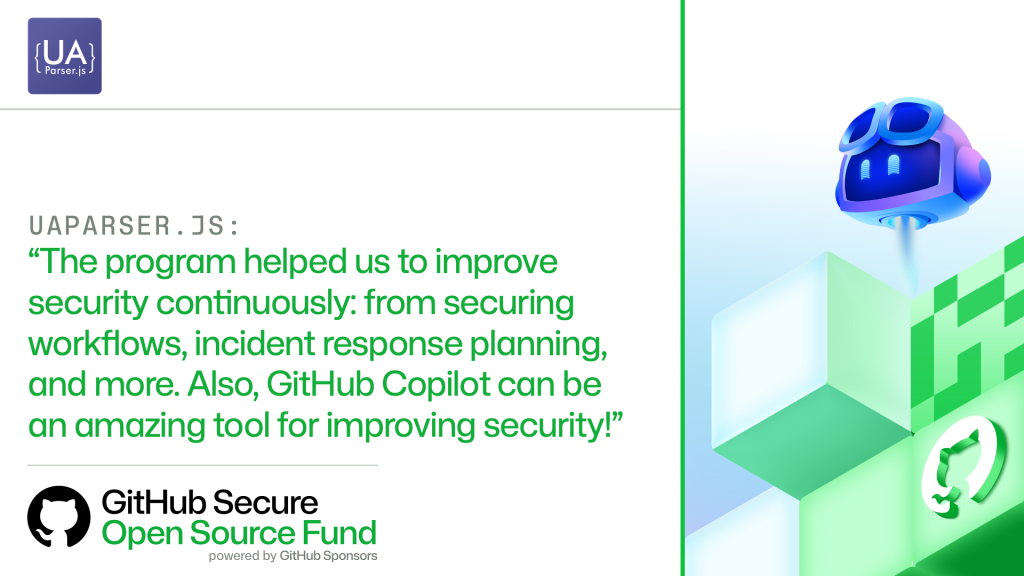
The benefits extend beyond individual projects. When maintainers strengthen the security of widely used open source software, they help build a more resilient ecosystem for everyone who depends on it.
The GitHub Secure Open Source Fund links funding directly to measurable security outcomes. The program combines hands-on security education, direct engagement with GitHub Security Lab experts, and a trusted community where maintainers can work through security challenges with their peers.
Each session is a three-week sprint and engagement for a total of 12 months. Funding and participation are tied directly to outcome‑driven goals and verified security improvements.
The sprint is designed and curated by the GitHub Security Lab, and delivered by security experts from GitHub and our partners. The training is structured into different focus areas per week.
These include:
Throughout this program, each project receives $10,000 USD via GitHub Sponsors (which breaks down to $6,000 USD during the sprint and $2,000 USD at six- and 12-month security check-ins). Projects are invited to a new security-focused community and office hours with the GitHub Security Lab, which they can take advantage of during the full 12 months. They also receive security resources to immediately implement in their project and Azure credits for cloud infrastructure.
Session 4 focused on improving security across the systems developers rely on every day. The projects below are grouped by the role they play in the software ecosystem.
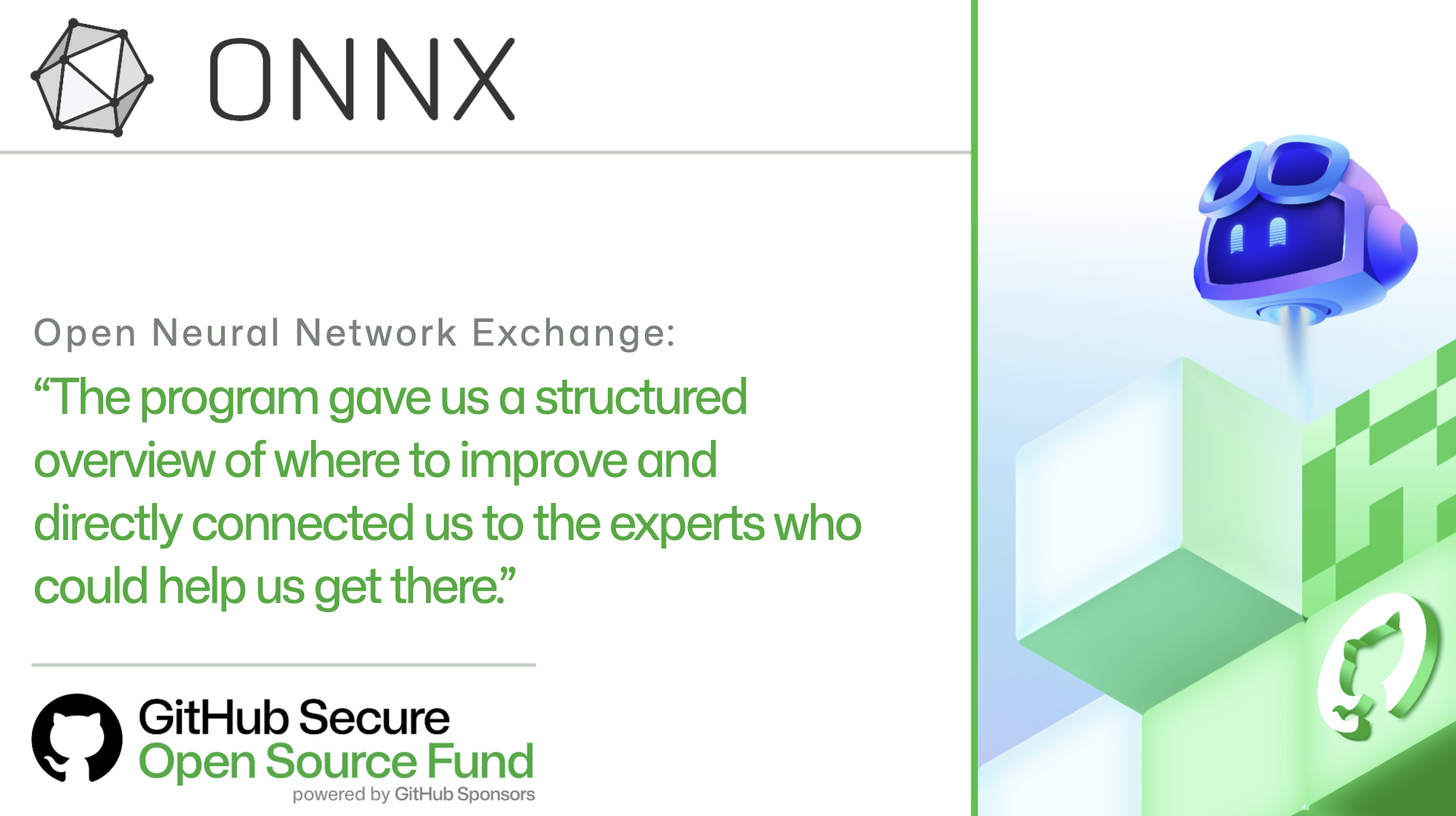
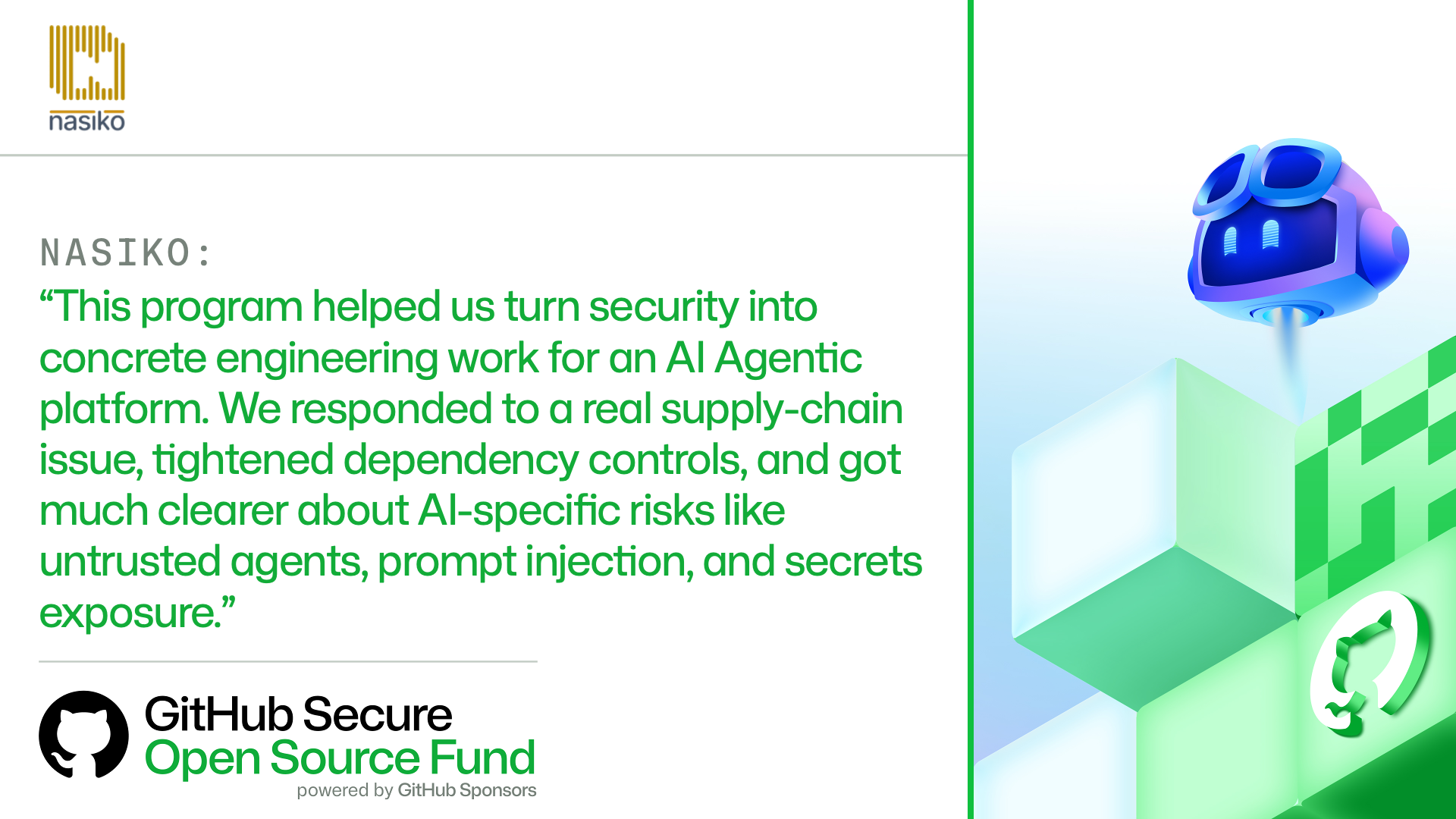
Caracal • Deep Agents • DocsGPT • LadybugDB • LangChain • n8n-MCP • Nasiko • ONNX • OpenClaw • PageIndex • Scenic • Serena
These projects sit at the intersection of AI, automation, data infrastructure, and machine learning. They increasingly serve as foundational components for modern AI workflows and production deployments. As AI adoption accelerates, security improvements in these projects help establish stronger foundations for emerging AI ecosystems.
browserslist • CycloneDX Python Library • Cucumber • golangci-lint • JReleaser • postcss • Task
These projects help developers test, validate, package, release, and maintain software across diverse environments. Tools in this group influence everything from software bills of materials and release pipelines to code quality and testing automation.
Byte Buddy • core-js • FS2 • Gleam • htmx • Pkl • Pyodide • termcolor
These projects help define how software is written, configured, executed, and extended. Improvements at this layer flow downstream to thousands of applications and developer ecosystems.
Security improvements in foundational runtimes and libraries can extend downstream to the many tools and applications that depend on them.
cheerio • Ciphey • CodeRunner • Hoppscotch • MapStruct • Python Pillow • Proyecto Respira • Readest • ToolJet • Vuetify • Yjs
These projects shape the everyday experience of building, testing, collaborating on, and using software. Many serve as widely adopted utilities, applications, and platforms that appear throughout developer environments and application stacks.
Together, this group supports API development, low-code platforms, collaborative applications, content processing, and software delivery workflows. When infrastructure projects become more resilient, the benefits extend far beyond a single application and strengthen entire technology ecosystems.
actix-web • aiohttp • Apache Solr • Apache ZooKeeper • etcd • FastAPI • Haraka • Hummingbird • mimetype • Sniffnet • Starlette • UAParser.js
These projects form part of the internet’s operational backbone. They handle APIs, networking, search, messaging, service coordination, and distributed systems infrastructure relied on by organizations around the world.
This group includes technologies that sit on the critical path of modern cloud applications and internet services.
AI-related security questions appeared across projects in Session 4, from machine learning infrastructure and agent frameworks to developer tools and internet infrastructure.
At the same time, established security responsibilities did not go away. Maintainers still needed to manage vulnerabilities, secure dependencies, protect release workflows, and prepare for incidents. AI introduced new risks and increased the speed at which maintainers needed to understand and respond to them.
The lesson from Session 4 is clear: AI security is not evolving in isolation. It is becoming part of the broader practice of building secure software. As that shift continues, maintainers will need practical education, trusted communities, and expert support that can evolve with them.
We couldn’t do this without our incredible network of partners. Together, we are helping secure the open source ecosystem for everyone!
Funding Partners: Alfred P. Sloan Foundation, American Express, Chainguard, Datadog, Herodevs, Kraken, Mayfield, Microsoft, Shopify, Stripe, Superbloom, Vercel, Zerodha, 1Password

Ecosystem Partners: Atlantic Council, Ecosyste.ms, CURIOSS, Digital Data Design Institute Lab for Innovation Science, Digital Infrastructure Insights Fund, Microsoft for Startups, Mozilla, OpenForum Europe, Open Source Collective, OpenUK, Open Technology Fund, OpenSSF, Open Source Initiative, OpenJS Foundation, University of California, OWASP, Santa Cruz OSPO, Sovereign Tech Agency, SustainOSS
Staff Program Manager

Build what’s next on GitHub, the place for anyone from anywhere to build anything.

Join us October 28-29 in San Francisco or online for GitHub Universe, our flagship developer event uniting people, agents, and the world’s code.
此内容由惯性聚合(RSS阅读器)自动聚合整理,仅供阅读参考。 原文来自 — 版权归原作者所有。

