


惯性聚合 高效追踪和阅读你感兴趣的博客、新闻、科技资讯
阅读原文 在惯性聚合中打开

推荐订阅源

cs.AI updates on arXiv.org
罗磊的独立博客
人人都是产品经理
人人都是产品经理
博客园_首页
Hugging Face - Blog
Hugging Face - Blog
美团技术团队
L
Lohrmann on Cybersecurity
博客园 - 【当耐特】
量子位
Last Week in AI
Last Week in AI
D
Darknet – Hacking Tools, Hacker News & Cyber Security
让小产品的独立变现更简单 - ezindie.com
C
Cyber Attacks, Cyber Crime and Cyber Security
腾讯CDC
有赞技术团队
有赞技术团队
Cyberwarzone
Cyberwarzone
T
Tor Project blog
V
V2EX
L
LINUX DO - 热门话题
Security Latest
Security Latest
OSCHINA 社区最新新闻
OSCHINA 社区最新新闻
NISL@THU
NISL@THU
C
Cisco Blogs
T
Tailwind CSS Blog
G
GRAHAM CLULEY
钛媒体:引领未来商业与生活新知
钛媒体:引领未来商业与生活新知
博客园 - Franky
cs.CL updates on arXiv.org
小众软件
小众软件
K
Kaspersky official blog
博客园 - 司徒正美
IT之家
IT之家
大猫的无限游戏
大猫的无限游戏
Jina AI
Jina AI
S
Schneier on Security
月光博客
月光博客
freeCodeCamp Programming Tutorials: Python, JavaScript, Git & More
T
The Exploit Database - CXSecurity.com
Scott Helme
Scott Helme
J
Java Code Geeks
博客园 - 聂微东
Martin Fowler
Martin Fowler
MongoDB | Blog
MongoDB | Blog
AWS News Blog
AWS News Blog
Know Your Adversary
Know Your Adversary
C
Cybersecurity and Infrastructure Security Agency CISA
F
Fortinet All Blogs
T
Threat Research - Cisco Blogs
C
CXSECURITY Database RSS Feed - CXSecurity.com
雷峰网
雷峰网

The GitHub Blog

The case for a cooldown: Why Dependabot now waits before issuing version updates Copilot vs. raw API access: What are you actually paying for? Next chapter: Restructuring GitHub's bug bounty program How to build interactive experiences with canvases $100 million for open source: A milestone built by the community The cost of saying yes has changed GitHub for Beginners: Your roadmap to mastering the GitHub essentials Better tools made Copilot code review worse. Here's how we actually improved it. How GitHub gave every repository a durable owner Automating cross-repo documentation with GitHub Agentic Workflows GitHub availability report: June 2026 How GitHub Copilot enables zero DNS configuration for GitHub Pages Q1 2026 Innovation Graph update: Open source collaboration is accelerating worldwide How GitHub used secret scanning to reach inbox zero 6 security settings every GitHub maintainer should enable this week How GitHub maintains compliance for open source dependencies Highlights from Git 2.55 Inside the Advisory Database and what happens when vulnerability volume breaks records GitHub and UNDP team up to advance development priorities in Ghana with open source Transitioning as a Hubber Evaluating performance and efficiency of the GitHub Copilot agentic harness across models and tasks I automated my job (and it made me a better leader) GitHub joins coalition advocating for fixes to California AI Transparency Act to protect open source From pledge to practice: Building a more inclusive open source ecosystem How we built an internal data analytics agent How pull request limits are cutting down the noise Getting more from each token: How Copilot improves context handling and model routing What are git worktrees, and why should I use them? GitHub Copilot CLI for Beginners: Overview of common slash commands Accelerating researchers and developers building multilingual AI with a new open dataset How we made GitHub Copilot CLI more selective about delegation GitHub availability report: May 2026 Making secret scanning more trustworthy: Reducing false positives at scale Give GitHub Copilot CLI real code intelligence with language servers From one-off prompts to workflows: How to use custom agents in GitHub Copilot CLI GitHub for Beginners: Answers to some common questions GitHub Universe is back: All together now, in the agentic era GitHub Copilot app: The agent-native desktop experience Still a developer. Just outside. Our latest GitHub Shop collection is here. GitHub for Beginners: Getting started with Git and GitHub in VS Code GitHub recognized as a Leader in the Gartner® Magic Quadrant™ for Enterprise AI Coding Agents for the third year in a row Beyond the engine: 10 open source projects shaping how games actually get made Building GitHub’s next chapter in accessibility Investigation update: GitHub Enterprise Server signing key rotation Take your local GitHub sessions anywhere Building a general-purpose accessibility agent—and what we learned in the process Raising the bar: Quality, shared responsibility, and the future of GitHub’s bug bounty program GitHub availability report: April 2026 From latency to instant: Modernizing GitHub Issues navigation performance Dungeons & Desktops: 10 roguelikes that never die (because their communities won’t let them) GitHub Copilot individual plans: Introducing flex allotments in Pro and Pro+, and a new Max plan Dungeons & Desktops: Building a procedurally generated roguelike with GitHub Copilot CLI GitHub for Beginners: Getting started with OSS contributions Why age assurance laws matter for developers How researchers are using GitHub Innovation Graph data to reveal the “digital complexity” of nations Improving token efficiency in GitHub Agentic Workflows Agent pull requests are everywhere. Here’s how to review them. Validating agentic behavior when “correct” isn’t deterministic Welcome to Maintainer Month: Celebrating the people behind the code Register now for OpenClaw: After Hours @ GitHub GitHub Copilot CLI for Beginners: Interactive v. non-interactive mode GitHub for Beginners: Getting started with Markdown Securing the git push pipeline: Responding to a critical remote code execution vulnerability Highlights from Git 2.54 Building an emoji list generator with the GitHub Copilot CLI How GitHub uses eBPF to improve deployment safety Build a personal organization command center with GitHub Copilot CLI Developer policy update: Intermediary liability, copyright, and transparency Hack the AI agent: Build agentic AI security skills with the GitHub Secure Code Game How exposed is your code? Find out in minutes—for free GitHub for Beginners: Getting started with GitHub Pages GitHub Copilot CLI for Beginners: Getting started with GitHub Copilot CLI GitHub availability report: March 2026 GitHub Universe is back: We want you to take the stage GitHub Copilot CLI combines model families for a second opinion The uphill climb of making diff lines performant Securing the open source supply chain across GitHub Run multiple agents at once with /fleet in Copilot CLI Agent-driven development in Copilot Applied Science GitHub for Beginners: Getting started with GitHub security What’s coming to our GitHub Actions 2026 security roadmap
Bringing more transparency to GitHub’s status page
Jakub Oleksy · 2026-04-18 · via The GitHub Blog

GitHub is where millions of developers do their most important work, and that comes with a responsibility we take seriously. Earlier this year, we shared an update on GitHub’s recent availability issues and the work we’re doing to address them. Alongside those reliability investments, we have prioritized improving how we communicate during and after incidents, increasing the specificity of the data we provide and giving better insight into the platform’s health overall.

Guided by transparency, accuracy, and timeliness, we’re rolling out three changes to how we communicate service health—outlined below.
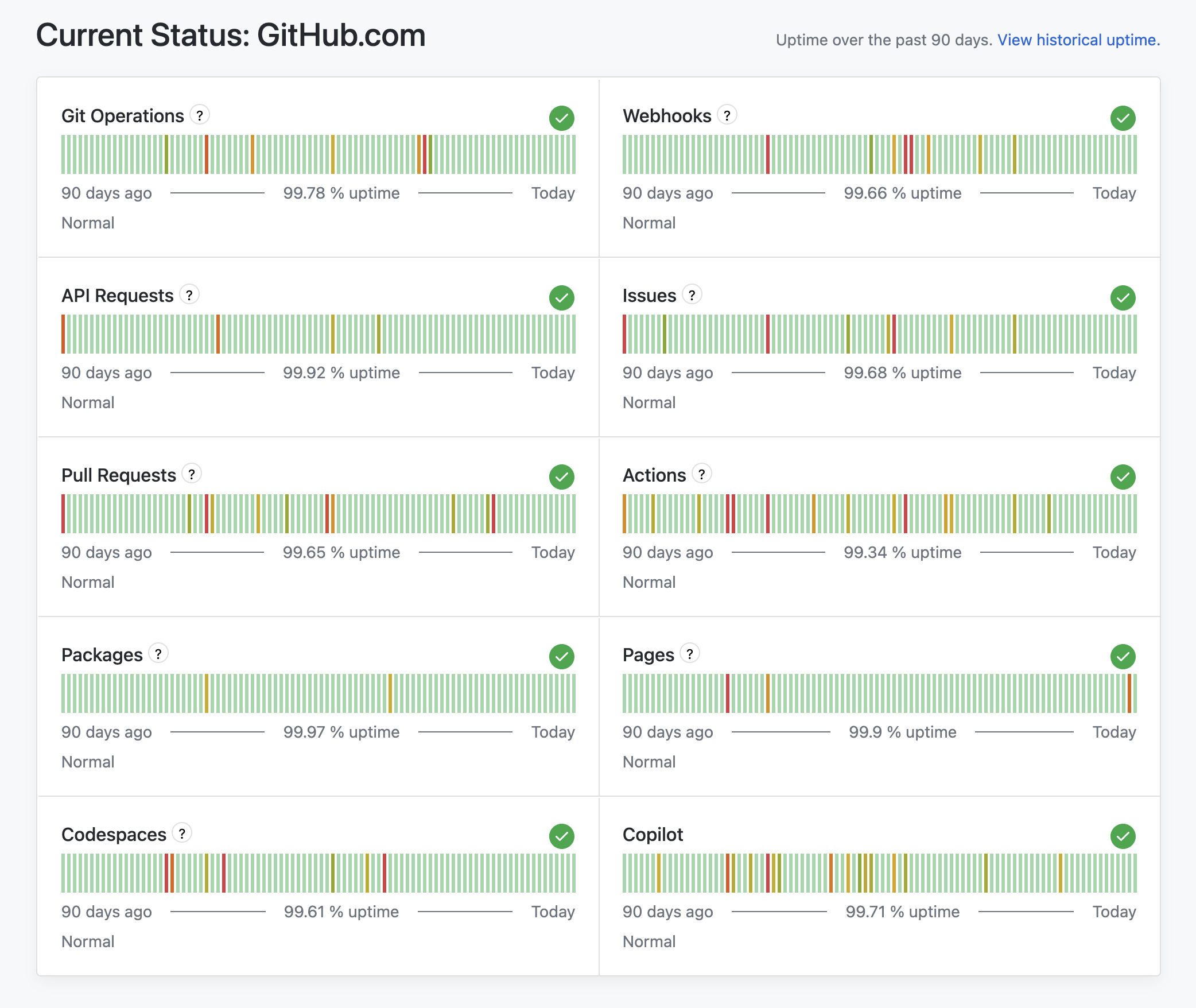
  • A new “Degraded Performance” state for more accurate incident classification
  • Per-service uptime metrics published for each service
  • More granular insights on service disruptions, starting with a dedicated “Copilot AI Model Providers” component for clearer communication around model provider availability
Image of the updated GitHub status page.

Improving accuracy

We’re adding a new incident severity level: Degraded Performance. This sits alongside our existing Partial Outage and Major Outage states, creating a three-tier system that more accurately reflects the spectrum of issues that can affect GitHub services.

State What It Means 
Degraded Performance The service is operational but impaired. You may experience elevated latency, reduced functionality, or intermittent errors affecting a small percentage of requests.
Partial Outage A significant portion of the service is unavailable or severely impacted for a meaningful number of users.
Major Outage The service is broadly unavailable, affecting most or all users. 

Previously, even with minimal service disruption, all incidents were classified at least as a partial outage. This did not accurately reflect customer impact and led users to believe a service was unavailable even if it was still functional.

Per-service uptime on the status page

We are now publishing per-service uptime percentages over the last 90 days directly on our status page, so you can quickly understand each service’s recent reliability track record.

These uptime percentages are calculated based on the number of incidents, their severity, and their duration for each individual service. These calculations are based on industry standard status page calculations.

Each severity level carries a specific downtime weight:

Severity Downtime weight 
Major Outage 100% — the full duration counts as downtime 
Partial Outage 30% — reflects significant but not total service loss 
Degraded Performance 0% — does not count as downtime; the service remains functional 

For example, if a service experienced a 1-hour Partial Outage over a 90-day period, that would count as 18 minutes of effective downtime in the uptime calculation—not the full hour. A Degraded Performance incident, by contrast, would not affect the uptime percentage at all.

Insights on model provider service disruptions

We’ve added a new component representing Copilot AI model providers.

Previously, when a model provider experienced an outage, we declared an incident against the Copilot service, even when the impact was limited to a single model. That didn’t always reflect your experience, because many Copilot features, such as GitHub Copilot Chat and GitHub Copilot cloud agent (formerly coding agent) support multiple models. On those features, if one model is unavailable, you can choose an alternative model or use auto model selection to have Copilot pick the best available option for you.

Going forward, incidents related to model availability will be reported under the new “Copilot AI Model Providers” component instead of the broader “Copilot” component. We’ll continue to share details, such as which models are affected, through public incident updates.

Our continued commitment to transparency

We recognize that clear communication and transparency matter most when things go wrong. The Degraded Performance state, per-service uptime percentages, and dedicated Copilot AI Model Providers component are designed to give you the context and details you need to make confident decisions about your operations.

We know GitHub is critical infrastructure for your teams, and we are committed to ensuring our platform is available when and where you need it; and communicating effectively and transparently when it is not.

Written by

Jakub Oleksy

Related posts

Explore more from GitHub

Docs

Docs

Everything you need to master GitHub, all in one place.

Go to Docs

GitHub

GitHub

Build what’s next on GitHub, the place for anyone from anywhere to build anything.

Start building

Customer stories

Customer stories

Meet the companies and engineering teams that build with GitHub.

Learn more

The GitHub Podcast

The GitHub Podcast

Catch up on the GitHub podcast, a show dedicated to the topics, trends, stories and culture in and around the open source developer community on GitHub.

Listen now