



Humanity has never been short on predictions of apocalyptic events, from plagues to asteroid impacts. Most doomsday scenarios hinge on an analysis of physical threats or indicators of societal collapse. Some researchers, however, have mounted a purely mathematical argument that suggests our time is running out. Their eerily simple “doomsday argument” relies solely on the laws of probability and a single data point: the total number of humans who have lived to date.
To get a feel for the argument, imagine you’re blindfolded and face two giant spinning drums. Each drum contains tickets numbered 1, 2, 3, and so on. One of them contains 100 tickets total, and the other contains a billion. You put your hand into one of the drums and pull out ticket number 14. Do you think you picked from the 100-ticket or billion-ticket pool? The 100-ticket bin feels much more likely because the chances of pulling such a low number out of a billion are astronomically small. If there were a billion tickets, you’d expect to draw a number that looks something like 437,893,112, rather than 14.
Now let’s play the same game but replace the tickets with people. You are roughly the 117 billionth human ever born. What’s more likely: that you are an extreme statistical anomaly living at the absolute dawn of what will become a multitrillion-person galactic human empire, or that you’re an average, run-of-the-mill human living somewhere near the middle of the pack? The first answer is akin to drawing 14 from a drum of a billion tickets. The second predicts an uncomfortably close extinction. Just how close depends on how we estimate certain variables.
If you're enjoying this article, consider supporting our award-winning journalism by subscribing. By purchasing a subscription you are helping to ensure the future of impactful stories about the discoveries and ideas shaping our world today.
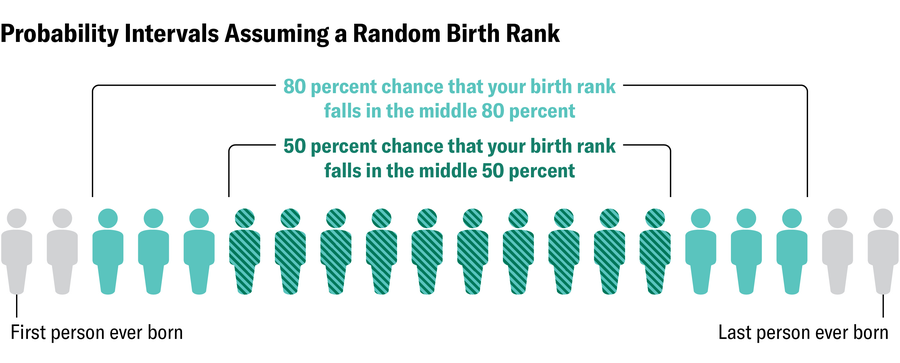
Consider another way to look at this argument, which would be to line up every person who has ever lived and ever will live chronologically, from the first Homo sapiens (admittedly a fuzzy boundary, but we’re okay with rough numbers) to the final human to draw a breath. A quarter of all people occupy the first 25 percent of this line, and another quarter occupy the last 25 percent, while half of all people will be born somewhere in the middle 50 percent. Without any evidence to the contrary, we shouldn’t assume we occupy a privileged, statistically miraculous spot at the beginning of the human story. We should reason as though we’re just a random person among all people, past, present and future. If our birth ranks are random selections among all birth ranks, then there is a 50 percent chance that we belong to the middle 50 percent group.
Because roughly 117 billion people predate us, there’s a 50 percent chance that those 117 billion ancestors represent between the first 25 percent and 75 percent of all humans that will ever exist, implying between 156 billion and 468 billion total humans. We can translate the number of souls to time remaining on humanity’s clock using the current birth rate of 132 million babies per year. At that rate, there’s a 50 percent chance that the last human will be born within the next 295 to 2,659 years—or an 80 percent chance that this occurs within the next 98 to 7,977 years. These projections might seem like plenty of time, but it’s a tiny fraction of how long we’ve been around, and they don’t bode well for our aspirations of a Star Trek future. Note that we assumed a consistent birth rate, on par with the recent linear growth of the population. If we made the model incorporate exponential population growth, that would only accelerate humans’ demise.
Amanda Montañez
If the doomsday argument reasoning sounds specious, it might unsettle you to learn that it has a track record of successful predictions. In 1969 astrophysicist J. Richard Gott III visited the Berlin Wall, which was eight years old at the time, and wondered how much longer it would stand. Gott needed only a single assumption to answer the question: that the timing of his visit wasn’t special. Under that view, he had a 50 percent chance of visiting sometime in the middle of the wall’s life, suggesting the eight years the wall had been standing could represent somewhere between 25 percent and 75 percent of the wall’s life. This allowed him to make a quantitative prediction that the Berlin Wall had a 50 percent chance of falling within the next 2.67 to 24 years. It fell 20 years later.
Gott then took his methods to Broadway. In 1993 he predicted bounds for when 44 shows in New York City would end their runs. According to his 2001 book Time Travel in Einstein's Universe: The Physical Possibilities of Travel Through Time, all 37 that had closed by the time his book went to print had done so within his projected timelines. Gott is one the main proponents of the doomsday argument, which was developed from work first put forth by astrophysicist Brandon Carter.
Perhaps astrophysicists gravitate toward the argument because it hinges on a concept from their field called the Copernican principle. Named for the Renaissance astronomer who theorized that the Earth is not the center of the universe, the principle extends that humility to a broad warning against cosmic narcissism. It asserts that, all else equal, we should view ourselves as typical, rather than special. Just as our planet is a mundane rock orbiting an average star in an unremarkable galaxy, Gott and his peers argue that we shouldn’t assume our current generation holds a spectacularly unique place in history. We’re probably just average observers somewhere in the middle.
The argument has no shortage of detractors. Many believe the math is pulling some sleight of hand, but the trouble is, nobody can seem to agree on where the trick lies. Some of the rebuttals put forth include:
The reference class problem:
Why should we reason as though we’re a random selection among all humans? Why not include Neanderthals? If the universe teems with intelligent aliens, why not reason as though we’re a randomly selected intelligent being? If, in the future, we become cyborgs and eventually no longer resemble humans, would that qualify as doom? Broadening the so-called reference class pushes back our expiration date, and an argument for doom shouldn’t depend so heavily on arbitrary boundaries.
The caveman objection:
If a philosophically inclined early human stumbled upon Copernican reasoning around a campfire, they would have confidently underestimated our longevity by millennia. If the math fails when applied in hindsight, why should we entrust it with our future?
The self-indication assumption:
Suppose we live in one of two possible universes: one will only ever house hundreds of billions of humans, and the other will have hundreds of trillions of humans. Knowing nothing else, we should expect to be born in the latter universe simply because it has more slots for consciousness to occupy. Our very existence is more likely in a universe with many souls than one with comparatively few. Incorporating this might nullify the doomsday pessimism.
One’s birth rank can’t end the world:
An asteroid or a nuclear war can end the world. Mathematical musings from one’s armchair cannot. Birth rank seems to have no causal connection to real dangers and therefore should not constitute evidence for an apocalypse.
All these rebuttals have counterarguments from doomsday proponents. The doomsday argument itself comes in a variety of flavors, as do proposed refutations. The dialectic continues and gets impressively technical. We’ve only scratched the surface here. For many, debating the doomsday argument is less about existential threats and more about how we contextualize ourselves. What inferences are valid to make from our mere existence? What are the limits of probabilistic reasoning? It’s intentionally provocative to force us to confront foundational assumptions. The point of the debate is to expand our understanding: if we never fully resolve it, it’s not the end of the world.
If you enjoyed this article, I’d like to ask for your support. Scientific American has served as an advocate for science and industry for 180 years, and right now may be the most critical moment in that two-century history.
I’ve been a Scientific American subscriber since I was 12 years old, and it helped shape the way I look at the world. SciAm always educates and delights me, and inspires a sense of awe for our vast, beautiful universe. I hope it does that for you, too.
If you subscribe to Scientific American, you help ensure that our coverage is centered on meaningful research and discovery; that we have the resources to report on the decisions that threaten labs across the U.S.; and that we support both budding and working scientists at a time when the value of science itself too often goes unrecognized.
In return, you get essential news, captivating podcasts, brilliant infographics, can't-miss newsletters, must-watch videos, challenging games, and the science world's best writing and reporting. You can even gift someone a subscription.
There has never been a more important time for us to stand up and show why science matters. I hope you’ll support us in that mission.
此内容由惯性聚合(RSS阅读器)自动聚合整理,仅供阅读参考。 原文来自 — 版权归原作者所有。