







Do declining immune systems explain the trend, or is something else going on? Experts explain
Liubomyr Vorona/Getty Images
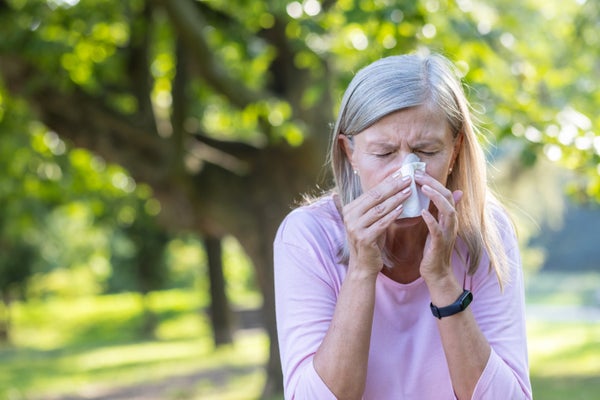
This spring about 80 million Americans will sneeze, sniffle and cough their way through dealing with a diagnosed seasonal allergy. Research shows that kids and working-age adults bear the brunt of these problems because they have more pollen allergies than older people do.
A common explanation is that aging diminishes certain immune responses, leading to milder reactions to seasonal allergies among seniors. But this tells only one part of the story. Changes in younger people as a group have just as much to do with the higher allergy rates they face, experts say.
“Young adults today have more allergies compared to the same age [group] 20 years ago,” says Ravi Viswanathan, an allergist and immunologist at the University of Wisconsin School of Medicine and Public Health. “And it’s being driven by a mixed bag of issues.”
If you're enjoying this article, consider supporting our award-winning journalism by subscribing. By purchasing a subscription you are helping to ensure the future of impactful stories about the discoveries and ideas shaping our world today.
Seasonal allergies happen when the immune system mistakes something harmless in the environment, such as pollen, as a danger, setting off reactions and symptoms that can turn spring from a gift into an ordeal. Older immune systems tend to mount weaker responses to pollen, which partly explains why seniors experience fewer seasonal allergies. As immune systems wane, the body makes less immunoglobulin E (IgE), an allergy-causing antibody, Viswanathan explains. Research, including a review by Viswanathan, confirms this downward trend.
Many older people suffer from symptoms that resemble pollen allergies—runny nose and congestion—but the majority of these seniors are actually bothered by other airborne irritants, such as cigarette smoke, perfumes or cleaning products.
This condition, sometimes called nonallergic rhinitis, occurs as older bodies lose some control over blood vessels in the nose and mucus glands. People with nonallergic rhinitis are less likely to have telltale symptoms of allergies, such as rapid-fire sneezing, Viswanathan says.
Some seniors have relatively robust immune systems that can still rev up allergic responses. Among Viswanathan’s older patients who experience symptoms, about 40 percent have allergies, while the rest have nonallergic rhinitis.
Although the rate of seasonal allergies often declines in older age, it’s going up in the broader population. About one third of people worldwide have a food, drug or environmental allergy, and research points to several explanations for the rise. Increasingly, scientists are learning how these causes interact.
One factor behind increasing seasonal allergies is that pollen seasons have become longer and more intense in recent decades. Higher levels of carbon dioxide trap more heat in the atmosphere—optimal conditions for pollen-producing plants to thrive. The hotter atmosphere may also drive winds and turbulence that shake more pollen loose and carry it farther in the air. As kids are exposed to more pollen, seasonal allergies are becoming more common, says Kari Nadeau, a professor of medicine at Harvard Medical School and chair of the department of environmental health at Harvard T. H. Chan School of Public Health, where she directs the Allergy, Extreme Weather and Exposomics Laboratory.
Pollen exposure is exacerbated by persisting air pollution—despite long-term declines in many major pollutants. “Pollen acts like a sponge that captures pollutants,” Nadeau says. The immune system treats this cocktail as more of a threat than pollen alone. Pollution has been shown to amp up IgE antibodies, airway inflammation and related allergies.
But another factor may be at play that compounds the effects of pollen and pollution: the immune systems of many younger people today may not be trained to prevent allergies. On average, people today spend 90 percent of their lives indoors, whereas many older people, as children, ventured outside more, where they encountered a wild diversity of microbes. Research shows these early exposures prime the immune system to recognize outside invaders for life. “The body realizes they’re not a problem and doesn’t react as much, which leads to fewer allergies,” Viswanathan says.
Allergies may also be diagnosed more frequently these days, but that explains only a fraction of the rise, Viswanathan adds.
It’s important for people to get the right diagnosis. This can be done through blood and skin tests, so people know whether to avoid allergies or irritants. Medications such as antihistamines and sprays must be dosed carefully for seniors because they can cause more severe side effects. “The tools are the same, but you have to be more cautious,” Viswanathan says.
For anyone who struggles with seasonal allergies, when heading outside, choose times and locations—away from busy roads—that reduce pollen and pollution exposure, Viswanathan says. “There has to be a balance” allowing some exposure, he says, because we want outdoor microbes to help train the immune system.
If you enjoyed this article, I’d like to ask for your support. Scientific American has served as an advocate for science and industry for 180 years, and right now may be the most critical moment in that two-century history.
I’ve been a Scientific American subscriber since I was 12 years old, and it helped shape the way I look at the world. SciAm always educates and delights me, and inspires a sense of awe for our vast, beautiful universe. I hope it does that for you, too.
If you subscribe to Scientific American, you help ensure that our coverage is centered on meaningful research and discovery; that we have the resources to report on the decisions that threaten labs across the U.S.; and that we support both budding and working scientists at a time when the value of science itself too often goes unrecognized.
In return, you get essential news, captivating podcasts, brilliant infographics, can't-miss newsletters, must-watch videos, challenging games, and the science world's best writing and reporting. You can even gift someone a subscription.
There has never been a more important time for us to stand up and show why science matters. I hope you’ll support us in that mission.
此内容由惯性聚合(RSS阅读器)自动聚合整理,仅供阅读参考。 原文来自 — 版权归原作者所有。