


Peptide-based substances are largely unproven and risky, experts say, but they’re gaining popularity among influencers and athletes—and the U.S. secretary of health
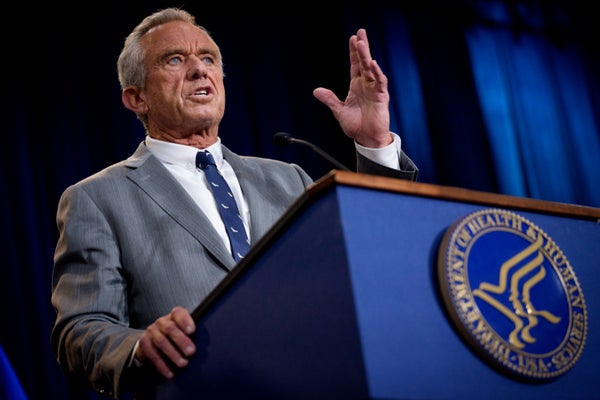
Secretary of Health and Human Services Robert F. Kennedy, Jr., speaks at a news conference at the Department of Health and Human Services on April 22, 2025, in Washington, D.C.
Andrew Harnik/Getty Images
Join Our Community of Science Lovers!
The U.S. Food and Drug Administration is set to convene an expert panel in July to discuss whether some pharmacies can manufacture certain peptides, according to an agency filing submitted on Wednesday. The list includes unproven substances that have become increasingly popular among wellness influencers and athletes.
Peptides are short chains of amino acids, the building blocks of proteins, and they are found naturally in the body and produced synthetically. GLP-1 drugs—glucagonlike peptide 1 medications—are peptides.
In recent years, a gray market of lab-manufactured peptides has gained traction as DIY treatments for all sorts of ailments, from wrinkles to inflammation to low libido. Many of these have not been through thorough clinical trials, and people who take them often source them from compounding pharmacies, which make customized medications that aren’t individually assessed by the FDA for safety or effectiveness, or from providers abroad that may be entirely unregulated.
On supporting science journalism
If you're enjoying this article, consider supporting our award-winning journalism by subscribing. By purchasing a subscription you are helping to ensure the future of impactful stories about the discoveries and ideas shaping our world today.
The FDA is under the jurisdiction of Secretary of Health and Human Services Robert F. Kennedy, Jr., who is vocally supportive of peptides, has claimed to have used them himself and has pledged to end the FDA’s “war” on public health, including substances such as peptides.
“Today, we took long-overdue action to restore science, accountability, and the rule of law,” Kennedy said in a post on X on Wednesday that announced the July expert panel meetings. “This action begins to restore regulated access and will immediately begin shifting demand away from the black market.”
The FDA’s Pharmacy Compounding Advisory Committee will meet on July 23 and 24 to discuss whether licensed compounding pharmacies should be permitted to manufacture at least seven peptides, including BPC-157 for ulcerative colitis and inflammation and TB-500 for wound healing. The expert panel will not issue a binding decision but will offer recommendations to the FDA.
Other peptides on the agency’s list are KPV, which is also used for wound healing and inflammation, and MOTs-C, which is used to treat obesity and osteoporosis, as well as emideltide and epitalon for sleep problems and semax for cognitive issues.
Editor’s Note (4/15/26): This is a breaking news story and may be updated.
It’s Time to Stand Up for Science
If you enjoyed this article, I’d like to ask for your support. Scientific American has served as an advocate for science and industry for 180 years, and right now may be the most critical moment in that two-century history.
I’ve been a Scientific American subscriber since I was 12 years old, and it helped shape the way I look at the world. SciAm always educates and delights me, and inspires a sense of awe for our vast, beautiful universe. I hope it does that for you, too.
If you subscribe to Scientific American, you help ensure that our coverage is centered on meaningful research and discovery; that we have the resources to report on the decisions that threaten labs across the U.S.; and that we support both budding and working scientists at a time when the value of science itself too often goes unrecognized.
In return, you get essential news, captivating podcasts, brilliant infographics, can't-miss newsletters, must-watch videos, challenging games, and the science world's best writing and reporting. You can even gift someone a subscription.
There has never been a more important time for us to stand up and show why science matters. I hope you’ll support us in that mission.