
惯性聚合 高效追踪和阅读你感兴趣的博客、新闻、科技资讯
阅读原文 在惯性聚合中打开

推荐订阅源

D
DataBreaches.Net
罗磊的独立博客
M
MIT News - Artificial intelligence
G
Google Developers Blog
V
V2EX
D
Docker
博客园_首页
The Cloudflare Blog
人人都是产品经理
人人都是产品经理
Y
Y Combinator Blog
WordPress大学
WordPress大学
T
Tailwind CSS Blog
博客园 - 司徒正美
J
Java Code Geeks
L
LangChain Blog
博客园 - 三生石上(FineUI控件)
B
Blog RSS Feed
博客园 - 【当耐特】
小众软件
小众软件
Apple Machine Learning Research
大猫的无限游戏
大猫的无限游戏
P
Proofpoint News Feed
freeCodeCamp Programming Tutorials: Python, JavaScript, Git & More
博客园 - Franky

Scientific American

Former deputy surgeon general Erica Schwartz nominated as new CDC chief NASA Artemis II astronauts say thank you to the world Congress grills RFK, Jr., about vaccines and cuts to health budget How the Grand Canyon formed is a surprisingly messy story. Here's the latest clue How far from humanity were the astronauts of Artemis II? The answer will surprise you Effect of antiamyloid Alzheimer’s drugs ‘absent or trivial,’ Cochrane review finds The Trump administration is looking to experts to weigh in on peptides When a naked mole rat queen dies, that usually means war—but not for this colony NASA needs nuclear power for its moon base. Here’s the White House plan to get it Why do older people have fewer seasonal allergies? 250-million-year-old fossil proves mammal ancestors laid eggs A face-swapping illusion can unlock childhood memories 30 years of Pokémon—how the Japanese franchise mirrors real-world science Sperm whales may make their own vowel sounds, similar to human language Colombia will euthanize Pablo Escobar’s invasive ‘cocaine hippos’ NASA’s Artemis III will pit SpaceX against Blue Origin The East Coast could see blazing hot temperatures this week. Here’s why Scientists just discovered 5.6 million bees under a New York State cemetery The real science of Pokémon How chemists engineer the signature smells of luxury perfumes How two mathematicians solved a cryptography mystery The engineering marvels hidden inside six-figure watches Expensive versus affordable binoculars—what’s the difference? How physicists found a new type of magnet hiding in plain sight A hot pair of supplements, creatine and methylene blue dye, may not work together Unlikely paths to discovery The baffling ecological disaster that's killing America’s freshwater mussels Poem: ‘How I Became a Spitfire Pilot during My Cataract Operation’ DARPA built an AI to fact-check enemy weapons claims Mathematicians created an ‘impossible’ shape that shouldn’t exist
See the Pentagon's new UFO image release
2026-05-09 · via Scientific American

The Pentagon has started releasing files related to unidentified anomalous phenomena, or UFOs. Here are the images released so far

By Jeanna Bryner edited by Claire Cameron

The Pentagon on Friday released what appears to be the first batch of government files related to UFOs, or unidentified anomalous phenomena (UAPs). The files include Federal Bureau of Investigations reports into unexplained sightings as well as NASA debriefs with astronauts who saw things on the moon they couldn't identify—some of which was captured in images.

Scientific American's Adam Kovac reports that experts in the field are not surprised by any of the released files and say rather than quelling speculation the declassification could fuel it.

Here are some of the images included in the file release, as well as the information the Pentagon has provided saying what the photographs might show.


On supporting science journalism

If you're enjoying this article, consider supporting our award-winning journalism by subscribing. By purchasing a subscription you are helping to ensure the future of impactful stories about the discoveries and ideas shaping our world today.


Still from a video that a U.S. military operator reported as featuring UAP flying across their screen.

DOW

This still image was taken from a video captured in May 2022 by a U.S. military operator flying over the Middle East, showing a UAP flying across their screen.

Infrared still image (black hot) captured of unidentified object below helicopter over western United States in September of 2025.

FBI

Newly released infrared still image (black hot) shows an unidentified object below a helicopter above the western United States in September 2025.

U.S. Indo-Pacific Command reported UAP that resembles a football-shaped body near Japan.

DOW

In 2024, personnel of the U.S. Indo-Pacific Command reported seeing a UAP that resembled a football-shaped body near Japan.

The monochrome image displays a uniform, grainy texture with a central crosshair reticle. A small, dark, and slightly irregular object is visible just below and to the right of the center of the reticle.

FBI

In late 2025, a U.S. military operator reported a small, dark and slightly irregularly shaped object visible on their screen. This monochrome image shows the object just below and to the right of the center of the reticle.
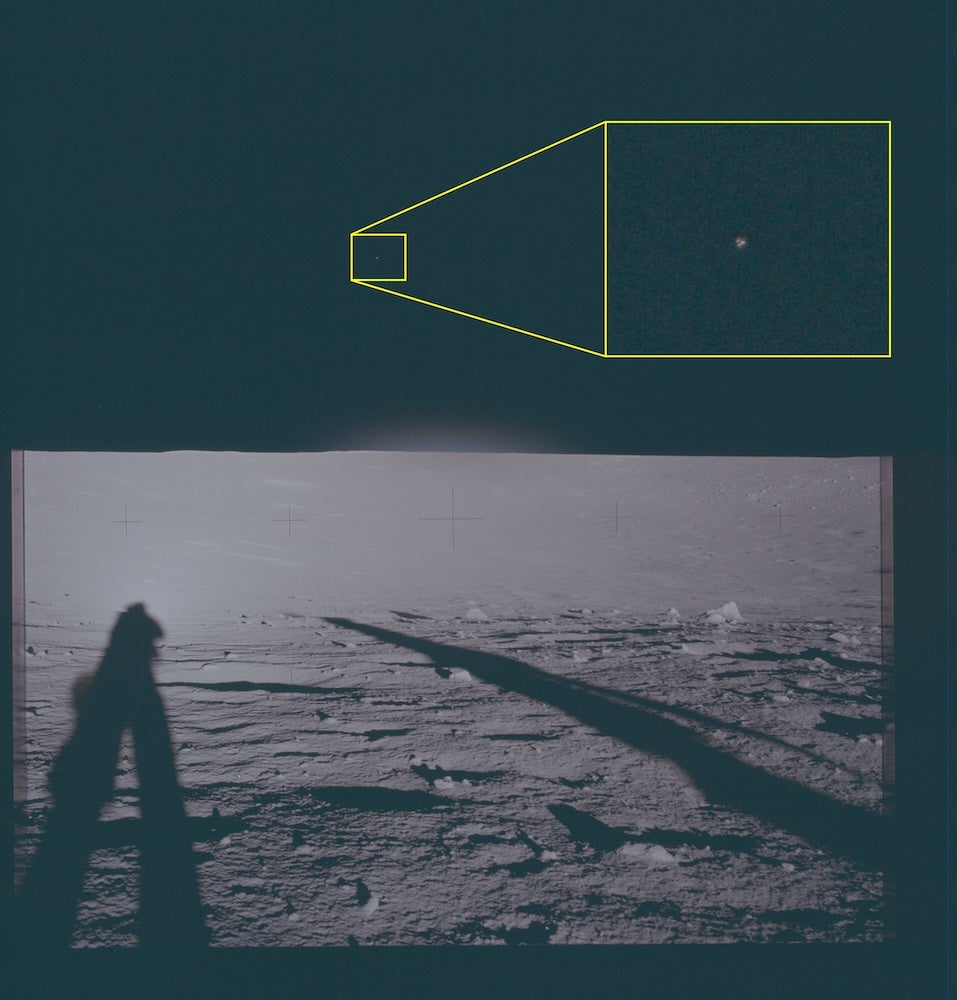
This archival photograph depicts the lunar surface as viewed from the landing site of Apollo 12. This image features a highlighted area of interest slightly to the left of the vertical axis of the frame, above the horizon, in which unidentified phenomena are visible.

NASA

In this archival image you can see the lunar surface as viewed from the landing site of Apollo 12, the sixth crewed flight for the U.S. Apollo Program and the second to land on the moon on November 19, 1969. The UAP can be seen in the highlighted area slightly to the left of the vertical axis of the frame, above the horizon.

This archival photograph depicts the lunar surface as viewed from the landing site of Apollo 12. This image features a highlighted area of interest slightly to the right of the vertical axis of the frame, above the horizon, in which unidentified phenomena are visible.

NASA

Another archival photograph taken during the Apollo 12 mission, depicting the moon surface with an unidentified phenomenon in the highlighted box.

This archival photograph depicts the lunar surface as viewed from the landing site of Apollo 12. This image features two highlighted areas of interest, labeled “Area 1” and “Area 2,” slightly to the right of the vertical axis of the frame, above the horizon, in which unidentified phenomena are visible.

NASA

This archival photo of the site of the Apollo 12 landing features two highlighted areas of interest, labeled “Area 1” and “Area 2,” slightly to the right of the vertical axis of the frame, showing unidentified phenomena.

This archival photograph depicts the lunar surface as viewed from the landing site of Apollo 12. This image features a highlighted area of interest near the right edge of the frame, above the horizon, in which unidentified phenomena are visible.

NASA

Another Apollo 12 archival image viewed from the landing site, in the southeastern region of Oceanus Procellarum, or Ocean of Storms. The highlighted UAP can be seen near the right edge of the frame, above the horizon.

NASA photograph from the Apollo 17 mission, taken December 1972. The image contains three “dots” in a triangular formation in the lower right quadrant of the lunar sky that is clearly visible upon magnification of the image.

NASA

NASA photograph from the Apollo 17 mission, taken December 1972 shows three “dots” in a triangular formation in the lower right quadrant of the lunar sky, which are more visible in the pulled-out magnification of the area.

Infrared still image (black hot) captured of unidentified object over western United States in December of 2025.

DOW

An infrared still image (black hot) captured of unidentified object—a dark dot—over the western United States in December 2025. Parts of the image has been redacted.

It’s Time to Stand Up for Science

If you enjoyed this article, I’d like to ask for your support. Scientific American has served as an advocate for science and industry for 180 years, and right now may be the most critical moment in that two-century history.

I’ve been a Scientific American subscriber since I was 12 years old, and it helped shape the way I look at the world. SciAm always educates and delights me, and inspires a sense of awe for our vast, beautiful universe. I hope it does that for you, too.

If you subscribe to Scientific American, you help ensure that our coverage is centered on meaningful research and discovery; that we have the resources to report on the decisions that threaten labs across the U.S.; and that we support both budding and working scientists at a time when the value of science itself too often goes unrecognized.

In return, you get essential news, captivating podcasts, brilliant infographics, can't-miss newsletters, must-watch videos, challenging games, and the science world's best writing and reporting. You can even gift someone a subscription.

There has never been a more important time for us to stand up and show why science matters. I hope you’ll support us in that mission.