







NASA announced that this uncrewed lander, called Endurance, completed vacuum testing on Earth—a key step toward a planned launch later this year
By Adam Kovac edited by Claire Cameron
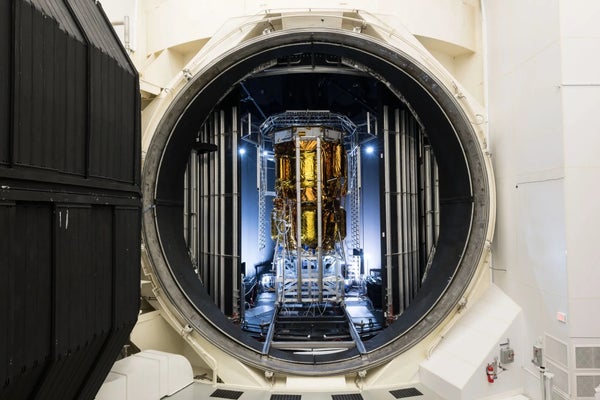
NASA/Blue Origin
Join Our Community of Science Lovers!
Blue Origin’s Endurance moon lander may live up to its name: on Monday NASA revealed that the spacecraft has completed a battery of tests inside the space agency’s vacuum simulation chamber. The checks are crucial if Blue Origin, Jeff Bezos’s private space company, is to test launch the lander later this year, as it hopes to do.
Endurance, also known as the Blue Moon Mark 1 (MK1), is a single-use, uncrewed cargo lander that will operate as part of NASA’s Commercial Lunar Payload Services (CLPS) program, in which the space agency works with private companies to develop new cargo delivery systems for use in its planned Artemis moon missions. MK1 is designed to deliver up to three metric tons of supplies and equipment to the lunar surface—a critical capability as NASA looks to set up a permanently staffed moon base.
During the course of the testing at the agency’s Johnson Space Center, Endurance was subjected to conditions similar to those in space, including extreme temperatures and the stresses of a vacuum. Data from these tests will now be analyzed and used to improve MK1’s design, as well as that of Blue Origin’s Blue Moon Mark 2 (MK 2) spacecraft—a larger, crewed landing system that Bezos’s company hopes will be used to ferry astronauts from a craft in lunar orbit to the moon’s surface and back. MK 2 is set to take part in 2027’s Artemis III mission, a test in which both it and a moon lander variant of SpaceX’s Starship will attempt to rendezvous and dock with a crewed Orion capsule.
On supporting science journalism
If you're enjoying this article, consider supporting our award-winning journalism by subscribing. By purchasing a subscription you are helping to ensure the future of impactful stories about the discoveries and ideas shaping our world today.
It remains to be seen which spacecraft will ultimately be used in the agency’s Artemis IV mission to deliver astronauts to the moon’s surface for the first time in more than half a century. SpaceX’s Starship is also still in development; the spacecraft has exploded several times during test flights, although its last demonstration was a success. Another demo flight is on the docket for as soon as later this month.
Endurance now has to prove it can survive the pressure of launch and flight in space. That’s due to happen later this year on Blue Origin’s Pathfinder Mission 1, in which the lunar lander will be launched onboard one of the company’s New Glenn rockets. In the mission, the lander’s engine, cryogenic power fluid and propulsion systems, avionics and other systems will be put through their paces.
NASA also hopes to use the lander for its upcoming CT-3 Science mission, which will carry two science payloads to the moon’s south pole. Those instruments will be used to capture photos of a lunar descent to help inform future missions to the surface, and to study what sorts of material gets ejected from the surface as the lander falls.
It’s Time to Stand Up for Science
If you enjoyed this article, I’d like to ask for your support. Scientific American has served as an advocate for science and industry for 180 years, and right now may be the most critical moment in that two-century history.
I’ve been a Scientific American subscriber since I was 12 years old, and it helped shape the way I look at the world. SciAm always educates and delights me, and inspires a sense of awe for our vast, beautiful universe. I hope it does that for you, too.
If you subscribe to Scientific American, you help ensure that our coverage is centered on meaningful research and discovery; that we have the resources to report on the decisions that threaten labs across the U.S.; and that we support both budding and working scientists at a time when the value of science itself too often goes unrecognized.
In return, you get essential news, captivating podcasts, brilliant infographics, can't-miss newsletters, must-watch videos, challenging games, and the science world's best writing and reporting. You can even gift someone a subscription.
There has never been a more important time for us to stand up and show why science matters. I hope you’ll support us in that mission.