


Your network does not care that your team is busy. IP conflicts surface at the worst moments. DNS threats do not check your calendar. And when your address space spans on-premises infrastructure, branch offices, and the cloud at once, the gaps between your tools stop being an inconvenience. They become a liability.
That is the problem Infoblox set out to fix, with help from Google Cloud. Over the past year, we collaborated on three integrations that give enterprise network and security teams measurable control over their Google Cloud environments. This post walks through what each integration does, and who it can help.
Most enterprise IT teams manage multiple environments simultaneously: on-premises data centers, branch offices, multiple clouds, and a growing inventory of devices and workloads that are constantly changing.
Google Cloud can help expand your organization’s speed and global reach. But speed without visibility increases risk. When DNS records, IP address space, and security policies are spread across different systems, blind spots can appear. As a result, organizations may be forced to reconcile data manually, chase IP conflicts after outages, and apply security policies unevenly.
This is where Infoblox’s collaboration with Google Cloud comes in. DNS, DHCP, and IP address management (DDI) form the backbone of network operations. By unifying and automating them across Google Cloud, teams resolve issues faster and focus more on strategic priorities.
Within the past year, Infoblox has delivered three integrations with Google Cloud. Each one targets a specific, recurring issue many enterprise teams face.
Universal DDI™ with Cloud WAN Integration
In the past, connecting branch offices and remote sites meant managing several MPLS circuits, hardware appliances, and WAN solutions. Each site needed its own DNS and DHCP infrastructure, and you had to manually coordinate changes, wasting time and money.
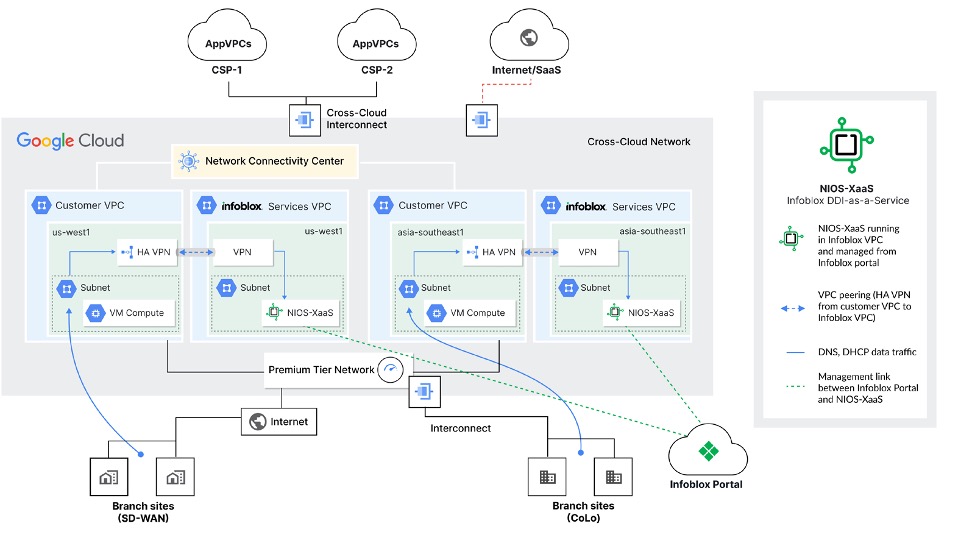
Infoblox Universal DDI for Cloud WAN greatly reduces complexity by delivering DNS and DHCP services across every enterprise location, eliminating the need for on-premises hardware. Your team can deploy in minutes, not weeks. IP address management is centralized across every Cloud WAN-connected location, so conflicts are caught before they cause outages, not after.
For organizations overseeing numerous sites, this simplifies network operations.
DNS Armor for Google Cloud
DNS underpins every device, application, and service in your network—and attackers exploit it. Over 90 percent of malware uses DNS for command-and-control. DNS can be your network’s earliest security indicator.
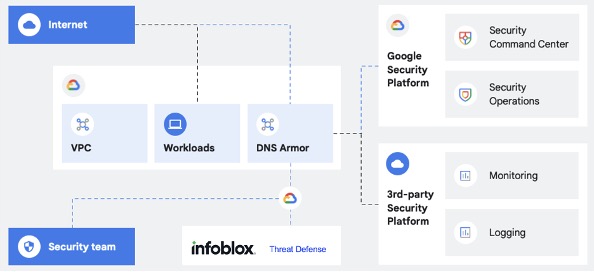
Infoblox DNS Armor addresses common security challenges by analyzing DNS queries from Google Cloud workloads in real time, detecting malicious domains and threats—such as ransomware or C2 activity—before they can access your environment. This means security teams can prevent attacks earlier, improving overall cloud protection and reducing mean time to detect.
You can activate the service directly in the Google Cloud console, with no extra infrastructure or management tools. DNS Armor works quickly and processes DNS traffic with a 0.0002% false-positive rate. On average, it blocks attacks 68 days earlier than other solutions.
Without DNS-layer security, threats that could potentially compromise your workloads go undetected. DNS Armor catches threats during the query, before a connection is ever established. In its preview phase alone, the Infoblox service processed more than 22 billion DNS queries and surfaced over 8.5 million threats. For security teams already stretched thin, that kind of early detection at that scale can change everything about how you respond.
Infoblox integration with Google Security Operations
Security operations teams face a different kind of problem: too many alerts, too little context, and tools that do not share data. Lack of context in SIEM leads to longer incident response times. By the time an analyst investigates, the damage is often done.
The Infoblox integration with Google Security Operations helps to change that. Infoblox Threat Defense provides additional threat detections and asset data directly into the security operations platform, where enriched DDI asset data—device, user, IP address—gives analysts immediate context. Included within Threat Defense, Infoblox SOC Insights utilizes AI-driven correlation to streamline high volumes of repetitive security alerts into a manageable set of distinct, actionable cases. Google Security Operations can then trigger automatic actions to enable a unified and automated response to the threats.
IP Internal Range Integration
Google Cloud’s internal range resource lets you reserve and protect IP address blocks for VPC networks. However, teams still manage these ranges separately from on-premises address space, leading to overlapping IP addresses, routing failures, and long troubleshooting sessions.
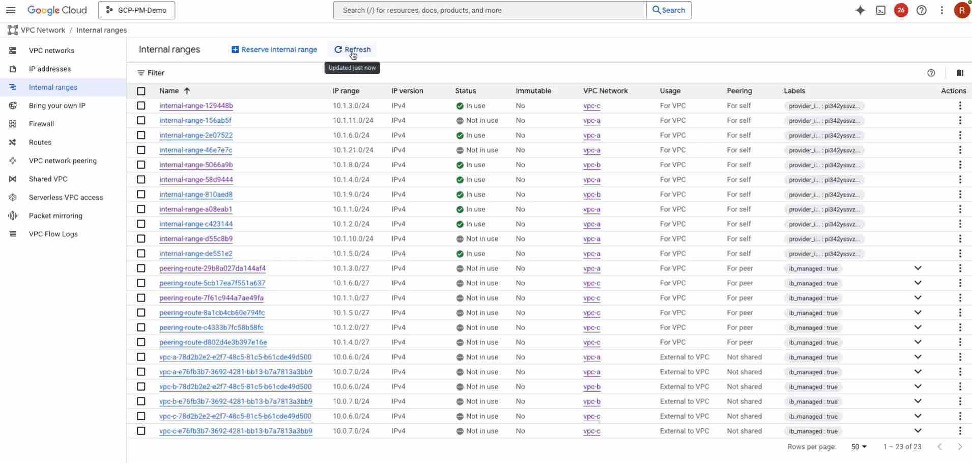
Infoblox connects directly to Google Cloud’s internal range API to automatically discover Google Cloud Virtual Private Cloud (VPC) networks and IP addresses, so teams can manage both cloud and on-premises resources with a single console. This integration reduces manual work, enforces consistent IP policies, and detects conflicts early, streamlining network administration.
Before deploying Infoblox, one large retailer’s NetOps and CloudOps teams managed IP address space in separate systems. Google Cloud ranges lived in one tool. On-premises ranges lived in another. The result was overlapping addresses which can be the source of routing failures leading to long troubleshooting cycles. After rolling out Infoblox Universal DDI across both environments, IP provisioning time dropped by 30 percent. For the first time, the team had a unified view of VPC peering relationships and subnets. That visibility alone changed how NetOps and CloudOps worked together day to day.

Heading to Las Vegas for Google Cloud Next 2026 this April 22 to 24? Come find us at Booth 2913.
Come with your network and security questions. Our product and security experts will be there to work through them with you, one on one. See the integrations covered in this post running live. Get answers that apply to your specific environment, not a generic demo script. If you want time with Infoblox leadership, that is available, too.
Over 6,000 customers, including the majority of Fortune 100 companies as well as emerging innovators, trust Infoblox. At Google Cloud Next, you can get direct answers from the people who build the products.
Book a one-on-one with Infoblox at Google Cloud Next 2026.
Follow Infoblox on LinkedIn for updates on our collaboration with Google Cloud and upcoming announcements at Next: Infoblox on LinkedIn.
此内容由惯性聚合(RSS阅读器)自动聚合整理,仅供阅读参考。 原文来自 — 版权归原作者所有。