










Welcome to Not-Ship's 11 new paying subscribers! They've joined as part of my ten-day campaign to find 15 new paying members. That campaign ends on May 1. We have only four more to go!
💙 Amanda
Imagine you're confined to a tiny cell. Would you feel better about it — calmer, less aggressive — if all the walls were this colour?

That's Baker-Miller pink. In 1979, a US academic claimed the shade subdued inmates. Subsequent studies found no effect at all, but the idea spread anyway. Across the West, pink prison cells multiplied. In Switzerland, almost every fifth prison or police station has at least one.
We commonly believe that colour shapes how we feel. And wall colour is where this belief shows up particularly often. Interior designers tell us blue paint will reduce stress. Hospitals use colour palettes designed to speed patient recovery. And on a tour of Ottawa's Cold War bunker, a guide told us the pastel walls were there to keep 533 officials sane through a nuclear attack.
Unfortunately for those theoretical Canadian officials, colour doesn't actually work that way.
"For now, we do not know if we feel colours, but we know that colours convey emotions," concluded a 2025 study that reviewed 128 years of research on colour and emotion across 64 countries. In other words: We reliably associate colours with emotions, but there is no good evidence that colours actually cause us to feel them. We talk about sadness as "feeling blue," but blue doesn't actually make us sad (or less stressed).
The emotional associations themselves, though, are genuine and remarkably stable. The patterns hold across a century of studies and dozens of cultures.
That review found that all colours have consistent negative or positive associations. Light colours lean positive; dark colours lean negative. Red is the exception — we can't seem to figure out if it's a positive or negative hue.
Our positive and negative associations with colour
The percentage of articles studying each colour category that identified the colour as negative or positive (of 73 total articles).
Colours are also consistently linked to specific emotional concepts — though rarely just one. Happiness, for example, is associated with eight colours, and sadness with five.
The emotional concepts we associate with each colour
Zooming in to individual colours, the patterns become sharper. And some of the work cited in the review shows that these associations span nations. Yellow and orange cluster around positive, energetic emotions. Black and grey pull toward fear, regret and shame. Some colours lean more strongly in one direction or another, but no colour belongs exclusively to one feeling.
The emotional charge of each colour
Across 30 countries, the probability that a colour is associated with a particular emotion. A higher value means the colour is more likely to be associated with that emotion.
But consistently associating yellow with joy is a very different thing from feeling joyful when we look at yellow. Or feeling agitated from the colour red. Or feeling more relaxed because of the colour green. The science doesn't show that.
Conducting colour research is tough. For one, colour depends a lot on context: Green evokes contentment in a forest and disgust on the surface of your mouldy cheese. There's also a measurement challenge. Many studies fail to separate colour's three properties — hue, lightness, and saturation — so researchers can't tell which is driving any effect. (The lightness of colour, not its hue, may actually affect our heart rate.) And the nuance can get muddled in the telling: The studies that do show real physiological effects were measuring the impact of wavelengths of coloured light, not the experience of looking at a painted wall.
There's a reason those false ideas spread. As Andrew J Elliot, one of the field's leading researchers, put it: "Findings from color research can be provocative and media friendly, and the public (and the field as well) can be tempted to reach conclusions before the science is fully in place."
Not-Ship covers a lot of heavy topics: Category 6 hurricanes, the decline of democracy, expired nuclear treaties. I try to balance that by also finding the data behind systems that are working, or strategies to get by (like birds!). So, I went looking for evidence that something simple, like surrounding ourselves with the right colours, could genuinely help. Instead, I got a reminder that sometimes our most confidently held notions — the kind repeated everywhere until they seem like common knowledge — are based more on feeling than fact.
Turns out pastel walls won't keep us sane.
TWO DAYS LEFT!
Last week was Not-Ship's six-month birthday. Making sure this work can continue for the next six months (and six years!) means making it financially sustainable.
So, I kicked off a short campaign to get 15 new paying subscribers by May 1. There are two days to go, and only four more members to make our goal!
Thank you to the 11 wonderful souls who have already stepped up! Will you join them?
FROM ELSEWHERE
Here's what I found interesting, important or delightful this week:
974 years to go. Longplayer is a one thousand year long musical composition that began playing at midnight on the 31st of December 1999. It's composed for singing bowls, so it sounds appropriately creepy. Thanks to Not-Ship reader Charlotte who shared this remarkable find!
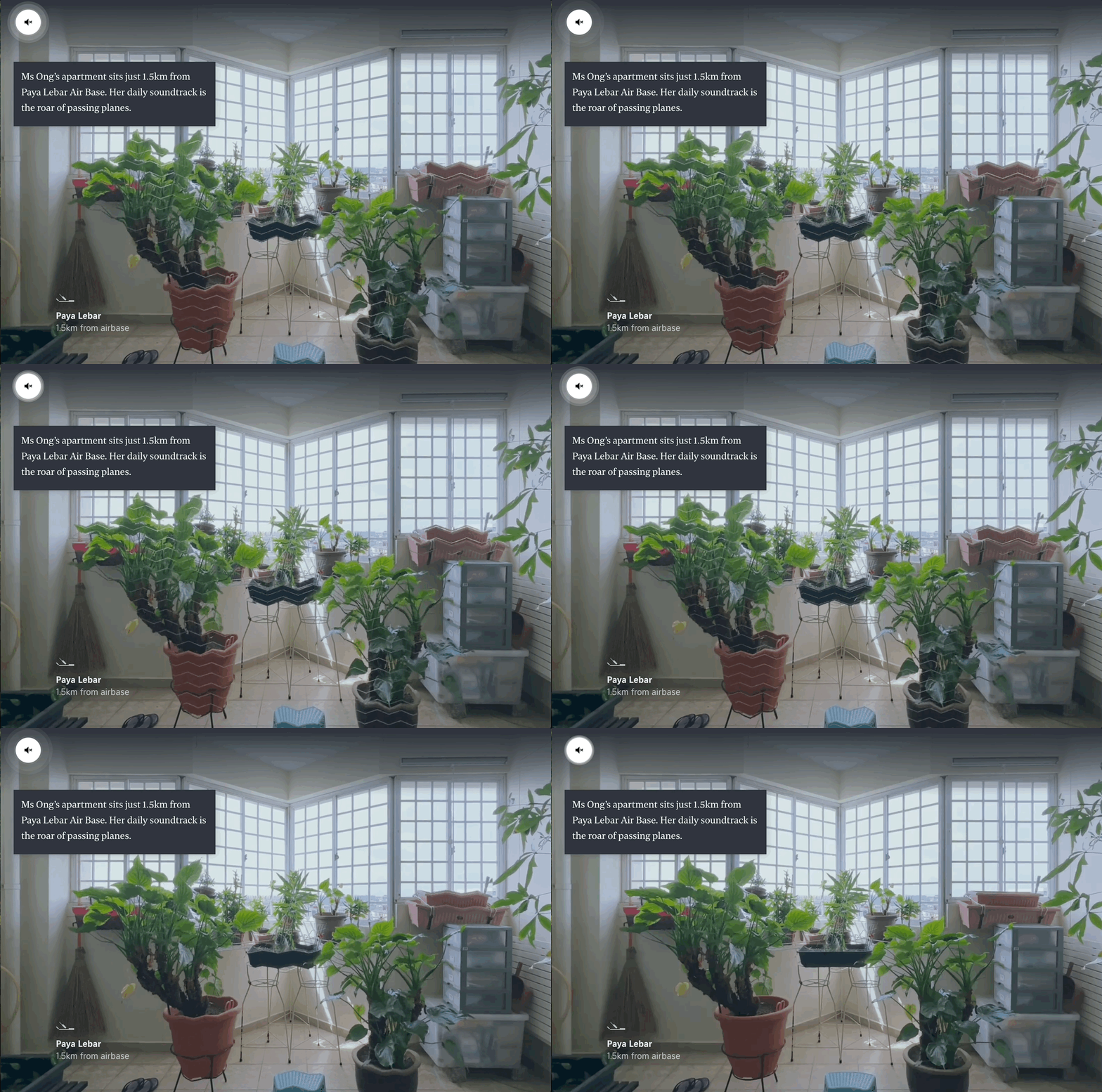
No quiet at home. It's journalism awards season, and this piece I worked on for the Straits Times just won a bunch of them. (Why start your own newsletter if you can't brag in it?) It's about the impact of noise on a dense, busy city like Singapore.
Dad brain. Journalist Diego Arguedas Ortiz explores the impact of fatherhood on his mind and body. Diego is a wonderful person and father and this piece about the physical changes that men undergo around birth is genuinely fascinating. (Why start your own newsletter if you can't brag about your friends in it?)